WE ARE FOOTBALL 2027 Youth Scouting Guide: Talents, Poaching, Fees
Youth scouting in WE ARE FOOTBALL 2027: scouting days, the training-observation bonus, outliers in the statistics centre, poaching fees and a suspected contract bug.
Frequently Asked Questions
How often should you run a scouting day in WE ARE FOOTBALL 2027?
Does watching youth training actually do anything?
How many boarding-school places can a club have?
How old must a poached youth player be?
What does poaching a youth player cost?
Can poaching fail in WE ARE FOOTBALL 2027?
Why do poached youths get a professional contract directly?
How long until youth work pays off in WE ARE FOOTBALL 2027?
Building a talent factory in WE ARE FOOTBALL 2027 is a different job from buying ready-made players — slower, cheaper at the entry point, and far more profitable at the other end. This page walks the whole pipeline in the order of a 30-minute tutorial filmed on a Dortmund save: staff and boarding school first, then scouting days, the hunt for outliers, talent-tree decisions, and finally poaching other clubs’ youngsters with real fee numbers. If you want the wider context on young stars already in the game’s database, the best wonderkids guide covers that side; here it is about growing your own.
What a youth department needs first
The video opens where youth work is decided: the HR department table. The row that matters is the Jugendkoordinator — in the tutorial save he sits at level 12, and the presenter credits him with feeding more talented, stronger youth players into the Jugend squad. Around him stand the youth coaches; the tutorial counts thirteen of them in this save and calls that setup fantastic for a big club. Whoever fills the coordinator seat long-term also acts as a safety net: with a good coordinator, a few new players are guaranteed to join the youth team at every change of season, which keeps the pipeline from drying out because youngsters see no chance for themselves.
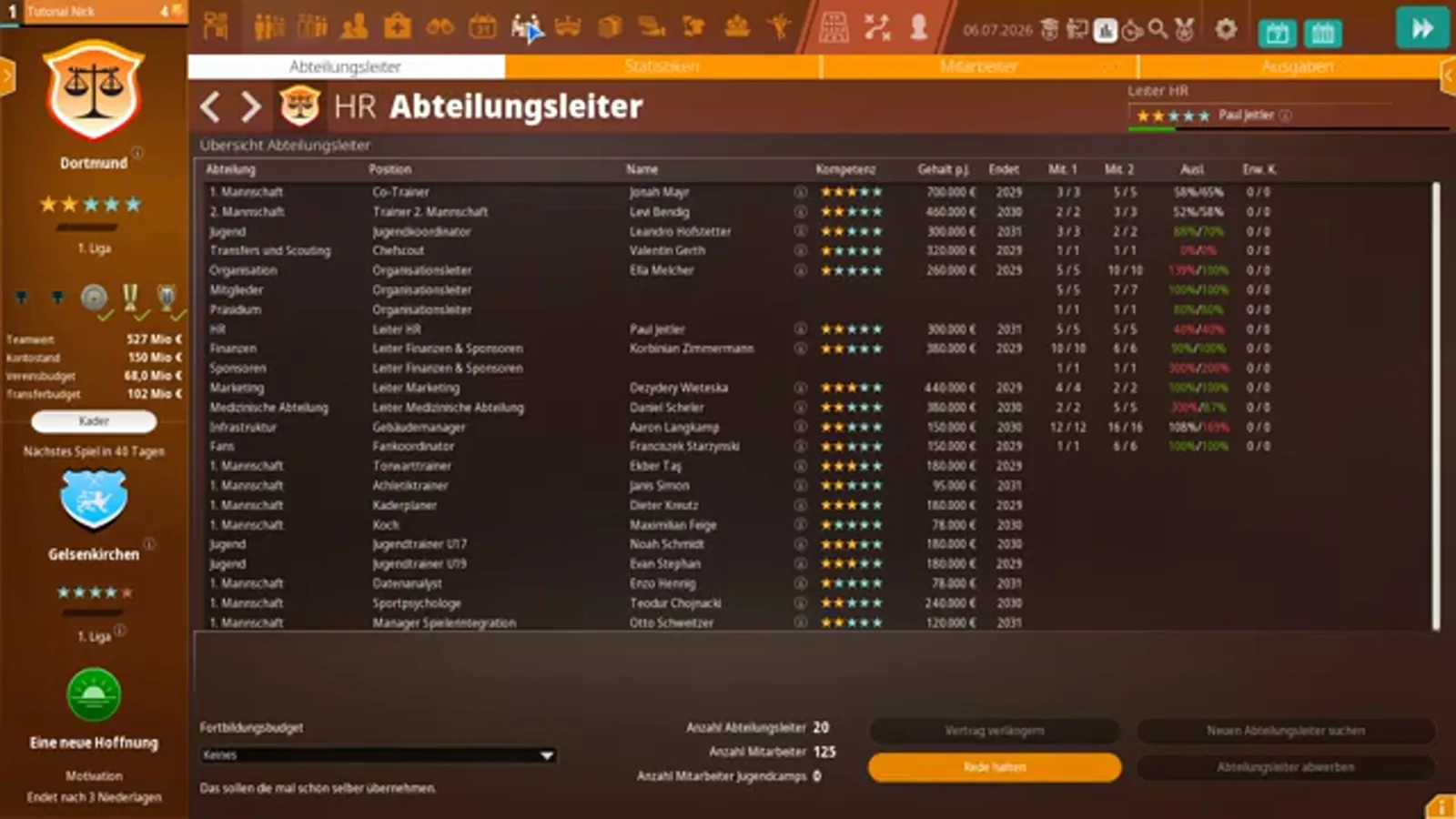
The second structural piece is a 2. Mannschaft: an under-23 side that actually plays league football — in the video’s save, fourth division West — so that your best youngsters collect real playing experience and improve from it. Hiring for all of these seats follows the same rules as the rest of your backroom staff, laid out in the staff and HR guide.
Boarding-school places: the 50-seat ceiling
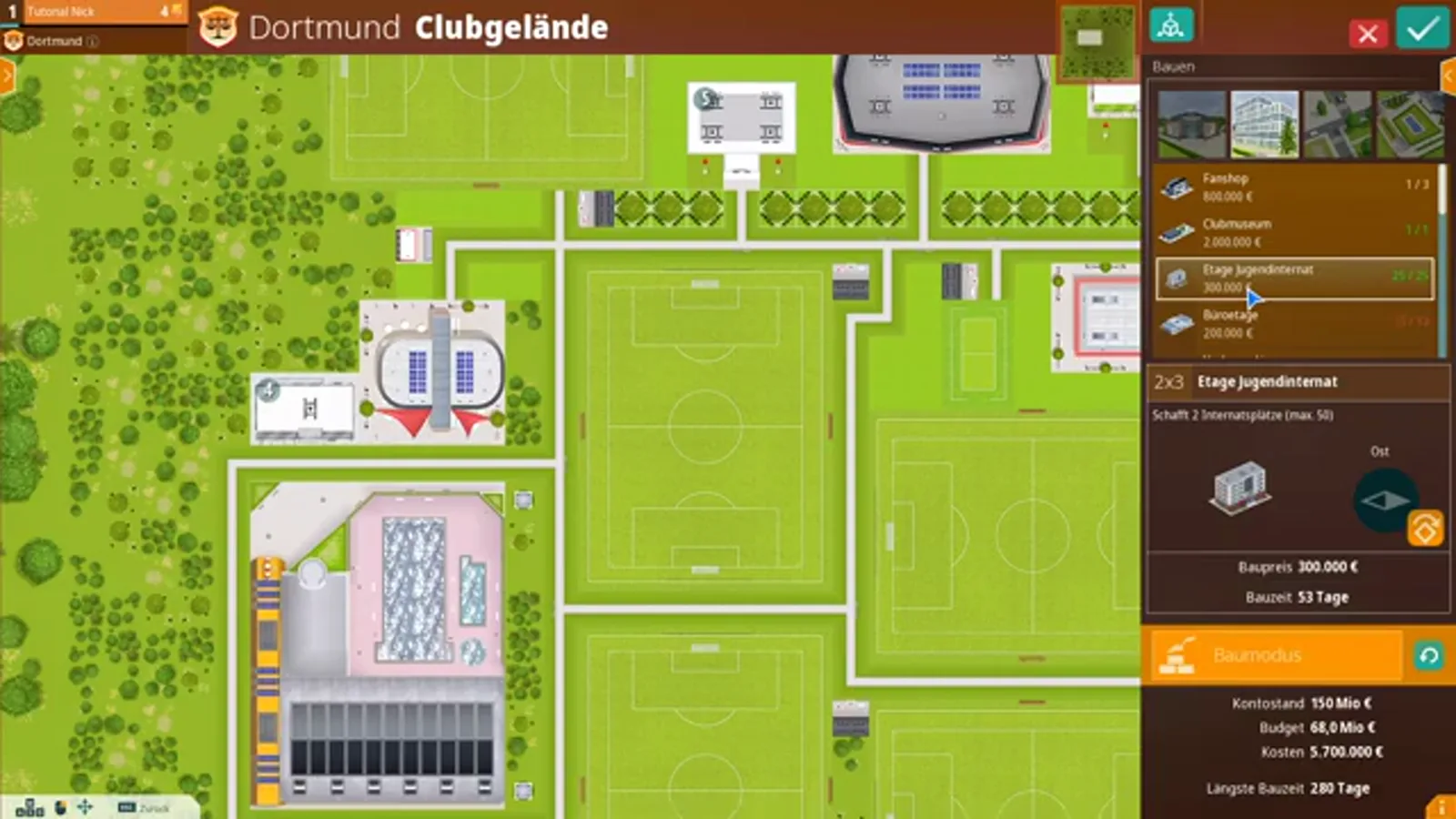
On the Clubgelände the youth boarding schools live and die by one number: 50 places, club-wide. The build screen lets you raise a single school towards level 7, but the tutorial’s reading of the system is that more than 25 places in one school brings no benefit — there are simply no more places available — and the maximum sensible layout is three level-7 schools plus one level-4. Anything beyond that, the presenter says, is not worth it and not possible anyway. His demonstration build costs 5.7 million euro out of a 68 million budget and takes 280 days before local suppliers equip the finished school.
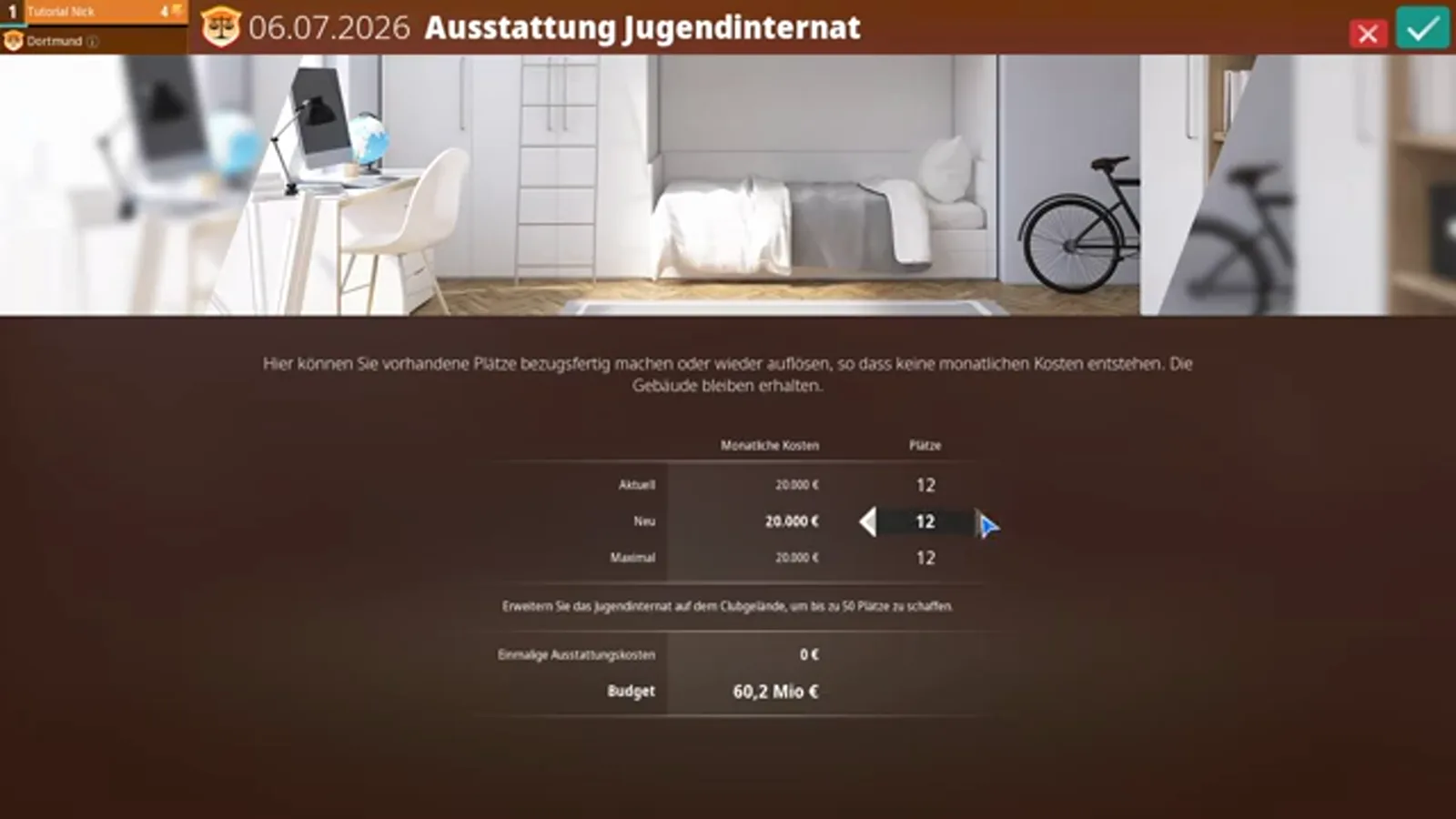
Places are also managed week to week. An Ausstattung Jugendinternat event hands you the allocation screen: the tutorial save sits at 12 equipped places, the sliders set the monthly cost per place, and handing places back returns money for equipment and maintenance. Keeping the school full matters because, as the next section shows, boarding-school places are where your signings learn.
Scouting days and watching youth training
The Sichtungstag is the scouting day, and the video’s stance is blunt: definitely make the most of it. The presenter runs it once a month, and says explicitly that he does not know whether twice a month is even possible — his once-a-month rhythm might even be too little. That is the honest state of it: monthly is the proven baseline, and nobody in this video claims a hard cap.
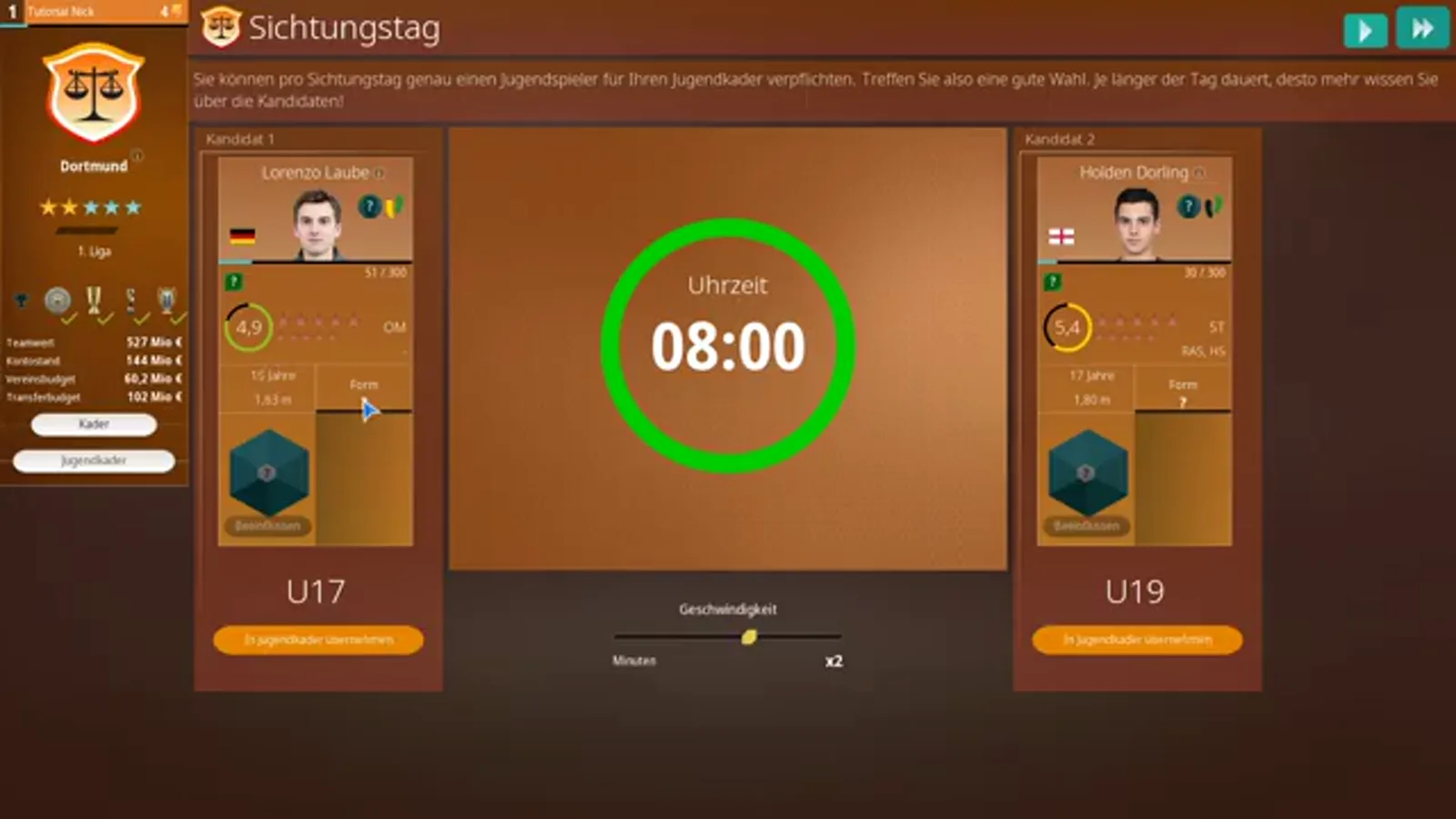
The second habit costs nothing: watch the youth training sessions as often as possible, because doing so gives the players a bonus to their development. Between the monthly scouting day and weekly training observation, your own youth squad is also where the first outliers surface — which is what the Sichtungstag candidates on the event card represent.
Outliers: a 15-year-old at 4.9 beats a 17-year-old at 5.4
The video’s scouting philosophy is age-adjusted strength. Its Dortmund save shows the extreme case: a once-in-a-century talent playing attacking midfield at a strength of 3.9 at twelve years old. You will not find one of those every save, but the profile to look for is always the same — players whose strength is absurd for their age. Given the choice, the presenter takes a 15-year-old at 4.9 over a 17-year-old at 5.4, because the younger body has years of boarding-school development ahead of it. Two housekeeping rules come with it: weak 13-year-olds can be released, but if a player carries talent the board may intervene and refuse — and a youth player only gains a market value once he signs a contract and plays first- or second-team football, which is also when a surplus talent becomes a saleable asset for your transfer budget.
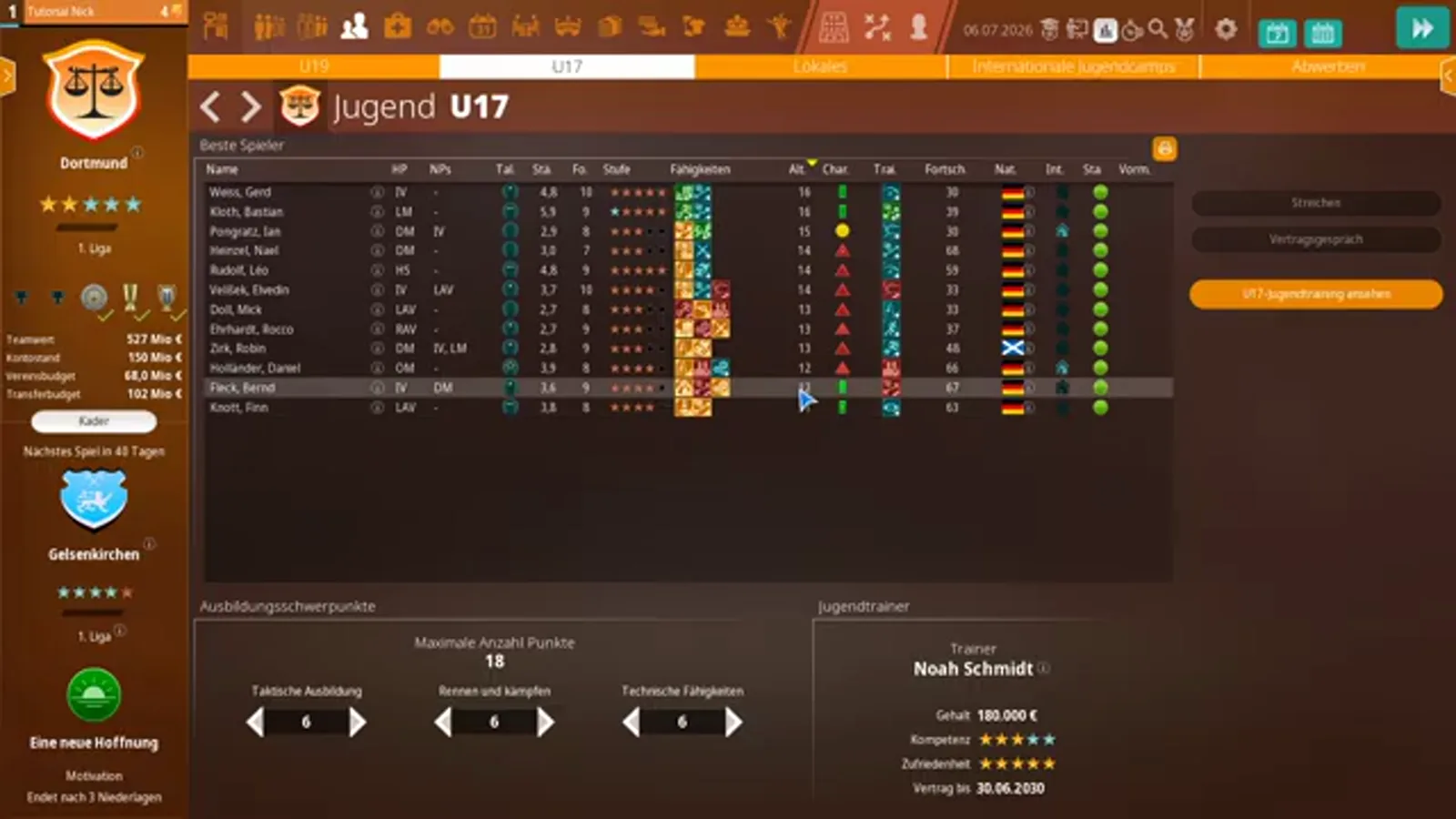
Targets also rotate: leave a promising name unattended for a while and he eventually disappears from the pool, replaced by a new generation. Checking the youth lists is therefore routine work, not a one-off sweep.
Talent trees shape player types, not all-rounders
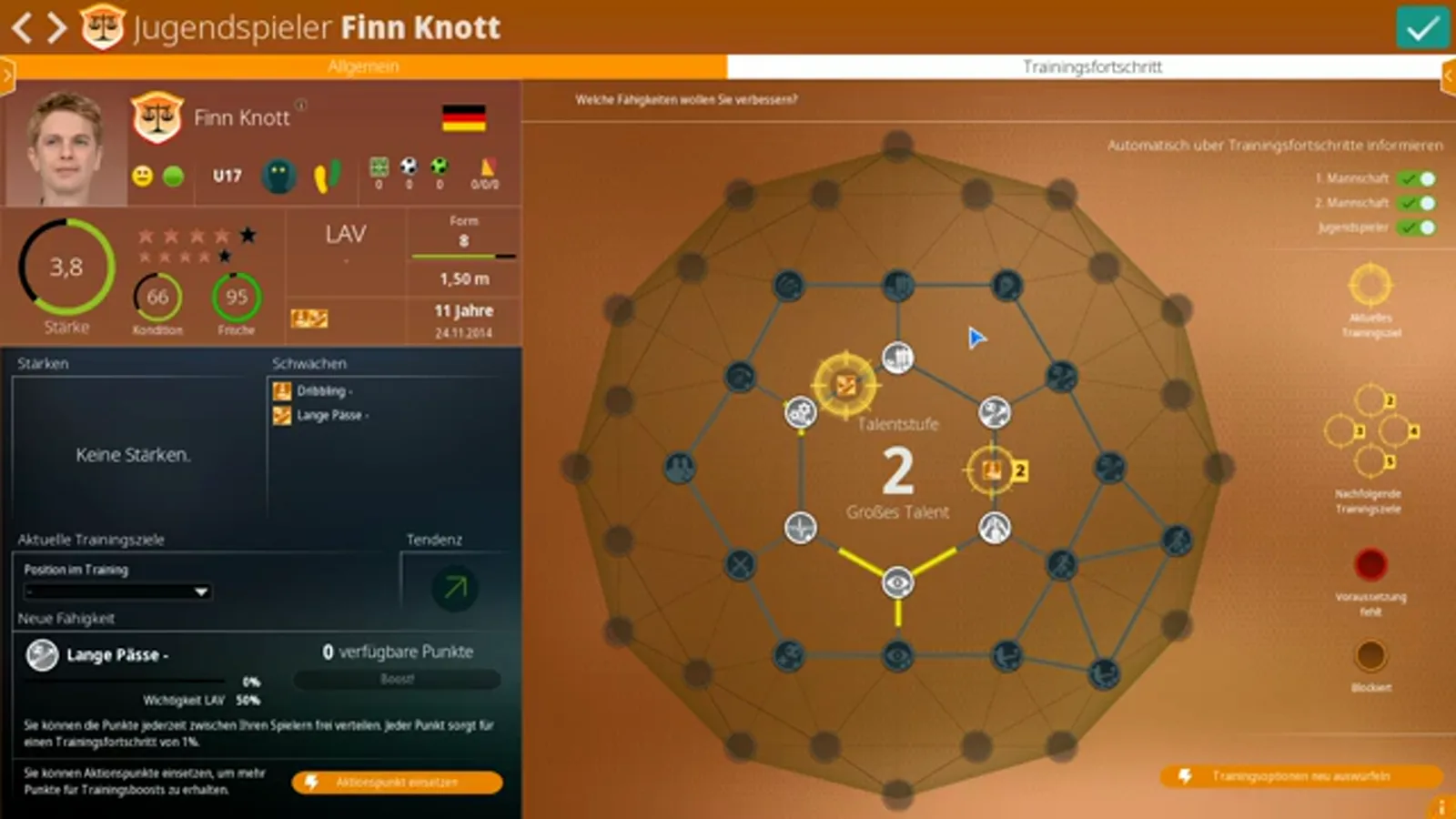
Every youth player carries a talent tree, and the video is keen to correct a misunderstanding: filling it does not produce a player who can do everything. What the tree shapes is a player type. The demonstration case is a left-back — LAV — whose tree holds vision, stamina, technique, free kicks and passing, but no crossing, which the presenter calls disastrous for the position: this, he concludes, will never be a really good LAV. The honest options are to retrain him where the existing skills fit — defensive midfielder with tackling and man-marking, attacking midfielder with passing, running, volleys and creativity, maybe a CM — or to reroll the training plan and hope the new arrangement of skills matches the position you want. Either way the decision belongs early, while the boarding school is still doing the teaching; how the weekly plan itself is structured is covered in the training plan guide, and what the finished player type means once he is yours — honorary titles, leader and team-player types, coaching a type deliberately — is the player types and roles guide.
Sign late — unless the talent argues for the first team
For everyone else, the video’s rule is: sign them as late as possible. In the boarding school, under a proper youth coach, a teenager learns much more than he would playing second-team football. The exception is the genuine phenomenon: put him into the first team early, let him come on in a Champions League match where the experience points per game are higher, and he may develop faster in competitive play. Both paths are real, and the video presents the choice as one to weigh per player, not a doctrine.
One more intake channel sits outside the club: international youth camps. The video touches them — Brazil as an inexhaustible talent pool, and a warning to check whether the chosen city already has a first-division club that would snap up the graduates — but that system has its own page: the youth camps guide.
Poaching: dig through the statistics centre
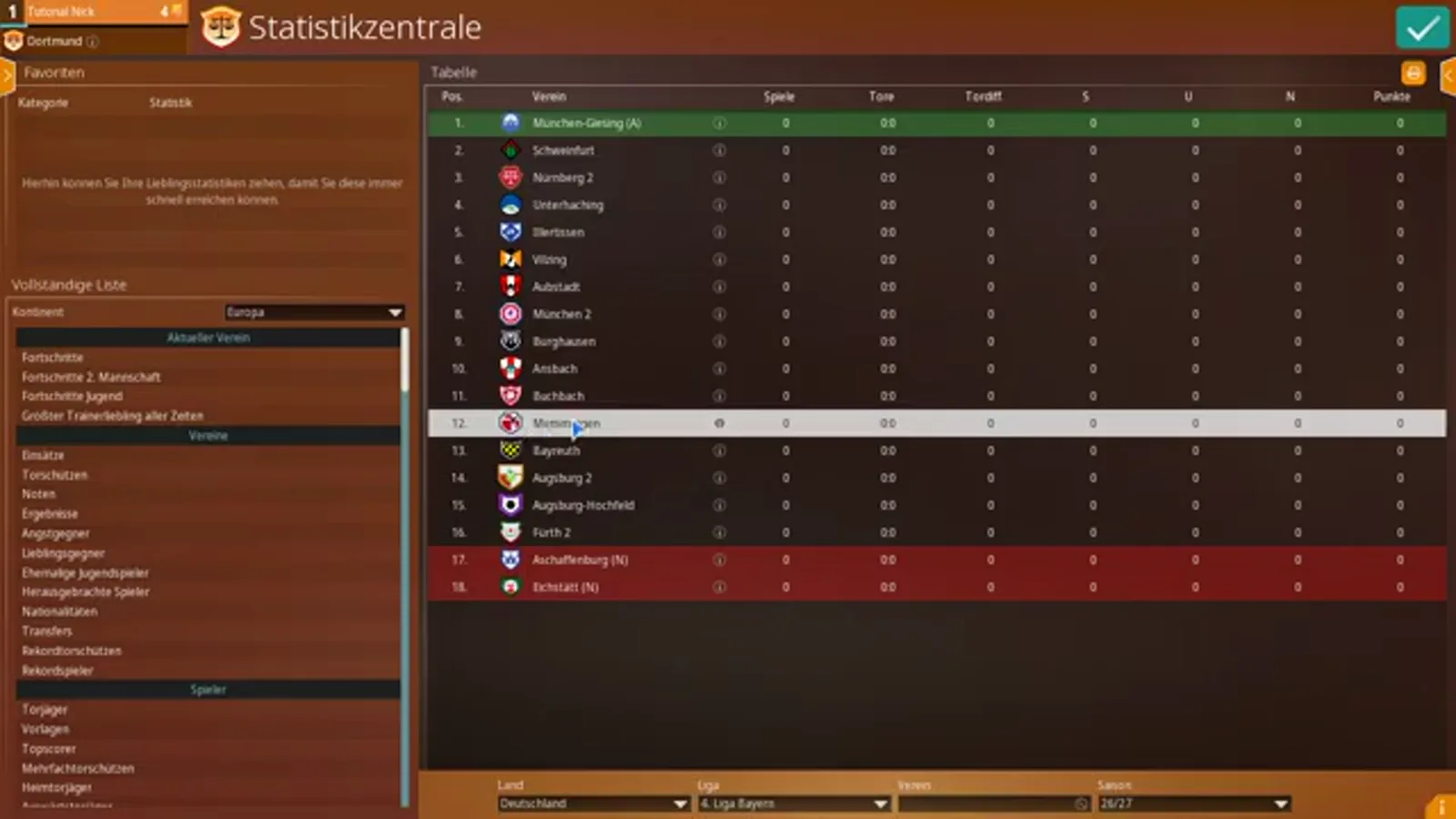
Poaching other clubs’ youngsters needs two keys: knowledge of the country and access to the league. The search pattern from the video: ignore the first division — everyone there is already a professional outfit — and climb down into the third, fourth or fifth division. And do it via the statistics centre rather than the youth screen, because that is where filtering by league and club is fastest.
The workflow, demonstrated on Wolfsburg: select the club, open its youth squad, and read the age table against strength. The tutorial’s Wolfsburg list shows 18-year-olds rated around 4 — and the highlighted 17-year-old matches the best of them at 4.8, a full year ahead of schedule. That is the outlier profile: extremely strong at a young age. You do not need to scout every player in every squad; you need the exceptions.
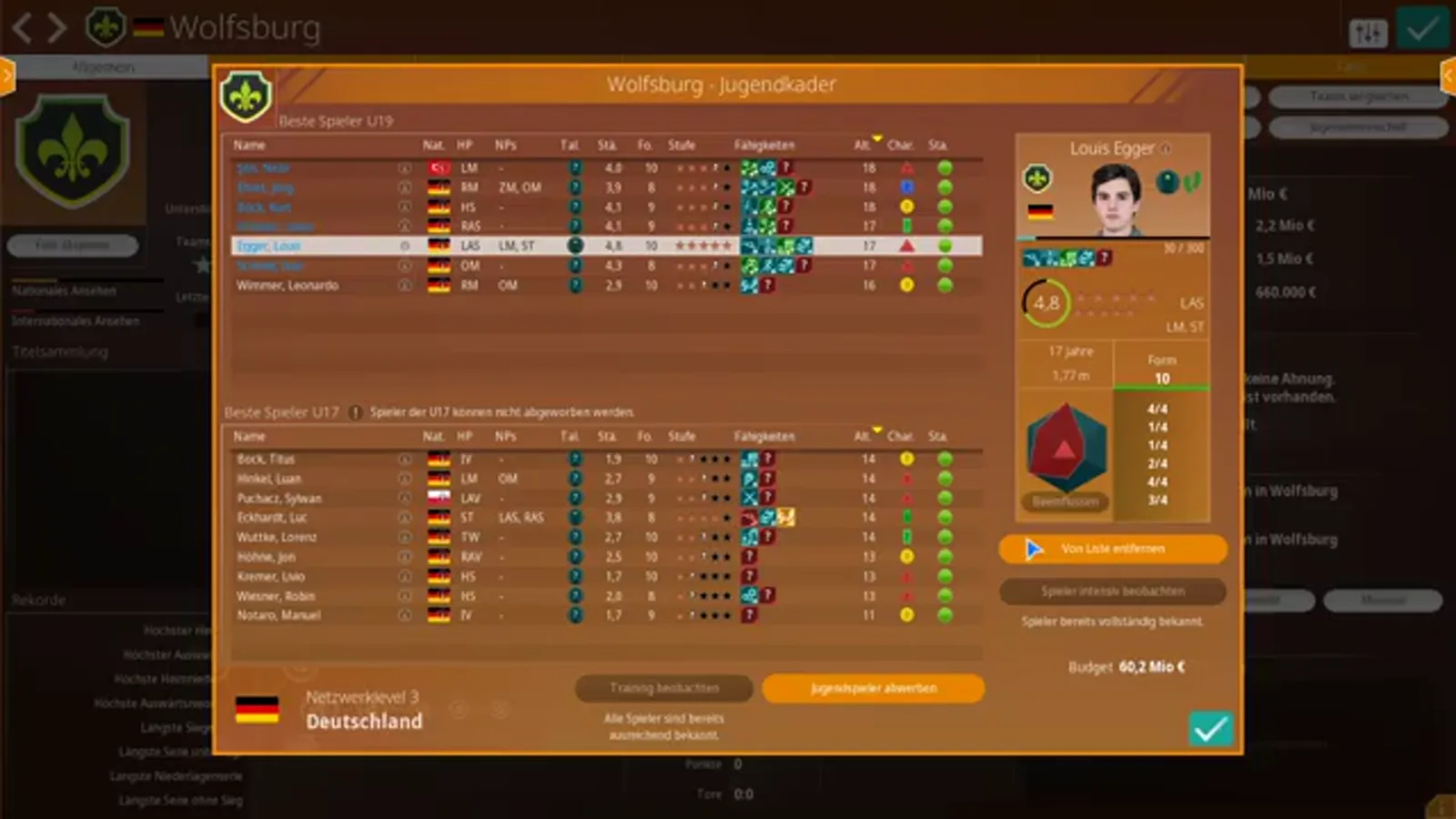
Knowledge level gates what you can do next. At Netzwerklevel 3 the button to observe training unlocks; a small payment then reveals the player’s skill list, closer monitoring reveals whether he carries a talent star, and from there he goes onto your watchlist. Two hard limits frame the whole business: the game’s own screen notes that U17 players cannot be poached, and the video says outright that poached players must be over 16 years old to be offered the contract. The mechanics of the wider transfer market — sell-on clauses, release clauses, negotiation levers — work the same way for youngsters as for professionals and are covered in the transfer market guide.
What poaching costs when it works — and when it doesn’t
The money talk happens with the agent. The small example in the video: a closing fee of 36,000 euro, due on success, to establish contact with the player. The star example shows the scale at the other end — the screen lists 540,000 euro to open contact and an Abschlussgebühr im Erfolgsfall of 6.3 million euro for an 18-year-old centre-back rated 9.3.
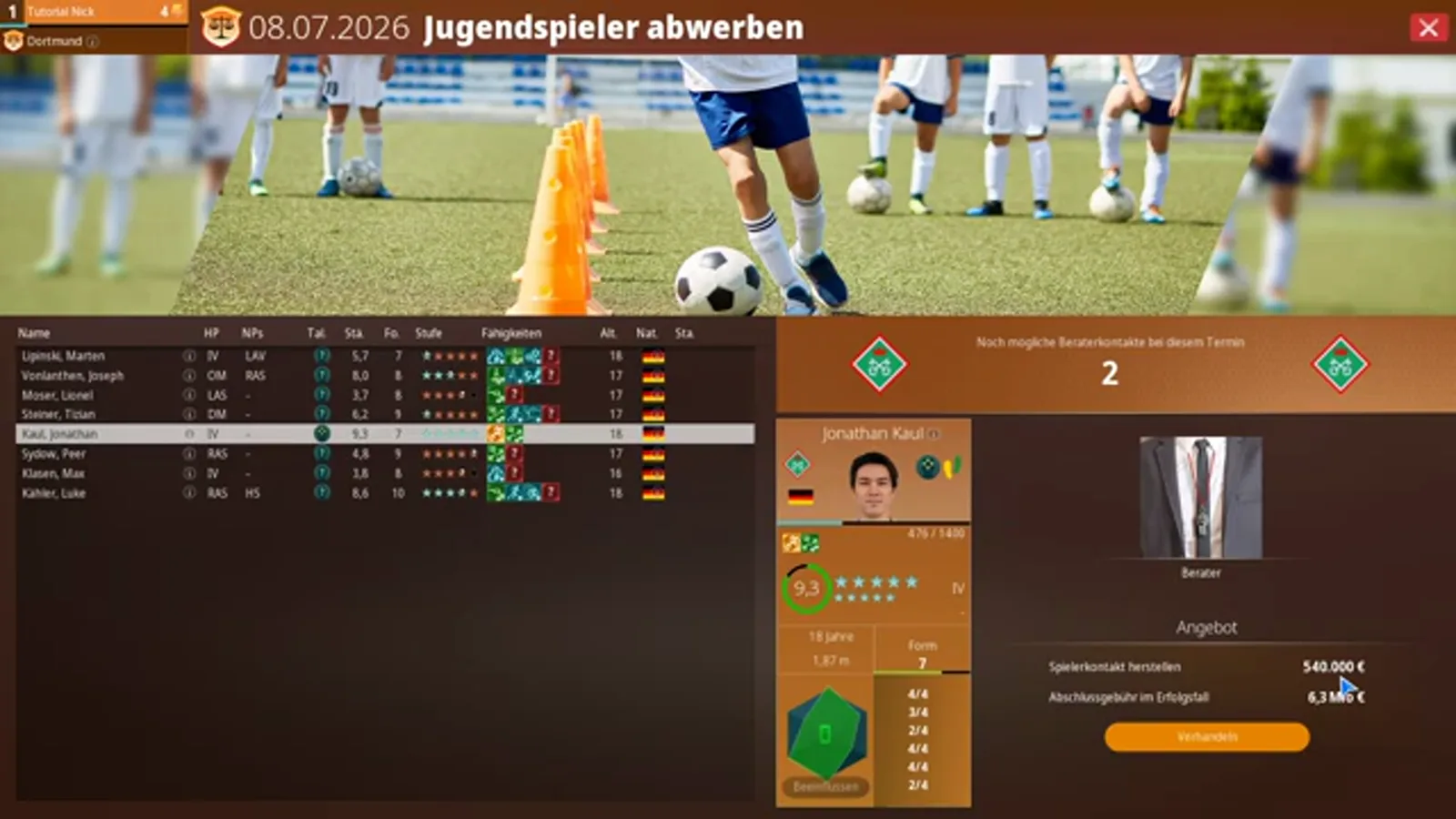
And then the lesson: the video fulfils every contract demand for that 9.3-rated youngster, the screen shows an 84 per cent chance he joins, three in-game days pass — and the news feed announces that he rejects Dortmund and stays at Wolfsburg. “We should have offered more,” is the author’s post-mortem; nobody arrives, and the money already spent on the attempt is gone. Poaching is an auction with no refunds, so budget the fee as spendable before you open talks. When a deal does close, the contract that follows is negotiated with the same levers as any professional deal — the contract negotiations guide breaks those down.
The suspected bug: poached youths land on professional contracts
During the first demo deal the presenter stops mid-negotiation, visibly surprised: the game wants him to hand the teenager a professional contract directly. In earlier versions, he says, it was possible to bring a poached player into the youth programme instead — and he cannot find that option anywhere now. He returns to the point twice more, and his summary at the end of the video is explicit: “it seems to be a bug. I hope that gets fixed,” because otherwise signing 16-year-olds stops making sense at all.
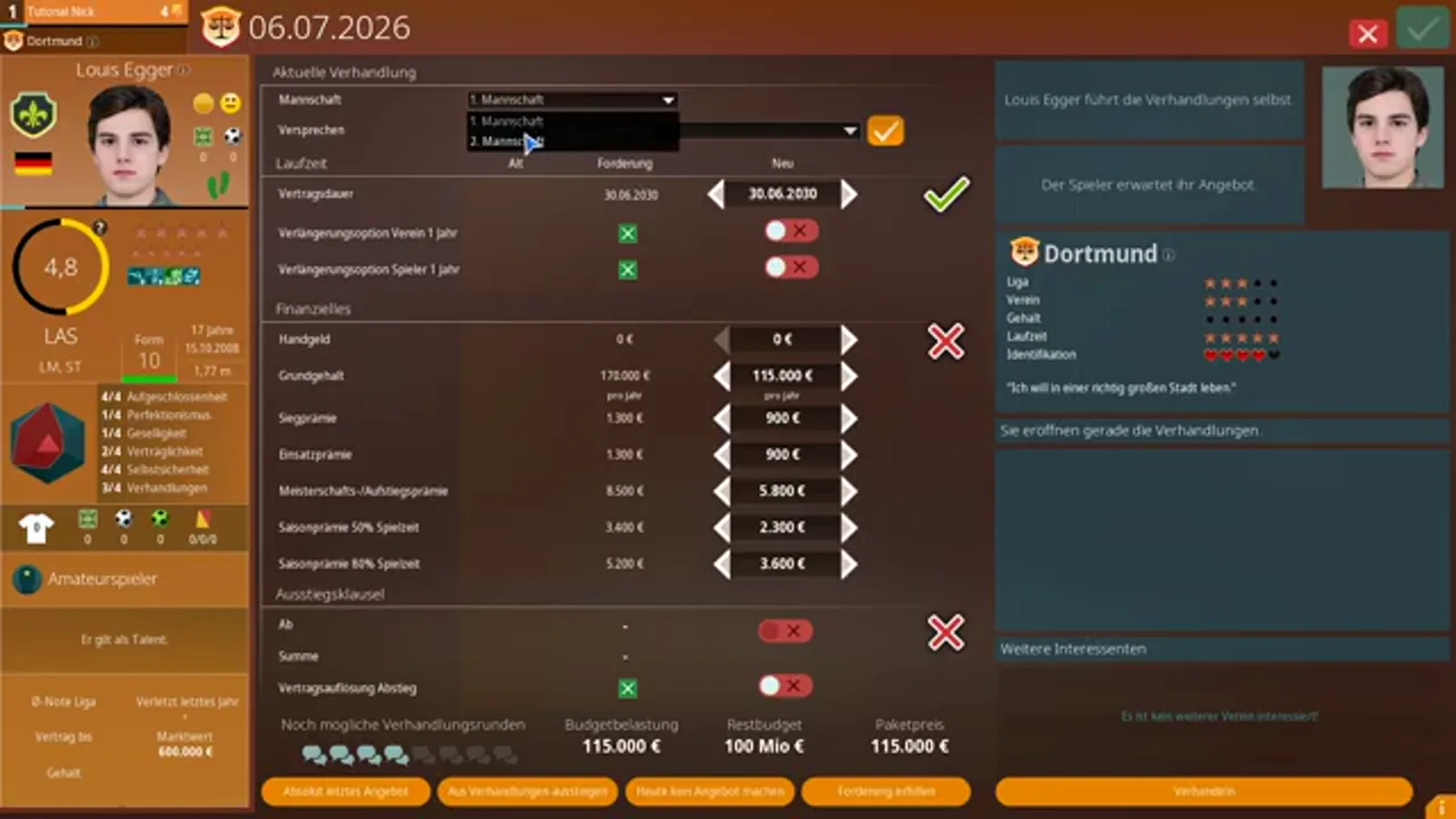
Treat this exactly as what it is: the video author’s observation about v1.0 behaviour, not a confirmed mechanic. Whether a future patch reintroduces the youth-programme path is open. What you can rely on is the observed behaviour — poached youngsters currently sign on professional terms — and planning your wage book accordingly.
The seven-year plan
The video closes with the horizon that makes all of it worthwhile, and it is long: seven to eight years at the club before a properly built youth setup pays you back. Players raised this way arrive in the first team as 8s, 9s and 10s — ready to play, instead of parking themselves in your squad as 6s and 7s. An 18-year-old getting Champions League minutes develops to a strength of 14 or 15, with further training towards 16, and market values beyond 100 million euro are the realistic endgame. If one of them then goes to Madrid or Barcelona, the entire programme has paid for itself several times over — the goals and bonuses along the way are the interest. Youth development in WE ARE FOOTBALL 2027 rewards exactly one thing: starting early and not stopping. Where to play those regens once they break through, and how to build the side around them, is the business of the best wonderkids guide; the baseline rules of the game itself are collected in the official manual guide.
Related Guides
talents
WE ARE FOOTBALL 2027: Player Types & Roles Explained
Player types in WE ARE FOOTBALL 2027 explained: Ehrentitel hero powers, leader vs. team-player colours, development potential, and reshaping types with coaching.
talents
WE ARE FOOTBALL 2027: Best Wonderkids & Talents
Discover top young wonderkids in WE ARE FOOTBALL 2027: 5-star potential ratings, cheap release clauses, scouting setups, and youth academy growth.
talents
WE ARE FOOTBALL 2027: Youth Camps & Academy Scouting Guide
Build profitable youth camps in WE ARE FOOTBALL 2027: global setup costs, talent-pool math, coach upgrades, star ratings, and promotion timing.
Was this helpful?
Thanks for the feedback!