WE ARE FOOTBALL 2027 vs 2024: Is the Upgrade Worth It?
WAF 2027 vs 2024 compared: save import, a compressed league pyramid, round-based negotiations, regional cups — and whether the 19.99 € upgrade is worth it.
Frequently Asked Questions
Is WE ARE FOOTBALL 2027 a DLC for WAF 2024?
Does WE ARE FOOTBALL 2027 import my WAF 2024 save?
Do achievements work in creative mode in WE ARE FOOTBALL 2027?
What does WE ARE FOOTBALL 2027 cost and which languages does it support?
How do contract negotiations differ from WAF 2024?
How actively is WE ARE FOOTBALL 2027 supported after launch?

NickFrei zockt: WE ARE FOOTBALL 2027 – Preview – Was ist neu? (German, pre-release build)
Is WE ARE FOOTBALL 2027 worth upgrading from WAF 2024?
For most people who played the 2024 edition, yes — and the clearest reason is the deal itself. WE ARE FOOTBALL 2027 costs 19.99 € as a standalone game. It is not a DLC, it does not require the old version, and the developer’s stated philosophy, as the video author relays it, was to reject both the DLC route and a full-price release so that anyone curious about a football manager can simply buy it. You are not paying twice to keep playing the same game; you are paying budget-movie money for a rebuilt 2027 world.
What you get for it is a longer list than the similar-looking screens suggest — the Steam page’s own pitch (200+ playable countries, a new creative mode, multi-stage negotiations, regional cups) all checks out in play. The headline changes: your league pyramid below the Regionalliga is compressed into merged leagues, contract negotiations run in rounds instead of points, regional cups feed the DFB Cup, staff contracts renew in one click, and a creative mode lets you bend every rule the simulation knows. What you do not get is a new match engine or licensed clubs — if either of those is your dealbreaker, our honest review says plainly who should skip this one.
What carries over from WAF 2024?
One thing, and it is a thoughtful one: the season review. The main menu carries a dedicated load screen for it, and on the preview build it found the author’s old save without any fuss.
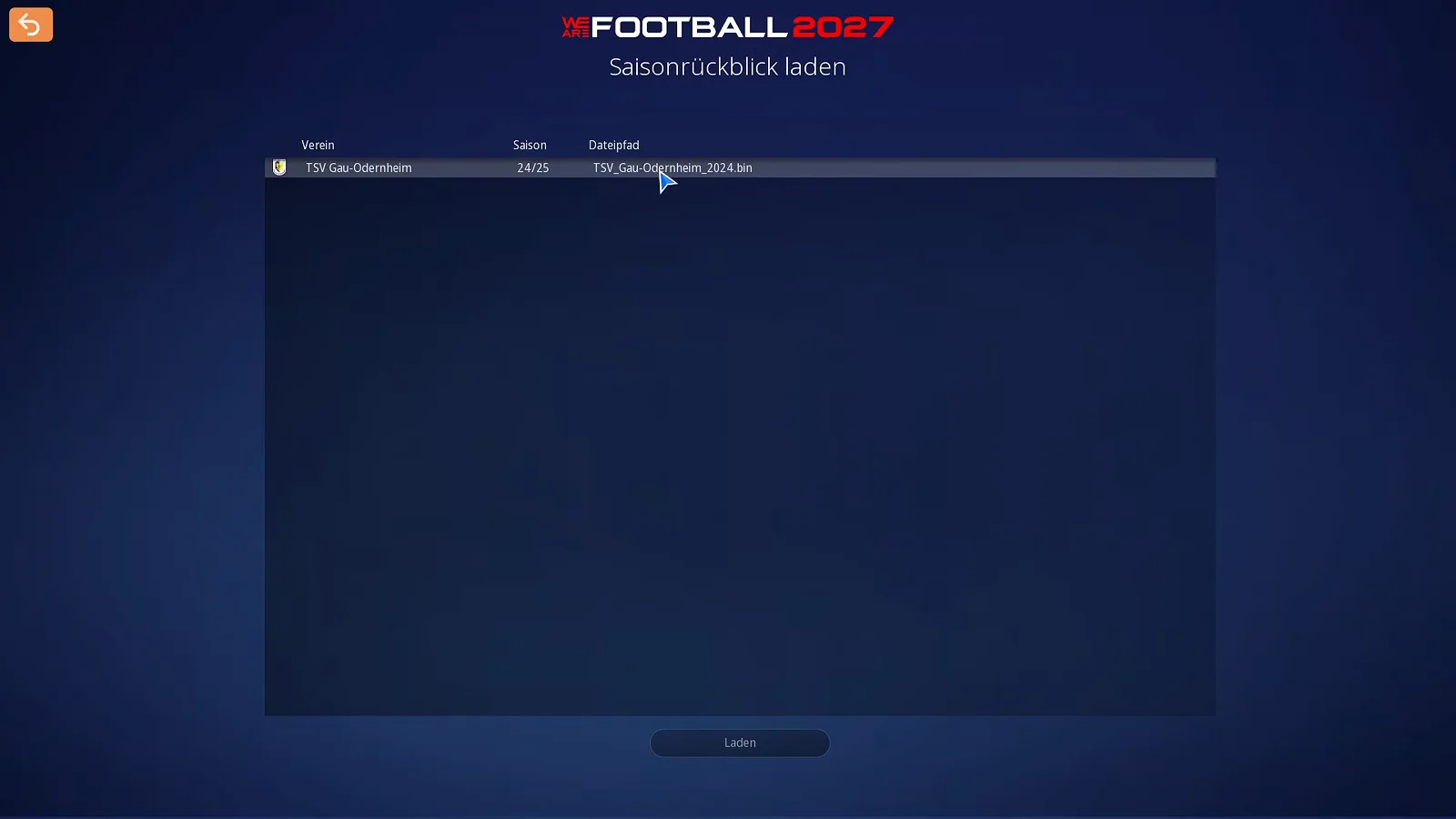
The screen „Saisonrückblick laden” lists his WAF 2024 save — TSV Gau-Odernheim, season 24/25, file TSV_Gau-Odernheim_2024.bin — as importable. What does not carry over is your manager: his profile, reputation and history stay behind in 2024. You keep the memories, not the CV. The usual caveat applies: this is a preview-build recording, so treat the exact import behaviour as subject to the release version — though Update 1’s patch notes did fix editor start problems „in connection with WAF24”, which shows the old game’s data still matters to the new one. Where the two editions sit in the wider line-up — career, club founding, national teams, spectator mode — is laid out in our career mode and game modes overview.
What is new in WE ARE FOOTBALL 2027?
This is the section the comparison really lives in. The changes concentrate under the hood: data, rules and screens you touch every week rather than a reskin.
A bigger world database — standard or world
The new game opens with a choice the old one made less vividly: a standard database or the world.
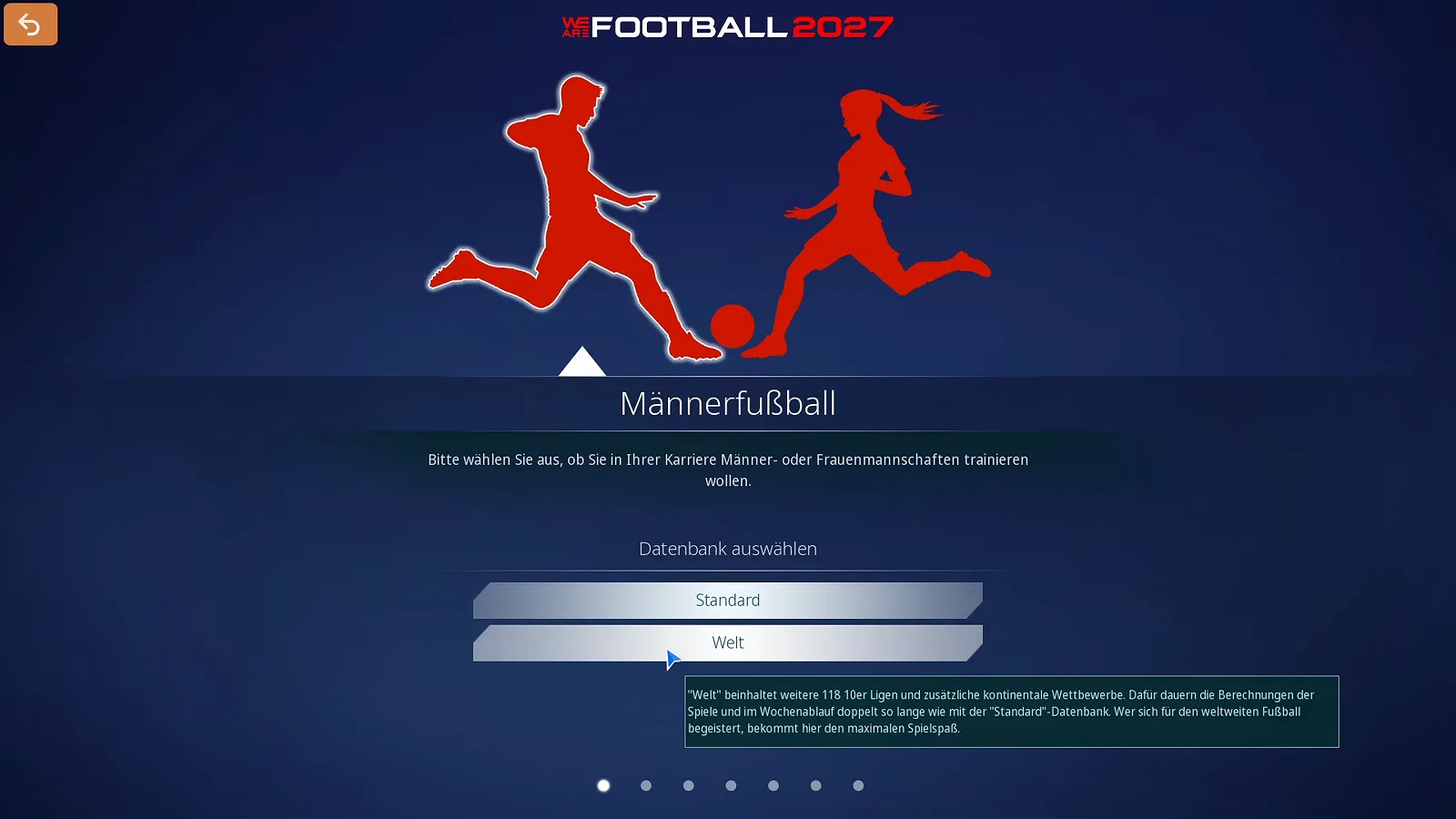
The tooltip on the „Welt” option spells out the trade: it adds „weitere 118 10er Ligen und zusätzliche kontinentale Wettbewerbe” — 118 additional ten-club leagues plus continental competitions — and doubles the calculation time for matches and the weekly flow. Journeyman-style careers across the globe are therefore supported out of the box; you only pay for it in simulation speed.
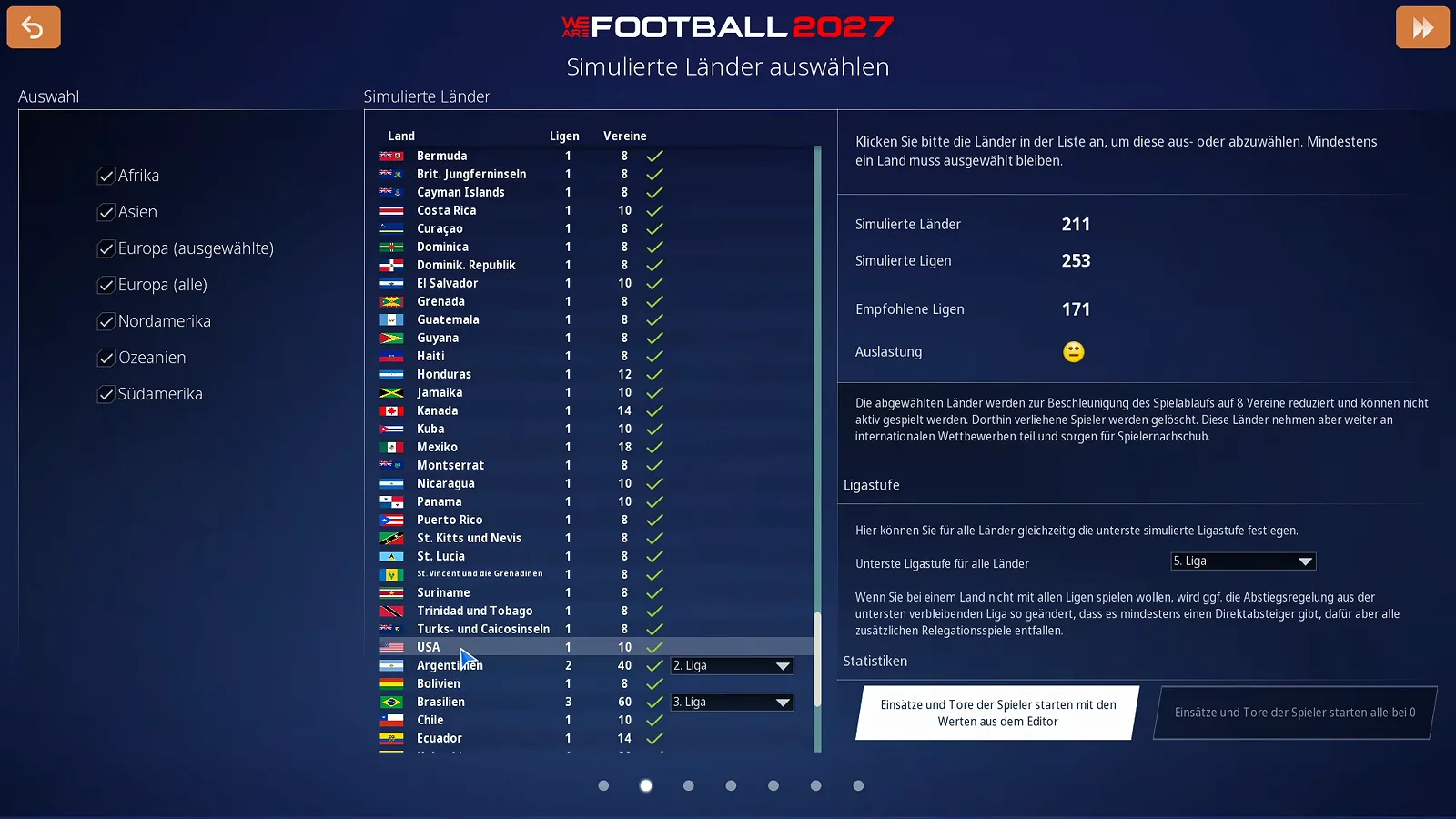
The summary panel on the selection screen counts 211 simulated countries, 253 simulated leagues and 171 recommended for the full world database, with a system-load smiley beside it. Two honest footnotes: these are preview-build figures, and Update 2 then shipped „Better calculation of the recommended number of leagues at game start” — so the recommendation counter may well read differently in the shipped game. Also visible on this screen: deselected countries are reduced to eight clubs for performance, keep producing players, and still take part in international competitions. The USA line is its own curiosity — one ten-club league with no relegation, as the author puts it, „unrealistically chaotic”. Which database suits which save is the territory of our database choice guide.
A compressed league pyramid — and a UK focus this year
The German lower tiers changed more than any screenshot suggests: the parallel Oberligen under the five Regionalligen were merged to keep the database manageable.
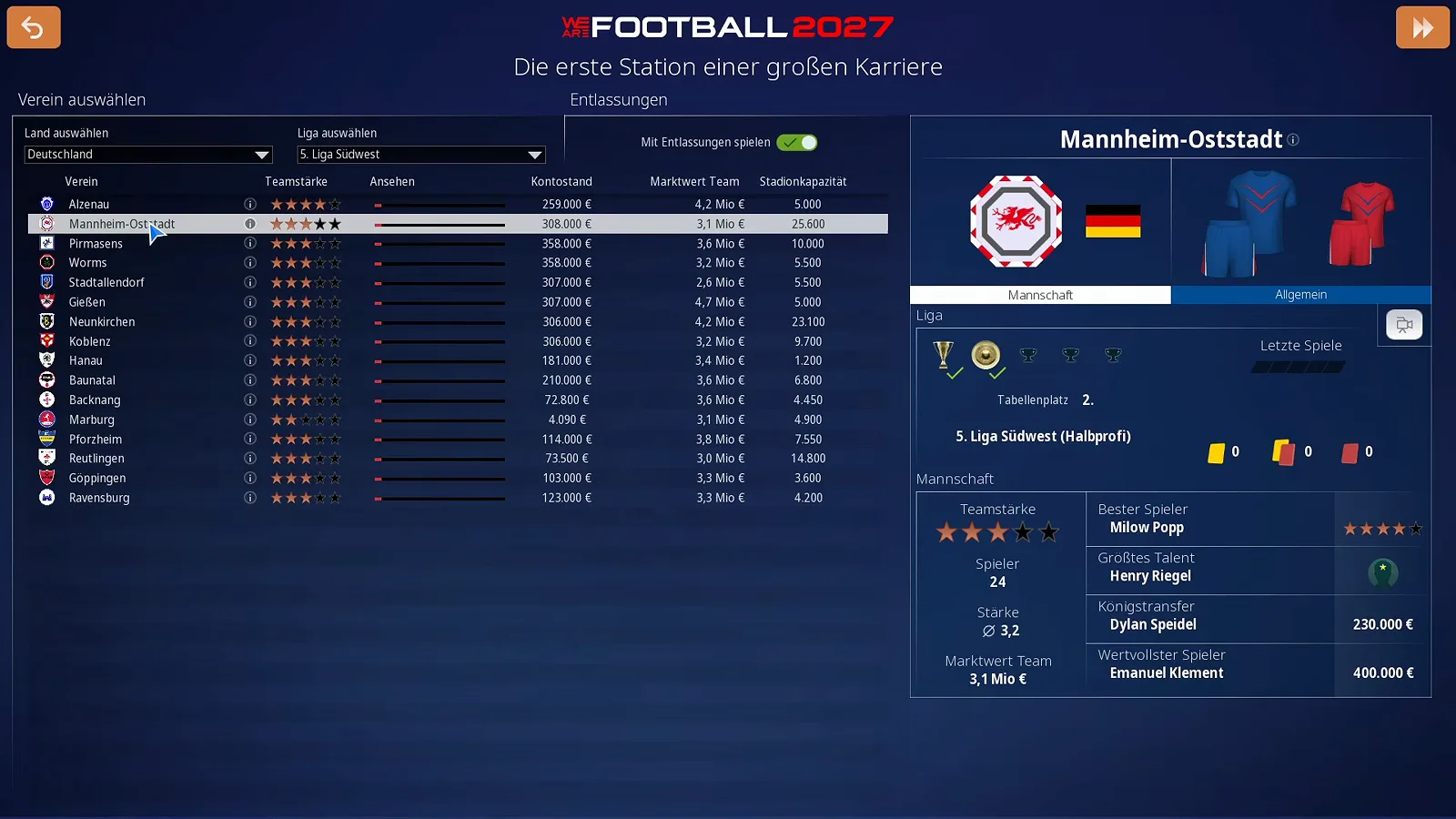
The 5. Liga Südwest in the frame is the proof: one league whose club list mixes Worms, Pirmasens and Koblenz with Mannheim-Oststadt, Göppingen and Reutlingen — clubs that used to play in different parallel Oberligen, now pulled „two or three clubs from each” into a single Southwest league, as the author walks through. His pet club Gau-Odernheim did not make the cut, a small tragedy he takes personally. The same screen shows the new league status labels — „5. Liga Südwest (Halbprofi)” — part of the reworked professional/semi-professional/amateur distinction that also scales training plans down for lower tiers. England, by contrast, got the opposite treatment: five fully professional tiers, and Scotland — part of this release cycle’s United Kingdom focus — built out to the third tier as semi-professional. The author adds that the developers rotate this focus, with Austria and Switzerland named as the next countries; Update 2’s „New city and country descriptions, special focus on Austria” already points the same way. How licensing and country depth shake out in detail is covered in our leagues and licences guide.
Sharper squad data: playing time, characters, an auto-sorting bench
The squad screens gained a data layer the old game lacked.
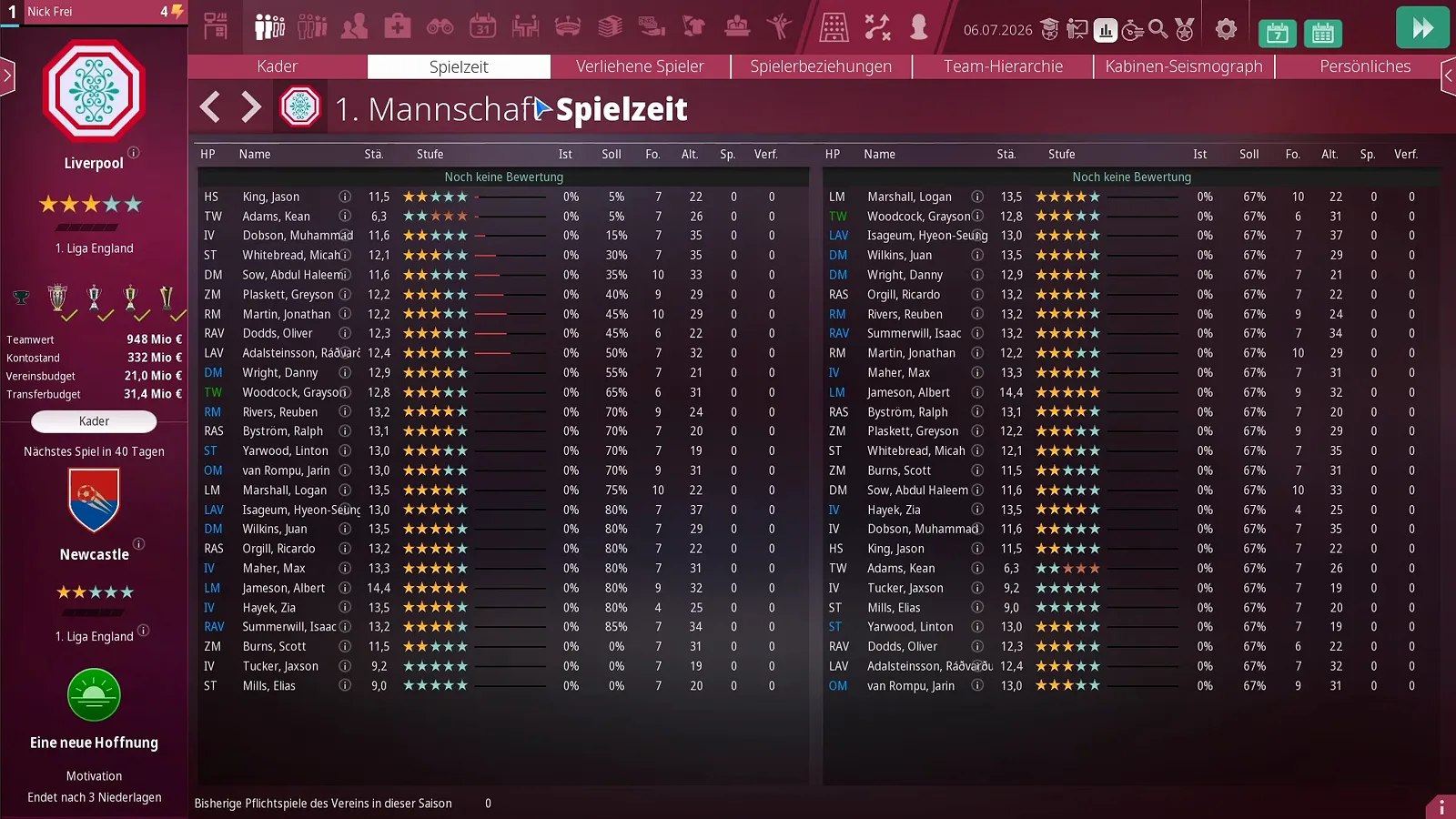
The Spielzeit tab puts every player’s Ist (actual) minutes next to Soll (wanted) — in the frame, the right half of the Liverpool squad sits at 0 % actual against 67 % wanted while the left half shows staggered targets, pre-season, and the author reads exactly the promise pressure out of it. Alongside it he walks the new personal-information page (hobbies, character development, positions), an honorary-titles display, a clearer motivation view, and an integration value that tracks how well a new signing has settled — up to two years for full integration, helped by a suitable character and the new player-integration staff role. Two smaller conveniences round it off: the substitutes’ bench now sorts itself by position automatically, and tactics gained a new positional-loyalty slider with five settings from „wild” to „extreme”. The talent and preferred-foot counts he reads out („seven huge talents, eight mega talents…”) are from his preview save, so treat them as an illustration of the feature, not fixed values. Our squad screens guide goes deeper on each tab.
One-click staff contracts and a sponsor pyramid
Two club-management screens were visibly rebuilt.
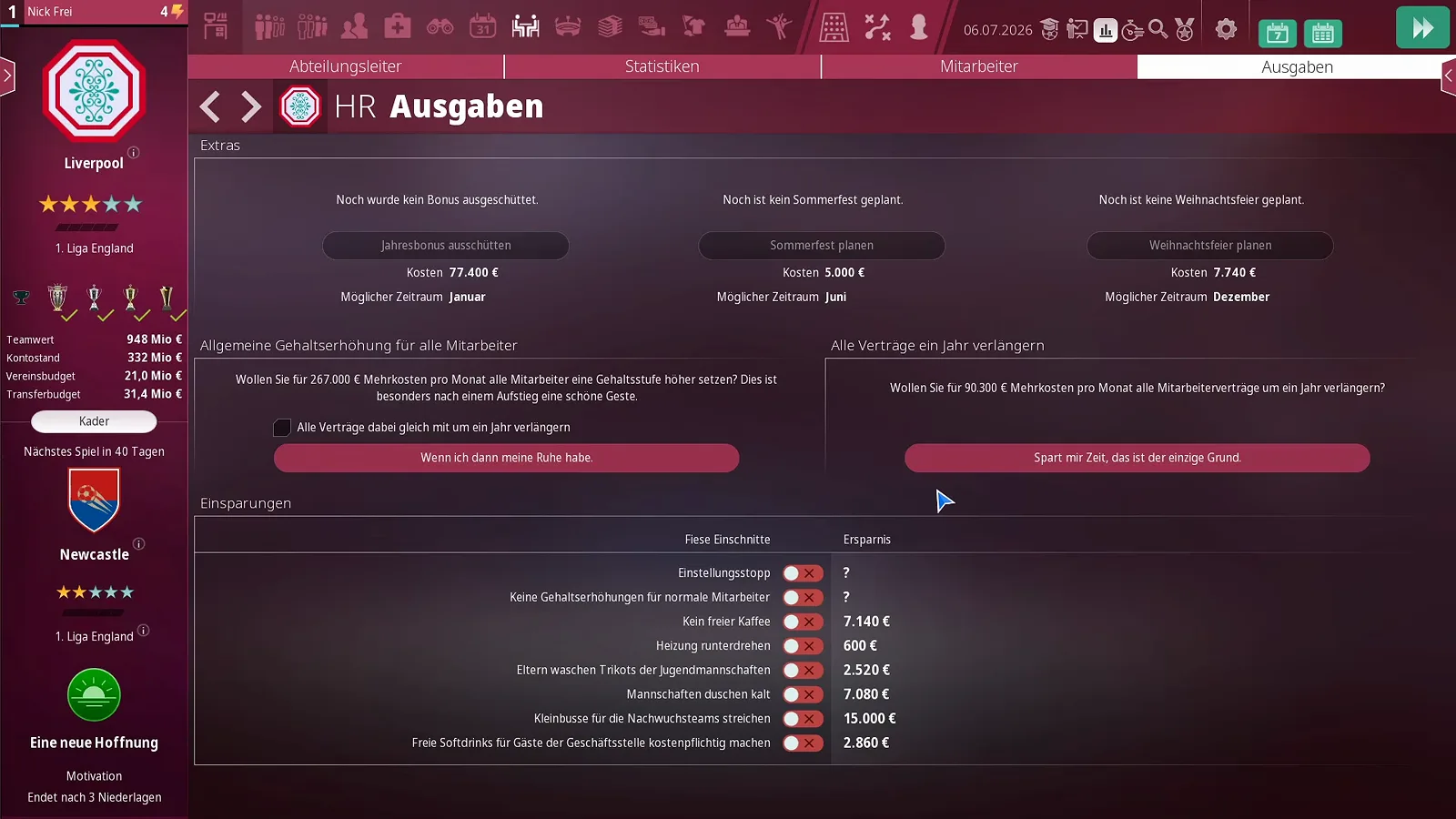
The HR screen now answers the two most annoying rituals in the old game. „Alle Verträge ein Jahr verlängern” renews every staff contract at once — 90.300 € extra per month in the frame — and the pay-grade rise for a promotion (267.000 € per month here) can bundle the same one-year extension via checkbox. The author’s delight is audible: no more two-hour appointment with every scout whose contract is expiring. He also shows a new staff investment screen — training budgets, „our own academy”, invited speakers — with his spoken figures (1.2 million per month towards staff level 15) unverified on screen. For the whole department, our staff and HR guide takes over from there.
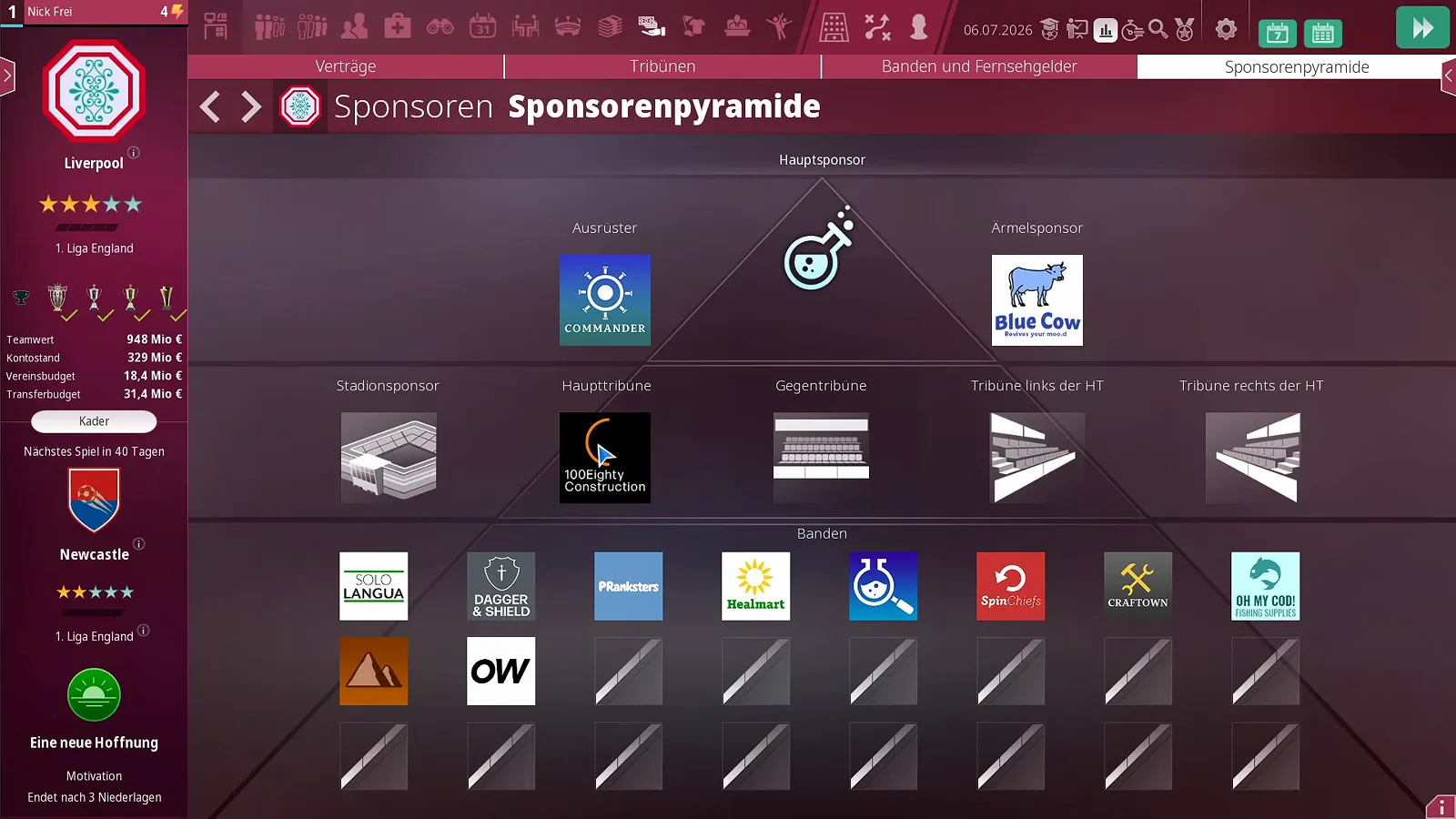
The sponsor screen is now a full pyramid: Hauptsponsor at the top, kit supplier and sleeve sponsor beside it, stand-level deals below, advertising boards at the base — populated with a fictional brand universe (COMMANDER, Blue Cow, 100Eighty Construction, Healmart) that replaces the old generic „Chemie Bauen”-style names, and the club overview page gained a title-by-title column layout with the pyramid viewable for every club. Sponsor income mechanics live in our sponsor deals guide.
Negotiations without points — and a new trap
Contract talks changed more than any other single system.
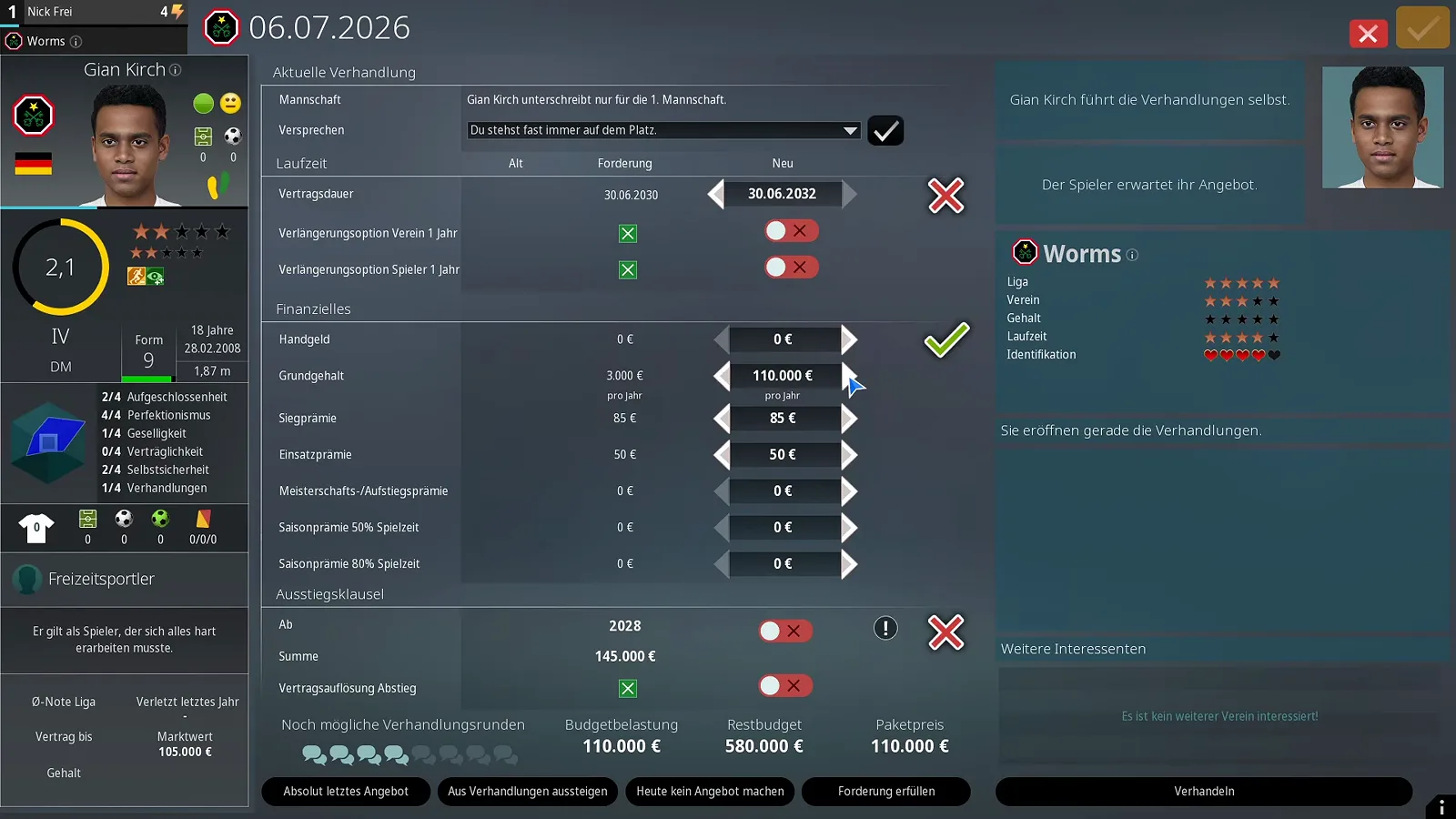
The author’s summary — „we’re out of points” — is the feature: instead of a spending budget capping every offer, the negotiation screen shows „Noch mögliche Verhandlungsrunden” (remaining rounds), and every term from signing fee to release clause moves freely. Push too hard and you burn rounds, not points; the player’s reaction arrives as feedback („a generous offer, I just need to consult someone”). The shipped game’s store page confirms the design as „multi-stage negotiations where rival clubs can swoop in at any moment”. The trap sits in the same screen: when an offer is accepted you are no longer asked to confirm — bid for two strikers in parallel and both can land in your squad. Our contract negotiations guide carries the full released mechanics.
Regional cups: the road from the district to the DFB Cup
The feature the author calls one of the most important additions.
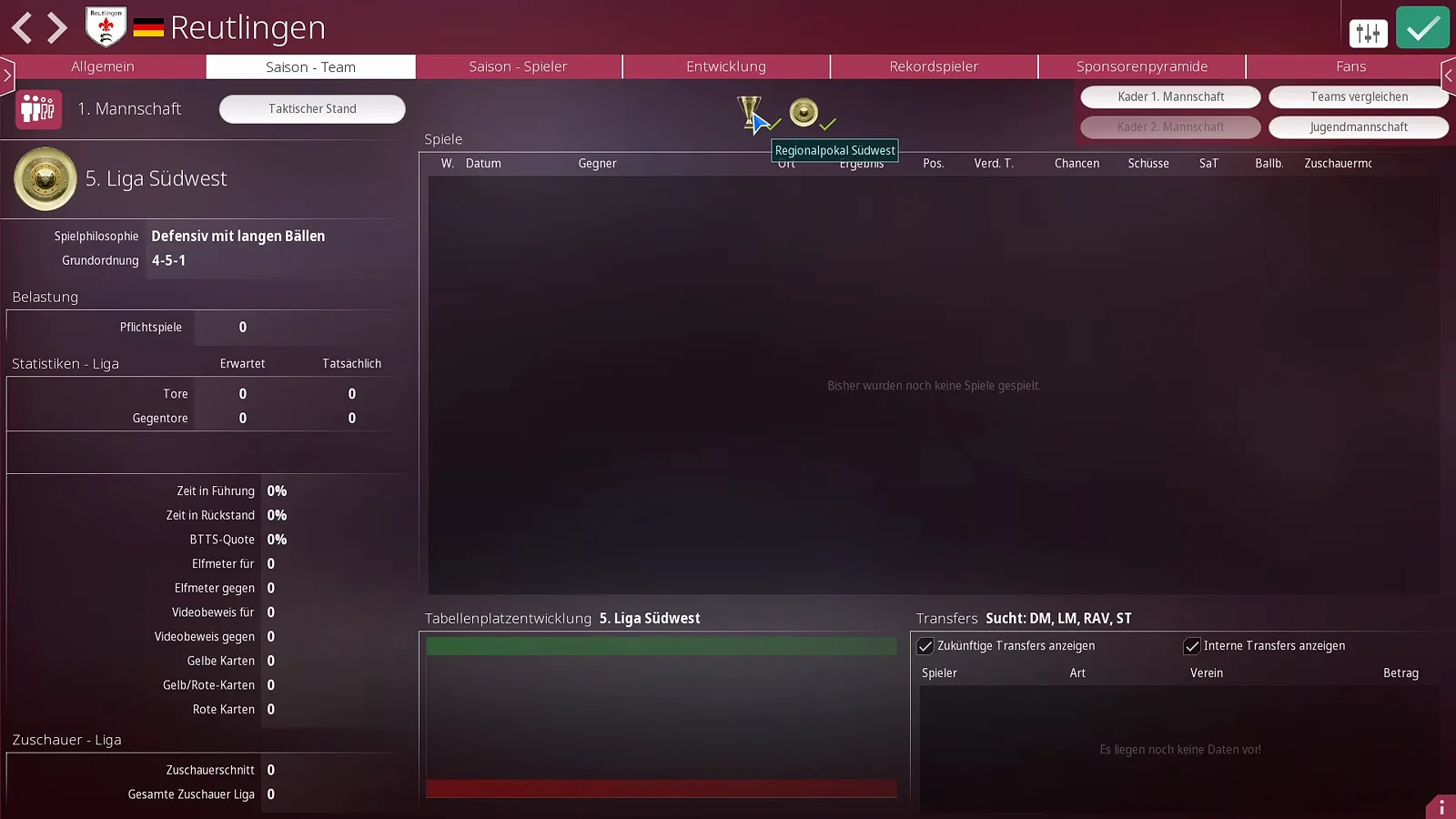
Reutlingen’s season page shows the new Regionalpokal Südwest sitting in the fixture list, one of a family of regional cups (West, Südwest, Nord, Nordost, Bayern) alongside the DFB Cup and Supercup. Per the author, winning one earns your club a place in next year’s DFB Cup draw — the store page tells the same story from the top: „Start in your local district, fight your way into regional glory, and earn your ticket to the national stage.” For lower-league saves this is the new spine of a career, and our regional cups guide maps the format.
Creative mode: sliders, actions, rules — zero achievements
The sandbox is the release’s most-discussed addition, and the store page is explicit about its ambition: „Rewrite rules, rebuild systems, push boundaries, and unleash direct actions — like jumping to any club in the world with a single click.”
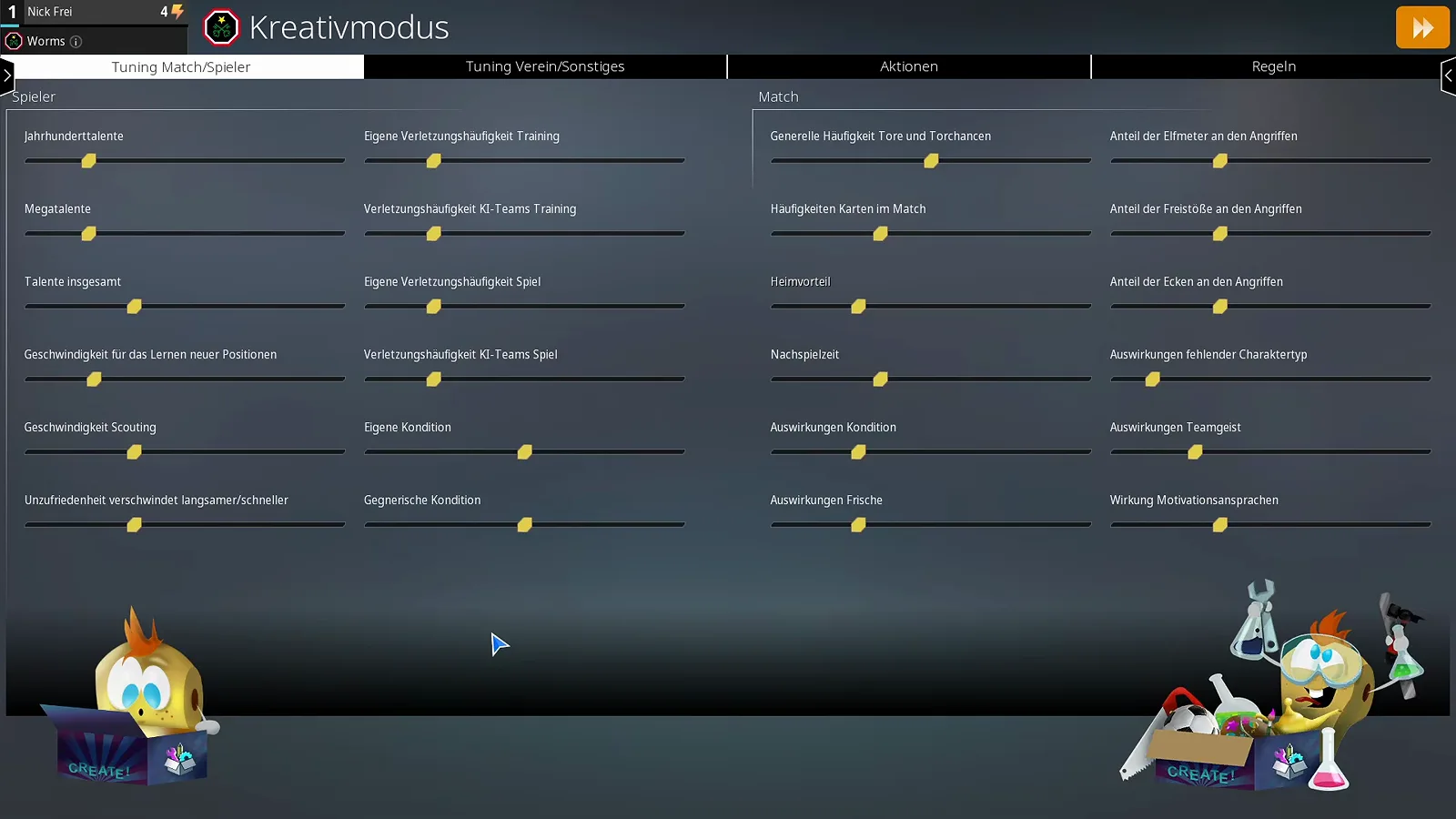
The preview build shows the price of that power immediately: sliders for everything — Jahrhunderttalente (once-in-a-century talents), scouting speed, injury frequency, the share of penalties in attacks, home advantage, stoppage time — plus an Aktionen tab (jump to any club, hand yourself points, gift a club a billion) and a Regeln tab where the 50+1 rule, penalty shoot-out formats and cup draws can be rewritten mid-save. Two hard edges are confirmed by the manual, not just the preview: achievements and records are locked in creative mode, and the switch is one-way — once activated, no route back to realistic rules. The author also notes this cost the mode its achievements on Steam and Discord discussions. Our creative mode guide walks the whole sandbox, and the achievements list documents the lock.
Spectator mode: follow clubs, now with fast-forward and rewind
The watch-don’t-manage mode got the quiet upgrade sim-watchers care about.
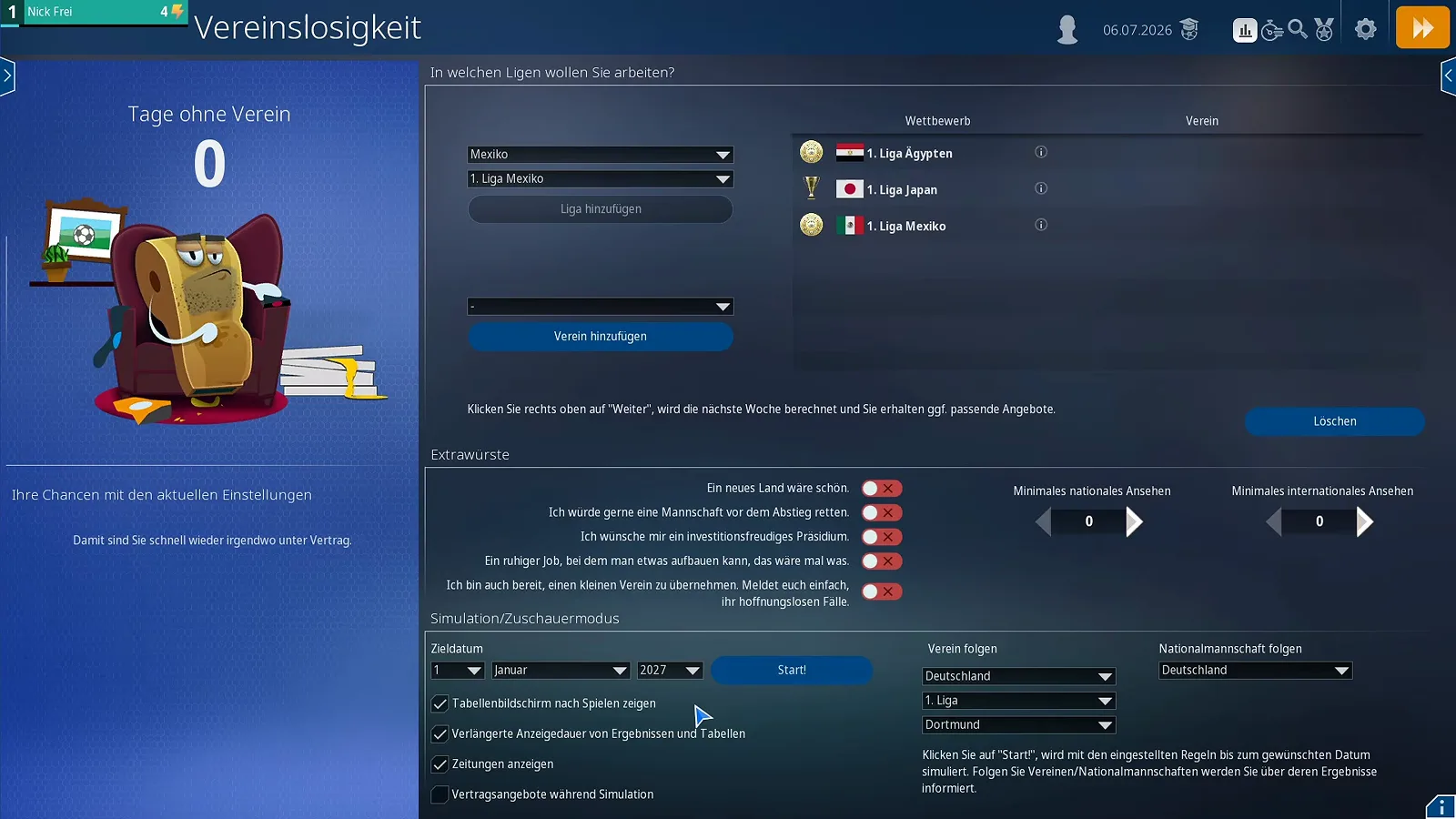
From the „Vereinslosigkeit” start — which now doubles as the spectator setup — you follow up to three clubs and a national team, set a target date, and simulate the world forward; the frame shows Dortmund plus the German national team queued up towards 1 January 2027, with the author’s Egypt–Japan–Mexico hexagon-challenge pick above. His headline, demonstrated live: „now I can fast-forward and rewind — that wasn’t possible last time.” Being able to scrub the simulation backwards is exactly the feature a spectator career was missing. The mode’s full loop is documented in our spectator mode guide.
The smaller changes worth knowing
A grab-bag of additions that each help a specific kind of save:
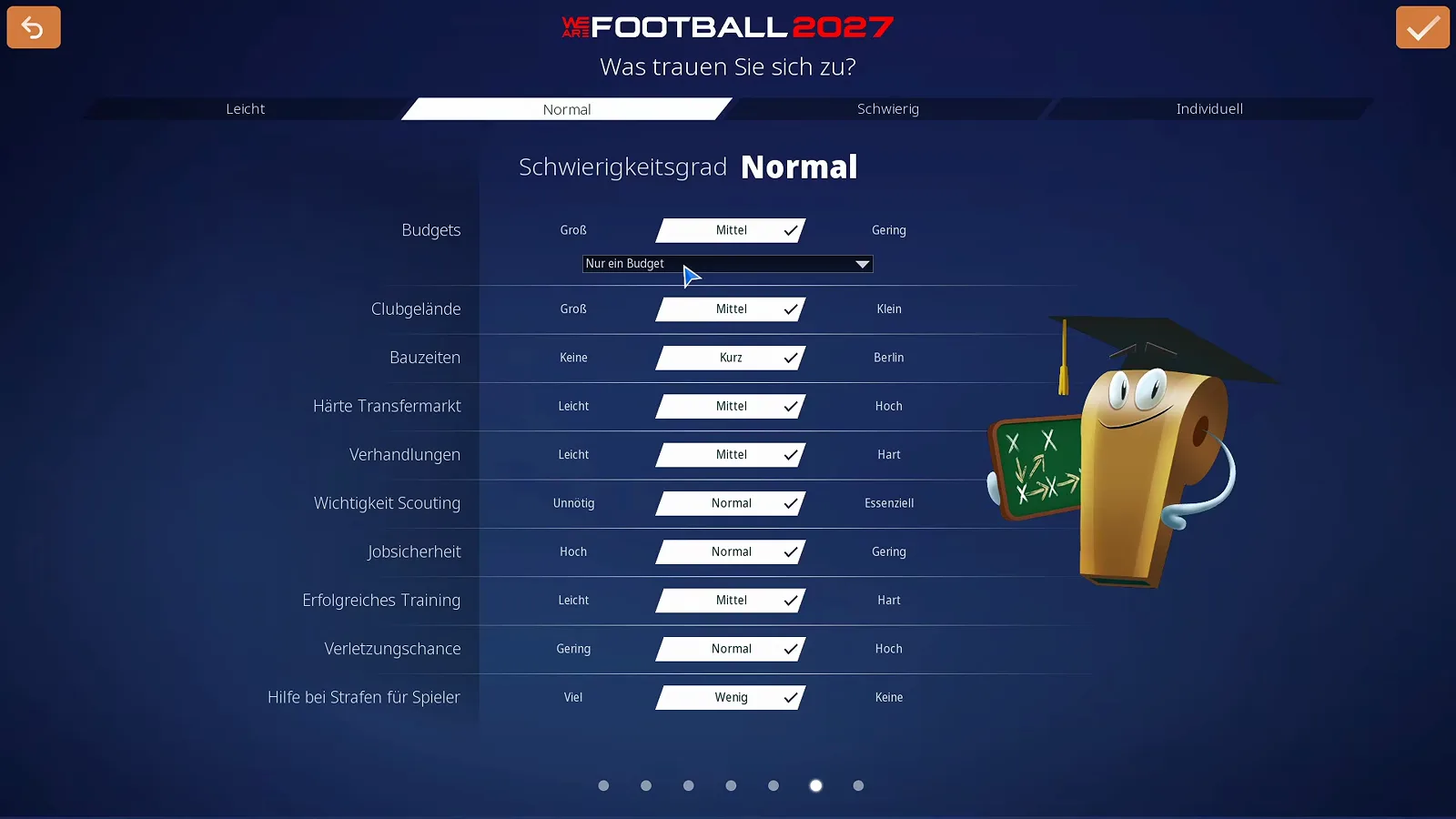
- Nur ein Budget — a new difficulty option that abolishes separate transfer/wage budgets and runs your club on the account balance alone. Freeing, and dangerous: the balance ignores your monthly running costs, as the author warns. Club founders who finance their own club are the natural audience.
- Redesigned club badges and kits — the fictional crest art was redone across the board; the author misses Munich’s Bavarian-flag look and Leipzig’s bull, but concedes the new set is coherent.
- Scaled-back training plans for semi-professional and amateur tiers — mornings and Saturdays only, costing the lower tiers six afternoon sessions; real amateur clubs get even less, which finally makes tier-appropriate saves feel tier-appropriate.
- A U21 league in England — reserve teams have their own competition with its own rules; on the preview build the author could not get its table to display, so we flag that as unverified rather than claim how it resolves.
- New countdown screen, browsable match days in the league table, and an explicit unemployed start — small packaging changes around the same fast week-to-week core.
Price and editions: 19.99 €, standalone, no DLC
The pricing decision deserves its own paragraph because it reframes the whole comparison. The video author’s framing: treat it as „Football 24, plus a 20 € DLC that brings all the systems up to scratch” — except nobody has to pay 60 € first. The Steam store confirms the substance: a full standalone listing at 19.99 € with no launch discount, three languages (German, English, French) and no DLC attached.
The community’s „24 vs 27” thread on Steam mirrors the argument in miniature. One player, translated from German: „It does look very similar to 24, that’s true. But a lot has changed underneath. The sheer number of new settings alone is a superb addition … In my view it IS a new game — at a price others charge for a small DLC.” The counterpoint, from the same thread: „There are some noticeable changes … I can still understand the criticism, because at first and second glance it looks exactly like its predecessor and plays largely the same. You could see it less as a new version and more as a bigger patch or a DLC.” Both are fair; the price is what makes the experiment low-stakes.
A second thread has since joined the debate, and it cuts the other way. „Diese Probleme auch in 2027?”, opened on 23 September and still active at the end of the month, asks the upgrade question from inside 2024: two things annoy the player there, he writes — „Die explodierenden Gehälter nach ca. 15 Saisons” and „das extreme Minusgeschäft der 2. Mannschaft” of a third-division club that loses around 10,000 per home game with the crowd capped at 1,000. Is all of that fixed in the new edition? Nobody in the thread has a definitive answer yet, which is the honest state of the question — but the specific pain points he names are exactly where 2027 reworked its simulation, and our second team guide covers the reserve-side economy he is asking about.
How good is the post-launch support?
This is where the upgrade case strengthened after the video was recorded. Update 1 arrived on 24 September 2026 and fixed, among other things, „Editor: Starting problems in connection with WAF24 solved”, three crash sources and the language-selection display at first start. Update 2 followed on 28 September with six improvements and eleven fixes, including:
- „Better calculation of the recommended number of leagues at game start” — directly touching the database screen shown above;
- „Fix: Youth players no longer automatically receive a professional contract, which had previously caused issues”;
- „Fix: Add interaction options in 1st/2nd team, e.g. with loan players”;
- „New city and country descriptions, special focus on Austria” — the first step of the announced country focus rotation.
That is two content-bearing patches in the first twelve days, roughly a four-day rhythm — the recommended-leagues fix alone means some preview-build numbers on this page were already re-tuned post-release. Our troubleshooting and update log keeps the per-patch detail, and the official manual guide tells you where the 281-page English handbook deepens any topic here.
The short version: nothing you built in 2024 survives except its story, but at 19.99 € you are buying a sharper database, calmer contract talks, a real cup road for small clubs and a sandbox with no leash — and the first two patches suggest the 2027 edition will keep moving under your feet.
Related Guides
guides
WE ARE FOOTBALL 2027 Team Strength Comparison: Stars, Gauges, Scouting Lists
How to read team strength in WE ARE FOOTBALL 2027: Kader stars, the profile gauge, the pre-match Mannschaftsteile bars and the scouting list for the next fixture.
guides
WE ARE FOOTBALL 2027 Season Planning Guide: Budget Split, Kits and Squad Numbers
The Saisonplanung stretch in WE ARE FOOTBALL 2027 screen by screen: promotion payout, league target, budget split, new kits, club rules and squad numbers.
guides
WE ARE FOOTBALL 2027 Relegation Battle Guide: Escaping the Red Rows
A relegation battle in WE ARE FOOTBALL 2027 screen by screen: the red Verbandsliga table rows, a 0:1 away steal, a 1:4 home defeat and the January deals in between.
Was this helpful?
Thanks for the feedback!