WE ARE FOOTBALL 2027 Leagues & Licences Guide: What's Licensed
Every league question around WE ARE FOOTBALL 2027: Standard vs World database, 200+ countries, what is licensed, the German league ladder and editor-built cups.
Frequently Asked Questions
Which leagues are in WE ARE FOOTBALL 2027?
Is WE ARE FOOTBALL 2027 licensed?
Can you play the real Bundesliga in WE ARE FOOTBALL 2027?
What is the difference between the Standard and the World database?
How many regional cups can a country have?
Can I create my own league in WE ARE FOOTBALL 2027?
Leagues are the skeleton of every save: they decide where you can start, what your club can win and how much of the world keeps running while you do it. This page collects the league facts of WE ARE FOOTBALL 2027 in one place — how many leagues and countries the two official databases simulate, what is and is not licensed, what the league screens in an actual fifth-division save reveal, and how regional cups, international competitions and your own editor creations extend the picture.
How many leagues are in WE ARE FOOTBALL 2027?
The honest answer: the number is not fixed — you choose it. The game ships two official databases for men’s football, and the start wizard’s country screen counts what each contains. The numbers below are the ones the database comparison guide measured on that screen:
| Database | Countries | Simulated leagues | Character |
|---|---|---|---|
| Standard | 95 | 137 | Europe plus selected countries, calculates almost twice as fast |
| World | 211 | 253 (172 recommended) | The full planet, plus international competitions |
The official manual describes the World set as adding “a further 118 leagues of 10 teams each, plus additional continental competitions” over the Standard set, at the price of doubling calculation time. Steam rounds the same fact down to “200+ playable countries, expanded leagues”. Germany alone lists 11 leagues and 206 clubs in the country table, and the big football nations carry double- and three-digit league counts.
Three dials then let you shrink or shape what simulates: the lowest fully simulated league tier per country, individual countries you untick (each keeps an eight-club residual presence for international football and the transfer market), and whether player statistics start from editor values or at zero. All three are walked through in the database choice guide — the short version is that the playable map ranges from first-division professional football down to village-level amateur leagues, and you decide how much of it runs.
Is WE ARE FOOTBALL 2027 licensed?
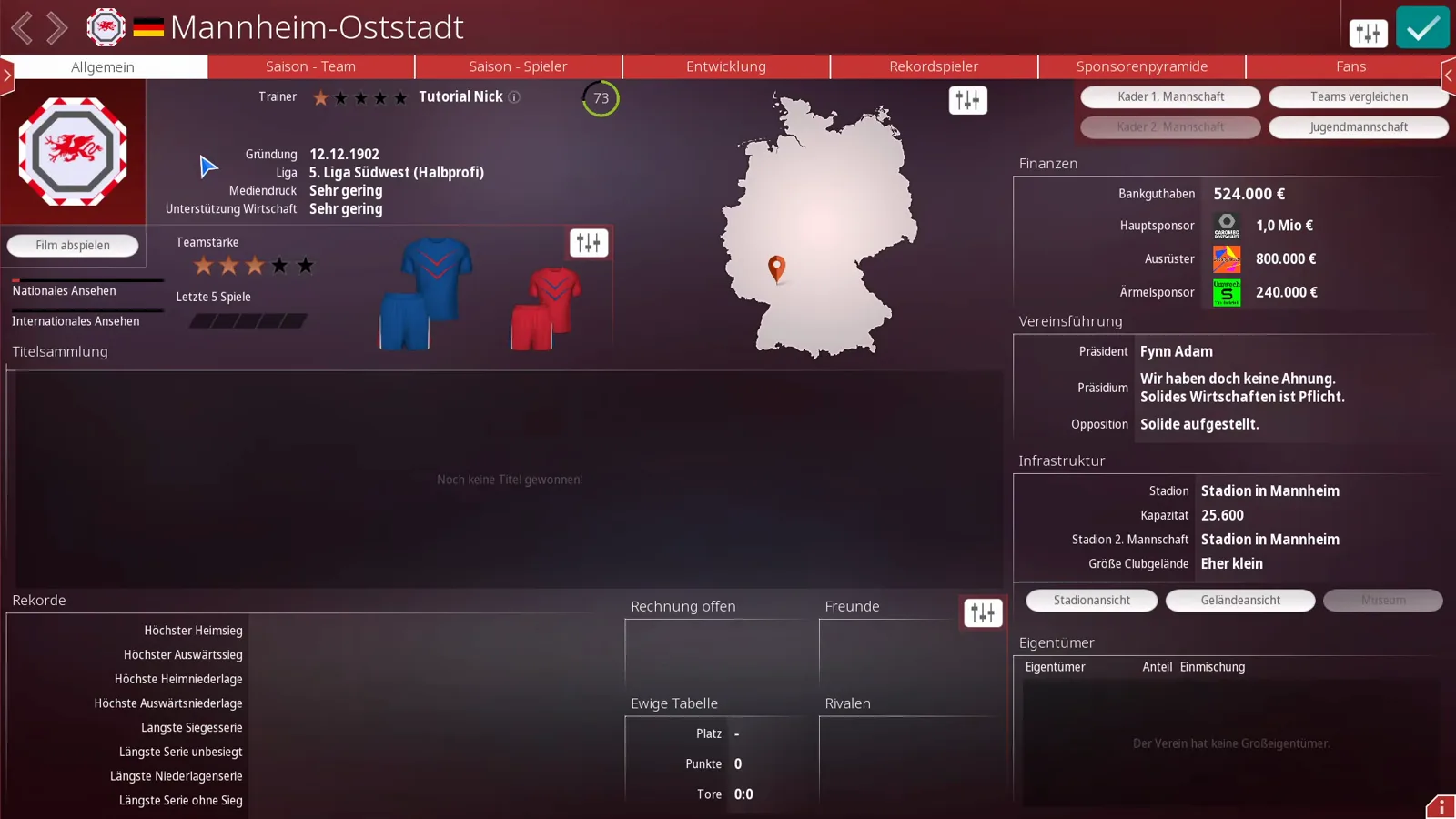
This is where expectations need calibrating. The two shipped databases are the “official databases with generic data” the manual itself names: club names are invented (city-based, believable, but fictional — the tutorial save’s club is called Mannheim-Oststadt), crests are generic, and Steam’s feature list openly counts “over 12,000 generic AI-generated player portraits”. The predecessor’s club museum joke in the tutorial — title cabinets sitting empty — underlines how little real-world history the generic data carries.
Two official statements qualify the picture, and both are worth knowing. First, the main menu has a Lizenzen (Licences) entry, which the manual describes as the place “where the game’s licensed content is listed” — that screen is the authoritative answer to what your edition has licensed. Second, the manual’s database chapter states that besides the generic databases, “for WAF there are also official databases featuring licensed leagues”, alongside fan-made databases and editor creations. What that means for a specific league, in a specific edition, is exactly what the in-game Licences screen lists — the manual publishes no league-by-league list.
In practice, the community fills the gap: the real name database patch adds authentic club names, badges and rosters, and since late September a Workshop-based “Real Names Database” delivers real club names without manual file copying. If you are evaluating the game purely on licences, that page is the one to read.
What the league screen tells you about each league
Every competition in the game world has a profile you can open, and the tutorial spends most of its runtime inside the profile of the 5. Liga Südwest — the fifth-tier southwest league his semi-professional club plays in. What a league screen carries:
- Match scheduling — when matchdays kick off. His explanation for why fifth-division games sit on weekday evenings: the players have day jobs. The setting is part of the league data, not a global slider.
- Promotion and relegation rules — his league shows two direct promotion spots and a relegation/playoff configuration, readable at a glance from the league’s mode line.
- Technology — no video evidence and no goal-line technology at this level; both switch on in the national cup from the round of sixteen upwards. The league profile tells you which standard your competition plays at.
- Training scope — the screen labels the league amateur or professional, which feeds the training presets. His club is semi-professional in an amateur league — club status and league status are two different values.
- The clubs — every club in the league with its national and international recognition rating. In his save a Frankfurt-based club carries 14 national and 1 international recognition points, while he quotes Bayern München at 20 national and 17 international. Those numbers are the invisible hand on the transfer market: an England-based striker simply refuses a call from a fifth-division club, while the same player listens when a top-reputation club calls.
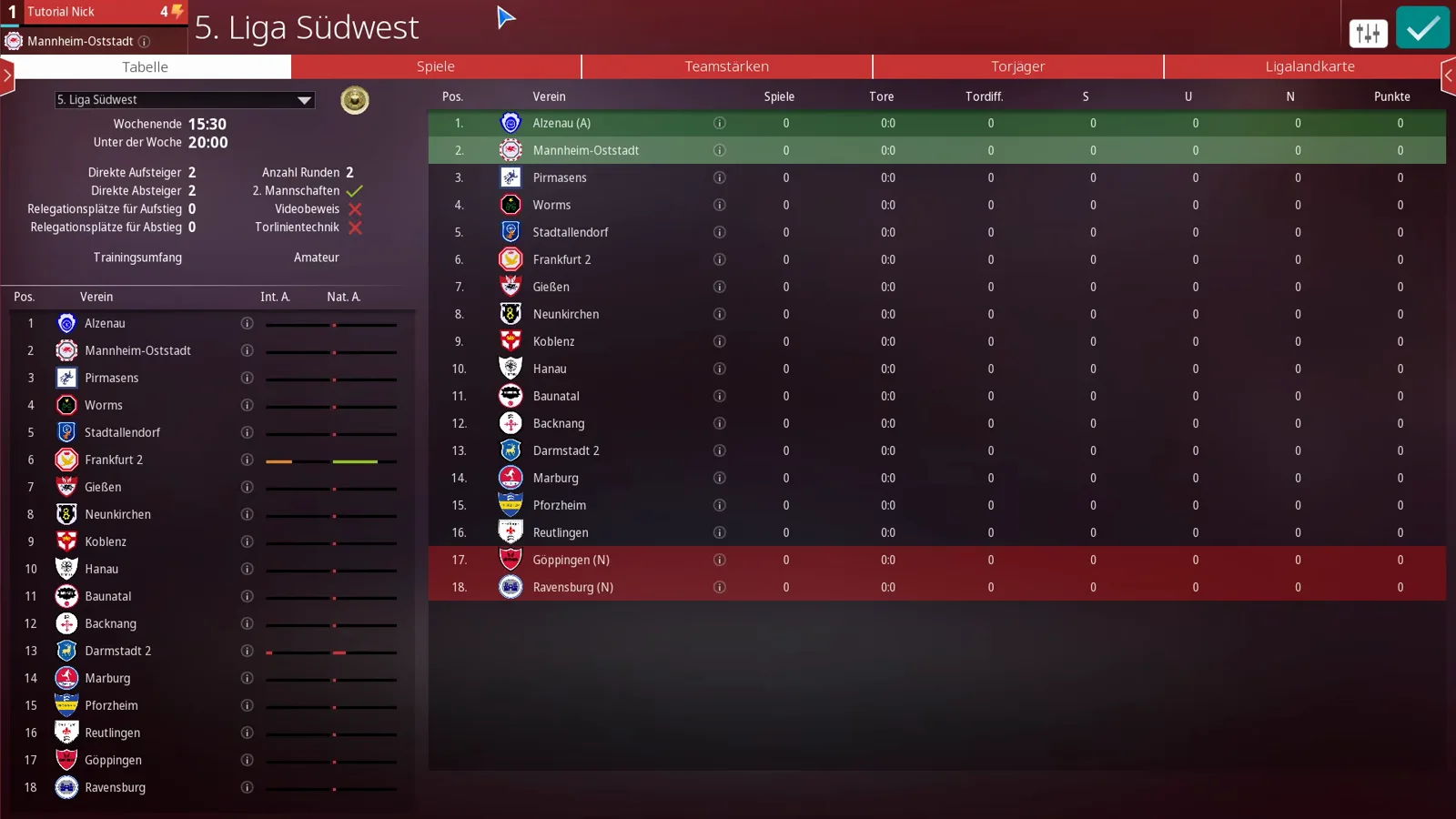
The league table itself follows the German rhythm: 18 clubs mean 34 matchdays (each team plays everyone home and away), the top rows glow green for promotion, the bottom red for relegation. A league map plots every club’s location, and travel is simulated: his league’s longest journey is 207 kilometres, the average 106 — and his experience-based rule of thumb is roughly one percent of team strength lost per hour of travel, which is why geographically cursed clubs underperform. What those green rows turn into over the final matchdays — the run-in, the xG readings after must-win games, the direct duels at the top — is the promotion race guide’s territory.
The pyramid as a whole keeps the German status model: divisions one to three professional, the fourth semi-professional, the fifth amateur — and that status flows into budgets, player expectations and training, as the career mode and game modes guide shows from the other side of the screen.
Cups underneath the leagues: regional cups and the national cup
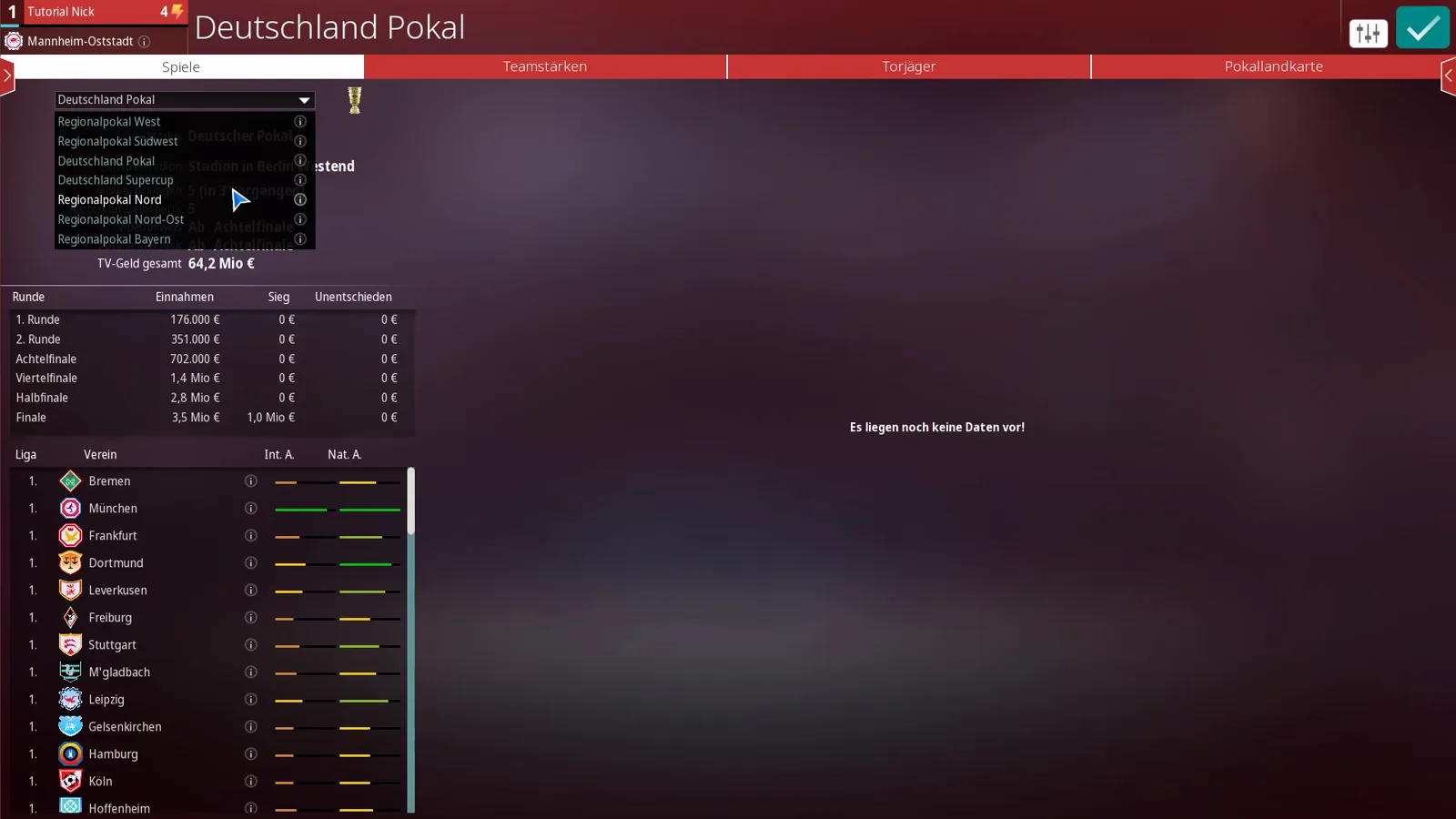
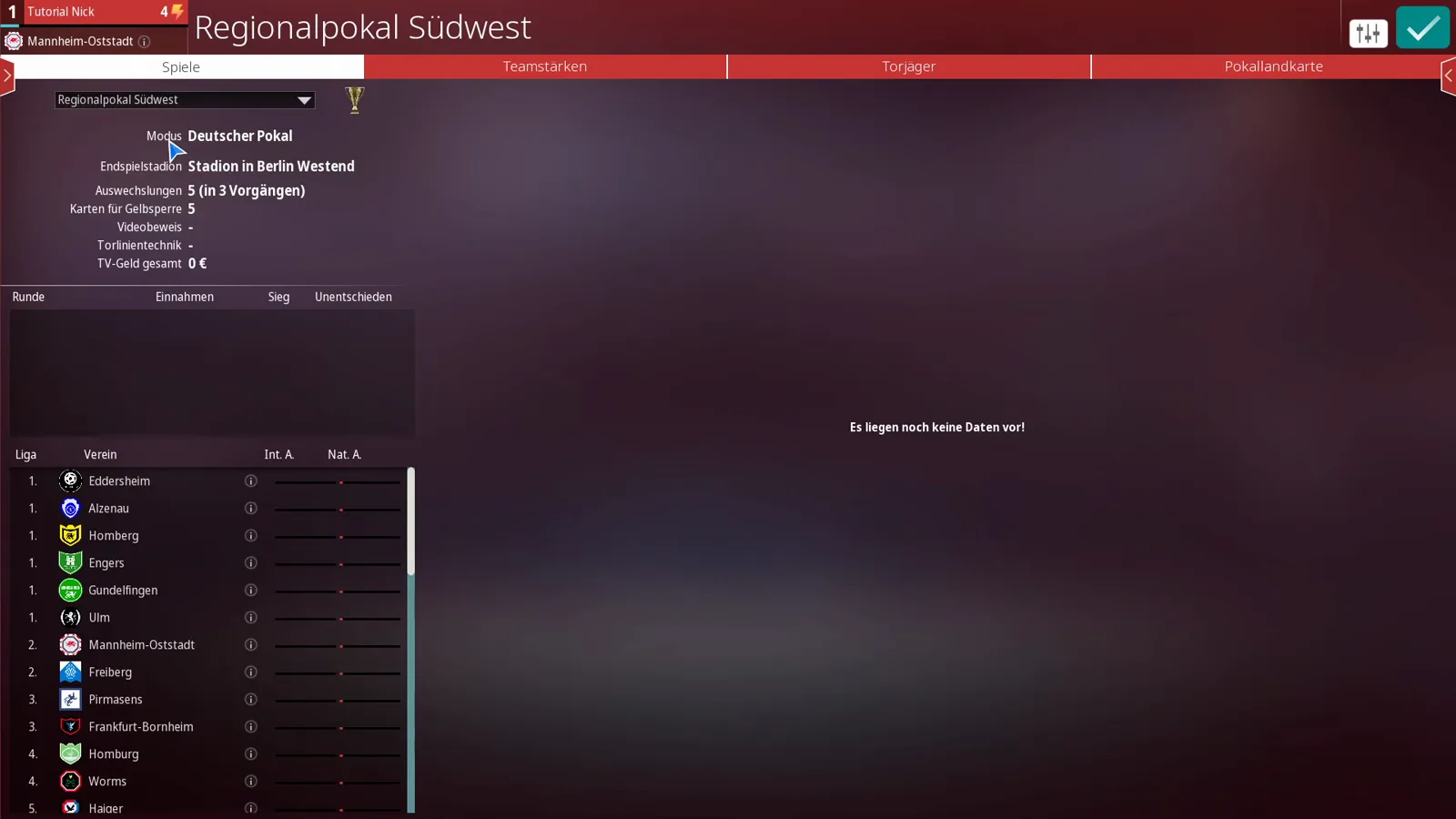
Open the cup dropdown in his save and the German cup system appears as a stack: several Regionalpokale — the list names cups for West, Südwest, Nord, Nord-Ost and Bayern — plus a Supercup below the Deutschland Pokal. The money gap between the levels is the lesson of the episode: the regional cup lists 0 € total TV money, while the national cup shows 64.2 million euros — paid out per round from 176,000 € in round one through 702,000 € in the last sixteen to 3.5 million € for reaching the final, plus a 1.0 million € winner’s bonus. Cup runs are also where the smallest clubs meet the giants: the national cup’s participant list reaches down to amateurs from the deepest tiers of the game world.
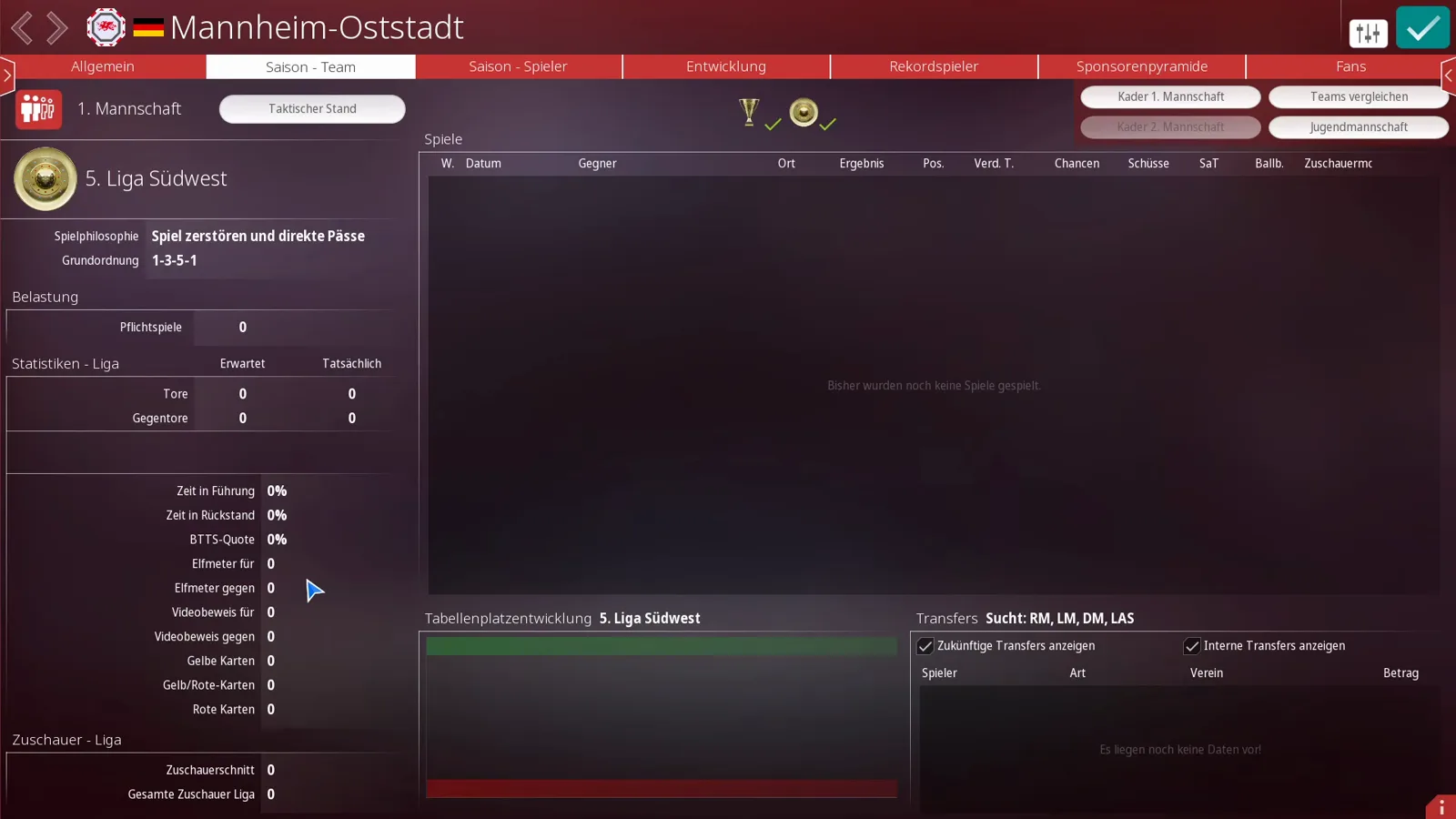
Where do these regional cups come from? The manual is explicit: they are an editor feature new in this edition — “up to 32 cups (one national cup plus 31 cups below that)” per country, chained so a district cup win qualifies you for the regional cup and a regional cup win for the national cup, with freely configurable catchments (a cup only for clubs of one regional league and below, or one combining two regional leagues). Whether your chosen dataset ships a regional pyramid or you build one is therefore a database question; our regional cups guide walks the whole ladder and what the official sources do and do not document.
International competitions and where they live
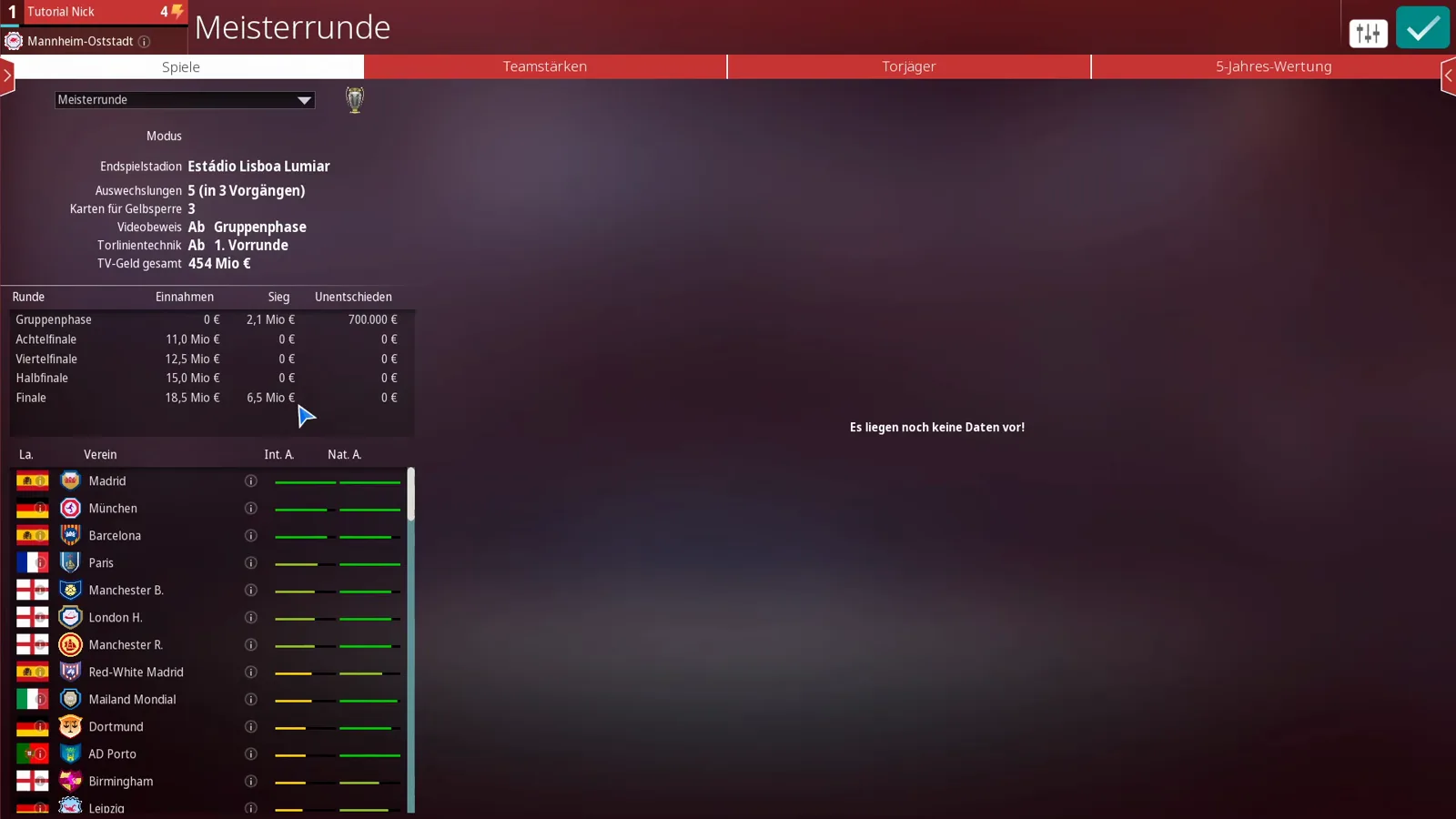
The continental championship — the tutorial calls it up from his first division’s entry list — is the other half of the league picture. It runs as a group phase plus knockout rounds, distributes 454 million euros of TV money, and its participant table reads like a reputation leaderboard: Madrid at 2020 points, München at 1720, Barcelona just behind. The club you meet there is decided by league finishing position, and how many clubs a country may send is tied to a rolling multi-season ranking — climb it as a nation, as the author puts it, and eventually you overtake the established leagues.
Crucially, all of this is world-database territory. The tutorial’s own test in episode #003 showed the Standard database has no international competitions at all — the qualification places simply do not exist there. Steam’s feature list confirms the scope: additional international club competitions are “now available in the world database for all continents except Antarctica”, two per continent. If continental football is why you start a save, the database choice has already been made for you.
Building your own leagues: editor and user databases
The last piece is that the league list is not a wall, it is a workbench. The external editor builds complete league systems — promotion and relegation rules, playoffs, national and local cups across multiple tiers, even separate U21/U23 leagues like England’s — and Steam’s description adds everything from stadiums to derbies and fan chants around them. The manual’s editor chapter warns that league systems should be modified in the editor, never directly in the database files, or seasons end early and promotion ladders break.
Your creations save as user databases, and this edition made them first-class: the career-start screen now offers a selection list of several user databases, each able to carry its own 80×80 logo, next to the fan-made databases floating around the community. The full tooling is documented in our editor guide, and if you would rather found a club inside your own creation than rework a league, the club creation guide is the natural next stop.

WE ARE FOOTBALL 2027 Tutorial #035: Ligen — NickFrei zockt
Related Guides
guides
WE ARE FOOTBALL 2027 Team Strength Comparison: Stars, Gauges, Scouting Lists
How to read team strength in WE ARE FOOTBALL 2027: Kader stars, the profile gauge, the pre-match Mannschaftsteile bars and the scouting list for the next fixture.
guides
WE ARE FOOTBALL 2027 Season Planning Guide: Budget Split, Kits and Squad Numbers
The Saisonplanung stretch in WE ARE FOOTBALL 2027 screen by screen: promotion payout, league target, budget split, new kits, club rules and squad numbers.
guides
WE ARE FOOTBALL 2027 Relegation Battle Guide: Escaping the Red Rows
A relegation battle in WE ARE FOOTBALL 2027 screen by screen: the red Verbandsliga table rows, a 0:1 away steal, a 1:4 home defeat and the January deals in between.
Was this helpful?
Thanks for the feedback!