WE ARE FOOTBALL 2027 Player Profile Guide: Stats, Integration, xG
Reading the player screens in WE ARE FOOTBALL 2027: playing-time expectations, the Persönliches card, scouting knowledge, the season log and expected goals.
Frequently Asked Questions
What does the 67 percent playing-time line mean in WE ARE FOOTBALL 2027?
What does Freizeitsportler mean on a WE ARE FOOTBALL 2027 player card?
How does player integration work in WE ARE FOOTBALL 2027?
What are expected goals in WE ARE FOOTBALL 2027?
Can you see other clubs' player data in WE ARE FOOTBALL 2027?
What does the Spielerbeurteilung bar do in WE ARE FOOTBALL 2027?
Half of good squad management is simply reading the player screens correctly — and WE ARE FOOTBALL 2027 hides more in them than most managers notice. This page follows the tutorial through the playing-time table, the Persönliches card, the season log with its expected-goals panel, the career tab and the public view of rival players. Where the game’s own manual contradicts the screen, we say so. For what happens to these numbers over a career, the player development guide covers the re-rating machinery.
What do the playing-time screens actually mean?
The Spielzeit tab lists the squad twice. The left block carries each player’s Erwartung — his own demand, in percent of available minutes: backup keeper Orsat Kralj expects 5 percent, squad rotations sit between 35 and 65, and the best attackers demand up to 90. The parallel column anchors everyone at the 67 percent starter benchmark, and the author is emphatic about the distinction: Erwartung is what the player wants, nothing more — it has no contractual weight. The promise that carries weight is Stammspieler status, and the screen’s arithmetic explains why the threshold is 67: a starter who plays every match and is substituted around the hour mark still accumulates exactly that share of minutes.
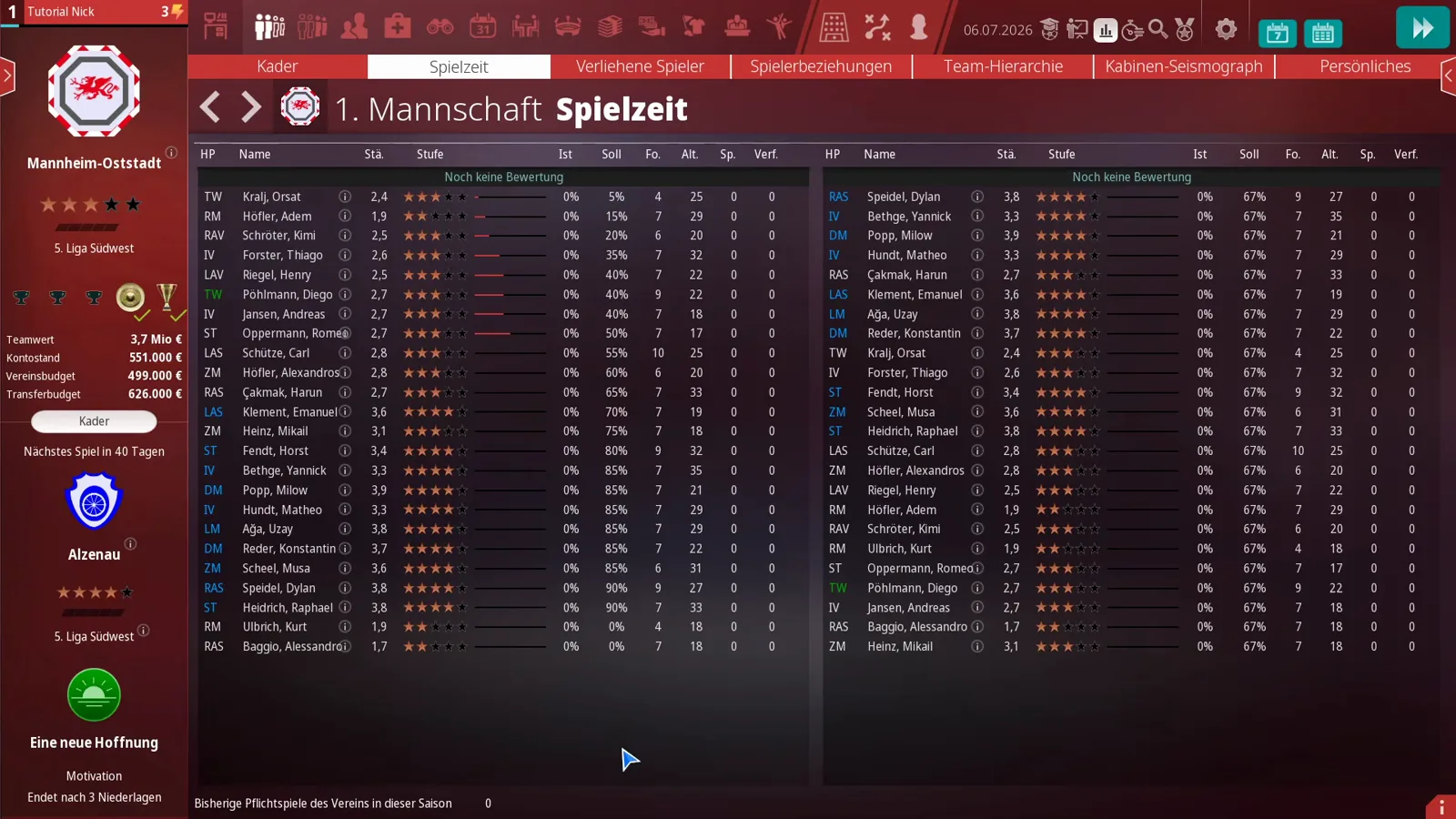
The author’s confession makes the section: he had the two columns mixed up in an earlier video, only understood the screen the night before recording, and reads out another guide’s wrong definition with a laugh. Trust the screen — Erwartung is the player’s wish, 67 percent is the starter line.
What does a player card tell you at a glance?
Open any player and the Persönliches tab answers a dozen questions at once. Kralj, the tutorial save’s second keeper: a 2.4 strength ring, three-and-a-half Stufe stars, condition at 63 and freshness at 97, shirt 25, form 4 of 10, born 24 April 2001, 1.88 m tall. The Stufe-1 Teamspieler hexagon unpacks six personality values — openness 4/4 down to negotiating skill 0/4 — and the status panel adds training impression (“hat nicht trainiert”), morale, injury vulnerability (normal) and the note that he is no international.
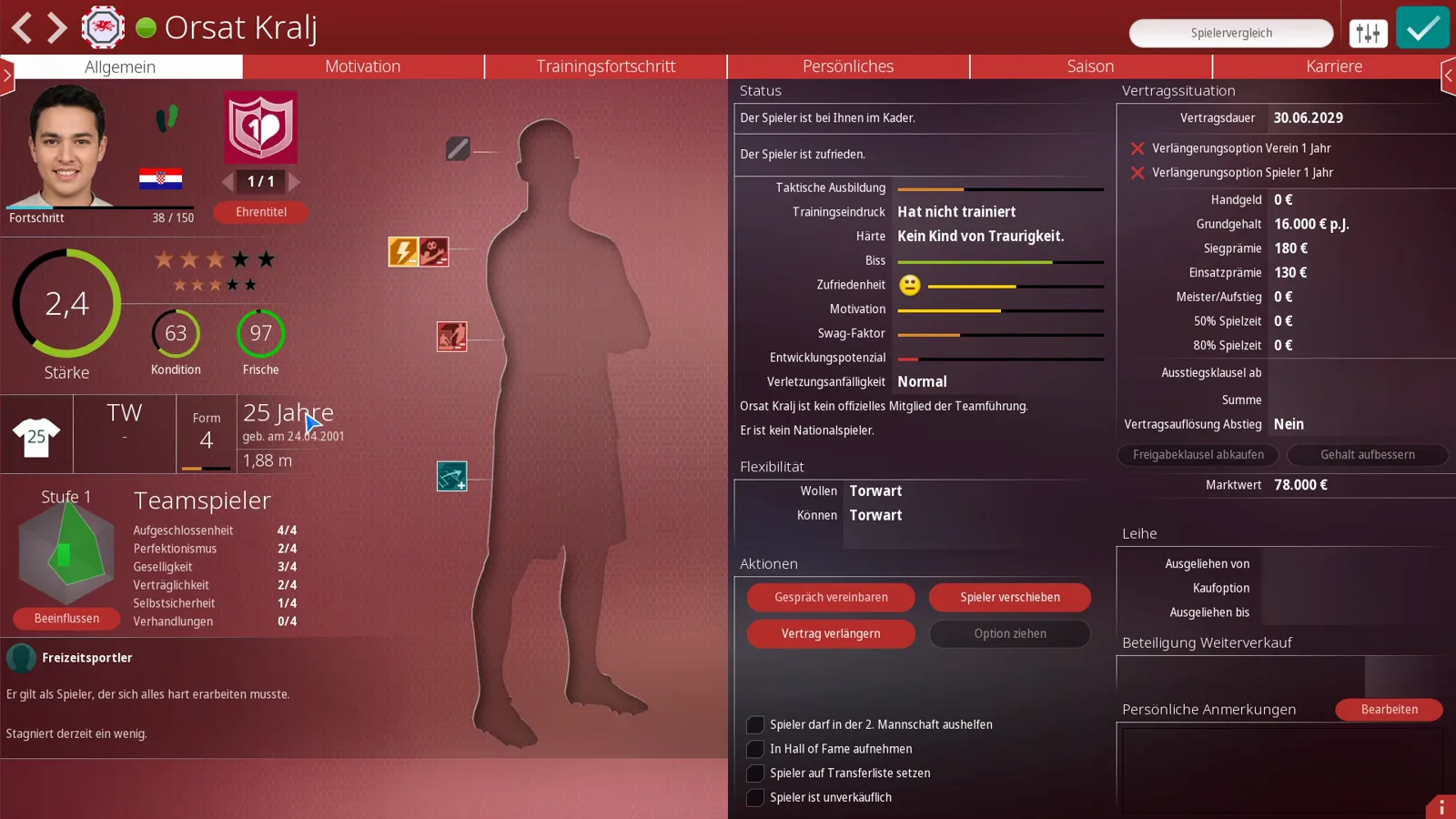
The classification line is the honest one: Kralj is a Freizeitsportler — “a player who has to work hard for everything” — currently stagnating a little, the card says. His contract panel completes the picture: 30 June 2029, 16,000 € a year, a 180 € win bonus, a 130 € appearance bonus, no release clause, market value 78,000 €. Action buttons (arrange a talk, move the player, extend) and the checkboxes for second-team help, Hall of Fame, transfer list and “untransferable” sit right below.
How do you learn a player’s character?
The tab’s right side is the intelligence file, and the video’s example is fresh: the columns are still empty because the manager barely knows his own signing. Vergehen (offences) shows a clean record so far. Hobbys stay hidden — “you first have to get to know this player better”. The Eigene Beobachtungen panel states the rule verbatim: your manager skill Spielerbeurteilung decides how fast you see through a player, and at full knowledge the hidden traits — anxieties, authority problems, weaknesses — appear where the save currently reads “keine Besonderheiten”.
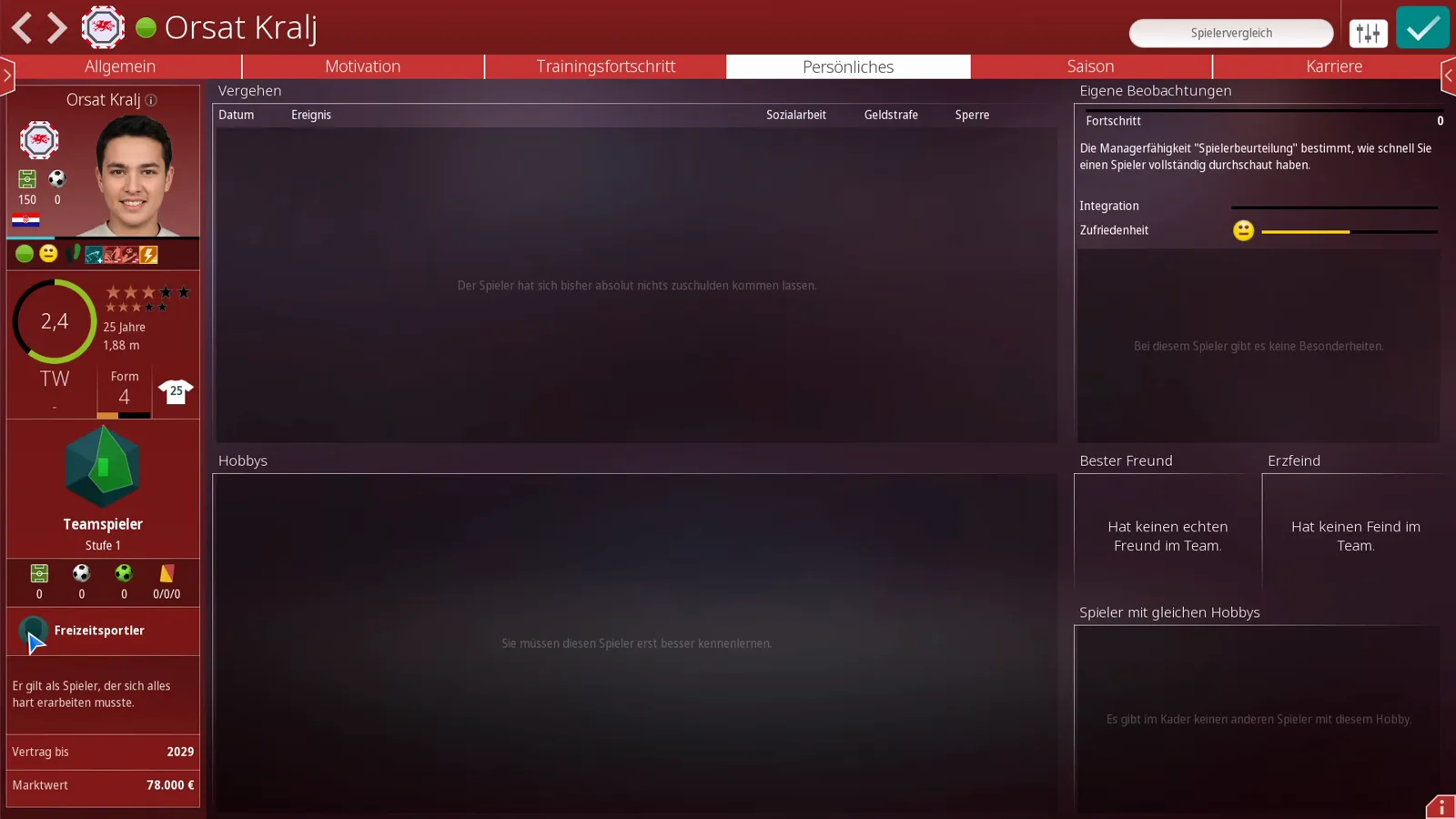
Two more bars sit in the same panel and matter for every new signing: Integration and Zufriedenheit. Integration can take up to two years and suppresses performance until filled — an integration manager and a player who embraces the language shorten it dramatically. And the friend-and-feud boxes below (best friend, arch-enemy, players with the same hobby) drive the private-life sim: bandmates become best friends or bitter rivals, and selling one angers the other. None of it touches football directly — the author’s point is that this game models the person, not just the athlete.
What does the season screen reveal?
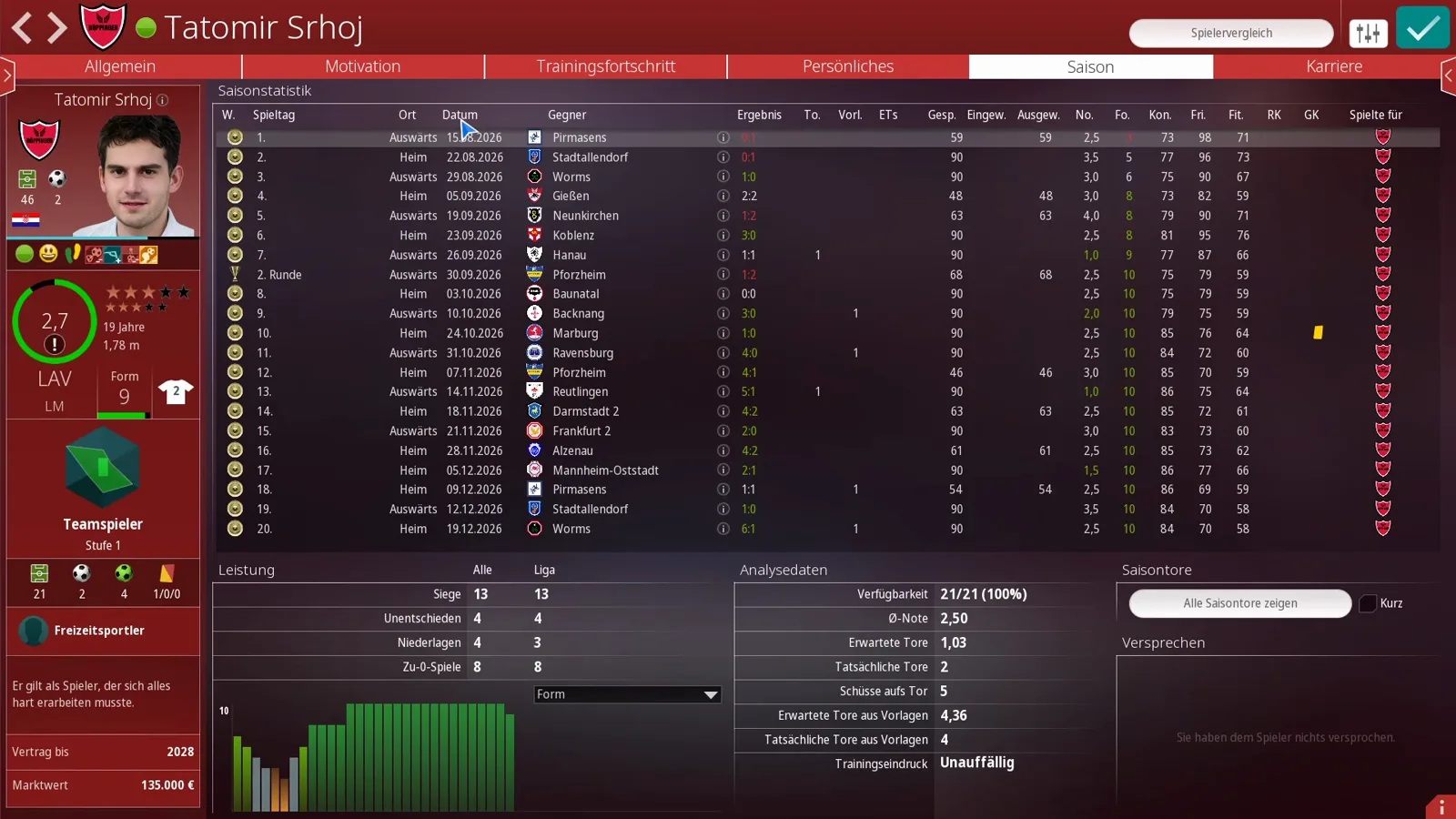
Switch to a save with matches played and the Saison tab turns into a full dossier. The video’s example, 19-year-old left winger Tatomir Srhoj, shows twenty matchday rows — league plus a second-round cup tie at Pforzheim — each with opponent, result, minutes, substitution marks, form, condition, freshness, fitness and cards. The Leistung block sums it up: 13 wins, 4 draws, 4 defeats (8 of them clean sheets) across all competitions.
How do expected goals change how you judge a striker?
The Analysedaten panel under the log is the screen the author calls ultra-important. Srhoj’s line: availability 21 of 21 matches (100 percent), average rating 2.50, and the pair that changes transfer thinking — 1.03 expected goals against 2 actual goals, plus 4.36 expected from assists against 4 converted. Two goals from one expected is an overperformer; a striker stuck at 20 expected against 3 scored is, in the author’s words, underperforming without end and has to be fixed or moved on. The training-impression line rounds the picture off as unauffällig — unremarkable — and the button above opens every goal he scored as a replay.
What does the career tab show?
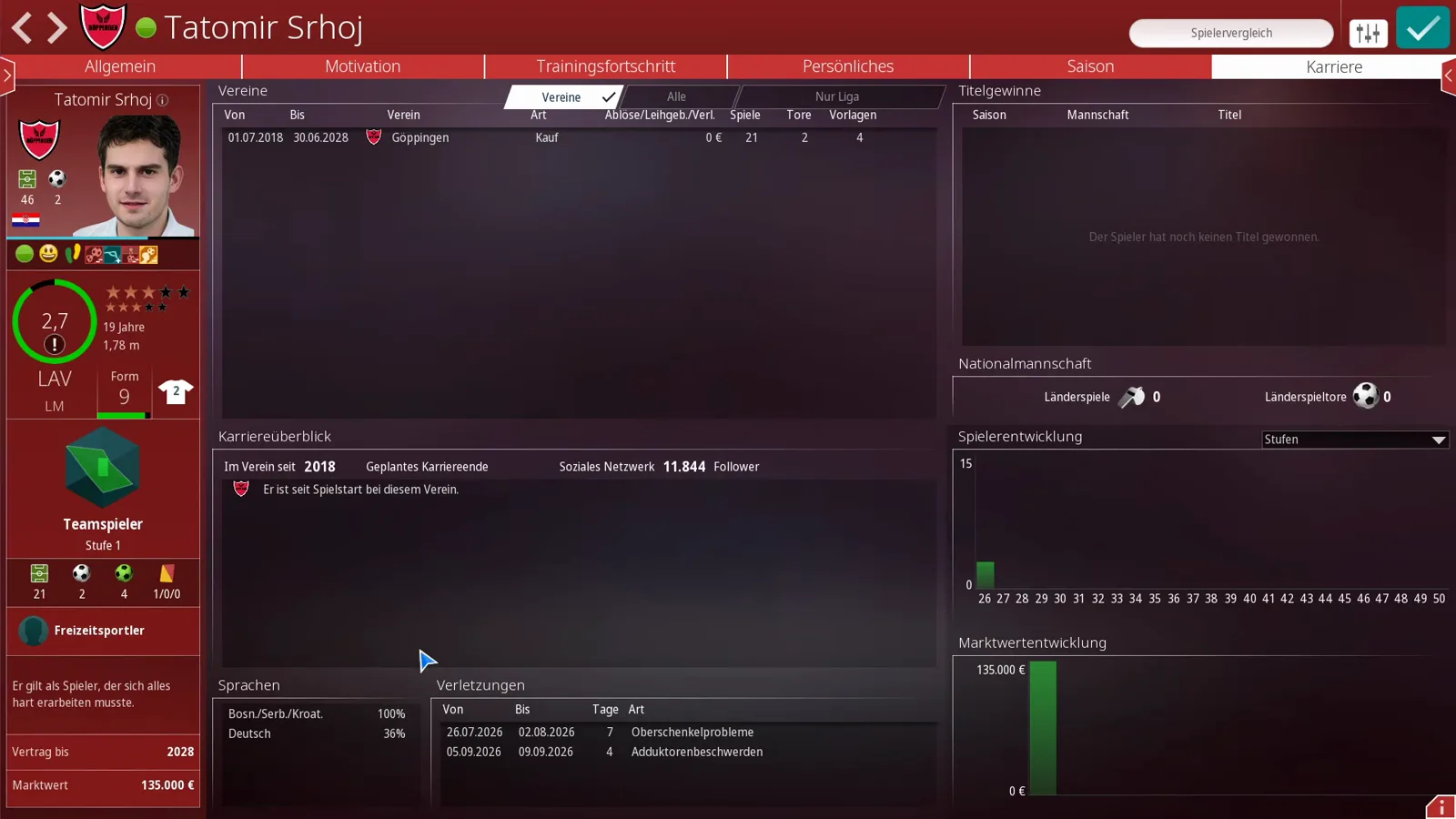
The Karriere tab is the long view. Srhoj’s club history is a single row — Göppingen, purchased, contract 1 July 2018 to 30 June 2028, 21 games, 2 goals, 4 assists — flanked by an empty title cabinet, zero caps, and the Karriereüberblick: at the club since 2018, 11,844 social-media followers. The Sprachen panel is where integration becomes concrete: Bosnian/Serbian/Croatian at 100 percent, German at 36 percent — the language bar ticking up as the weeks pass. The injury log lists two absences (seven days with thigh problems, four with adductor trouble), and the development and market-value charts close the tab.
How does the competition filter work?
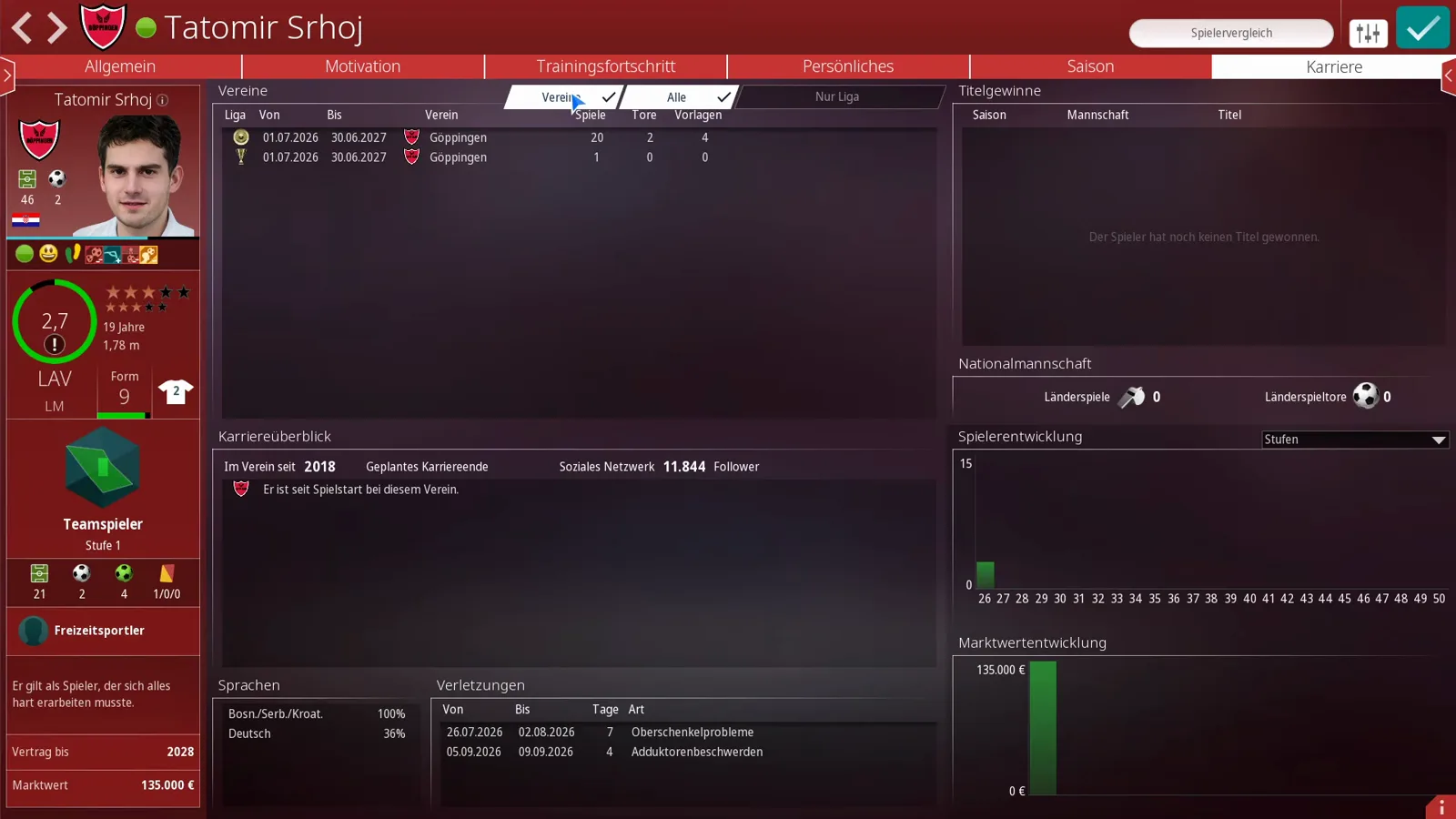
New in 2027 and easy to miss: above the club-history table sit the toggles Vereine / Alle / Nur Liga. Leave them alone and the table shows one aggregated row per club; switch to the competition view and Srhoj’s season splits into a league row (20 games, 2 goals, 4 assists) and a cup row (1 game) — the exact split the video demonstrates while admitting the filter is new and he had to find it himself.
Can you read data on players you don’t own?
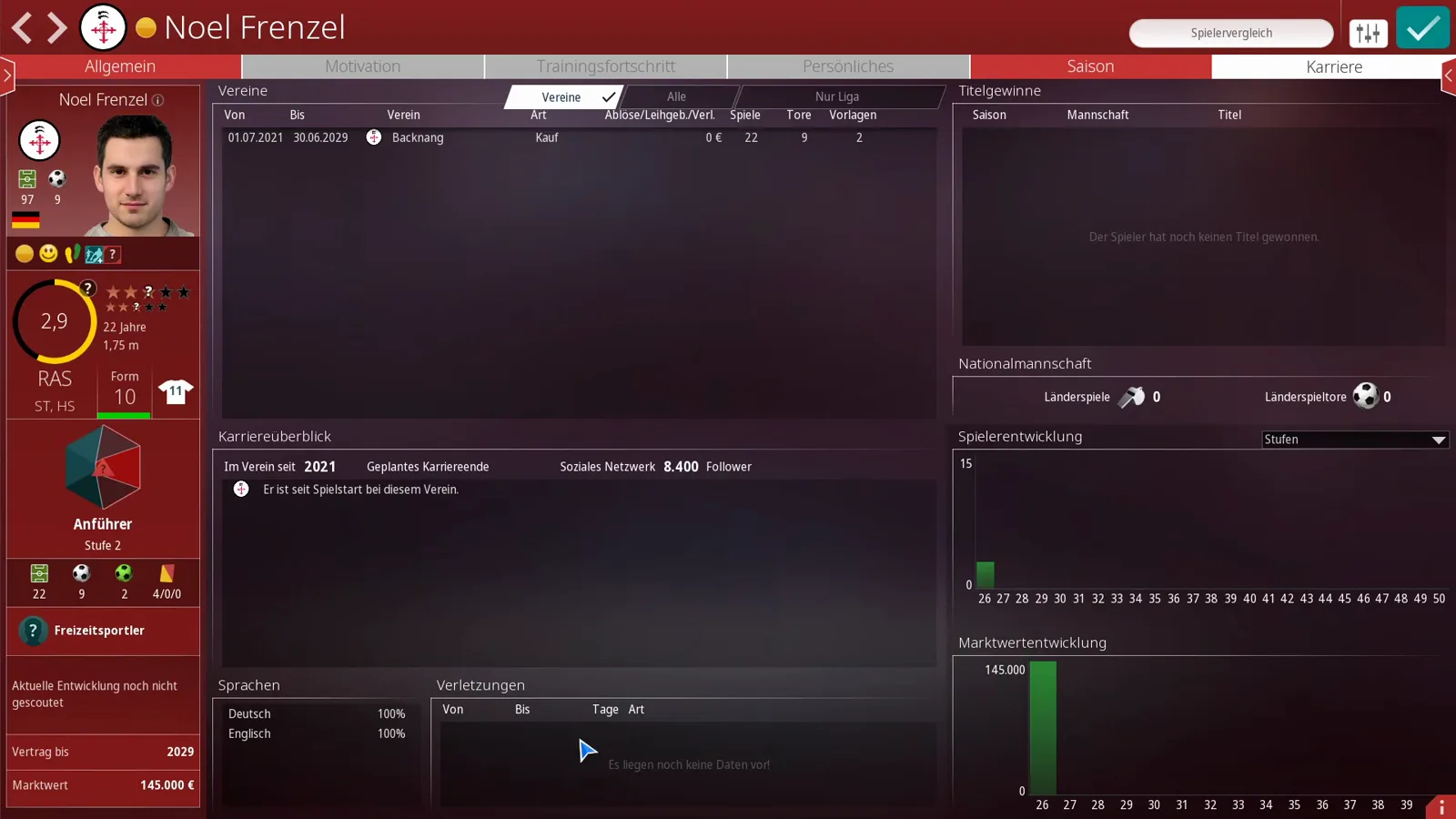
Yes — and this is where the screens become a scouting tool. Opening Noel Frenzel, a 22-year-old winger from Backnang, shows everything public: contract 2021 to 2029, 22 games, 9 goals, 2 assists, 8,400 followers, market value 145,000 €, languages at 100 percent. What stays locked is everything private — the motivation and personality tabs are greyed out with the note that no data exists yet. That is the boundary between what any manager can see and what your scouts have to earn; the scouting network guide covers how they earn it.
What does a finished superstar look like?
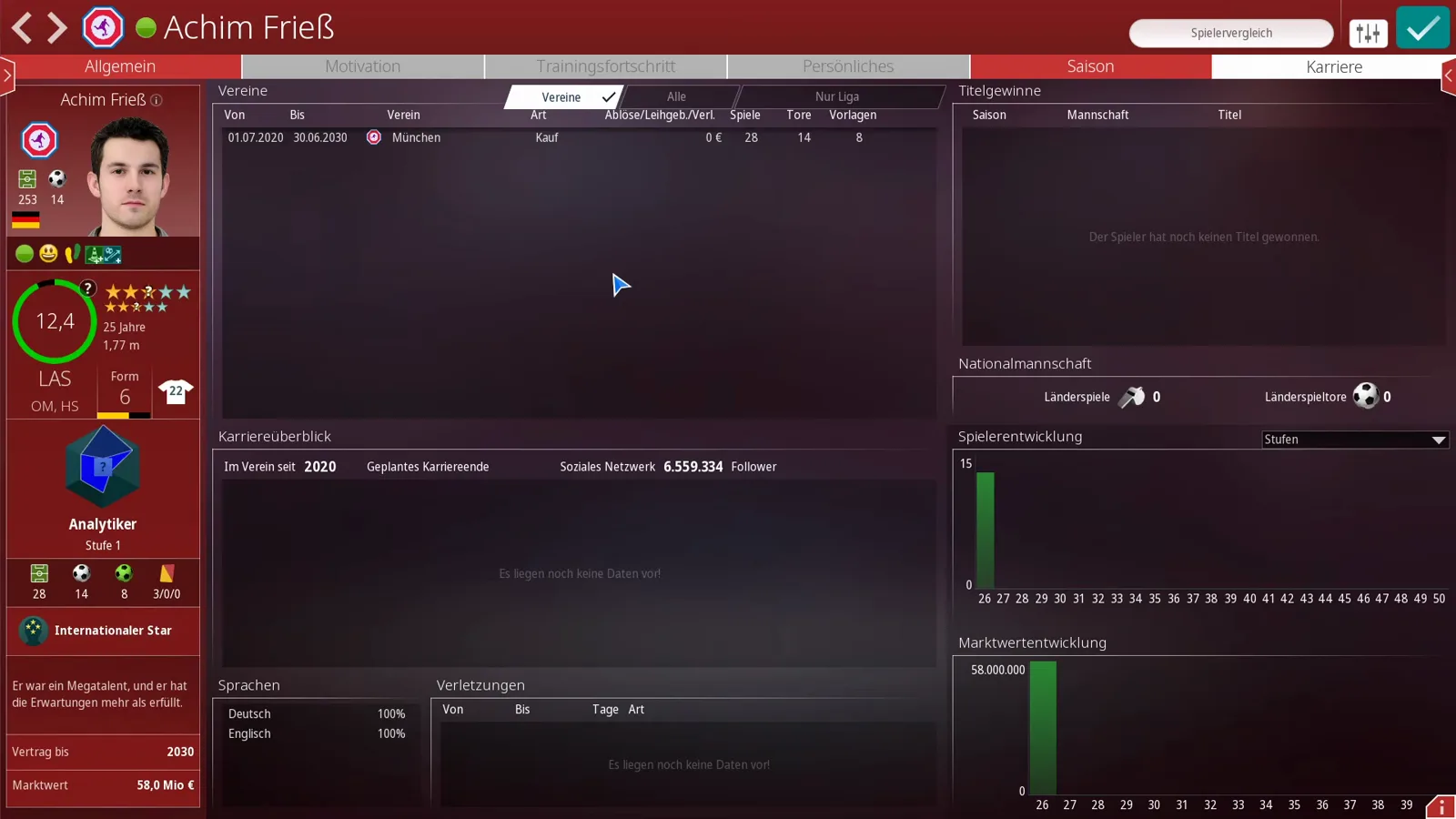
The video closes the loop with Achim Friß, 25, of München: a 12.4 strength ring, Analytiker type, and the résumé line every save is chasing — “Er war ein Megatalent, und er hat die Erwartungen mehr als erfüllt” (he was a mega talent and has more than met expectations). Twenty-eight games, 14 goals, 8 assists this season, 6.56 million followers, a market value of 58 million euros and a development chart still climbing. That is what the kids in your youth scouting pipeline are competing to become — and why the difference between a 2.4 Freizeitsportler and a 12.4 international star is the whole game played out in numbers.
If the growth side of these numbers — re-ratings, Stufe promotions, manager points — is what you came for, the player development guide continues exactly where this page stops.
Related Guides
guides
WE ARE FOOTBALL 2027 Team Strength Comparison: Stars, Gauges, Scouting Lists
How to read team strength in WE ARE FOOTBALL 2027: Kader stars, the profile gauge, the pre-match Mannschaftsteile bars and the scouting list for the next fixture.
guides
WE ARE FOOTBALL 2027 Season Planning Guide: Budget Split, Kits and Squad Numbers
The Saisonplanung stretch in WE ARE FOOTBALL 2027 screen by screen: promotion payout, league target, budget split, new kits, club rules and squad numbers.
guides
WE ARE FOOTBALL 2027 Relegation Battle Guide: Escaping the Red Rows
A relegation battle in WE ARE FOOTBALL 2027 screen by screen: the red Verbandsliga table rows, a 0:1 away steal, a 1:4 home defeat and the January deals in between.
Was this helpful?
Thanks for the feedback!