WE ARE FOOTBALL 2027 Player Development Guide: Re-Ratings & Growth
How players improve in WE ARE FOOTBALL 2027: decimal ratings, Spielerneubewertung re-ratings, Stufe promotions with manager points and post-match progress.
Frequently Asked Questions
How do player ratings increase in WE ARE FOOTBALL 2027?
What does a Stufe promotion actually give?
What triggers a Spielerneubewertung in WE ARE FOOTBALL 2027?
How do you retrain a player for a new position?
What are Managerpunkte for in WE ARE FOOTBALL 2027?
Do youth players get re-evaluated too?
Every save lives or dies by whether its players actually get better, and this page follows the one line of the game where that happens: rating growth. The walkthrough comes from a 59-minute career episode by Täglich Angespielt — 1. FC Düren, fifth division, right after Update 1 — whose centrepiece is a re-evaluation night that handed his 2.2-rated teenager a star promotion, exposed a new weakness in his striker, and quietly moved half the squad. Below we unpack the decimal rating, the Spielerneubewertung event, what a Stufe promotion pays, the post-match progress list, the weekly funding decision, position retraining and the youth ranks. Deliberately out of scope: the training week itself, which belongs to the training plan guide, and the wider question of what each player should become, which the player types and roles guide answers.
How do players improve in WE ARE FOOTBALL 2027?
Three channels move a player’s numbers, and the episode shows all of them in a single game week:
- Spielerneubewertung re-evaluations — periodic events where the game re-grades every player, promotes those who earned it to a higher Stufe, and can hand out new weaknesses.
- Post-match progress — after every game, the Teamfortschritt screen lists points each player added toward their next Stufe.
- Training and funding — individual training goals, pushed along by the weekly decision over which single player gets special support.

Spielerneubewertungen sorgen für tolle Überraschungen! — full career episode (German)
None of the three is a cheat code; they compound. The rest of this page takes them one at a time, in the order the video presents them.
How does the decimal strength rating work?
Every player card carries a Stärke value with one decimal place — the episode’s poster boy is Hans-Dieter von Blauberg, a 17-year-old defensive midfielder sitting at 2.2 with the Teamspieler type and the note “Er gilt als Talent” (he counts as a talent). Below the decimal sit the Stufe stars, one to five, and next to them the talent stars; the squad list shows all three columns at once, which is how you spot at a glance that goalkeeper Alessandro Odinius already stands at 4.9 while Blauberg’s 2.2 marks him as a project.
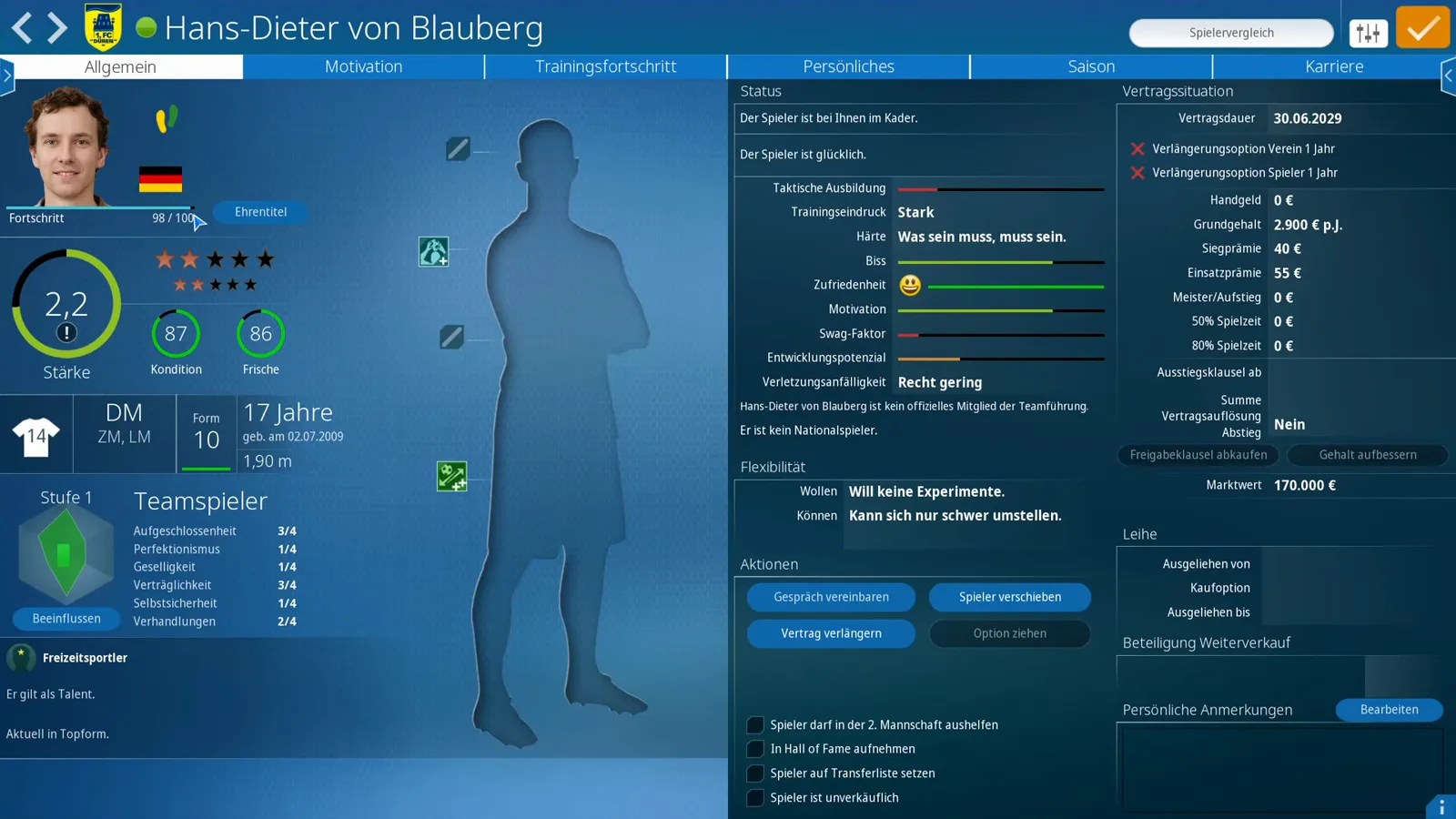
The author’s rule of thumb — his explanation, not an on-screen formula — is that a Stufe promotion is nominally worth +1.0 on the decimal scale: “an upgrade always brings +1.0, but it has to match the abilities”, so a promotion can land at only +0.9 or +0.8. Blauberg at 2.2 would therefore become a 3.2 at best, and more likely a 3.1. The same episode’s list also shows what the ceiling looks like: veterans in this fifth-division squad rate around 3.5–4.7, and the 29-year-old Burak Geißler sits at 2.9 with no talent marker — the difference between a prospect and a squad player, readable in one number.
What is the Spielerneubewertung?
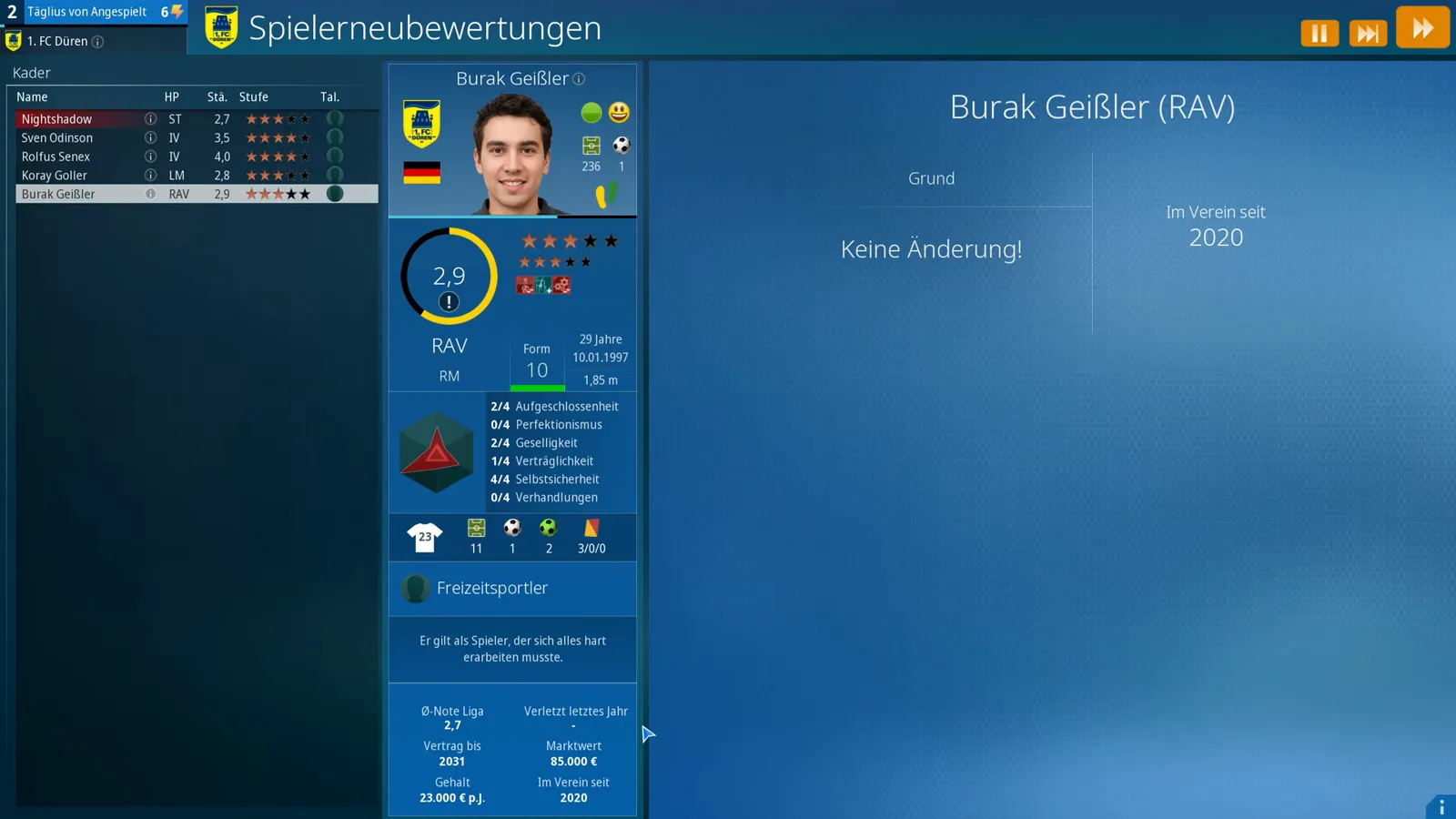
The Spielerneubewertungen screen is where the game re-grades the squad. It walks through the players one by one, and each gets a Grund — a reason. The mundane case is the one most players see: Keine Änderung!, no change, as with right-back Burak Geißler in the episode.
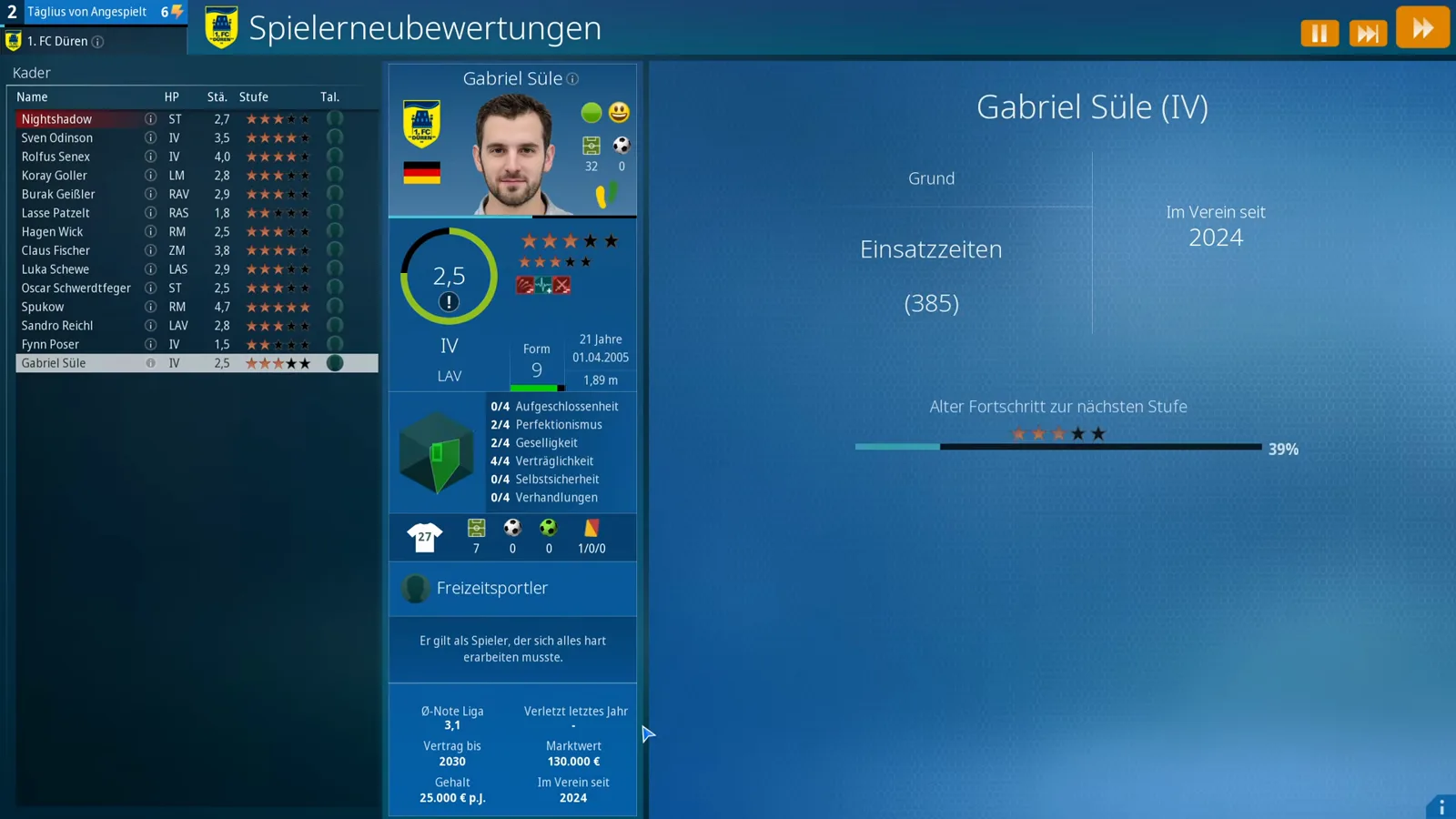
When something does move, the Grund names Einsatzzeiten — playing time — as the reason, with a minutes figure attached. Centre-back Gabriel Süle’s card shows Einsatzzeiten (385) and his progress bar toward the next Stufe, labelled Alter Fortschritt zur nächsten Stufe, at 39%.
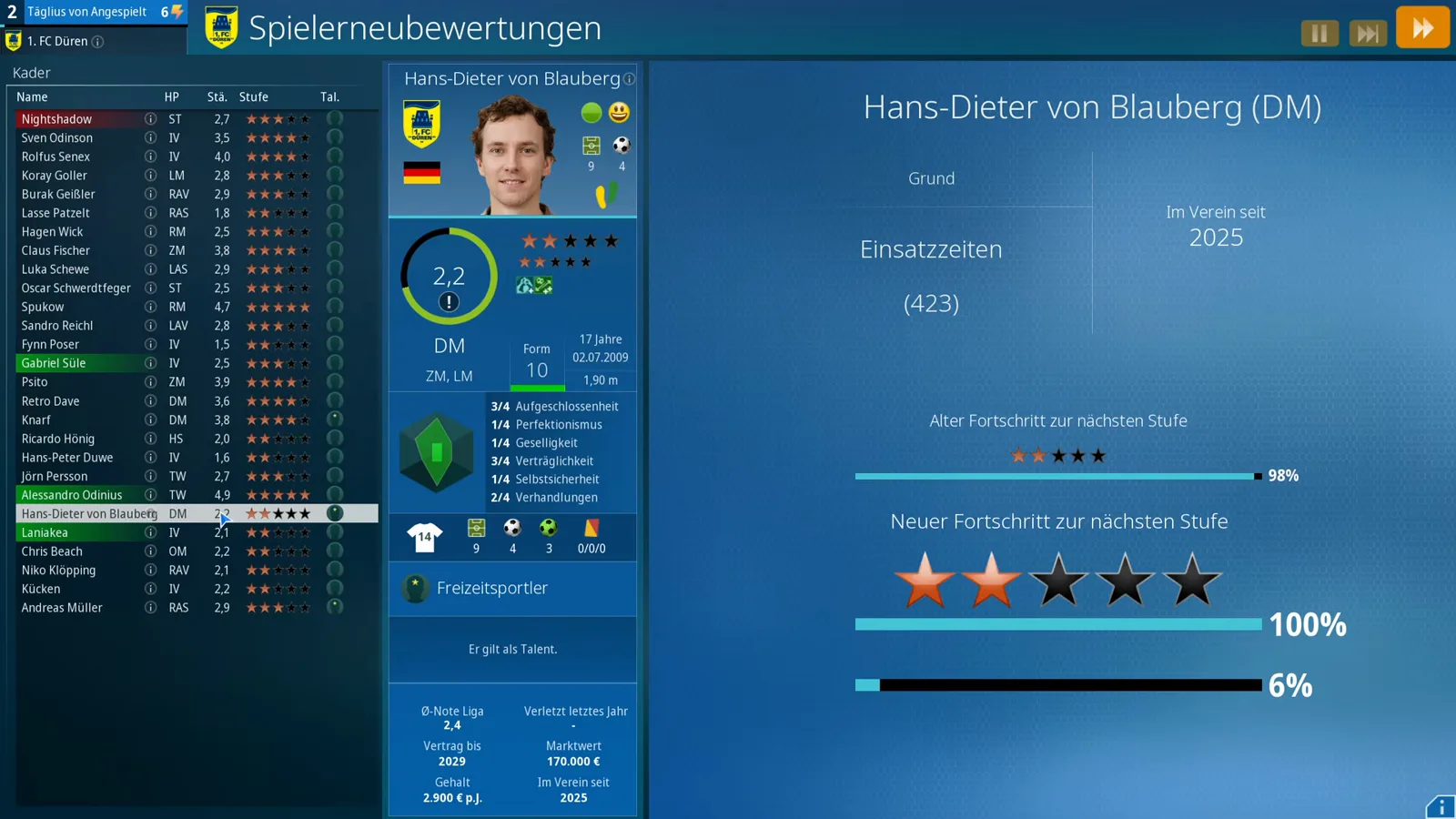
The dramatic case is Blauberg himself. His Grund reads Einsatzzeiten (423), his old progress toward the next Stufe stood at 98%, and the Neuer Fortschritt bar shows 100% — with a second bar already at 6% inside the new Stufe. Re-evaluations also cut the other way: the same night flagged a new weakness for the striker Nightshadow (flanks, which the author shrugs off as harmless for a centre forward — his verdict, not an on-screen rule). How often the re-evaluation wheel turns is not demonstrated in the video; treat the schedule as unknown rather than assuming a fixed interval.
What happens when a player climbs a Stufe?
The promotion itself arrives as a full-screen Stufenänderung popup. Blauberg’s shows the Alte Stufe at two stars, the Neue Stufe at three, and the line 3 Managerpunkte erhalten! — the club banks three manager points off the back of one player’s jump. His decimal Stärke landed at 3.1, exactly the “nominal +1.0, real +0.9” outcome the author had predicted before the event; with further talent and ability development, he notes, 3.2 or 3.3 could follow.
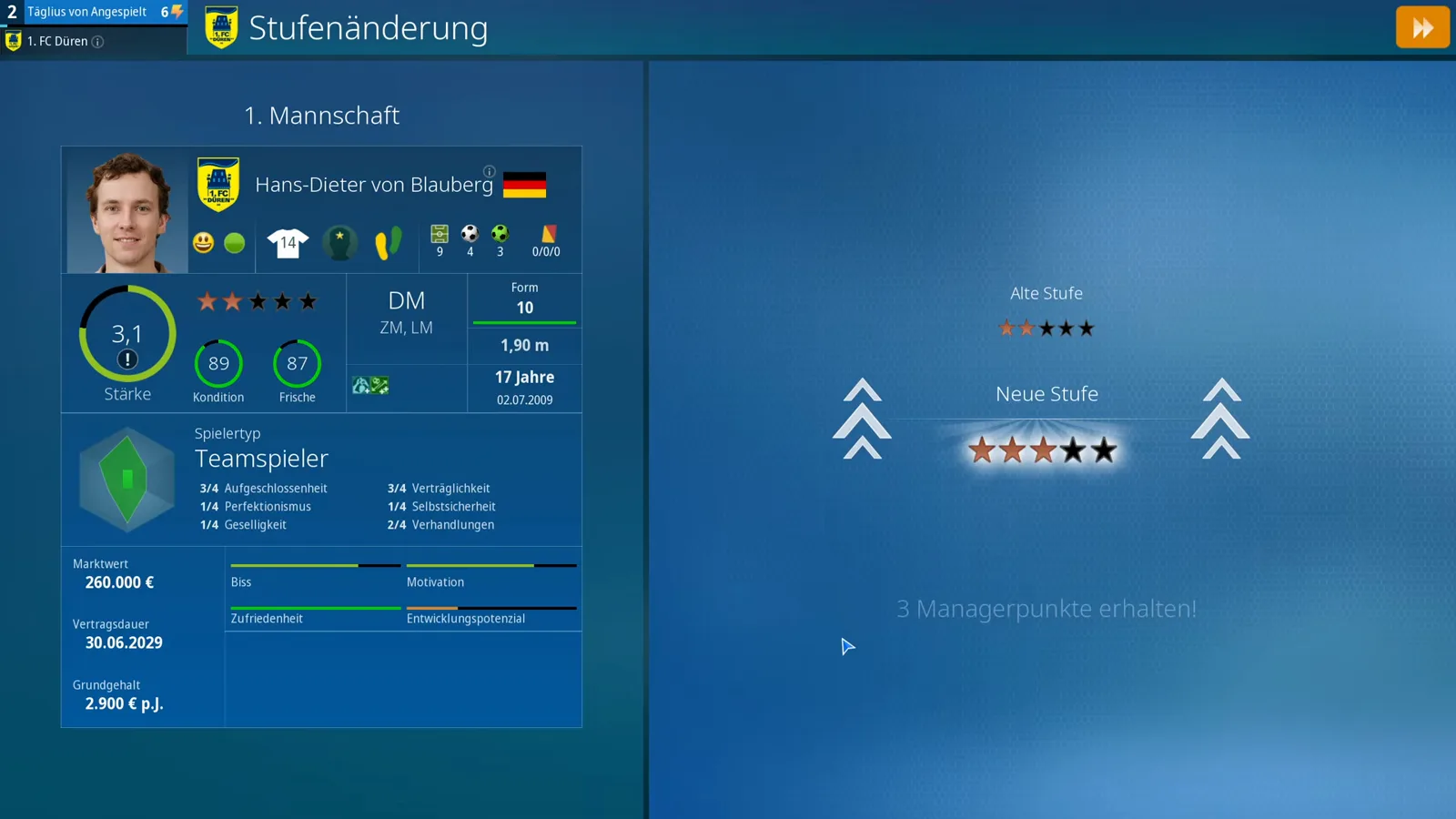
The manager points keep coming: later in the episode, at the winter break, the author receives five more. What they are spent on is never shown in this video, so we won’t guess — bank them and find out on your own save.
Do ratings move after every match?
Yes — smaller steps, but immediately visible. After the 1:0 win at Haltern am See, the Teamfortschritt screen lists the whole squad with a Fortschritt Stufe column of points gained toward the next Stufe: goalkeeper Alessandro Odinius +32, centre-back Laniakea +24, match-winner Hans-Dieter von Blauberg +8, with Gabriel Süle (+11) and Kücken (+8) also climbing.
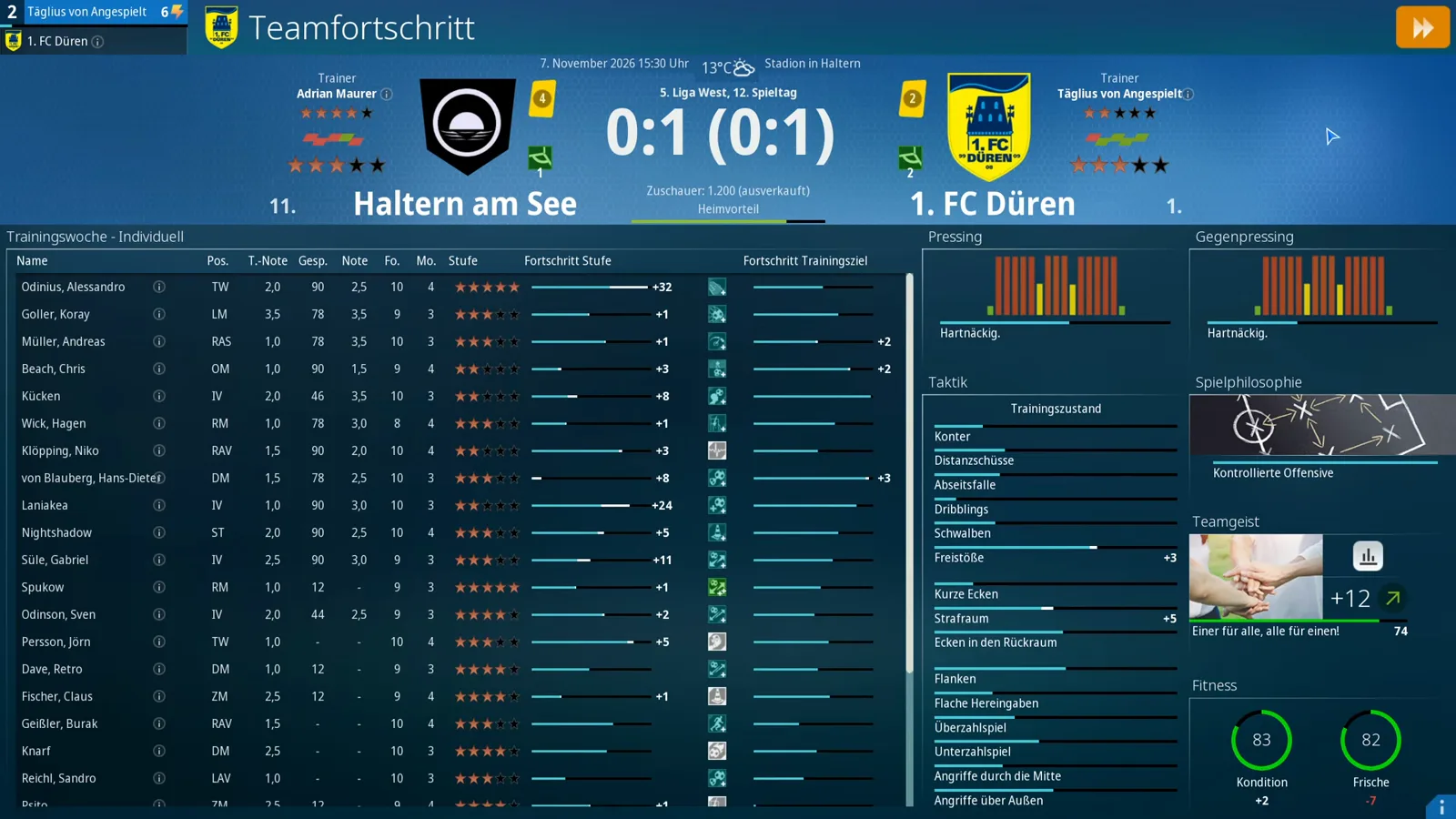
The author reads this as the re-evaluation machinery running in miniature after every game — the big earners, he says, are “already on their next trip”. The practical takeaway is his, and it matches the Einsatzzeiten Grund above: players who actually take the pitch are the ones whose bars move.
How does the weekly funding decision work?
Every Wochenstart screen asks the same question: Wollen Sie einen Spieler besonders fördern? — do you want to specially support one player? A dropdown ranks the squad by their Fortschritt percentage, a counter shows In dieser Saison besonders gefördert: 2 (two players specially funded this season so far), and buttons offer an additional boost or a training boost for all.
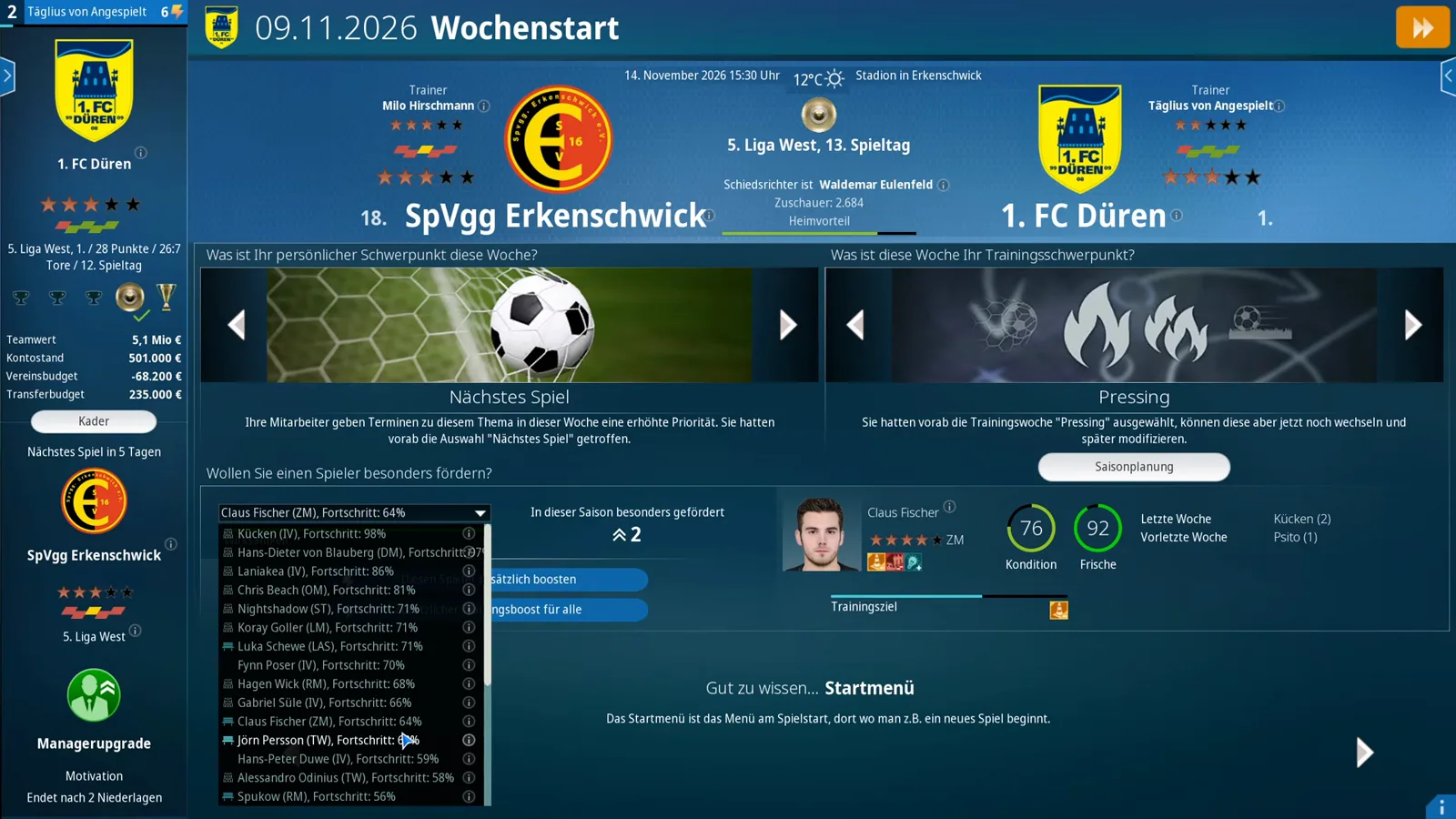
The author’s decision loop is worth copying: he checks who has already been funded — Laniakea, he notes, has been funded only once — and spreads the support rather than piling it on one favourite. The individual training goals this funding feeds are set on the player screens; how the training week itself is built is the training plan guide’s territory.
How do you retrain a player for a new position?
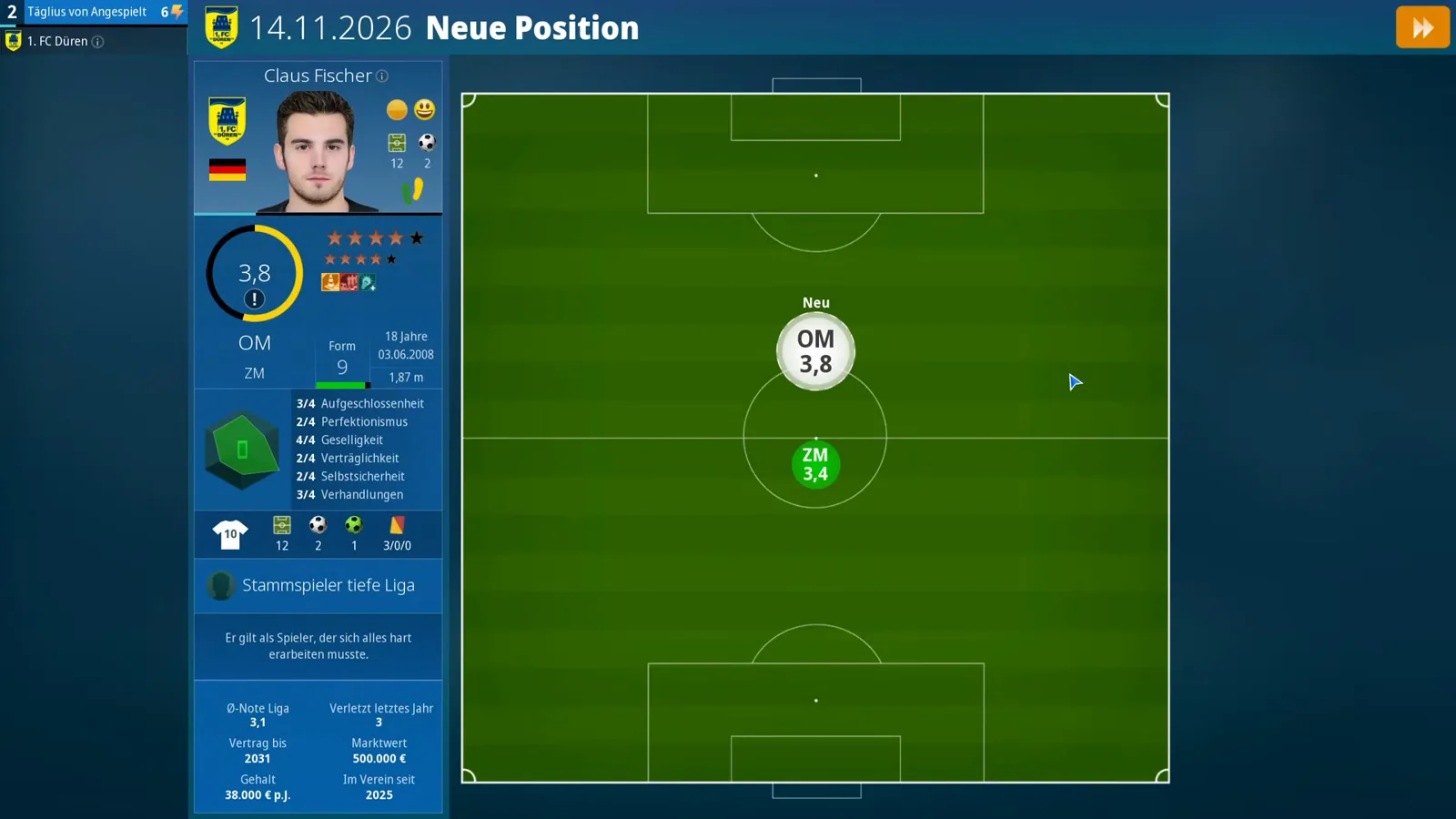
Positions are movable, and the payoff is explicit. The episode’s week ends with the Neue Position screen confirming that Claus Fischer — long a ZM — can now officially play OM: the pitch graphic shows his ball at the new spot reading Neu OM 3.8 against the old ZM 3.4, the “+0.4 points” the author celebrates. Position rating and decimal Stärke are the same currency; teaching a player a new home is a direct rating gain at his best position.
The author’s method for getting there is playing time, not menus: his plan for Laniakea — a centre-back the club wants converted — is starts at left-back so he develops into the position “as quickly as possible”, covering for the ageing Sandro Reichl. He notes elsewhere that the training units alone can’t drill a player into left-back; he has to play there. Which positions are worth converting towards is a squad-building question — the player types and roles guide sorts the templates.
How do youth players climb?
The same machinery runs in the academy, just smaller. Right after that first-team win, the save’s 14-year-old U17 midfielder Noel Helmer received his own Stufenänderung: Alte Stufe one star, Neue Stufe two, and 1 Managerpunkt erhalten! — a first promotion, a first manager point, and a market value of 115,000 € before he has ever signed a professional contract.
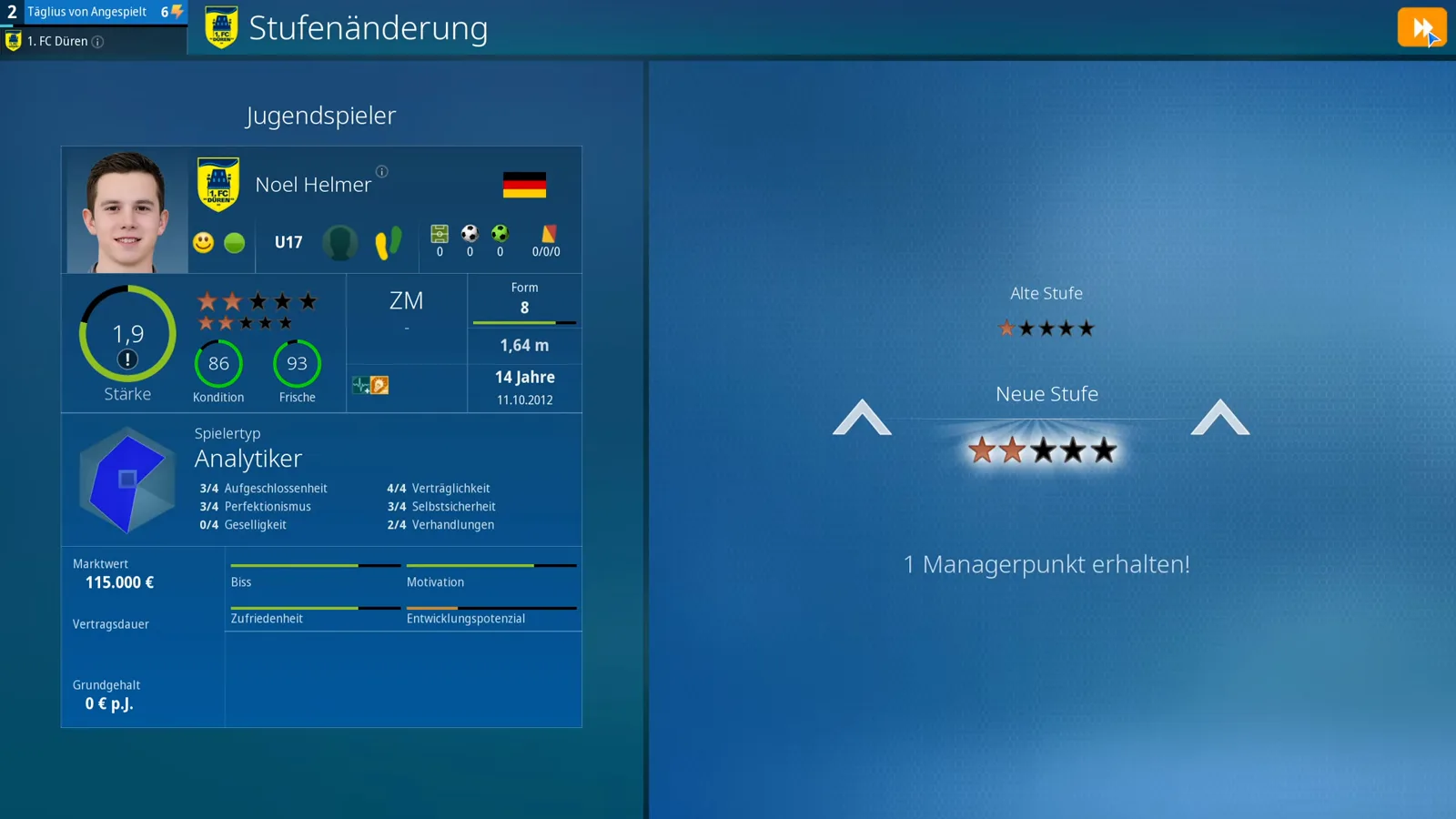
Growth at that age is shepherded with the same weekly funding question, and the author also banks playing time for his youngsters — Nico Klöpping starts on the wing in a cup tie, “slightly worse” on paper, explicitly so he can develop in the club’s own facilities. Where those youngsters come from and where they live between the U19 ranks and the first team is covered by the youth scouting guide, the international youth camps and the second team guide.
How do you track a player’s development?
Two screens close the loop. The Trainingsziel erreicht screen fires when an individual training goal completes — Blauberg’s shows Robustheit (robustness) trained, his Stärke now at 3.2, the strengths list grown to Robustheit +, Einwürfe +, Lange Pässe ++, and the weaknesses panel reading Keine Schwächen. The screen itself spells out the economy: you pick the next goal from the white circles, and every training point you distribute equals 1% training progress.
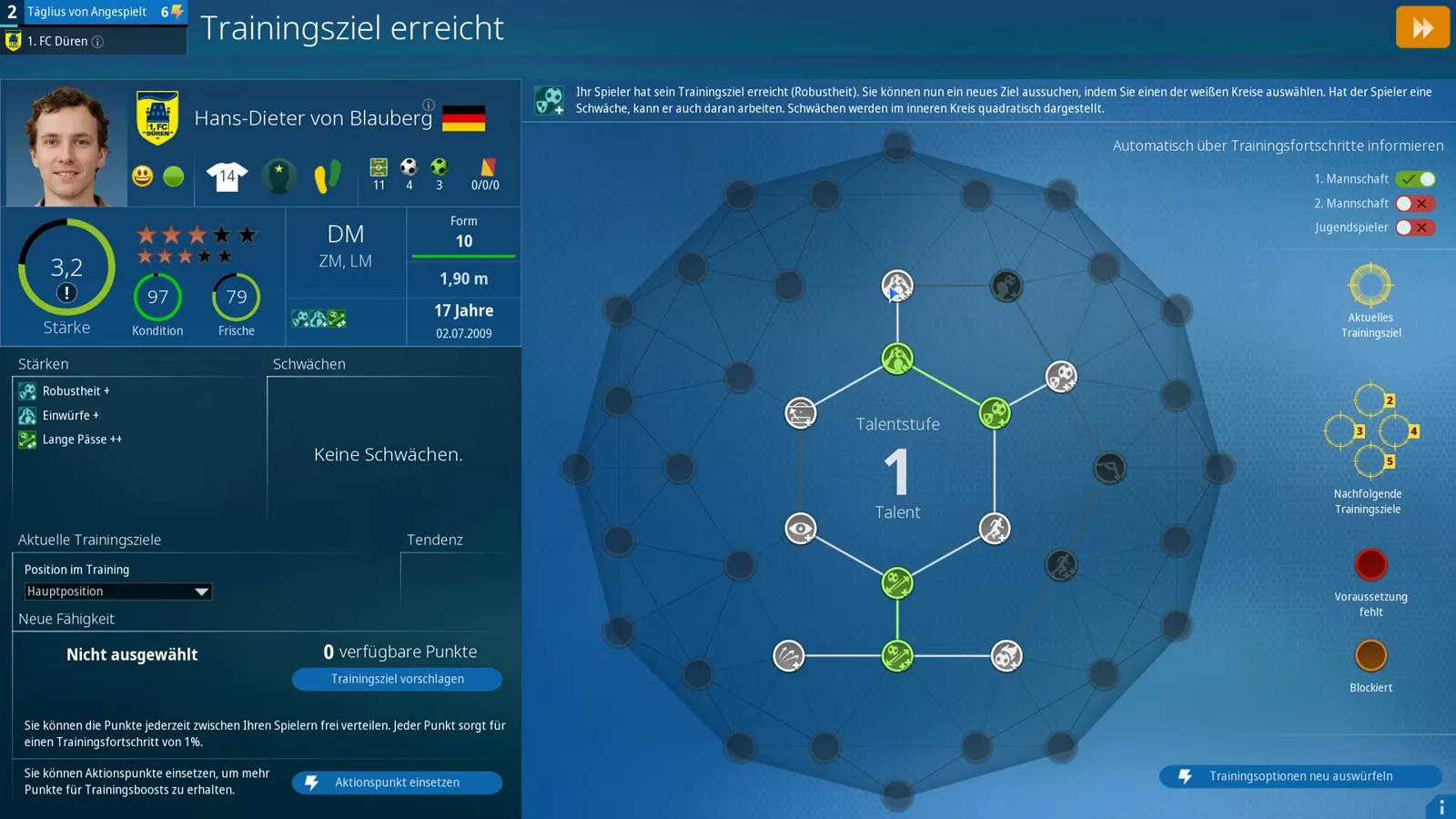
The second is social: the Spielergespräch dialog lists Entwicklung (development) among its conversation topics, and the author uses it to tell Blauberg he is developing well — praise that, in his telling, keeps the player happy while the numbers do the talking. Watch those two screens across a season and you’ll see a save’s whole growth curve without opening a single table.
If the wider system around all this — tactics, finances, the first weeks of a career — is still new, the beginner guide builds the frame before you optimise the growth curve.
Related Guides
guides
WE ARE FOOTBALL 2027 Team Strength Comparison: Stars, Gauges, Scouting Lists
How to read team strength in WE ARE FOOTBALL 2027: Kader stars, the profile gauge, the pre-match Mannschaftsteile bars and the scouting list for the next fixture.
guides
WE ARE FOOTBALL 2027 Season Planning Guide: Budget Split, Kits and Squad Numbers
The Saisonplanung stretch in WE ARE FOOTBALL 2027 screen by screen: promotion payout, league target, budget split, new kits, club rules and squad numbers.
guides
WE ARE FOOTBALL 2027 Relegation Battle Guide: Escaping the Red Rows
A relegation battle in WE ARE FOOTBALL 2027 screen by screen: the red Verbandsliga table rows, a 0:1 away steal, a 1:4 home defeat and the January deals in between.
Was this helpful?
Thanks for the feedback!