WE ARE FOOTBALL 2027: Career Mode & Game Modes Explained
Realistischer Modus vs Kreativmodus, the six career starting points, and what a week, a transfer window and a season in a real save look like.
Frequently Asked Questions
Which of the six career starts should you pick first in WE ARE FOOTBALL 2027?
Can you play World Cup or Euro campaigns in Kreativmodus?
How does a week in WE ARE FOOTBALL 2027 career mode actually work?
Before you sign your first contract, WE ARE FOOTBALL 2027 asks you two very different questions: how you want the game to behave, and which of six careers you want to live. The first is a choice between Realistischer Modus and Kreativmodus, the second between Weltmeisterschaft, Europameisterschaft, Vereinsgründung, Karriere, Vereinsauswahl and Zuschauermodus. This guide explains what each of those words means in practice, and then follows one real career — a fifth-division club in Germany — through its first transfer window, its first planned week and its first match, so you know what the day-to-day loop looks like before you commit. If you have not yet installed the game or walked through the new-save wizard, start with the installation and first-setup guide, which covers those screens step by step.
The Two Game Modes: Realistischer Modus or Kreativmodus
The wizard’s two-card question, Wie wollen Sie das Spiel spielen?, is the most consequential choice you make. The Realistischer Modus card plays it straight: you compete under the rules the game and its database define, and this is the only mode in which you can play individual national-team tournaments, set records and earn achievements. The Kreativmodus card hands you the workshop: game parameters become adjustable, new rules become experimentable — and unlike a classic editor sandbox, the game states that this stays possible at any time during the save, not only when you create it.
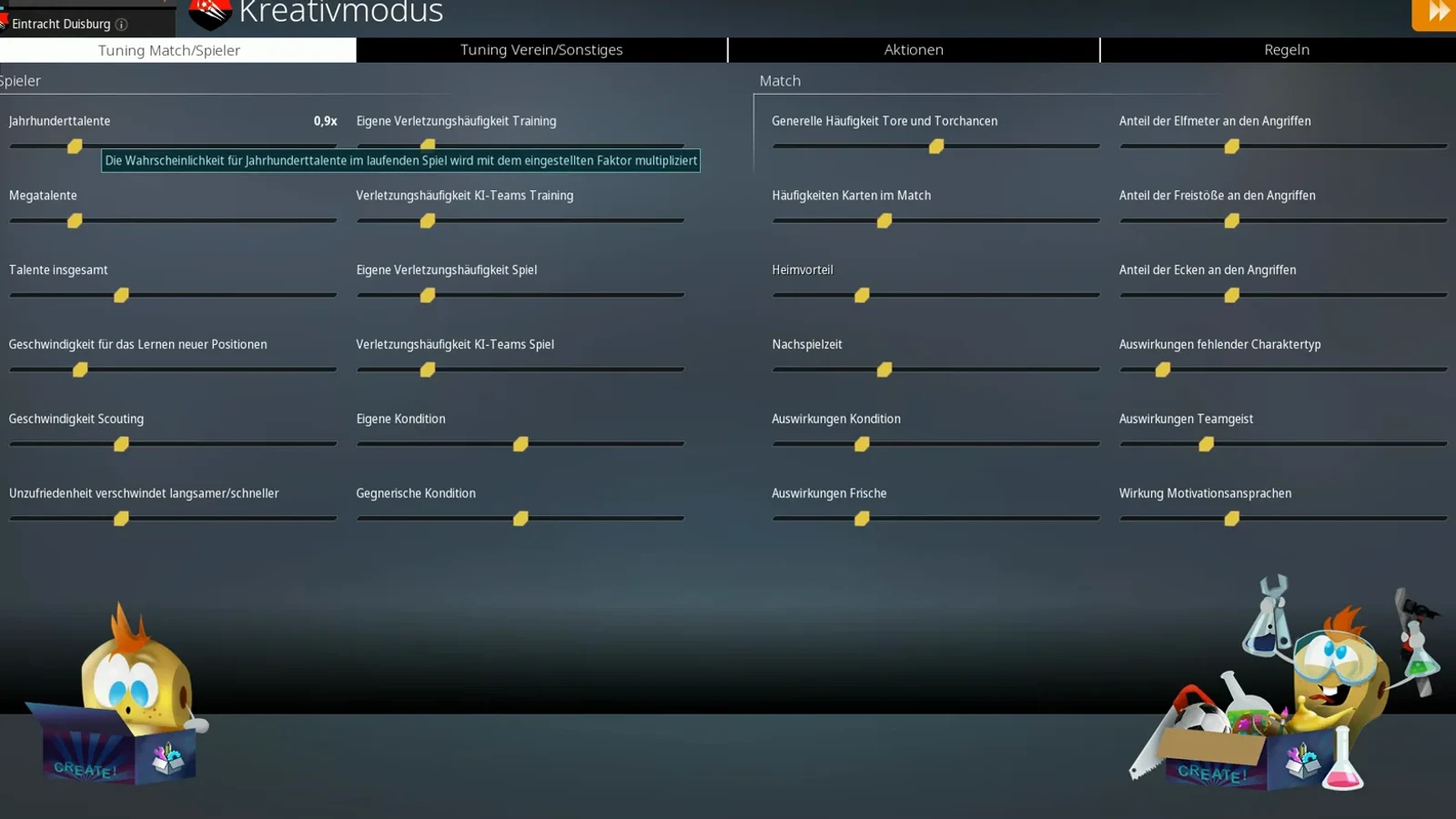
The tuning panel shows how far that control goes. Under Tuning Match/Spieler you multiply the likelihood of once-in-a-century talents, raise or lower injuries for your club and the AI teams in training and in matches, change how fast players learn new positions and how fast scouting works, and tune the match itself: how often goals and chances occur, the share of penalties, free kicks and corners in attacks, home advantage, stoppage time, even how strongly motivational speeches land. A second tab, Tuning Verein/Sonstiges, reaches into sponsorship money, construction funds for stadium and club grounds, cup premiums and taxes, and an Aktionen tab lets you set your own manager level and hand yourself action points. The presenter of the source video set up a brand-new fifth-division club this way and simply granted himself money when he wanted to experiment — nothing in the mode stops him.
Which one should you pick? If you want the career to mean something — promotion races, records, the achievements list on Steam — take the realistic card. Kreativmodus is a laboratory, and a wonderful one, but it is the wrong place to chase a clean title run. Difficulty, by the way, is not part of this choice: it gets its own screen with presets and individual sliders later in the same wizard, and our difficulty guide picks that apart in detail.
The Six Career Starting Points
The next step, Wie möchten Sie spielen?, lays out six ways to live in this football world, each with its own card and button.
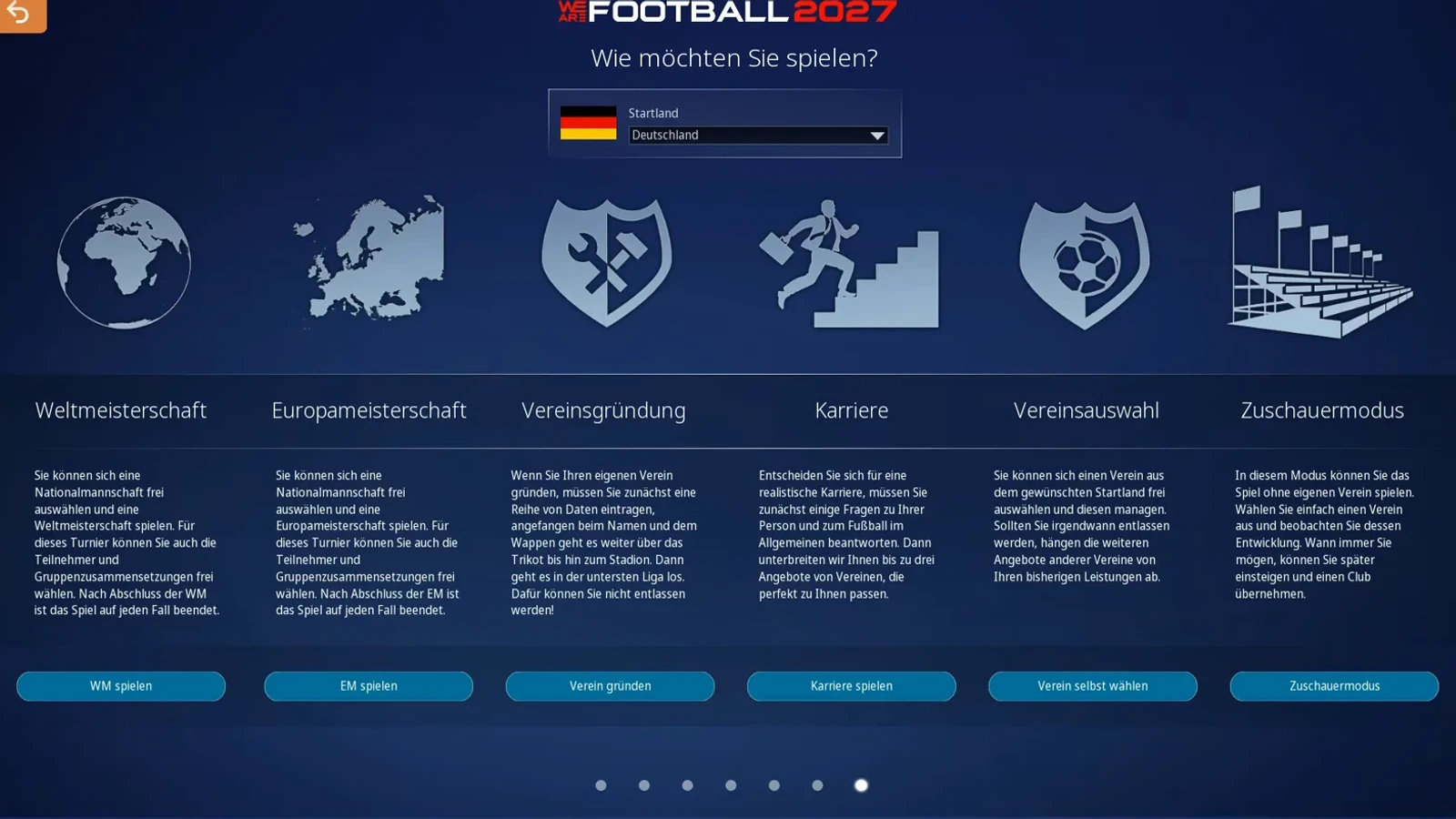
- Weltmeisterschaft and Europameisterschaft are pure national-team campaigns. You pick any nation you like, you may freely choose the participants and the group composition, and you can even coach the games live from the sidelines. The catch sits in small print on the card: once the tournament is over, the save ends. These are evenings of football, not careers.
- Vereinsgründung builds a club that did not exist yesterday: name, crest, kit, stadium, then off you go into the country’s lowest league — in Germany that means the 5. Liga. The compensation for starting from nothing is written on the card: you cannot be sacked from a club you founded.
- Karriere is the classical route. The game asks a few questions about you and your football, then brings you up to three offers from clubs that supposedly fit — and your career unfolds from whichever you accept.
- Vereinsauswahl skips the matchmaking: you browse clubs yourself and take over the one you want. If you later get sacked, your next offers depend on the record you left behind.
- Zuschauermodus is the spectator seat. You watch a club develop without managing it and are allowed to step in and take over whenever you feel like it — a gentle way to learn the game’s rhythms from the inside.
For a first career, the two middle cards are the honest choices. Vereinsauswahl gives you full control over the challenge — pick a big club for a title charge or a village club for a rebuild — while Karriere adds a bit of fate. The source video’s presenter took a fifth-division side from the Vereinsauswahl list and spent its first weeks restructuring the squad, which is exactly the material for the rest of this guide.
The Week Planner: Where Careers Actually Happen
Once the save starts, the game stops being a menu tree and becomes a calendar. The Terminplaner lays your week out from Monday to Sunday, and every commitment you make — a player contract talk, a course, a club event — occupies visible blocks with hours attached.
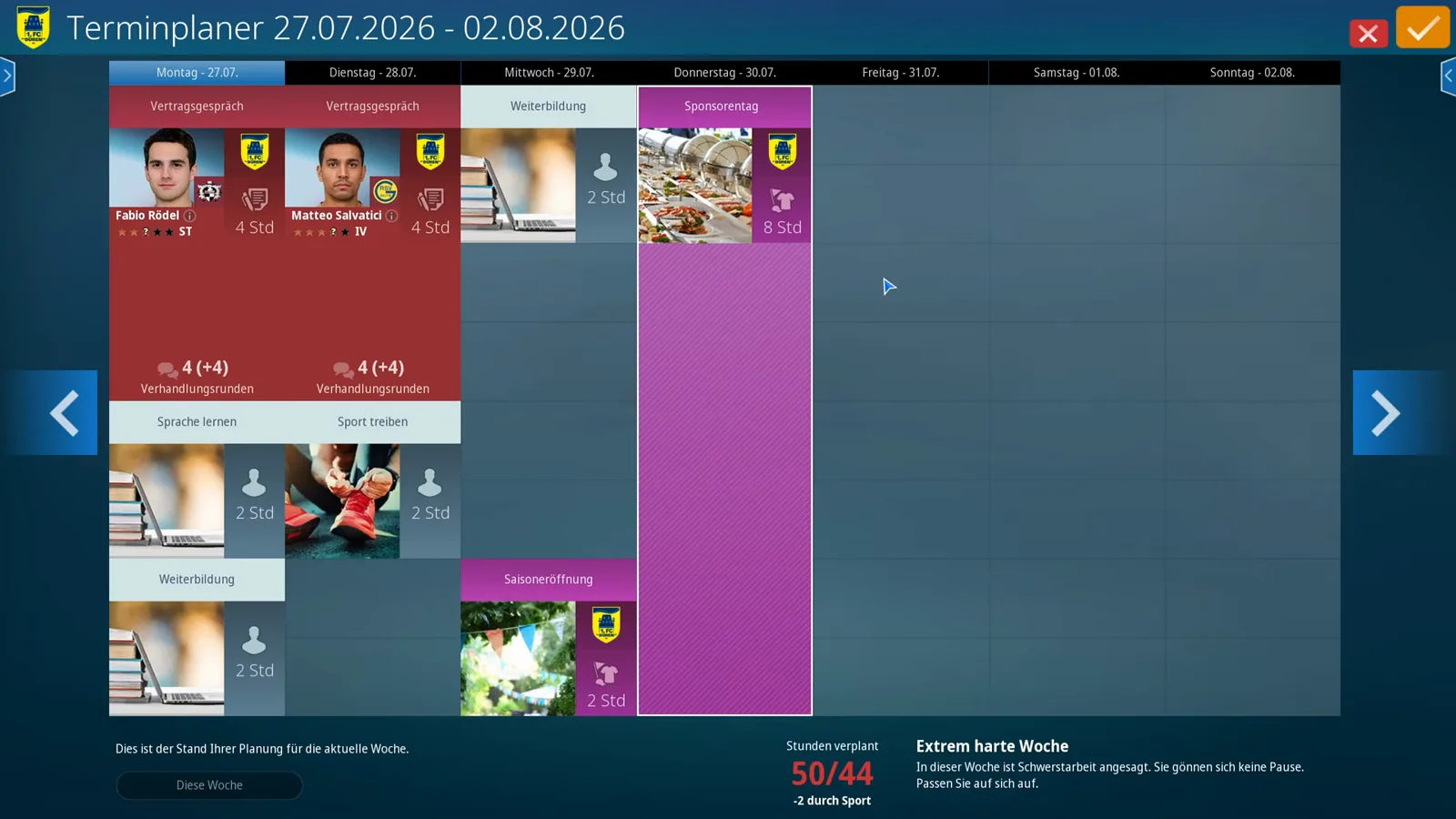
The week in the screenshot was the presenter’s first as Düren’s manager, and it reads like a job description. Monday and Tuesday carry Vertragsgespräche with two new signings — each with a set number of negotiation rounds — plus his own further education, a language course and a workout. Wednesday holds the Saisoneröffnung, the season opening event he deliberately scheduled for a Wednesday evening, and Thursday the eight-hour Sponsorentag, placed on a Thursday because, in his reasoning, sponsor employees are happiest when a long event feels like the start of the weekend. At the bottom the planner totals the damage: 50 hours planned against a capacity of 44, flagged as an extrem harte Woche. Overbooking is possible, but the game openly tells you the cost.
Every week runs on this pattern — appointments, events, training focus, then the match — and the game caps how much you can do through action points. Some weeks are quiet; the weeks around the transfer window and the season start are not.
The Transfer Window: Scouting, Signing, Selling
The transfer market is where a small club earns its season, and WE ARE FOOTBALL 2027 makes you work for it. The Spieler scouten/verpflichten screen is a filter machine on the left and a player list on the right: country, league, position, age range, star level, character attributes, market-value bounds, and toggles for transfer-listed, loan-available or expiring-contract players only.
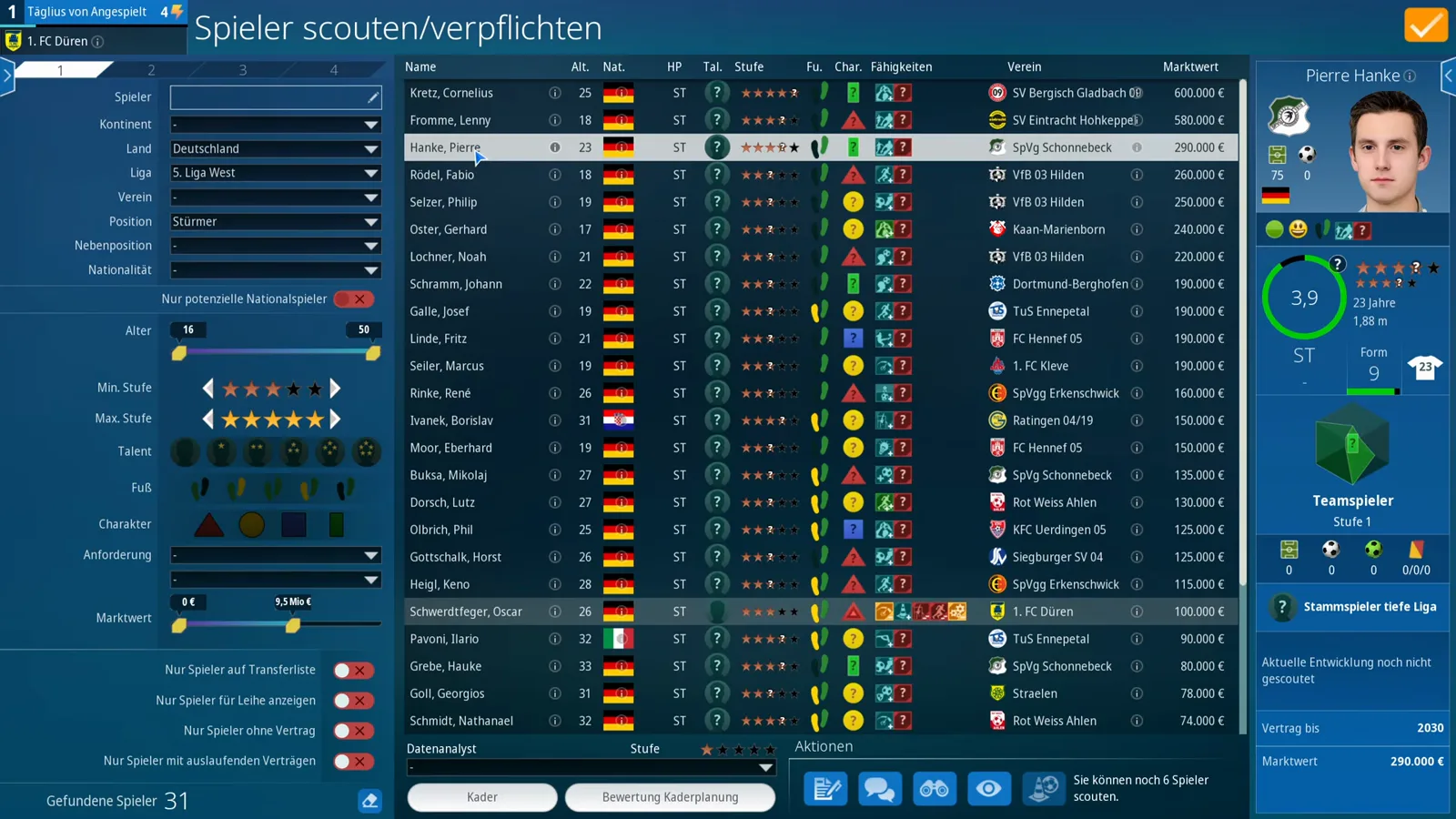
Two limits shape the hunt. First, knowledge: unscouted players hide their ratings behind question marks, and a fifth-division club only has a handful of scouting slots — the screen notes that six players can still be scouted — so you send your scouts out early and target the positions your squad analysis flagged. Second, money: the save in the video started with a transfer budget of roughly 300,000 euros, which buys exactly one meaningful fifth-division signing, so sales matter as much as purchases. The presenter’s window was a masterclass in small-club economics — signing a centre-back and a striker, sending an unsettled winger out on loan so that at least his salary would be covered elsewhere, and constantly weighing a player’s age against his market value because young signings appreciate and old ones do not.
One card detail deserves its own warning: release clauses. The video’s star goalkeeper arrived with a clause worth 240,000 euros while his market value sat around 400,000 — a bargain then, a liability the moment he develops, because any club can trigger the clause and take him for far below value. Renegotiating such contracts before the clause bites is part of the job; how those talks work is covered in the contract negotiations guide. The full system, from loans and release clauses to deadline day, lives in the transfer market guide.
Board, Budget and the Building Site
A manager in this game is also a facility director, and every euro you spend on the squad is a euro the club budget did not spend elsewhere. The Budgetänderungen screen makes that tension explicit: it shows your team-and-transfer budget next to the club budget and lets you shift money between them, with the club’s assets and your board popularity displayed alongside.
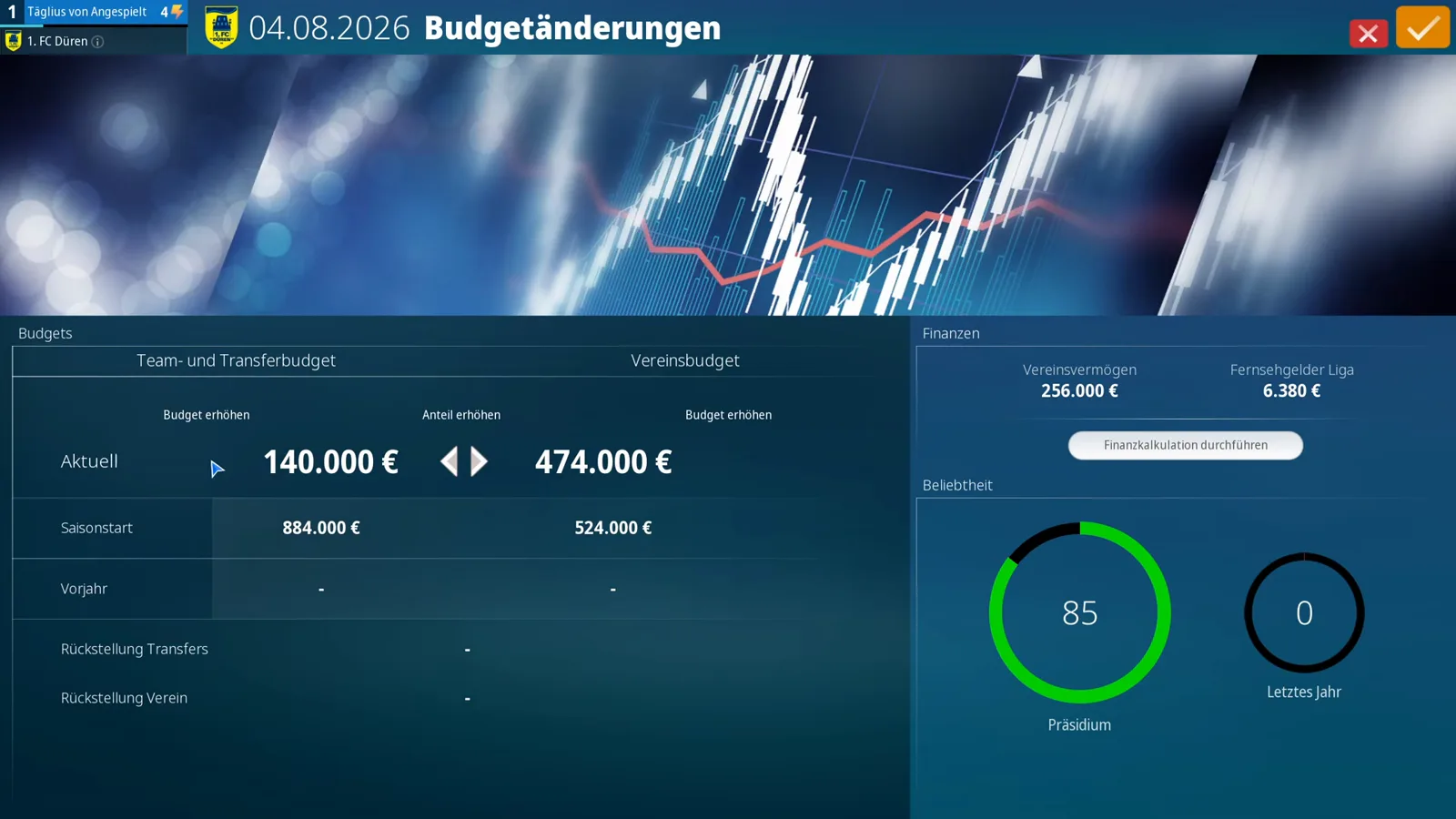
Money you keep at the club instead of the team is what buys the future. On the Clubgelände screen — a top-down map of your grounds — a build menu lists everything from extra training pitches at 150,000 euros, over office floors that house ten staff each, to a 4,000-seat mini-stadium for the second team and youth sides with a 179-day construction time. The presenter’s priority list was almost apologetic about it: more training pitches first, because one pitch for a whole club is a bottleneck, offices second, because his 28 employees were tripping over ten desks, and the stadium eventually, because the second team and the youth need somewhere to play.
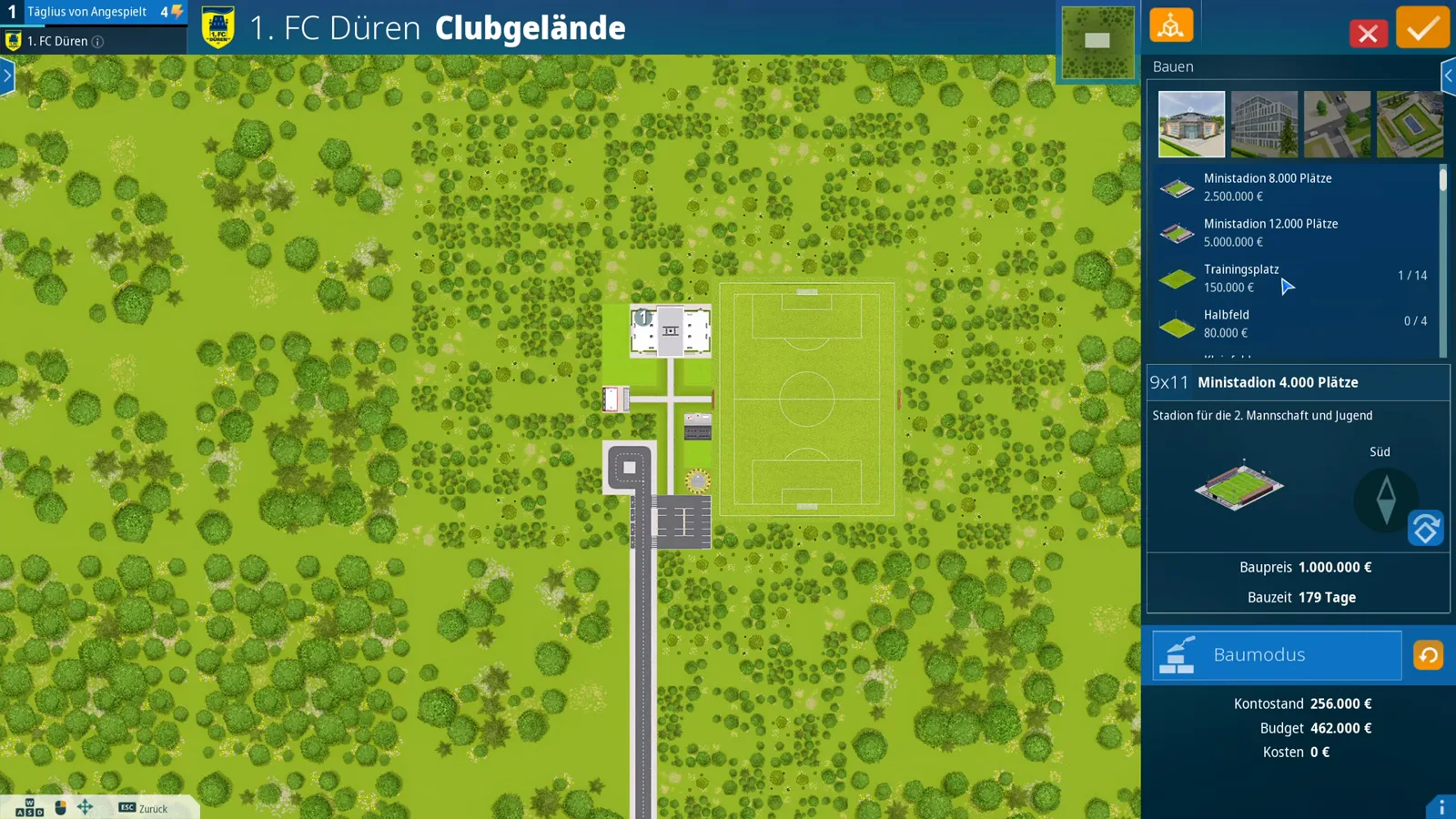
Facilities reach further than buildings. The same career plans international youth camps abroad, a youth boarding school, and poaching talented teenagers from other clubs — the long game that turns a village club into a talent factory, and the reason the youth camps guide and the stadium-side details in the stadium expansion guide are worth reading once your first season is underway. What the board thinks of all this spending, and how your popularity with it decides your employment, is the subject of the board expectations guide; the wage-side arithmetic sits in the finances and wage budget guide.
Match Day: Where the Week Pays Out
The match is the week’s exam. Before kickoff, the Matchanweisungen screen concentrates everything you know about the opponent into instructions: a fitness ring tells you how fresh your eleven is, the weather forecast sits in the corner, and per-player measures — man-marking the opponent’s top scorer, instructing your defence, provoking a short-fused winger — are set from dropdowns.
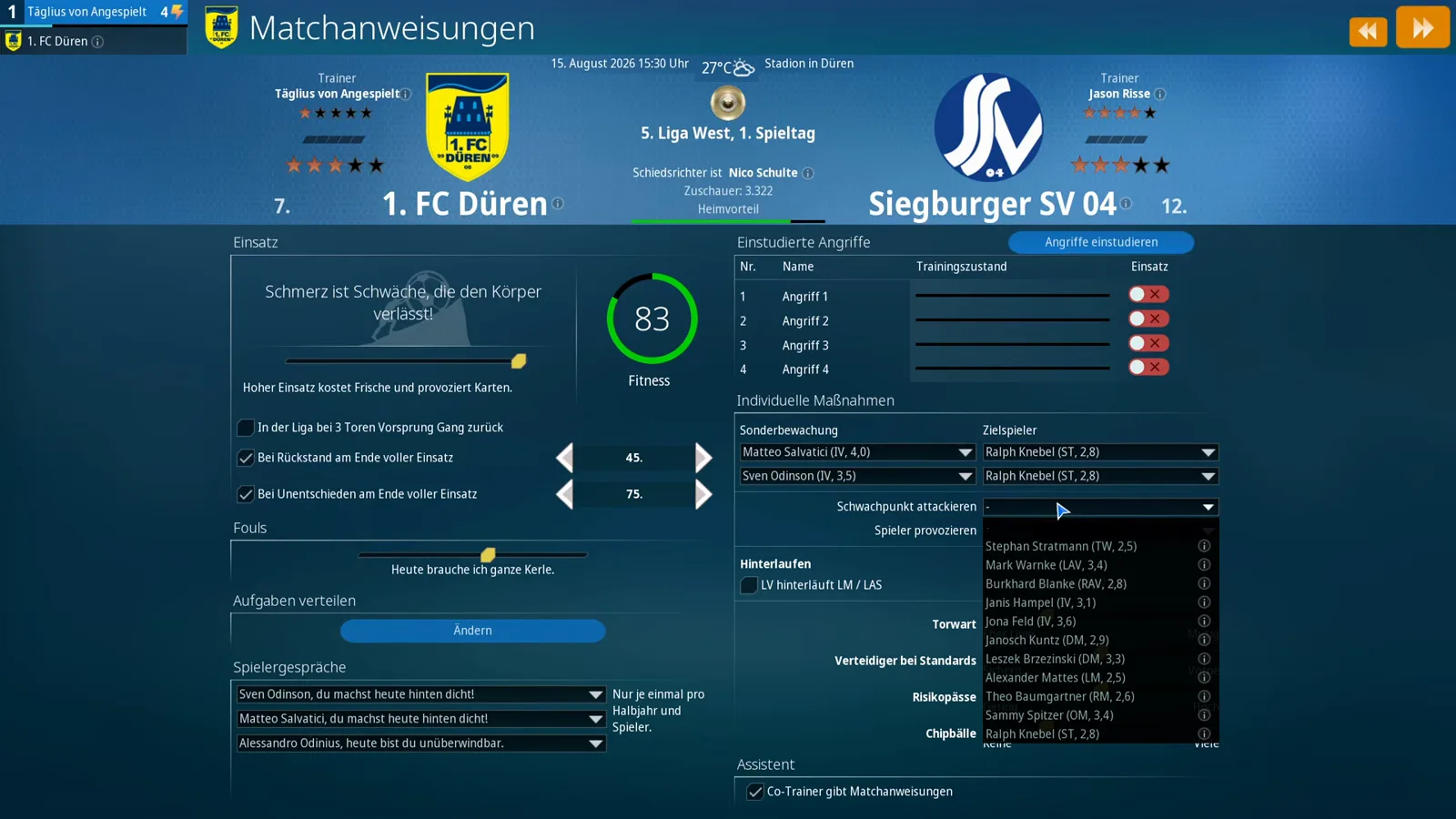
The panel at the bottom right is the human part. You address players individually — in the video the manager told his new centre-back to shut down the opponent’s striker, assured his goalkeeper he would be unbeatable today, and promised the team a day off training if they won what he called a compass game, the kind that sets the direction of a season. Then you whistle it off, watch it live or simulate it, and yell at your screen as needed.
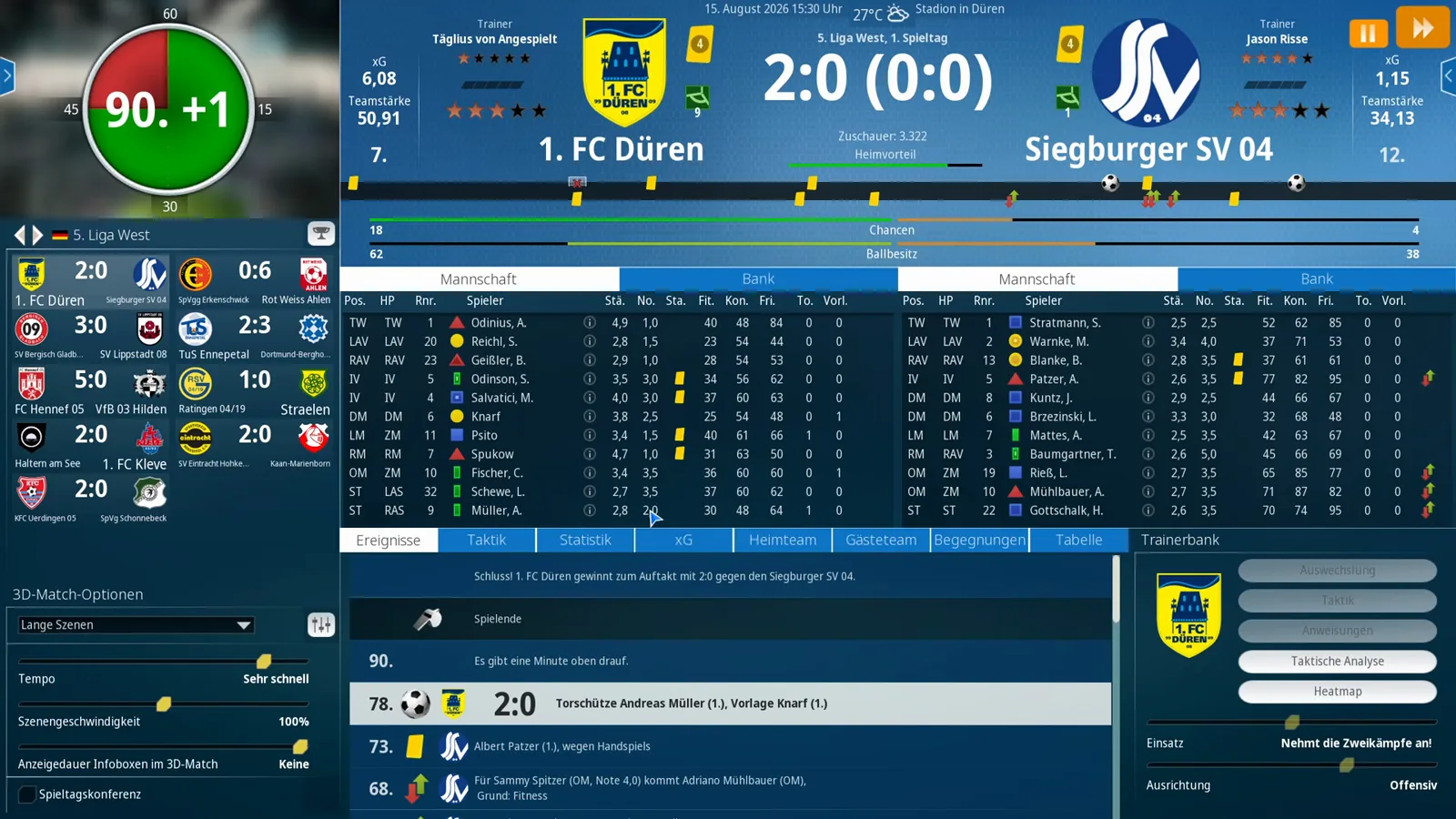
The full-time screen closes the loop: the score, the match feed with every goal and card, player grades, and the coaching bench with its last tactical buttons. Düren’s 2-0 win over Siegburger SV 04 lifted the club to fifth in the table after matchday one — the presenter noted with some irony that several rivals had won bigger — and fed the scorer list, the team-of-the-day selection and a bump in team spirit straight into the next week’s planning. Win, learn, adjust, repeat: that rhythm, week after week across a full league season and interrupted only by the transfer windows, is what a WE ARE FOOTBALL 2027 career is. When you are ready for your own first week, the beginner guide picks up exactly where this one ends, and if the tactical side of the exam is what trips you up, the match engine tactics guide is the natural next stop.
Related Guides
guides
WE ARE FOOTBALL 2027: Difficulty Settings and Career Start Options
All ten WE ARE FOOTBALL 2027 difficulty lines explained: presets, budgets, transfer market, scouting, job security, injuries, fines, start country and contract.
guides
WE ARE FOOTBALL 2027: Install, First Launch & New-Game Setup Guide
How to install WE ARE FOOTBALL 2027 on Steam and start your first save: language choice, database scope, manager creation, difficulty and club selection.
guides
WE ARE FOOTBALL 2027 Review: Is It Worth Buying in 2026?
An honest WE ARE FOOTBALL 2027 review built on the live Steam score: what players praise, what they complain about, and whether the €20 manager is worth it.
Was this helpful?
Thanks for the feedback!