WE ARE FOOTBALL 2027: Staff, HR Department & Employee Effects
What every employee does in WE ARE FOOTBALL 2027: department heads, diligence, training budget tiers, staff workload, seasonal bonuses and the cost-cut switches.
Frequently Asked Questions
What does diligence do for staff in WE ARE FOOTBALL 2027?
Which staff job should I fill first?
What happens when my staff are overloaded in WE ARE FOOTBALL 2027?
Staff effects in WE ARE FOOTBALL 2027 are scattered through the manual instead of printed on the screen. The HR hub itself is tidy — Abteilungsleiter, Statistiken, Mitarbeiter, Ausgaben — but no row says what that person changes, so this page walks the roster the way the tutorial reads it.
The Department Head Roster
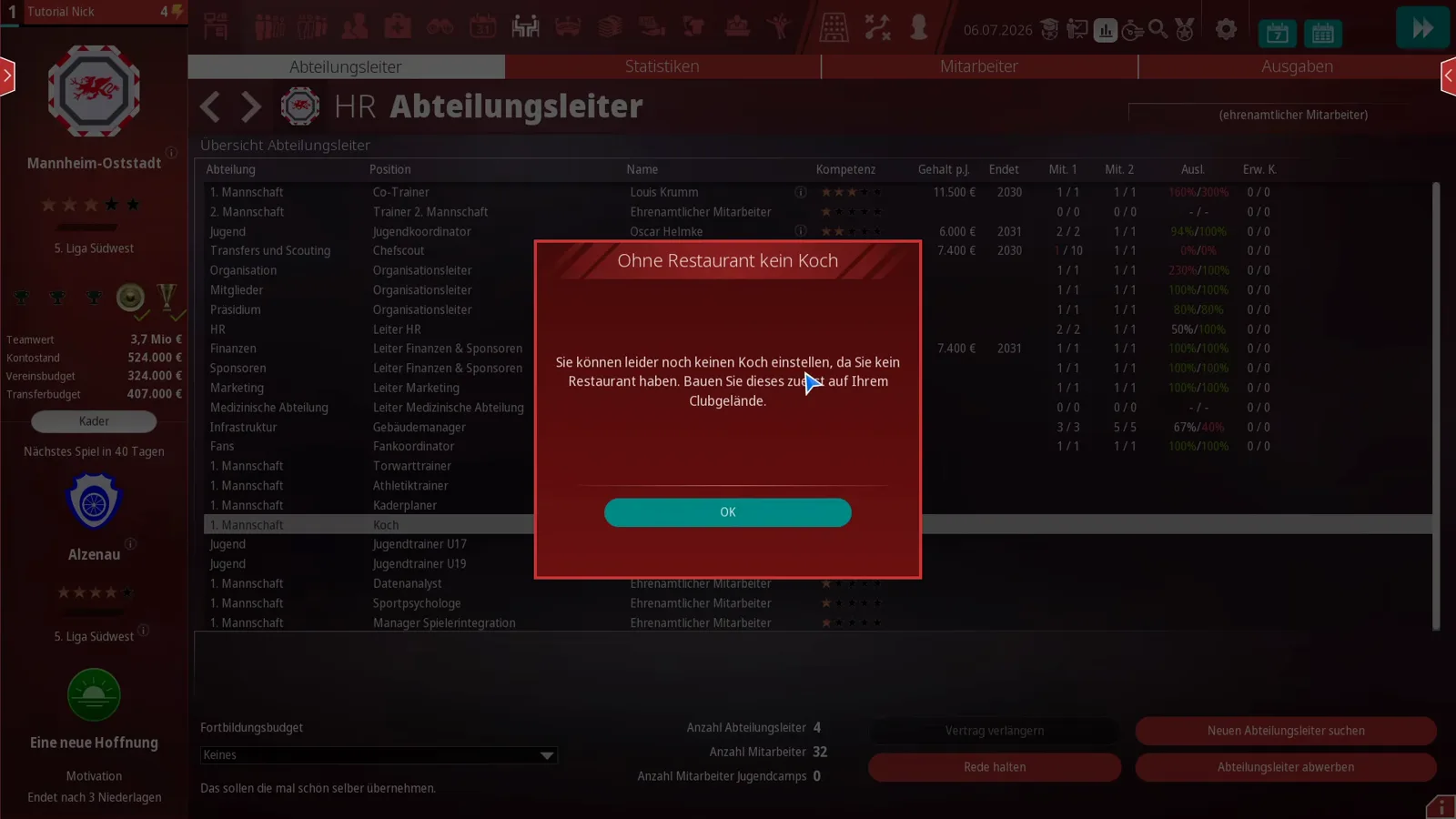
The HR Abteilungsleiter tab lists every position in the club — co-trainer, second-team coach, youth coordinator, chief scout, heads of organisation, members and board, HR, finance and sponsorship, marketing, medical, infrastructure and fan coordinator, plus goalkeeping coach, athletic trainer, squad planner, data analyst, sports psychologist, youth coaches, the first-team cook and the Manager Spielerintegration role.
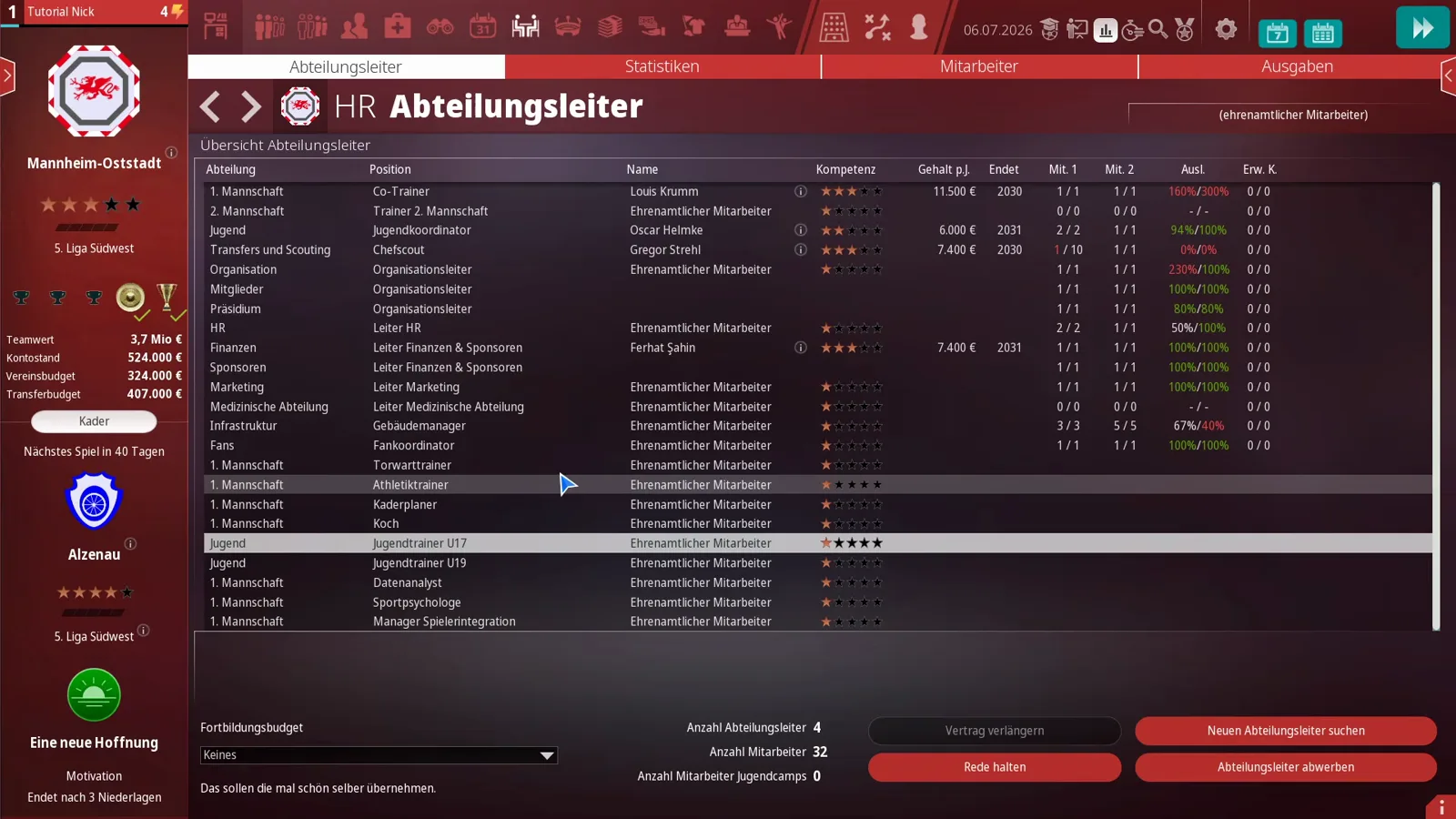
The panel under the table is the honest health check: Anzahl Abteilungsleiter 4, Anzahl Mitarbeiter 32, Anzahl Mitarbeiter Jugendcamps 0. Everything not held by a named person reads Ehrenamtlicher Mitarbeiter in the name column — a volunteer, and the tutorial’s first target for replacement.
Clicking a row opens a strip under the table with the person’s face, star row, nationality, date of birth and age, an ability hexagon, the Fleiß bar and the languages they cover.
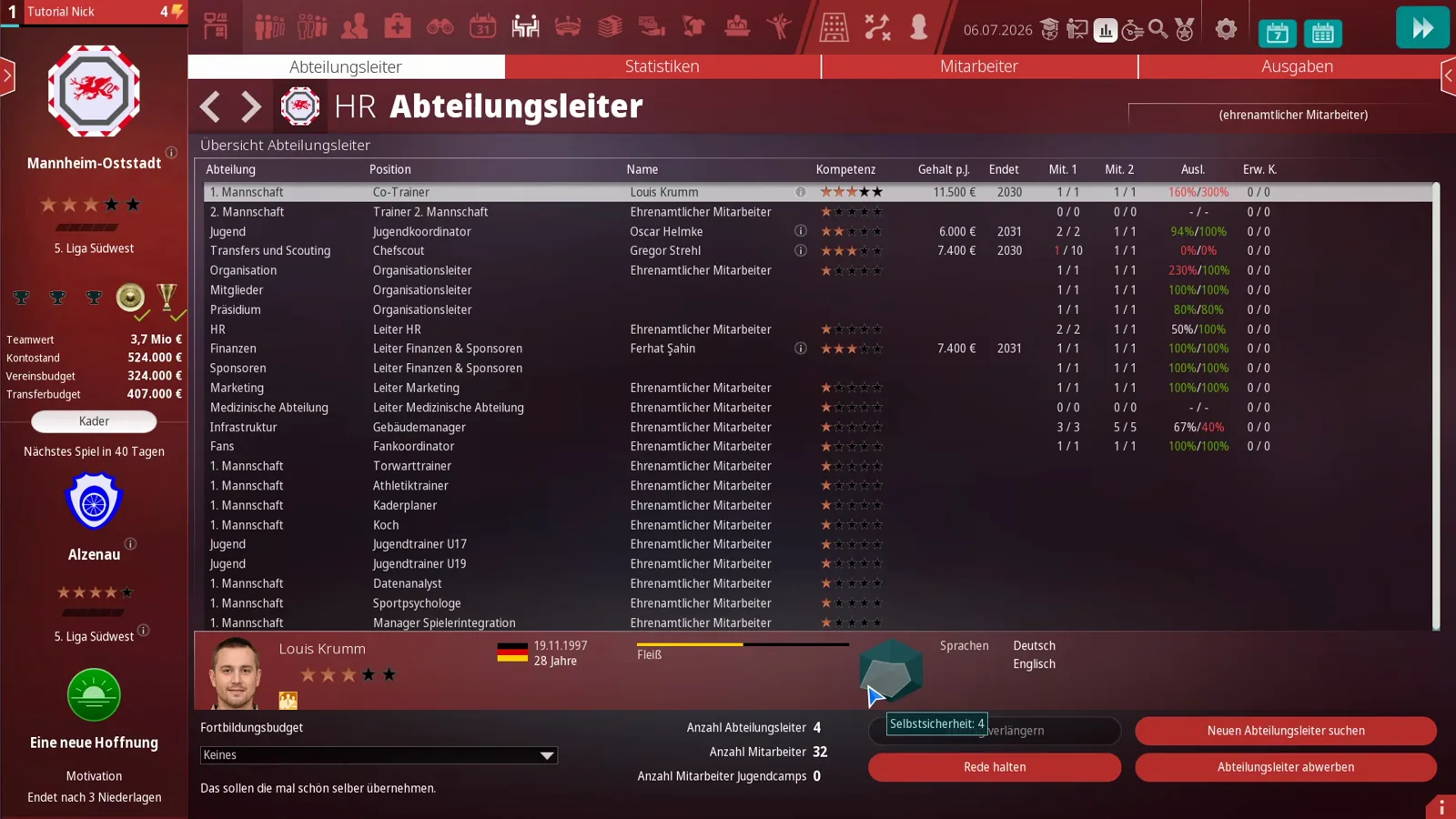
Four columns decide how useful a hire is. Kompetenz is the star row — the co-trainer sits at three of five while the second-team coach row has one — and the tutorial’s advice is to read it as how well the person covers what the job needs. Gehalt p.j. and Endet give you the running cost and the year the contract lapses. Mit. 1 and Mit. 2 count the staff a department has against what it wants, and Ausl. is the utilisation figure that drives hiring and firing, discussed below.
Fleiß (diligence) is the one the tutorial insists people skip: a diligent employee keeps their department under control and gains skills over the season, a lazy one decays instead. Someone middling stays put.
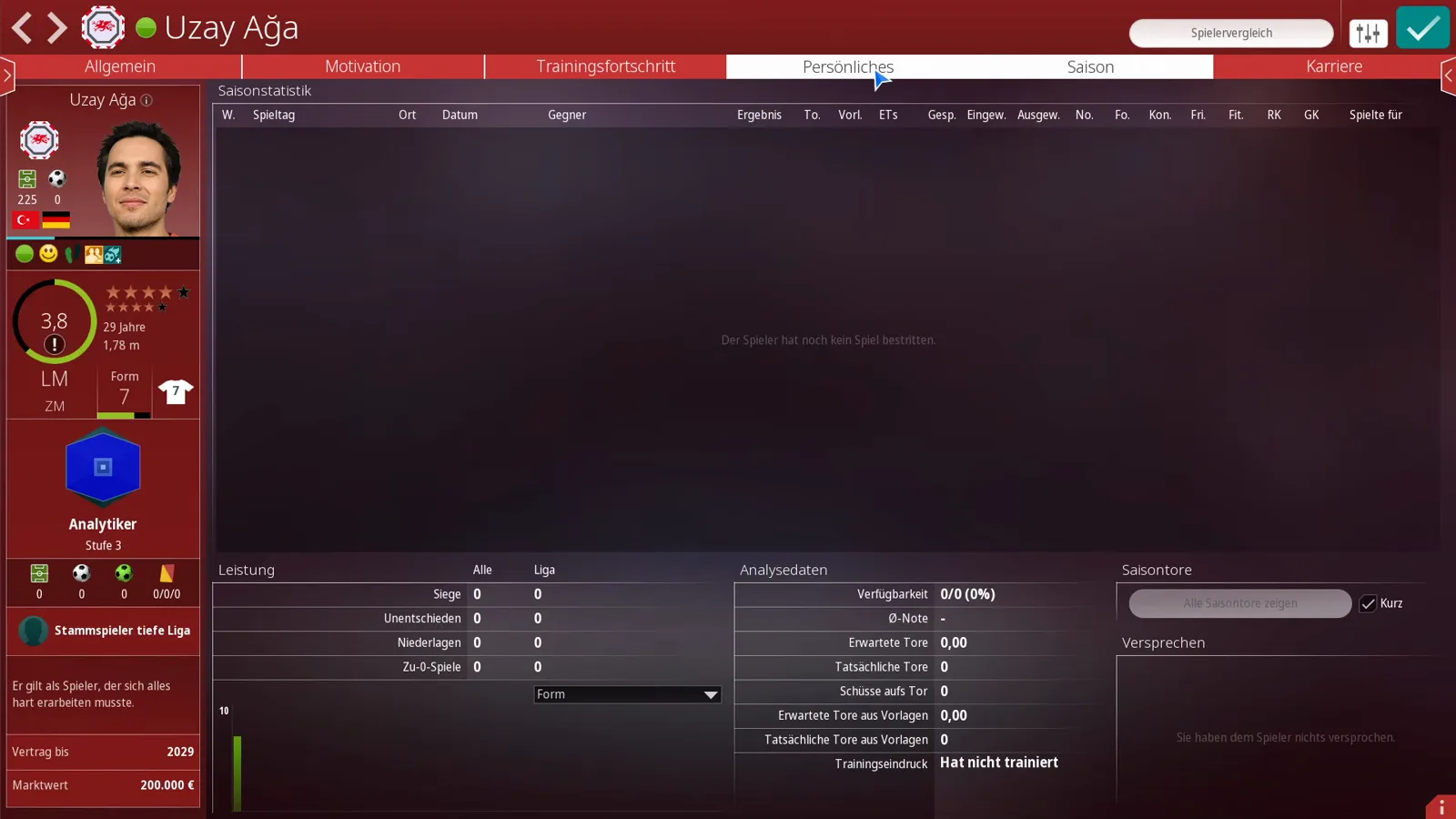
The roster never shows you what a head delivers. That appears one screen over, in the player file — the Analysedaten block, the Trainingseindruck line and the Versprechen panel are where good or idle staff become visible.
What Each Head Actually Does
The effects the presenter reads aloud group neatly.
Training and squad. The co-trainer speeds up development of first-team field-player qualities; the second-team coach does the same for the reserves. The goalkeeping coach and athletic trainer specialise — the latter is the direct answer to a squad that is unfit because training plans are thin. The squad planner fills the sparse first-team planning screen with stars and statements, and the data analyst builds the accurate player lists that the transfer market guide needs to price targets.
Youth. The youth coordinator brings more talented players in and loses fewer. U17 and U19 coaches train skills faster, and combined with boarding-school places and personal trainers they build an academy pipeline; the camp mechanics sit in the youth camps guide.
Commercial and club. The head of finance and sponsorship suppresses negative financial events; the tutorial save mentions a late tax return that cost a €4,000 fine. Marketing lifts sales through creative campaigns and reduces quality problems, the fan coordinator grows fan clubs and organised supporters, and the Gebäudemanager is the reason special offers appear at all — the presenter points at 50%-off weeks for stadium and infrastructure expansion, which changes the timing advice in the stadium expansion guide.
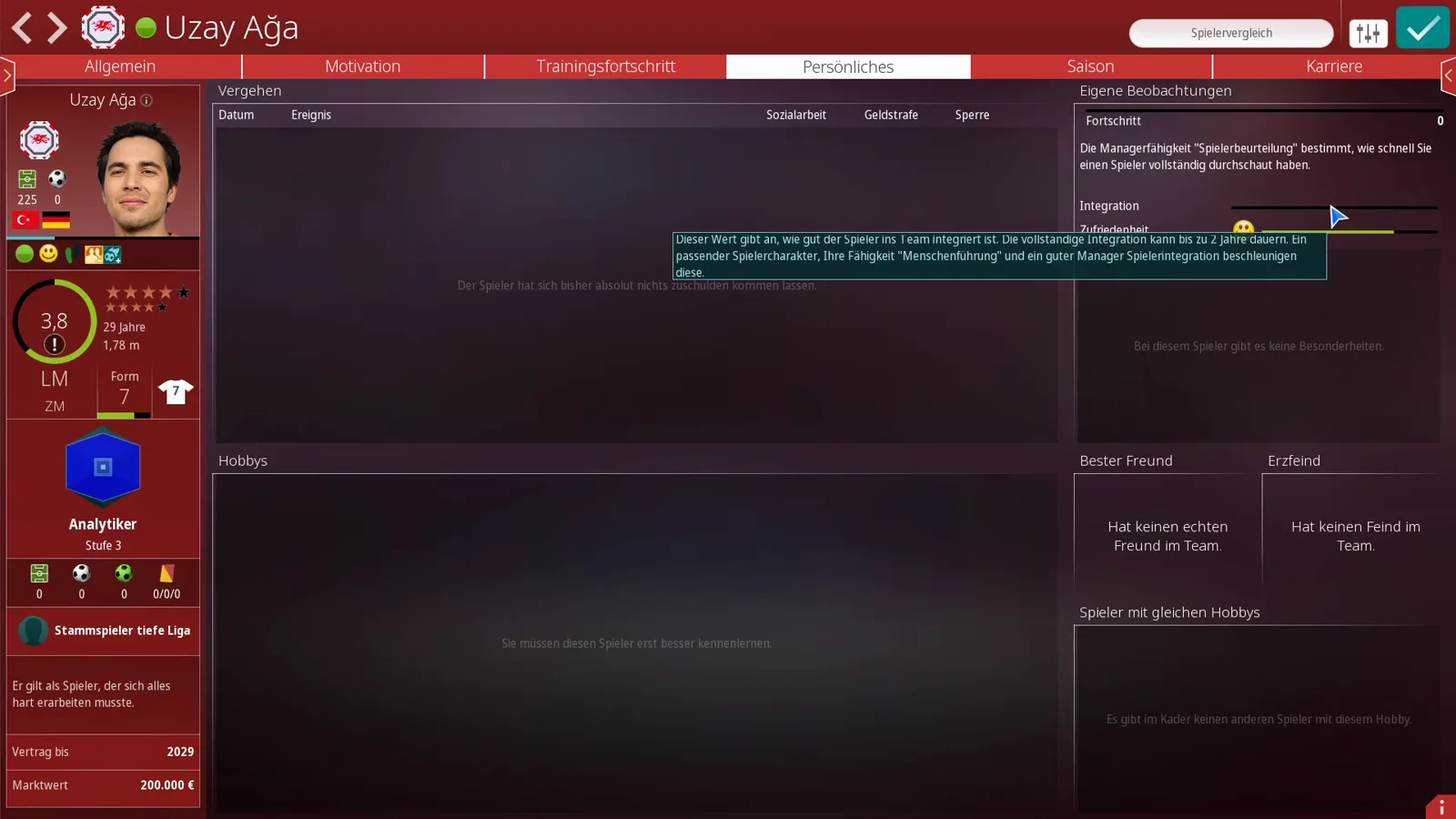
People. The medical department is the highest-value hire in the list: on the tutorial’s reading it reduces the loss of form that follows an injury, not just the injury itself. The sports psychologist handles players in personal crises without being asked, and the Manager Spielerintegration role fills the integration bar faster. The game puts a number on how much faster: the tooltip on a player’s Integration value states that full integration can take up to two years, and that a fitting player character, your own Menschenführung ability and a good Manager Spielerintegration all shorten it. Both roles feed directly into the mood meters in the morale and satisfaction guide.
Some roles are gated: the first-team Koch is described in the tutorial as lifting satisfaction and adding a small fitness bonus, but searching for one returns a refusal.
Training Budget, Workload and the Expensive Calendar
The Fortbildungsbudget dropdown under the roster sets how fast staff grow, and the line under it describes the tier you picked. At the bottom sits Keines — “Das sollen die mal schön selber übernehmen” — and at the top 1,2 Mio €: “Wir haben eine eigene Akademie, laden internationale Referenten ein und stehen für Operational Excellence.” The tutorial reads the steps in between as books plus one workshop a year, €48,000 for one course per employee, €120,000 for two, €240,000 for tailor-made programmes and €480,000 for a university partnership.
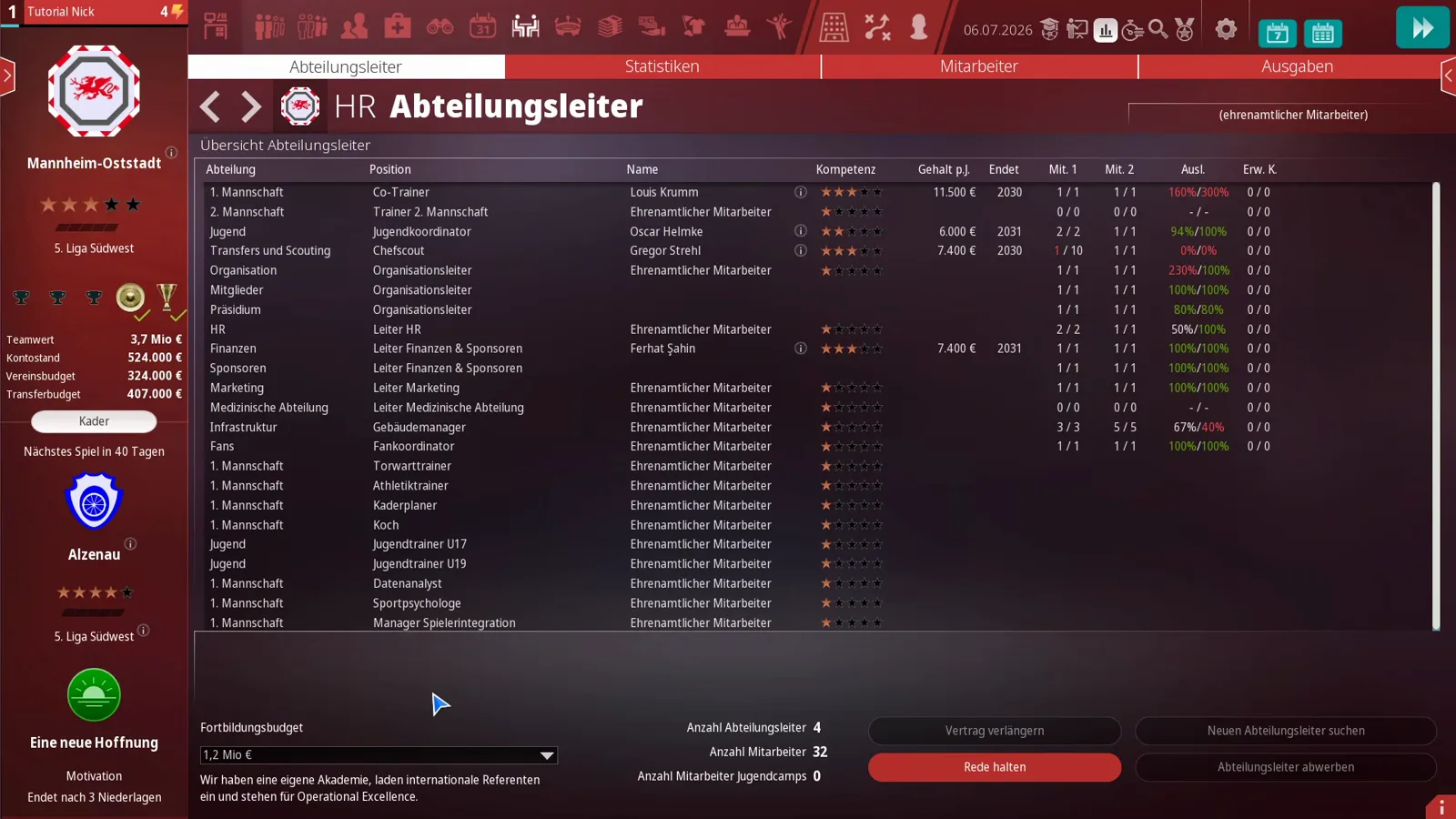
The manual only says staff improve at the events on 31 March and 30 September, so the presenter infers the tiers change speed rather than ceiling — roughly level 10 in two years at the top tier against level 4 on books alone. That is his estimate, not a published number.
Workload is where clubs quietly break. The Mitarbeiter tab lists every role with headcount, salary and total cost, an Ausl. utilisation figure beside each, and to the right the Richtlinien für Abteilungsleiter panel: three settings that decide what your department heads are allowed to do about it.
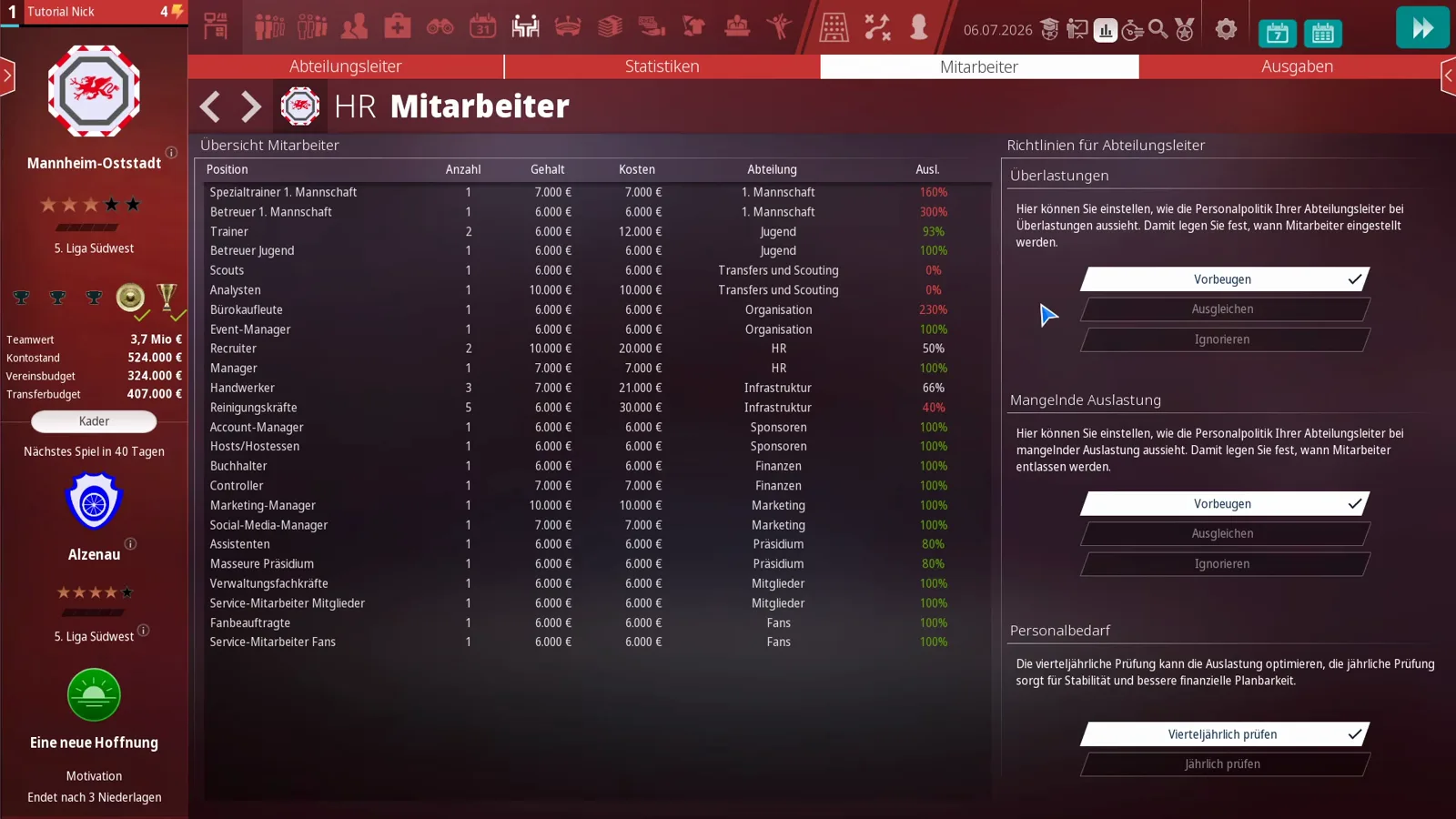
In the tutorial save the utilisation column is all over the place: one caretaker at 300%, office staff at 230%, the scouts and analysts at 0%. Überlastungen decides when heads hire, Mangelnde Auslastung decides when they fire, and the tutorial save has both set to Vorbeugen rather than Ausgleichen or Ignorieren. The third panel, Personalbedarf, is the review rhythm — the game’s own note says the quarterly check optimises workload while the annual one buys stability and financial planning. The presenter’s rule is prevention with a quarterly review, because annual checks leave the bars red for months.
The Ausgaben tab is three dated buttons plus a list of cuts. Jahresbonus ausschütten costs €3,200 and is only possible in January, Sommerfest planen costs €784 in June, Weihnachtsfeier planen costs €320 in December.
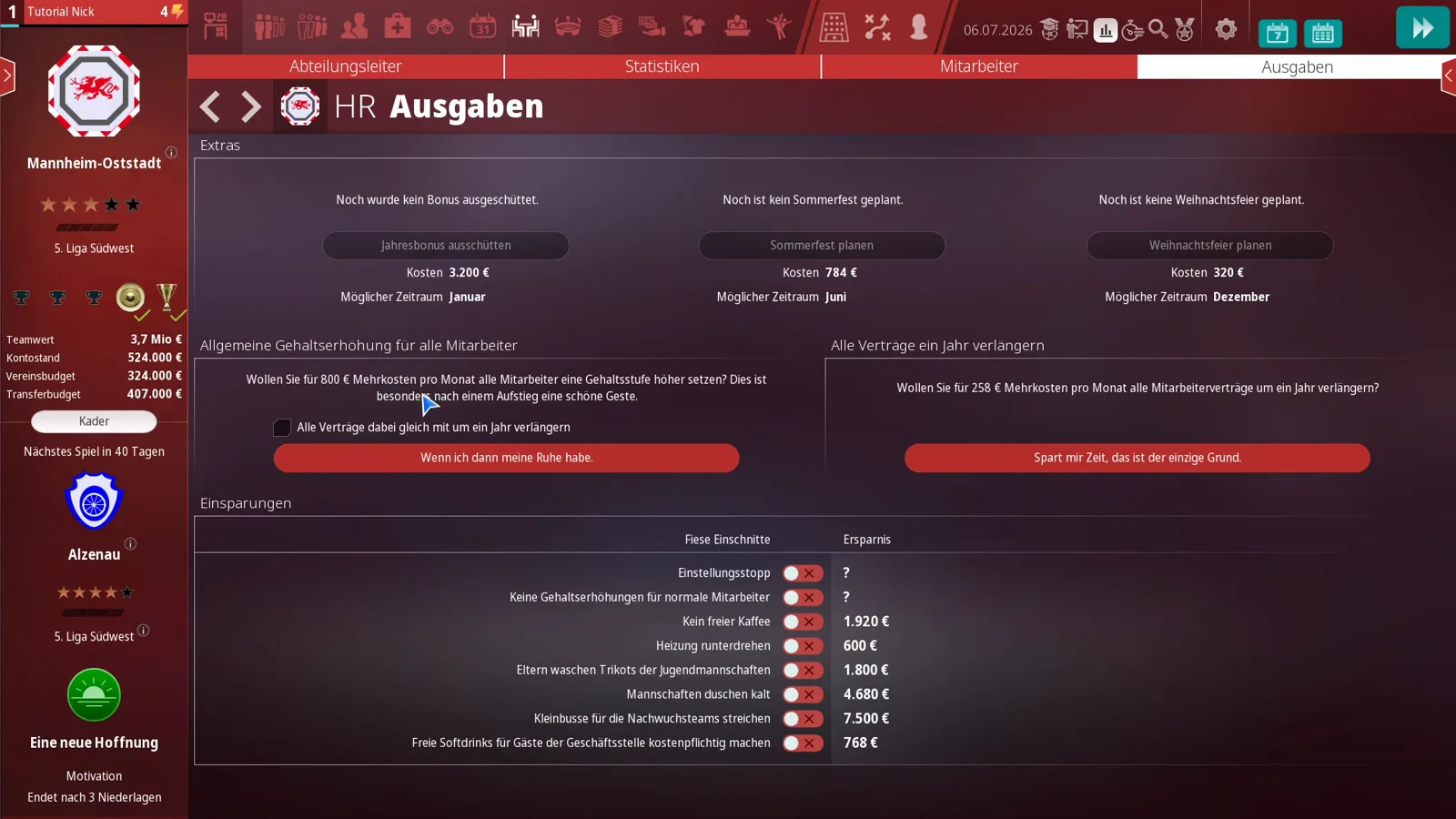
Two more panels raise everyone one salary step for €800 a month extra — the game pitches that one itself as a nice gesture after promotion — or extend every contract a year early for €258 a month, which stops the weekly stream of renewal requests. Under Fiese Einschnitte sit the savings switches: hiring freeze and no raises for ordinary staff (both listed with an open saving), no free coffee worth €1,920, cold showers at €4,680, parents washing the youth kits at €1,800, cutting the youth minibuses at €7,500 and charging guests for soft drinks at €768. Pull those and staff mood pays, so keep them for a real crisis and plan salary lines properly with the wage budget guide instead.
Related Guides
guides
WE ARE FOOTBALL 2027: Board Expectations, Popularity & Season Goals
Board expectations in WE ARE FOOTBALL 2027 explained: the Präsidium screen, season goals, popularity, budget requests, member approval and fan work.
guides
WE ARE FOOTBALL 2027: Player Morale, Satisfaction & Biss Explained
How morale works in WE ARE FOOTBALL 2027: the Motivation bar splits into Zufriedenheit and Biss, what moves each one, and the fixes that actually work.
guides
WE ARE FOOTBALL 2027: System Requirements & Compatibility
WE ARE FOOTBALL 2027 system requirements: 64-bit Windows 10, 8 GB RAM, 4 GB VRAM, Shader Model 6.0. Plus Mac, laptop, ultrawide, controller and offline answers.
Was this helpful?
Thanks for the feedback!