WE ARE FOOTBALL 2027 Scouting Guide: Network, Scouts, Transfers
How scouting works in WE ARE FOOTBALL 2027: hire scouts, raise the country network, run scouting orders, use the free Basismission scouts and read the ledgers.
Frequently Asked Questions
How many scouts should you assign in WE ARE FOOTBALL 2027?
What does the scouting network do in WE ARE FOOTBALL 2027?
How do scouting orders work in WE ARE FOOTBALL 2027?
What is the Basismission in WE ARE FOOTBALL 2027?
Why is my scouting list full of players from my old league?
What is the Solidaritätsmechanismus in WE ARE FOOTBALL 2027?
Transfers in WE ARE FOOTBALL 2027 are not won at the negotiating table — they are won weeks earlier, in the Transfers und Scouting hub, where the game quietly decides how much you are allowed to know about any player. The tutorial dissects that hub screen by screen: hiring scouts, raising the country network, running paid scouting orders, the free scouts of the Basismission, and the ledgers that track every euro moving between clubs. Where youth prospects come from in the first place is the youth scouting guide; this page is about the senior pipeline.
How do you hire scouts in WE ARE FOOTBALL 2027?
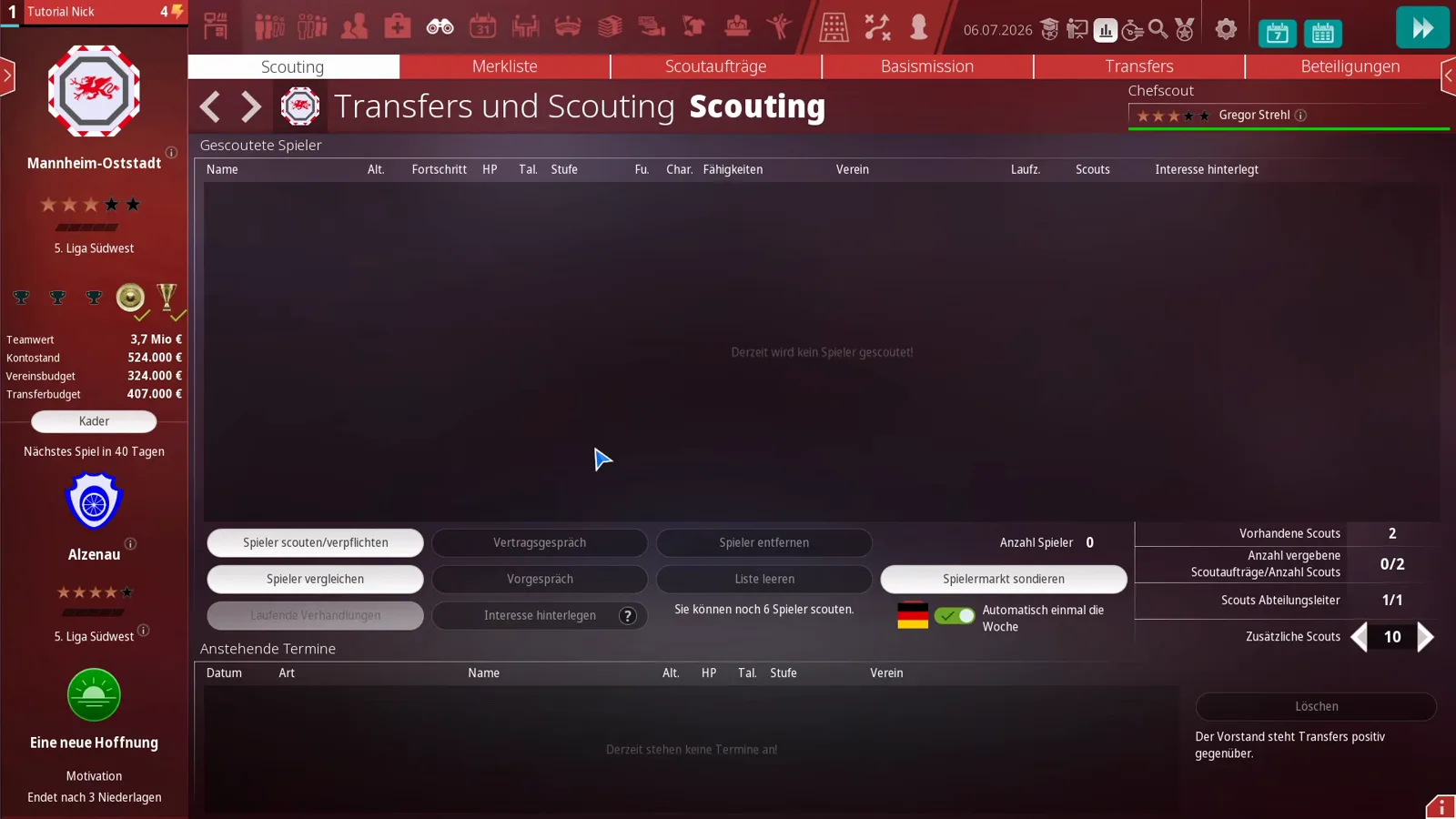
The Scouting tab opens on the workforce screen: your chief scout (the save’s is Gregor Strehl) sets the base speed of every assignment, the table below collects the players currently being watched, and the side panel counts what you have — 2 scouts available, none assigned, no orders running — plus the slider for how many additional scouts to hire. The catch is physical: scouts need offices, and a small club has none to spare. The author has run a full twenty-scout operation in this league, but only where the building existed first.
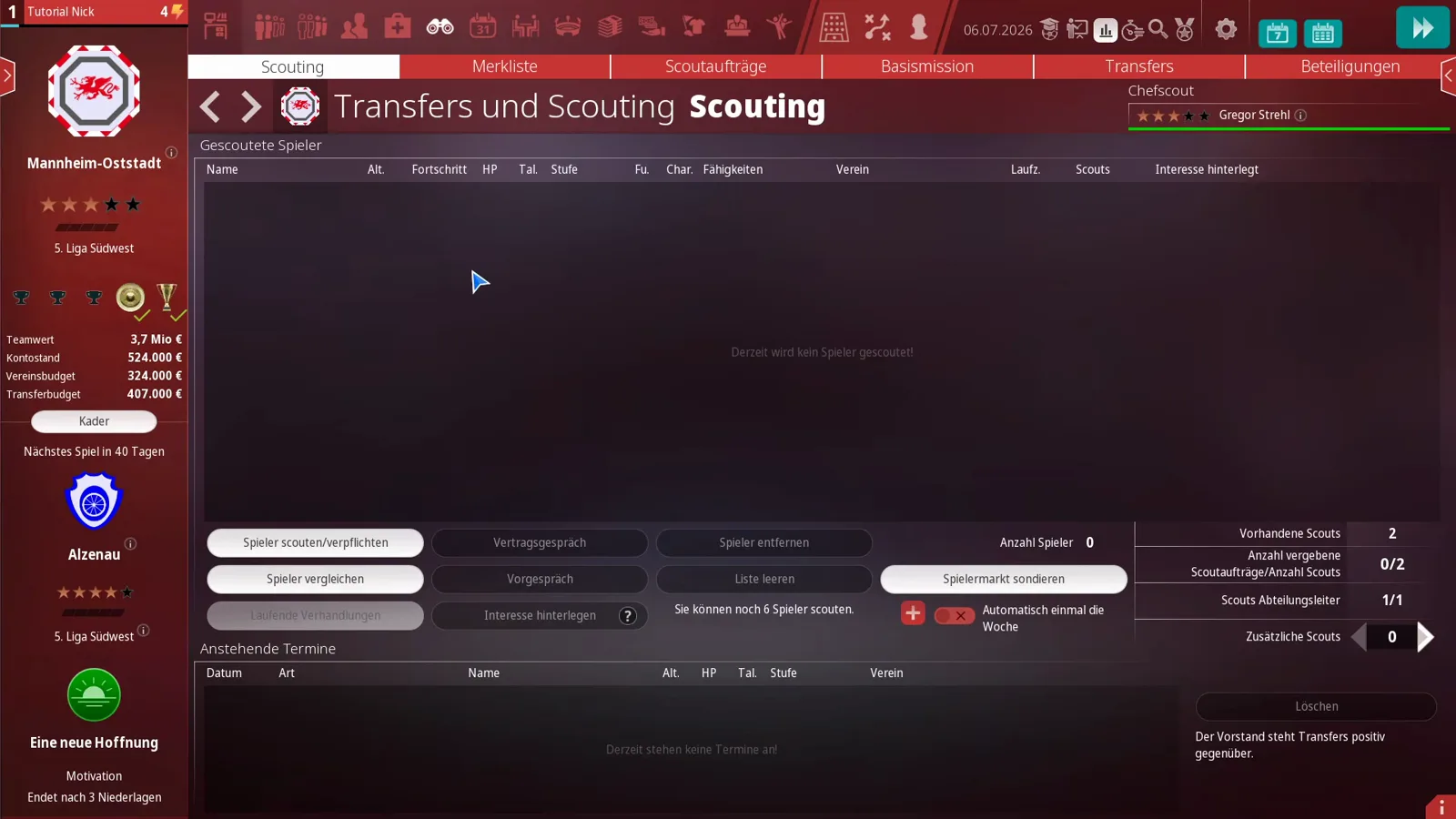
The scaling rule sits in the assignment dialog: the first scout on a player works at 100 percent, the second lifts the speed to 150 percent, the third to 175 percent — and a fourth adds nothing. Everyone who knows the game, the author says, scouts with three, even though the UI happily accepts six.
What does the scouting network do?
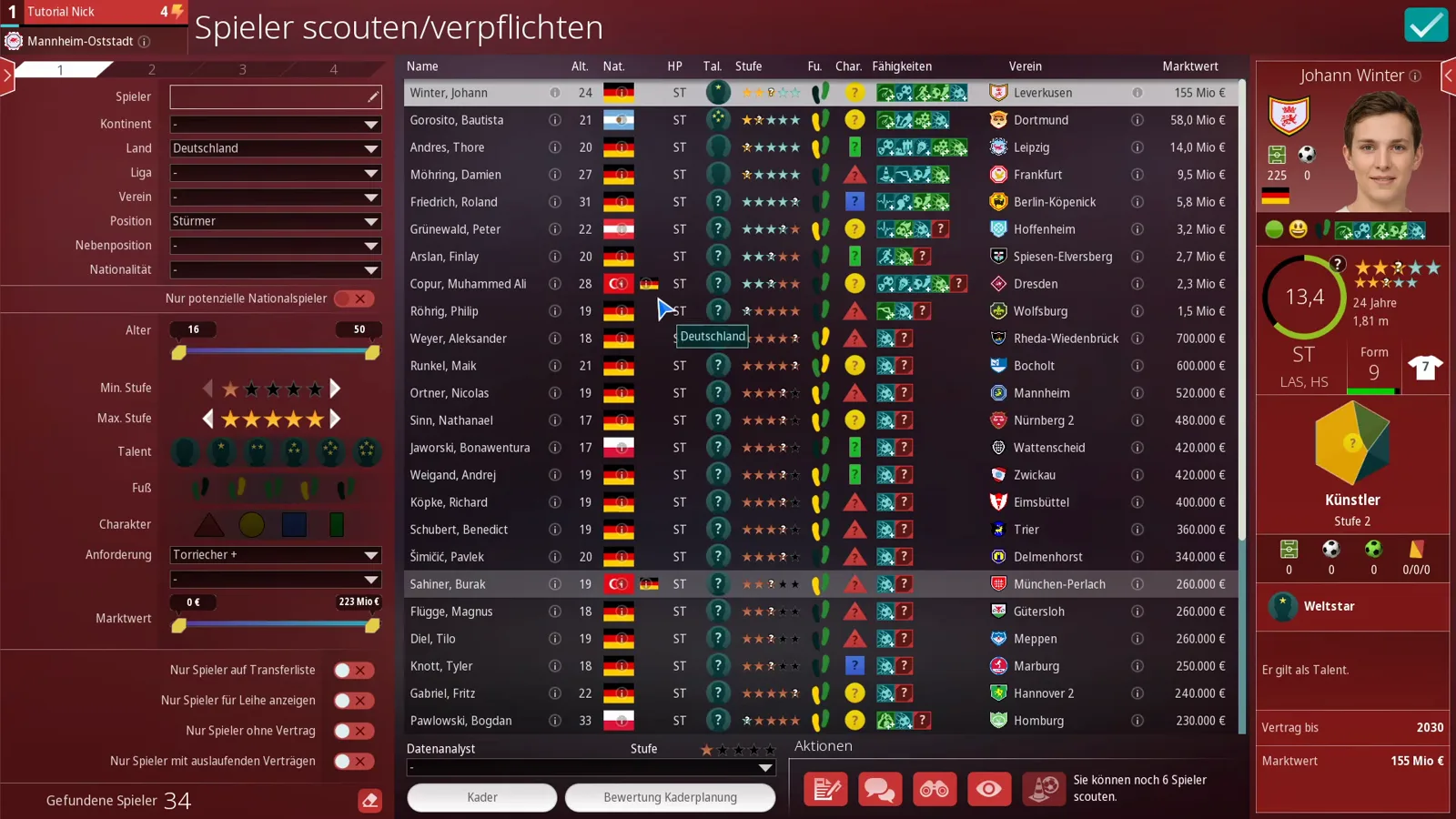
Before any search makes sense, the game asks where you are allowed to look. Every country carries a Netzwerk level from one to five, and the search dialog spells the mechanic out verbatim: the number in brackets shows how good your network is in that country — the better the network, the more you see about its clubs and players. Starting in Germany hands you level three at home; the author’s advice is to push it to five, because the network feeds two tanks at once: it reveals talent levels, character and more skills on the list without a single scouting hour spent, and it sets the level your scouts start at — a home-country report begins at 3, not 0, and finishes that much sooner.
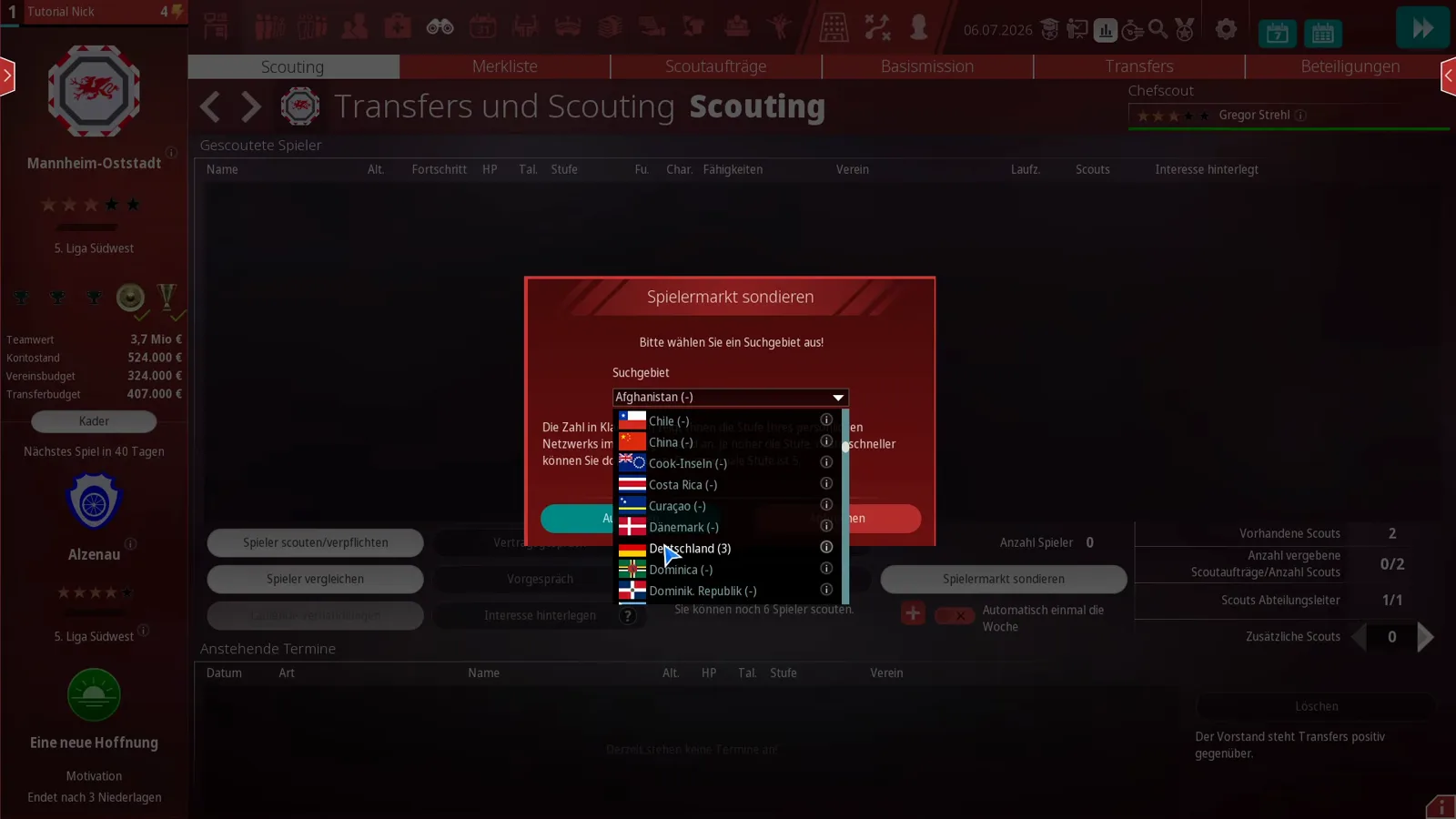
The demo makes the limit visible: filter the market for German strikers with a nose for goal and the list fills with home-league names — while Spanish or Italian forwards with the same trait simply do not exist for you yet. Their cells stay question marks until the network reaches them.
How do scouting orders work?
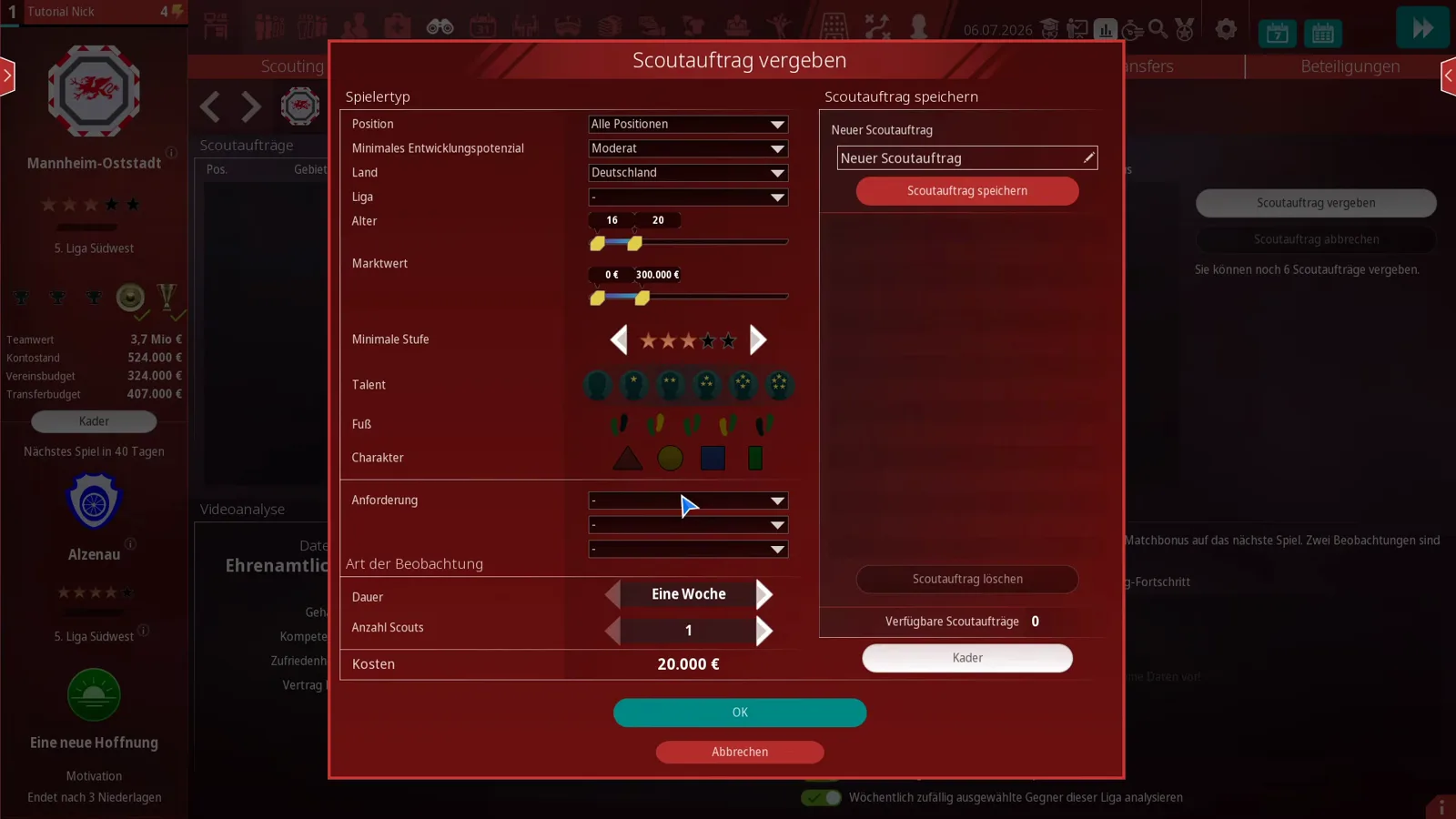
The Scoutaufträge tab takes up to six standing orders, each a fully configurable search profile. The dialog stacks the filters: position, a minimum development potential (the video picks Moderat), country, league, an age band (16 to 20), a market-value ceiling (300,000 € in the frame), a minimum strength rating, plus talent, foot and character grids. Duration is the cost dial: one week burns money fast with more scouts, a six-week run is cheaper but slow — the video’s one-week, one-scout order is priced at 20,000 euros. Every configured profile can be saved by name and reloaded later, which turns a good search into a reusable template.
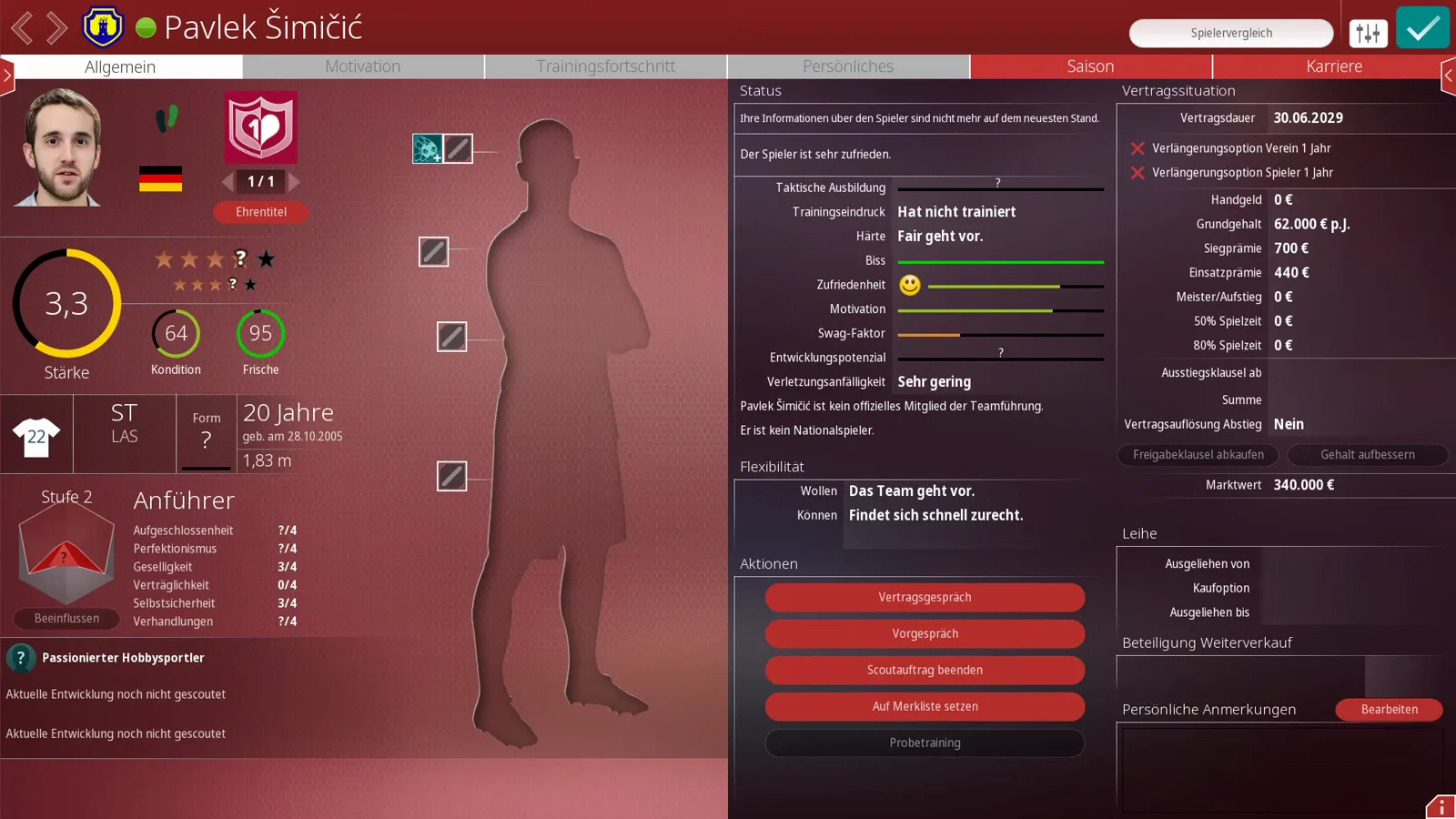
Paid orders are the expensive way to learn a region — the author calls them next to unaffordable below the professional leagues — and the results land as reports you promote onto the scouting list for a proper three-scout work-up. Once a player is fully scouted, the card’s action buttons take over: contract talks, a pre-talk, or parking him on the watchlist. What his numbers mean at that point is the player profile guide’s territory.
What does the data analyst do?
Below the orders sits the Videoanalyse panel, and it is the quiet match-day weapon. A data analyst (the save makes do with a volunteer earning 0 €) runs the video work and briefs the team in training, and two checkboxes steer where the analysis points: automatically analyse the next opponent once a week, plus a deep-dive into a random club of your league — the author enables both on camera, and the frame catches the weekly switch flipping green beside the German flag on the scouting overview. The match bonus that earns you is real, which is why the author hammers the trap: the league dropdown holds whatever you entered at your last club. Arrive at a new division with the old setting still selected and your analysts spend the season studying the wrong table.
What are the free Basismission scouts?
The Basismission rewards line fixes the cost problem: it hands you two permanent, free scouts who work your saved search pattern forever. The profile panel reads like the paid order’s twin — position all, minimum development potential Moderat, country Germany, league open, ages 16 to 20, market value open, minimum strength one star, maximum five — and whatever they find drops into the collection list, from where a click sends players to the scouting list, a contract talk or a pre-talk. The author ranks this above the paid orders for small clubs.
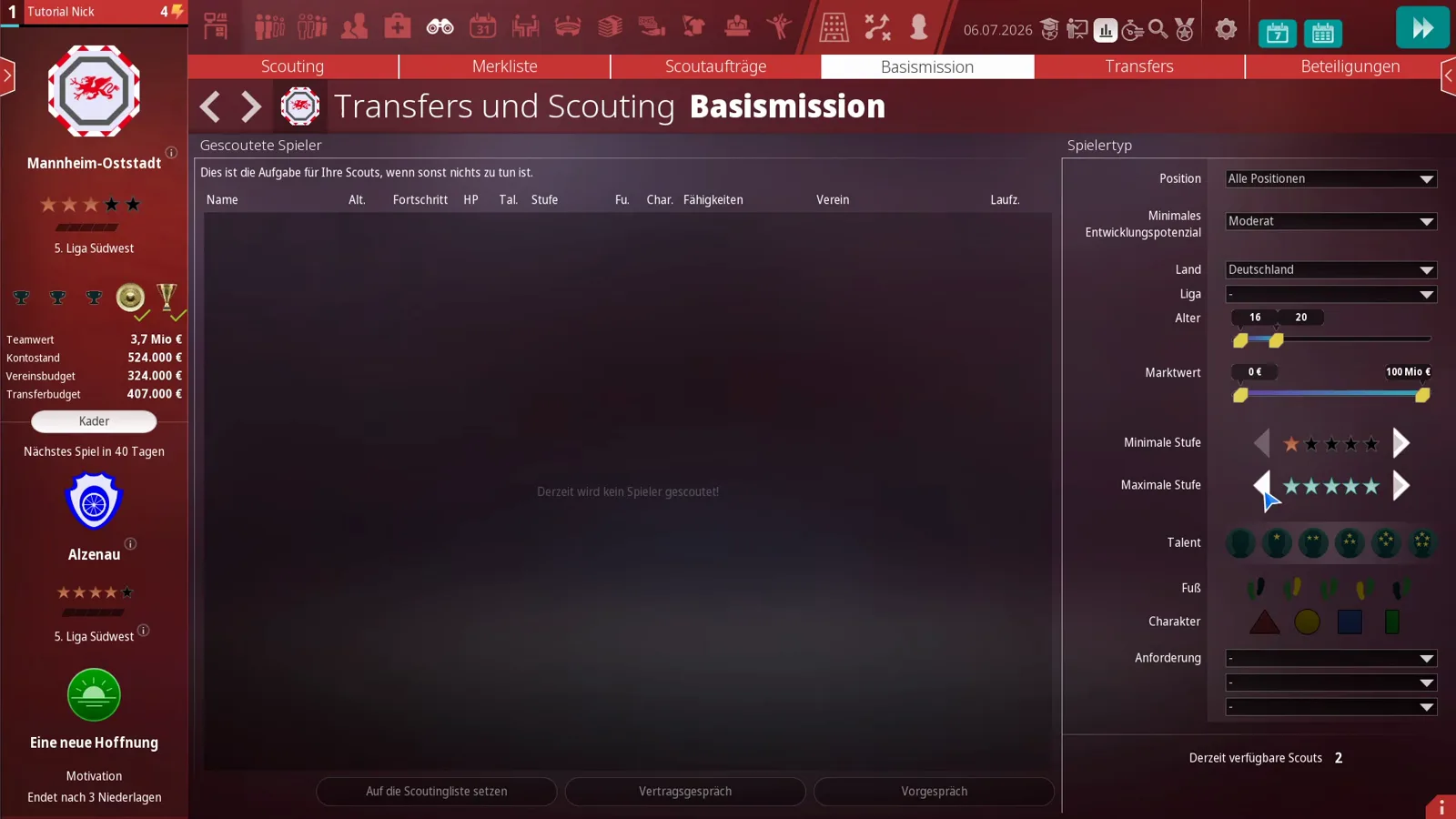
His favourite part is new in 2027: the search now accepts a maximum strength alongside the minimum. In the predecessor you could only set a floor — which is how a sixth-division budget ended up staring at a list of 13-rated Bundesliga talents priced at 15 million. The video demos exactly that trap: a Germany-wide striker search returns 34 names, topped by a 13.4-rated talent worth 155 million euros, with the unknowns in the table marking everything your network cannot yet see. The cap now filters dreams like that out of the suggestions.
How do you read the transfer balance?
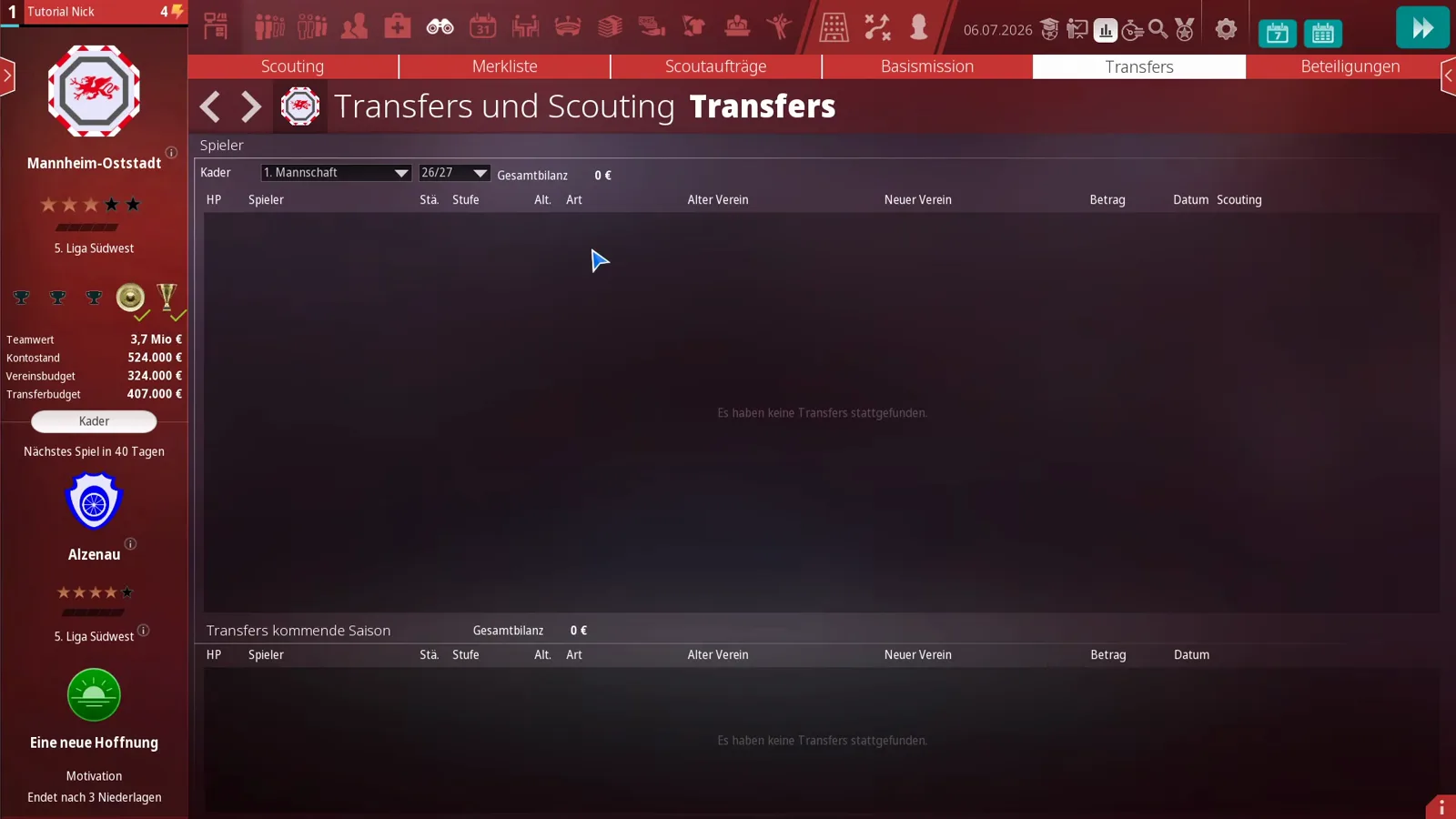
The Transfers tab is the club’s deal ledger: every incoming and outgoing player per year and squad, with the season’s totals — the tutorial save’s ledger is simply empty, zero in and zero out, which is as honest a starting point as any. One screen over, Beteiligungen lists the money that moves without negotiations: sell-on clauses you earn when former players move on, the shares you owe on signings with resale kickers, and the Solidaritätsmechanismus — the five percent of every transfer sum that flows back to the clubs that trained a player. Small clubs live on that drip; the author’s advice is simply to know it is there.
Between the free scouts, the network levels and the solidarity drip, the pipeline funds itself — provided the players it surfaces actually develop, which is the player development guide’s story, and provided the wonderkid shortlists it feeds get read, which the best wonderkids guide turns into a plan.
Related Guides
guides
WE ARE FOOTBALL 2027 Team Strength Comparison: Stars, Gauges, Scouting Lists
How to read team strength in WE ARE FOOTBALL 2027: Kader stars, the profile gauge, the pre-match Mannschaftsteile bars and the scouting list for the next fixture.
guides
WE ARE FOOTBALL 2027 Season Planning Guide: Budget Split, Kits and Squad Numbers
The Saisonplanung stretch in WE ARE FOOTBALL 2027 screen by screen: promotion payout, league target, budget split, new kits, club rules and squad numbers.
guides
WE ARE FOOTBALL 2027 Relegation Battle Guide: Escaping the Red Rows
A relegation battle in WE ARE FOOTBALL 2027 screen by screen: the red Verbandsliga table rows, a 0:1 away steal, a 1:4 home defeat and the January deals in between.
Was this helpful?
Thanks for the feedback!