WE ARE FOOTBALL 2027 Tactical Familiarity: Train Your Tactical Values Right
How tactical familiarity works in WE ARE FOOTBALL 2027: tactical values stack on base strength, weekly focus training earns +7/+10, and the assistant trap to avoid.
Frequently Asked Questions
How do tactical values grow in WE ARE FOOTBALL 2027?
What happens to tactical values in a week without a league match?
Can I train more than two tactical values per week?
When should I use special attacks (Einstudierte Angriffe) in matches?
Do tactical drills also train player skills?
Why is my team strength higher than the opponent's despite an equal squad?

DAS macht dein Team überragend! Training, Fitness & Taktik richtig nutzen
Every save has two strength sheets. The first one lists your players and their ratings — that sheet is mostly fixed by transfers and youth work. The second one lists your tactical values, and it is the sheet you can move every single week from the dugout. The author’s thesis, proven across a promoted save: you do not need the strongest squad to win, because team strength is base strength plus tactical familiarity, and the second half is fully trainable. This page follows that growth loop only. Which philosophy and formation to pick is the best tactics and formations debate, how the match-day sliders and instructions behave is the match engine tactics guide’s territory, the training screen’s plans and drill scope live in the training plan guide, and the week around match day is the weekly schedule guide’s.
What are tactical values in WE ARE FOOTBALL 2027?
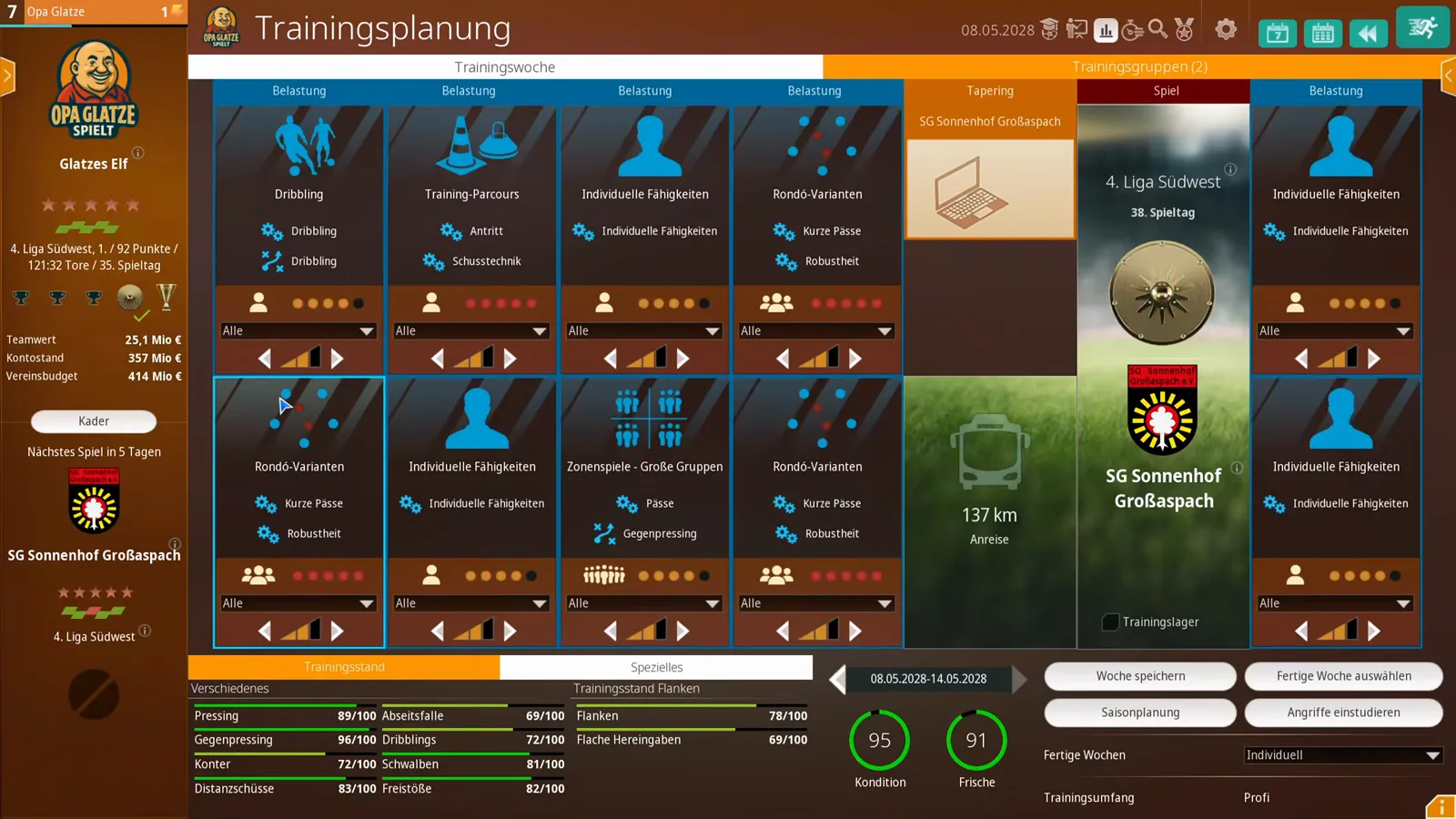
Open the tactic screen and look under your philosophy: every instruction carries its own Trainingszustand (training state) value on a 0-100 scale. The video’s save, drilled over seasons, reads Eigenes Pressing 89/100, Gegenpressing 96/100, Konter 72/100, Distanzschüsse 83/100, Abseitsfalle 69/100, Dribblings 72/100, Schwalben 81/100, Freistöße 82/100 — plus the corner trio Kurz 84, Rückraum 76, Strafraum 77 and the flank pair behind them.
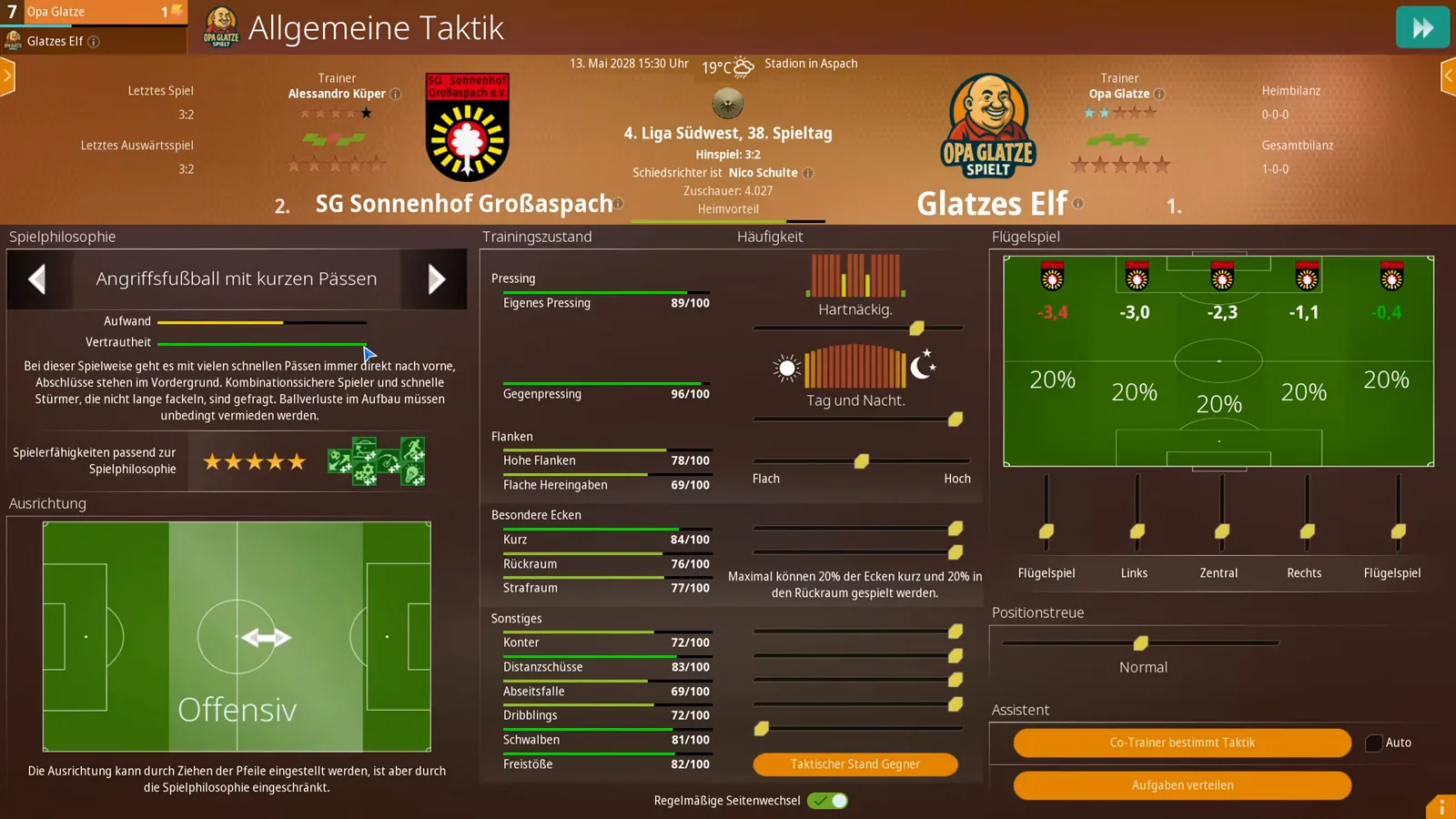
At the start of a save those values sit somewhere in the low double digits — the author quotes starting points like 10, 15 or 20 out of 100 — and they decay toward zero if you never train them. That is the whole economic loop of the feature: tactics you set in a match are tactics your players rehearse every time they play, and weekly training pushes the numbers further. The philosophy itself carries a Vertrautheit bar in the same panel, so even your style of play has a familiarity rating that only fills if you stop switching styles — the author’s rule is to decide once (he plays attacking football with short passes, always has) and never look back. The screen also spells out one hard-coded limit worth knowing: max 20 percent of corners can go short and max 20 percent to the far post, the rest land in the box.
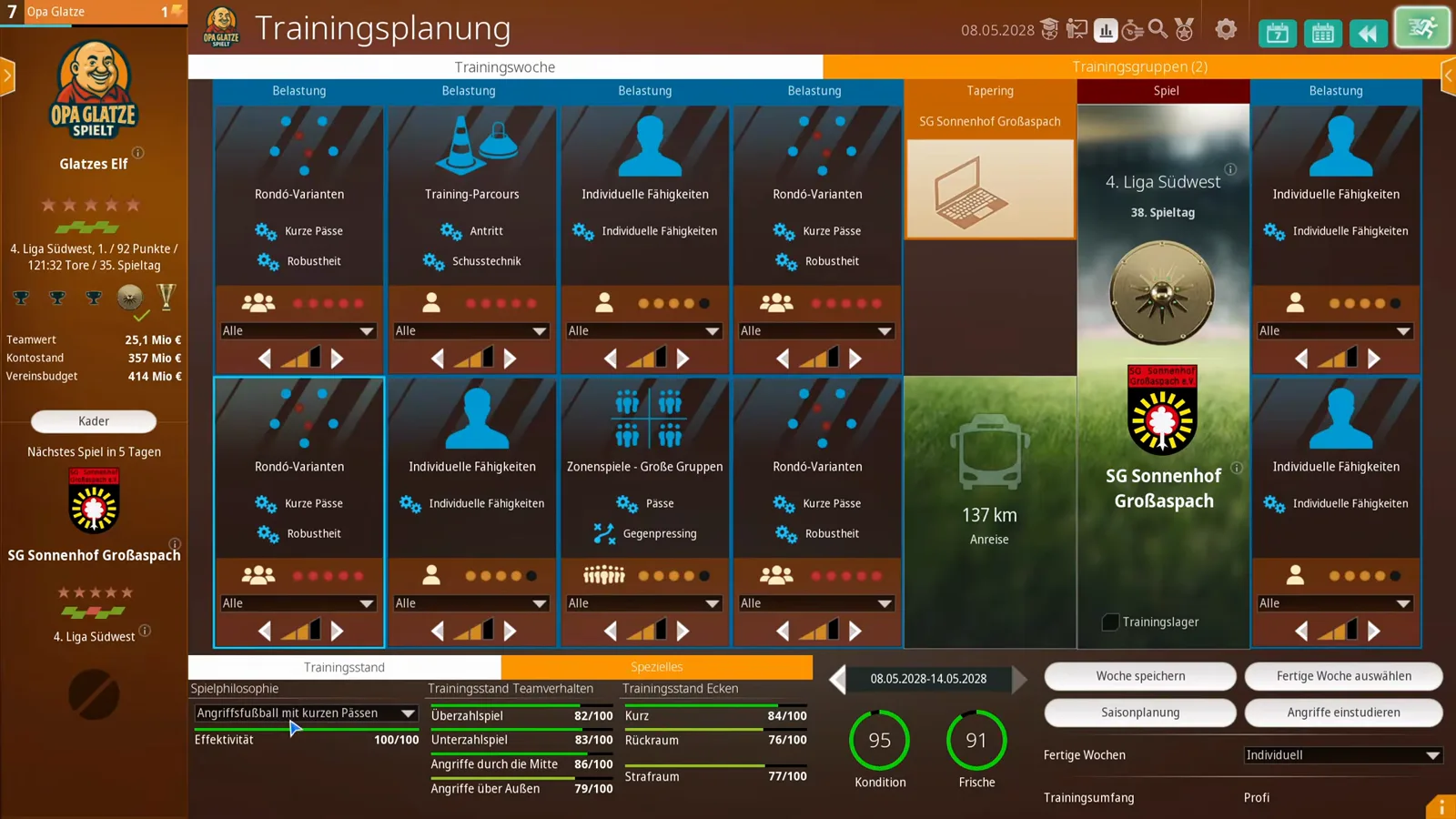
The second place the values live is the training week itself. The Trainingsplanung screen carries two strips under the day grid — Trainingsstand and Spezielles — and between them they list the whole battery: pressing family, counters, set plays, crossing values, and the Teamverhalten group (Überzahlspiel, Unterzahlspiel, Angriffe durch die Mitte, Angriffe über Außen).
Why team strength is base strength plus tactical familiarity
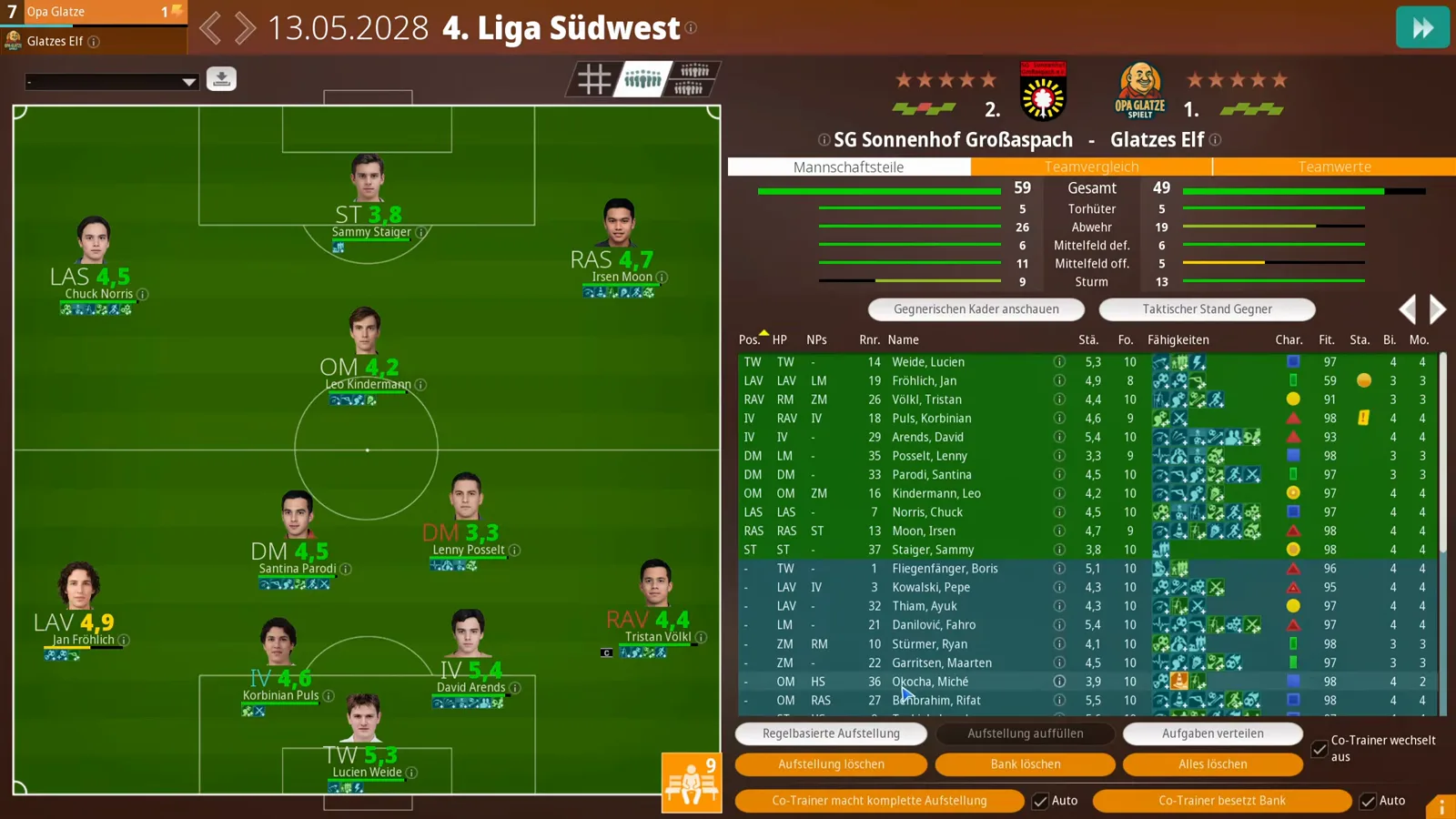
The cleanest demonstration in the video happens on one screen, twice. Before a league match against SG Sonnenhof Großaspach, the Teamvergleich tab first shows the author’s reserves: Gesamt 59 against 49 — ten points worse, exactly the gap he narrates (“we’re playing with the reserves here”).
Then he fields his strongest eleven and the same comparison reads 59 against 59 — dead even on paper, with the unit rows showing why the opponent still fancies himself: Abwehr 26 against 19, while the author’s own Sturm answers 17 against 9.
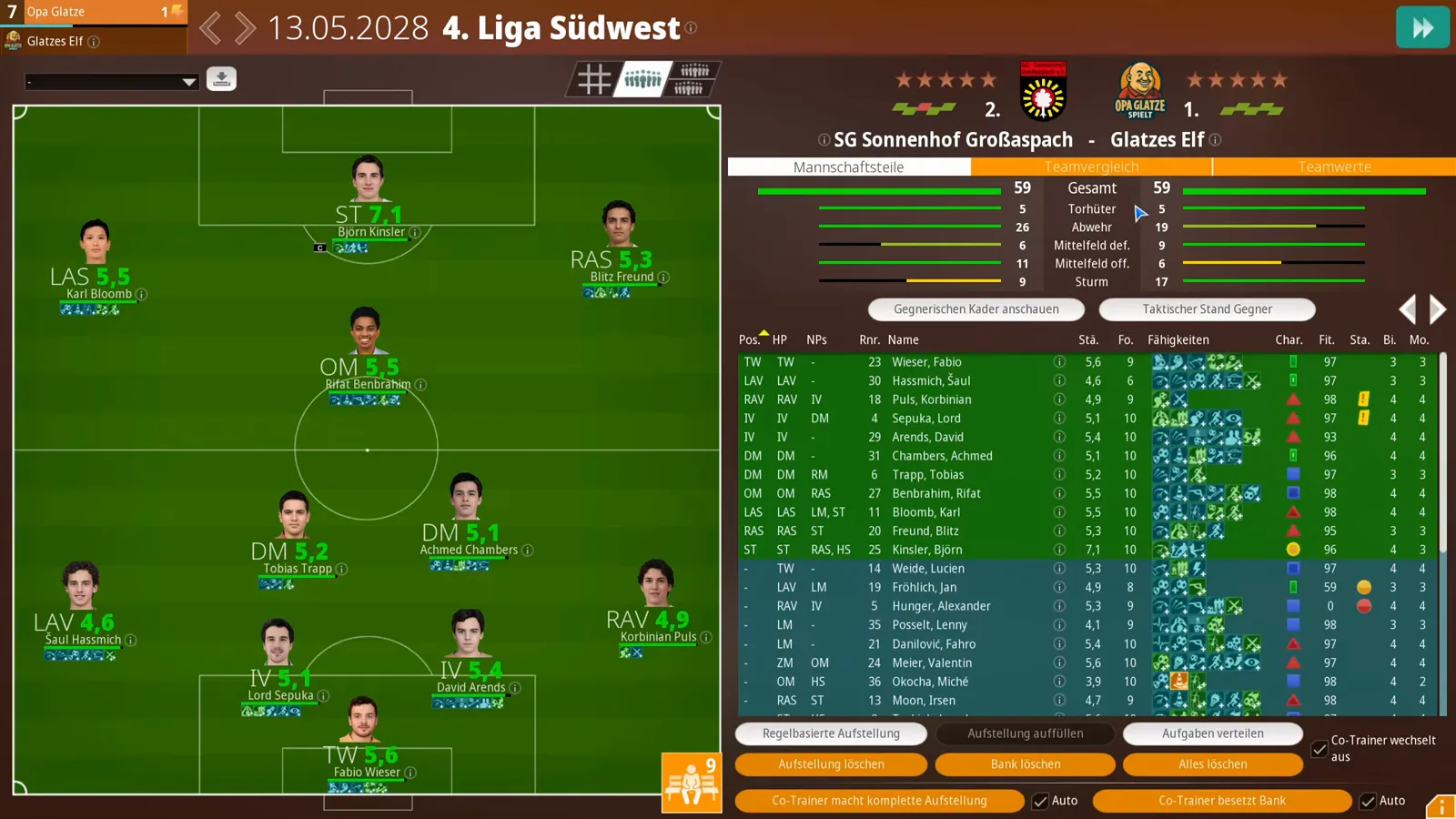
So how did that even match end 1:3? Because paper strength is only half the number. The author reads his tactical rating at about 95 against the opponent’s 75 and his team strength at 96 — his arithmetic, not a labeled figure the game prints, and the exact formula behind it is not documented in the game. His conclusion is the thesis of the page: when two squads tie on players, the drilled one carries roughly a 20-point head start into the engine. The same logic explains why your own team strength fluctuates season to season even with an unchanged squad — the tactical half moves under it.
How do you train tactical values week by week?
The weekly routine has four steps, and the author insists on doing them manually — “I don’t rely on the computer, I don’t rely on the AI”:
- Stop the training week and read the strips. The Trainingsstand strip lists the current numbers; in the video’s week that is Konter 72/100, Dribblings 72/100, Abseitsfalle 69/100, Flache Hereingaben 69/100 — the low marks are your candidates.
- Pick one tactic — two at most. Beginners should train exactly one value per week, established saves can afford two. The chosen drill goes on as many week days as the calendar allows; the video’s Monday carries the Dribbling drill with the match on Saturday.
- Let the match reinforce it. Every game played rehearses the tactics you have set — which is also why he sets his desired tactics from day one, even while the familiarity bar still shows a fraction of a star. A bad result costs you: his reading is that the match-day bonus collapses from +1 to 0 after a defeat.
- Collect the report. After the match the Teamfortschritt screen shows what the week earned.
The report is where the payoff is visible. In the video’s save, the Taktik list on the Teamfortschritt screen shows Konter +7 and Dribblings +10 — the two trained values jumping while the rest hold — and the Gegenpressing slider panel adds a +4 from its own week. Those are on-screen numbers from the video’s save, not theory.
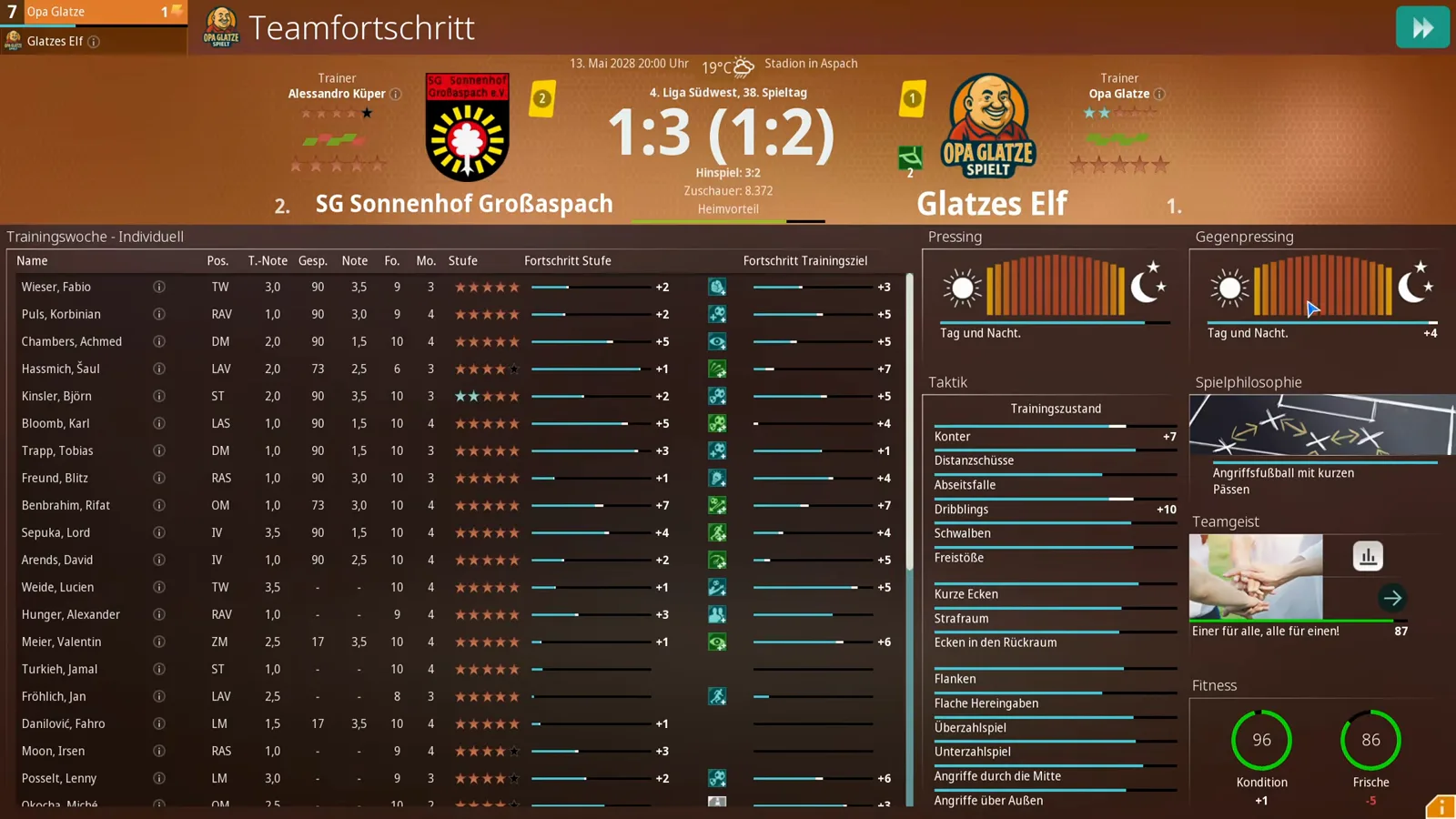
The counter-example is just as concrete: a week that sprinkles many tactics earns about +1 per value, untrained values sink by one point each in a week without a league game, and two negative weeks in a row start sliding a value back toward zero — after +10, that is ten lost weeks. Focus is not a preference here, it is the mechanic. How to place those drills around match day is rhythm work covered by the weekly schedule guide.
The assistant-coach trap: skills are not tactics
Every week the game proposes a training focus matched to your philosophy. The author’s verdict is blunt: “don’t listen to what he posts here.” His philosophy’s suggestion list — short passes, robustness, acceleration, shooting drills, individual skills — is almost entirely skill training, and he counts on screen that only two slots a week touch anything tactical, counter-pressing among them. Follow the assistant all season and your tactical values reliably rot while the skill numbers rise.
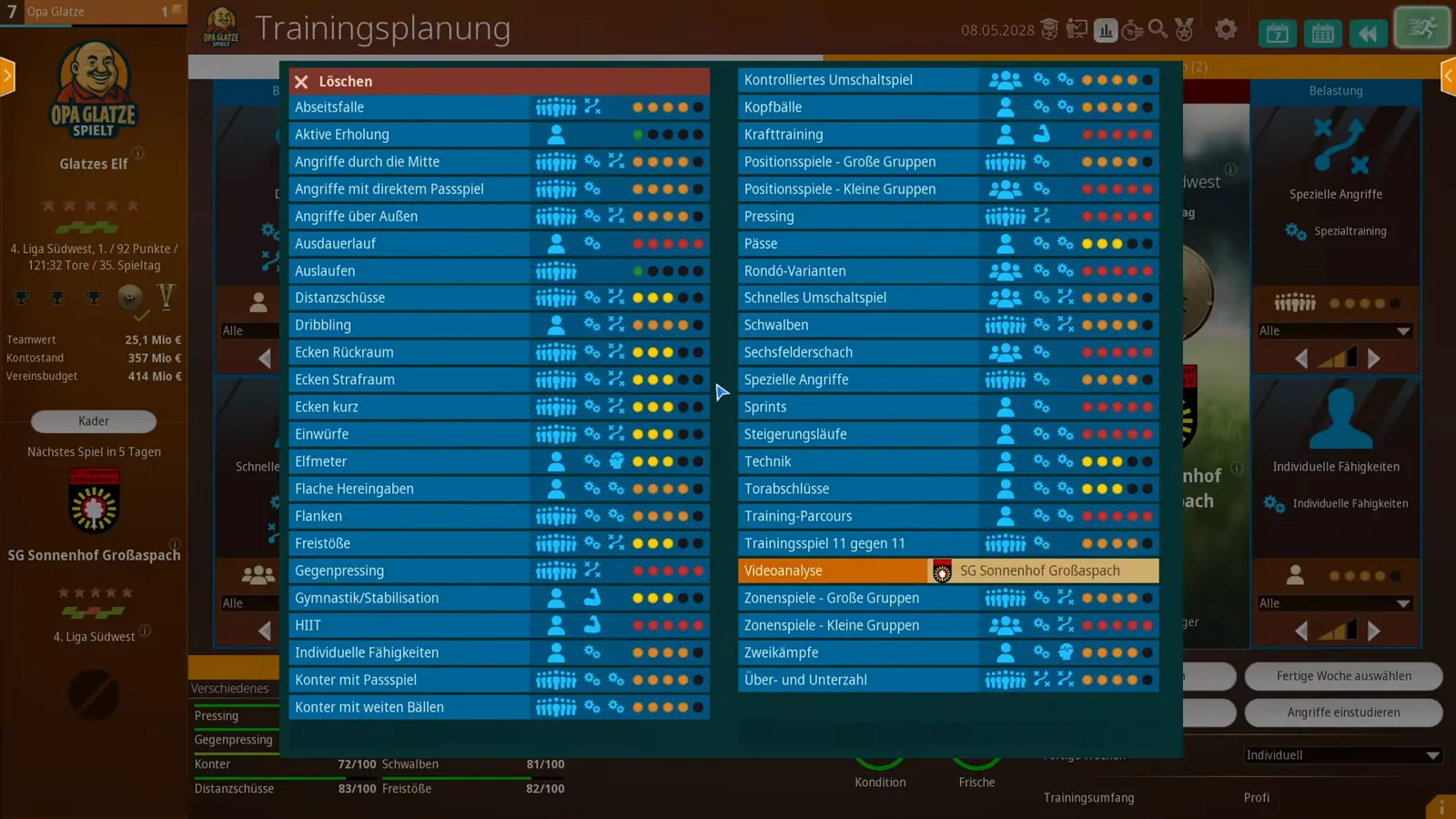
The drill catalogue shows why the confusion is so easy: every entry lists what it trains, and the gear icons separate abilities from tactics. The good news runs one way only. Tactical drills drag their skills along — the Dribbling drill carries both a Dribbling ability gear and a Dribbling tactic gear, so one card fills both sheets, and corner drills train the corner skill and the corner value together. Pure-tactic entries exist too: pressing, counter-pressing and the offside trap train the tactic only. But the reverse never holds: a week of individual skills trains zero tactics, and drills with Konter in the name train passing and speed — not the counter-attack value itself (the one drill that does carry the Konter entry is catalogued in the training plan guide’s drill list). Skills make better players; tactics make a better team, and the author ranks them without hesitation.
Special attacks: practice first, switch on later
Set plays are their own sub-loop. The Angriffe einstudieren editor holds four attack slots — the video runs all four, including an attack through the middle — each with a Trainingszustand progress bar and two toggles: Wird trainiert (being practiced) and Wird angewandt (used in matches).
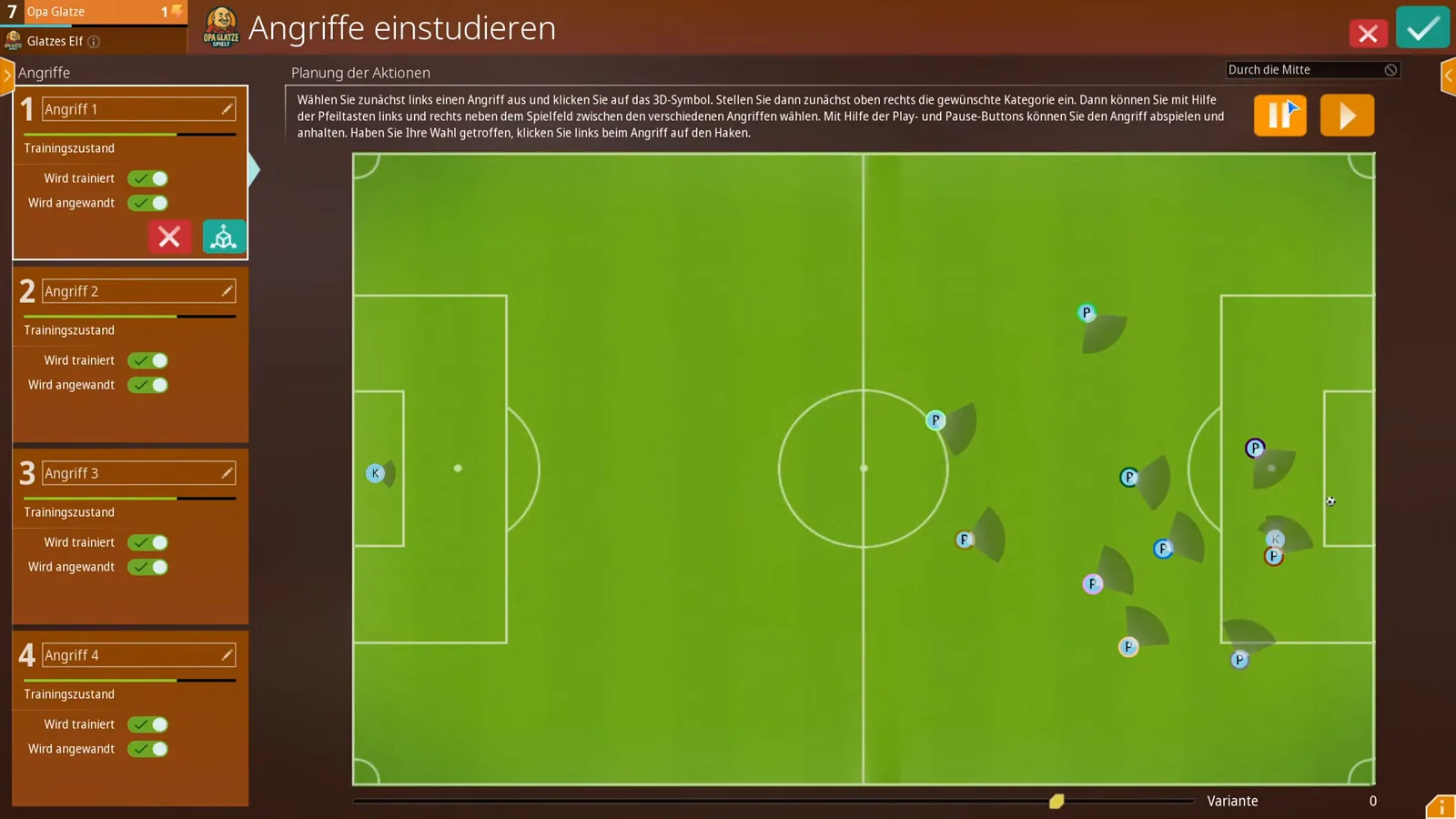
The author’s discipline: at the start he only practiced until a play’s bar reached the yellow tier, then flipped Wird angewandt on and let the match do the rest of the teaching. Half-trained set plays waste chances; never-trained ones never score. Once the bars run green — as his do on the match screen, all four attacks listed with full bars and live toggles — he reports they convert very often. The same four attacks then appear on the Matchanweisungen screen before kickoff, so you can audit what will actually run without opening the editor.
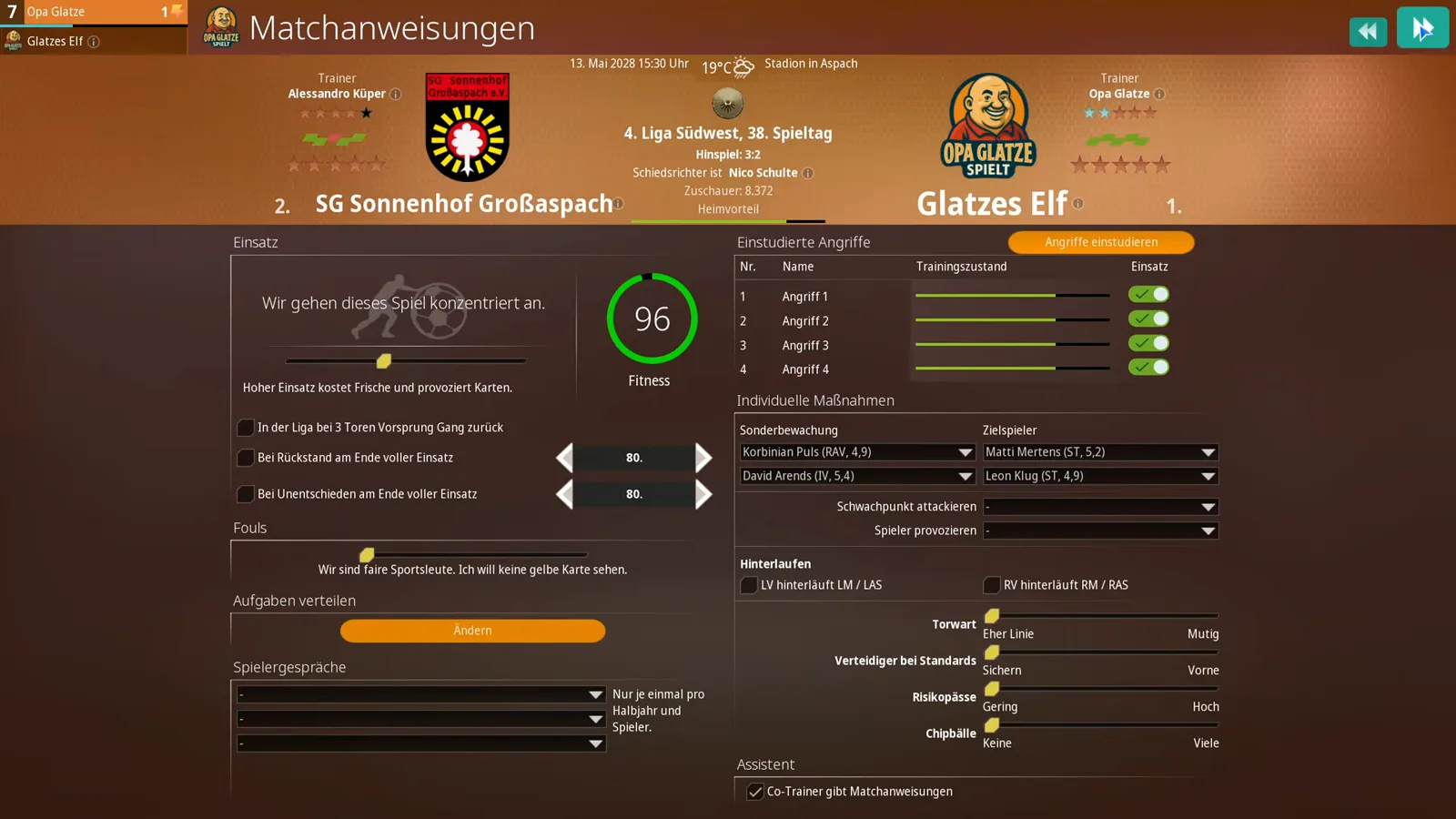
Who takes the resulting corners and free kicks is set in the Aufgaben verteilen dialog — covered step by step in the lineup screen guide.
Training groups: the fitness trade-off behind it all
None of this works on a squad that is always yellow. The author’s non-negotiable: split the squad into training groups — “anyone who plays without training groups has lost.” His standing setup, visible on the Trainingsgruppen tab, runs three groups: a Regeneration group for players who may recover this week, a Kondition group hammering the fitness base, and a Fähigkeiten group working through training goals. Both delegation checkboxes stay off — no weekly reset, no co-trainer management — while Dabei Gruppeneinteilung behalten keeps the assignments stable.
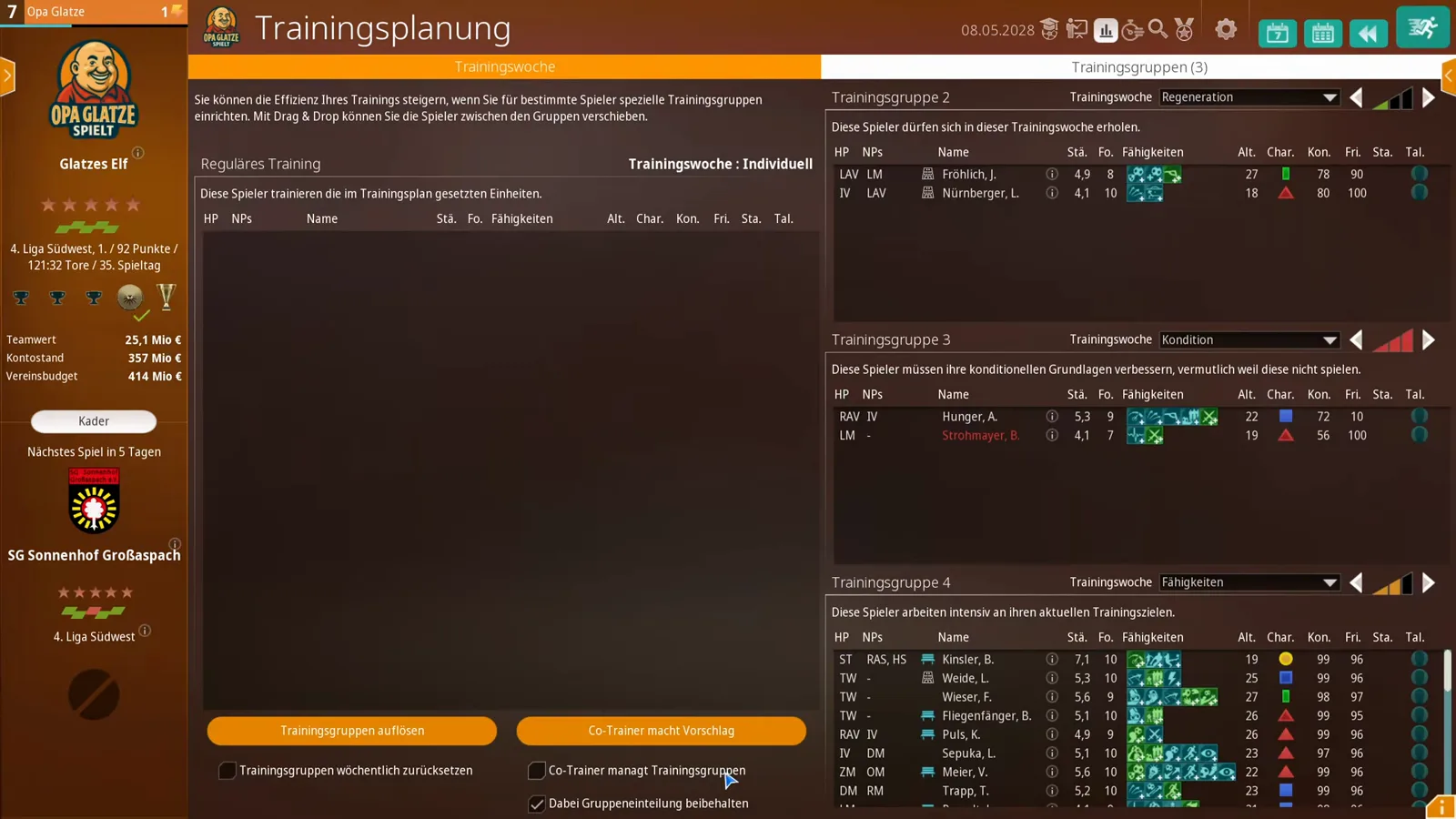
The trade-off he accepts: his players never sit at 100 percent fitness — regulars hover around 80-90, which the three-group loop keeps deliberate, because match players cannot also max their condition. Injured players rotate through regeneration until their stamina is rebuilt, and friendlies exist so the bench gets match minutes too — players who never play gain no tactical values at all, since match rehearsal is half the loop. How injuries and recovery interact with that calendar is the medical and injuries guide’s subject.
The weekly loop in short
Set your tactics once and leave them; read the Trainingsstand strips every week; drill the lowest one or two values all week; let the match do its half; check Teamfortschritt for the +7/+10; repeat until the Bundesliga battery reads 100 across the board. That is the author’s entire system — no wonder games, scouting and transfers only decide the ceiling, while this loop sets your floor. The tactic values you are feeding all this work into are only half the story if the instructions themselves fight your philosophy — that calibration lives in the match engine tactics guide, and the formation question in the best tactics and formations guide.
Related Guides
guides
WE ARE FOOTBALL 2027 Team Strength Comparison: Stars, Gauges, Scouting Lists
How to read team strength in WE ARE FOOTBALL 2027: Kader stars, the profile gauge, the pre-match Mannschaftsteile bars and the scouting list for the next fixture.
guides
WE ARE FOOTBALL 2027 Season Planning Guide: Budget Split, Kits and Squad Numbers
The Saisonplanung stretch in WE ARE FOOTBALL 2027 screen by screen: promotion payout, league target, budget split, new kits, club rules and squad numbers.
guides
WE ARE FOOTBALL 2027 Relegation Battle Guide: Escaping the Red Rows
A relegation battle in WE ARE FOOTBALL 2027 screen by screen: the red Verbandsliga table rows, a 0:1 away steal, a 1:4 home defeat and the January deals in between.
Was this helpful?
Thanks for the feedback!