WE ARE FOOTBALL 2027: Player Morale, Satisfaction & Biss Explained
How morale works in WE ARE FOOTBALL 2027: the Motivation bar splits into Zufriedenheit and Biss, what moves each one, and the fixes that actually work.
Frequently Asked Questions
What is Biss in WE ARE FOOTBALL 2027?
How do I fix an underpaid, unhappy player?
Does low morale actually reduce player strength in WE ARE FOOTBALL 2027?
The Motivation bar at the top of a player file is not a mood ring. It is arithmetic: the sum of Zufriedenheit (satisfaction) and Biss (bite). Half-full satisfaction plus a full bite bar lands the motivation bar at about three quarters, and a player with no bite at all can post a weak bar while being perfectly content.
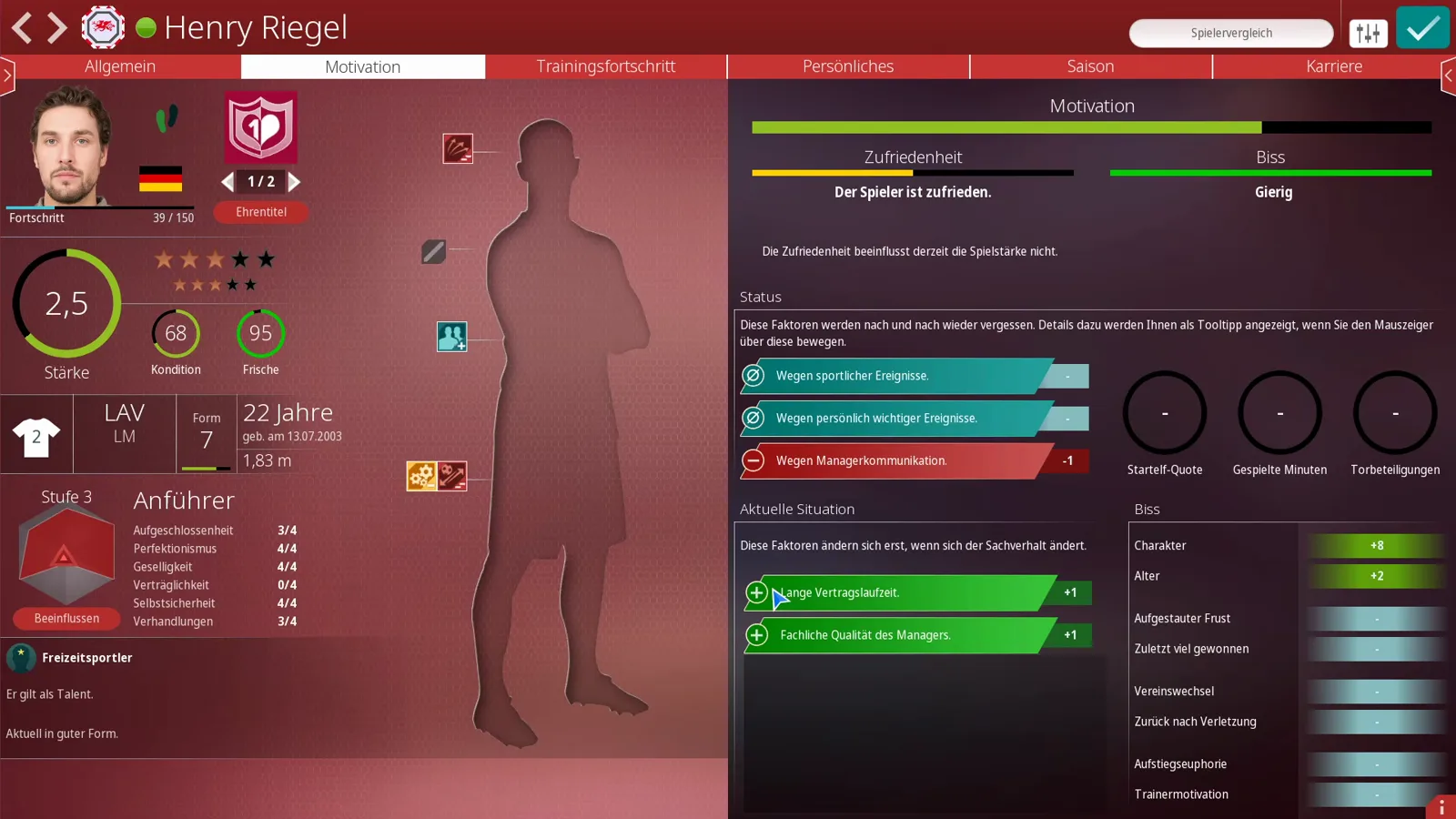
Read the two meters separately. Fixing “motivation” by talking to everyone is a waste of appointments.
What Moves Satisfaction
The tutorial lists five inputs, and the dossier prints them as scored rows under the bar: Wegen sportlicher Ereignisse (sporting events), Wegen persönlich wichtiger Ereignisse (personally important events) and Wegen Managerkommunikation in the Status block, plus Lange Vertragslaufzeit (long contract) and Fachliche Qualität des Managers (your own professional quality) under Aktuelle Situation. Each contributes a signed point, and the visible total is what the yellow or green bar represents.
Three of those are under your control.
Manager communication starts before the season. The tutorial’s examples: tell the dressing room you are building around experienced players and every youngster in the squad takes a deduction; criticise a player for yellow cards and poor grades and you score against yourself twice, once as communication and once as a sporting event. Personal events are the strangest line: the presenter cites a collector who bought a forged artwork and lost satisfaction when the fraud surfaced.
Your own qualification is the one new managers miss. In the tutorial’s worked case a level 1 coach in the top flight with a title challenger can see a -2 on the Fachliche Qualität des Managers row, because the squad rates the boss. Walk the other way — a level 12 Champions League winner dropping to the lower leagues — and the same row turns into a +2 bonus, because players want to prove themselves to a famous name.
Stadium and table feed in too. The presenter’s example is a 25,000-seat ground in front of 2,000 spectators costing satisfaction, and a relegation fight dragging the whole squad down — which he calls a self-fulfilling prophecy, because relegation battlers have to work far harder to keep any bite alive.
What Moves Biss
Bite is character first, age second. In the tutorial a 22-year-old with a strong personality shows +8 for character and +2 for youth, ten points of pure hunger — both rows are printed in the Biss block on the right of the same tab. As that player ages the youth bonus shrinks to one, zero or even minus one, and Aufgestauter Frust (pent-up frustration), a move to a weaker club or a bad run of results subtract further. Returning from injury, promotion euphoria and coach motivation can all push the number either way.
The game prints the rule itself once you hover that block: bite depends on age, character traits and past successes, and character is the most important factor for a value that stays high — without it a player loses “the absolute will to succeed” after his first successes and turns sated and slack.
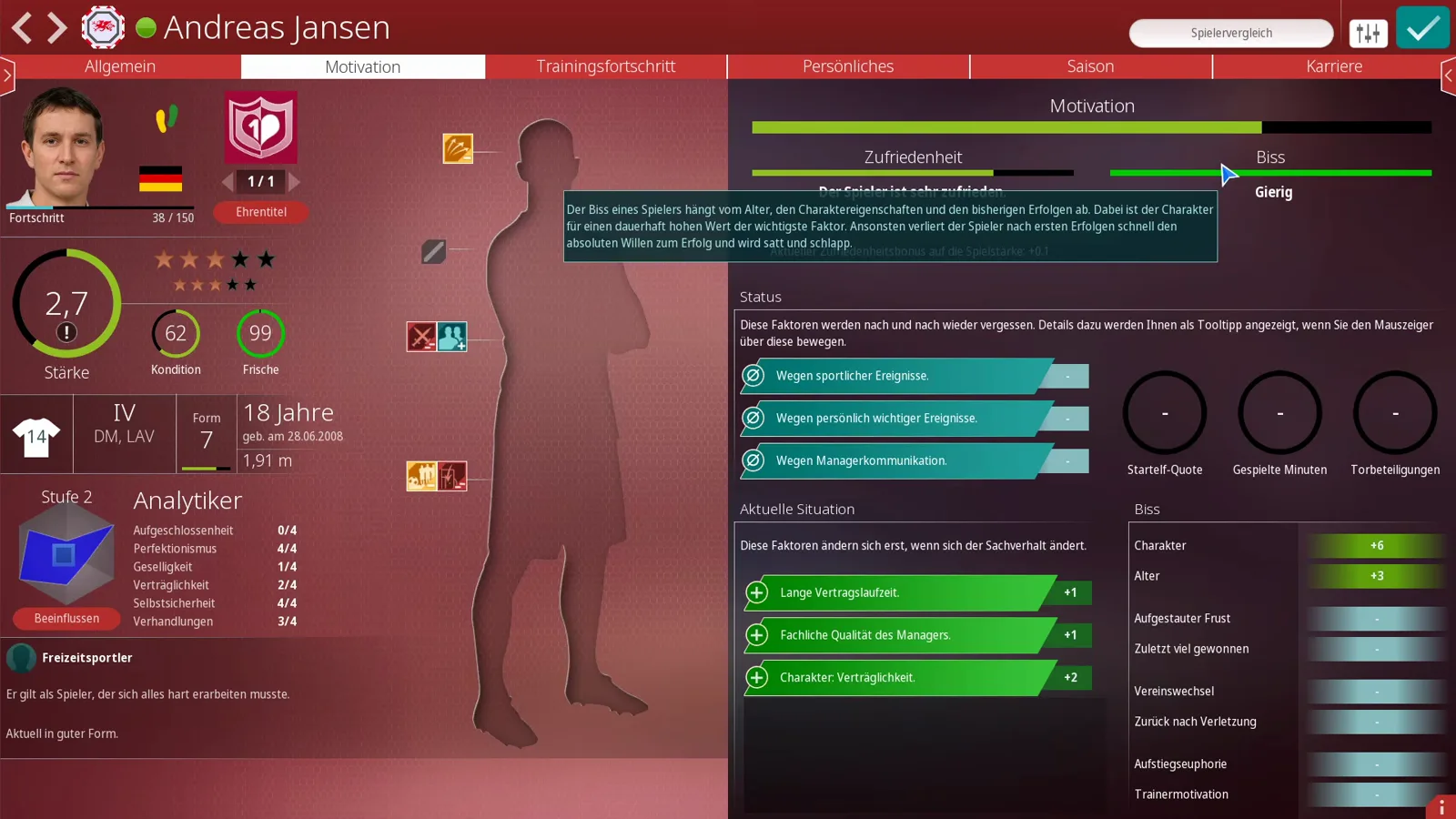
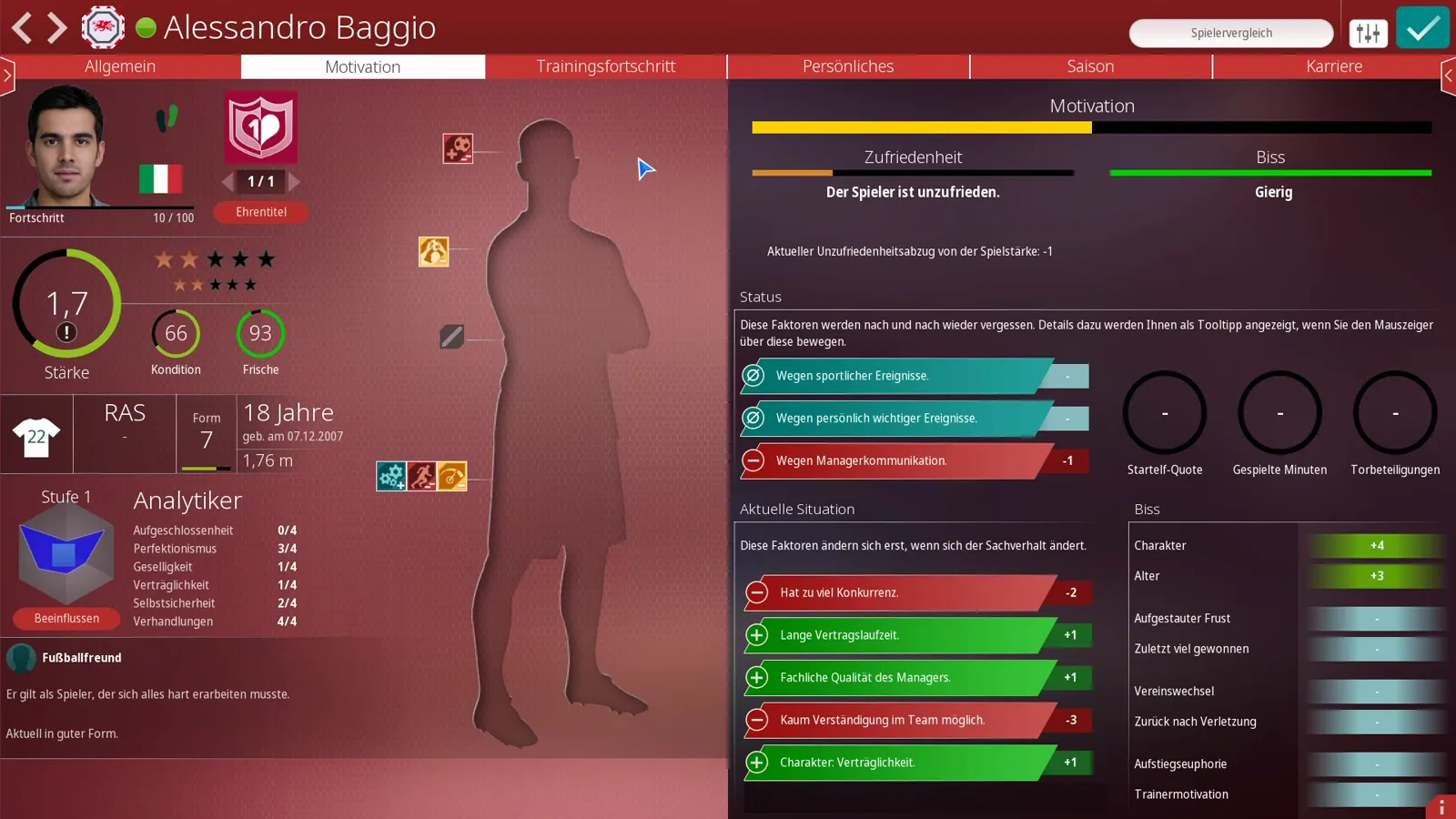
The practical consequence: a striker back from six weeks out often has the highest bite in the squad and should start, while a content but biteless player drifts through matches. The fix for the second type is either a conversation aimed squarely at bite — the tutorial’s advice is to push the Biss side rather than the satisfaction side — or a sale. The mirror image sits in the same menu: an 18-year-old whose bite block reads +4 character and +3 age is hungry enough, and his problem is entirely on the satisfaction side.
The Three Causes You Can Actually Fix
Underpaid. The clearest repair in the whole screen. A player flagged as underpaid gets a Gehalt aufbessern negotiation where the demand sits beside the current deal; the tutorial’s winger asks for €28,000 against €20,000 and the presenter simply grants it, along with €190 win and appearance bonuses. Mood restored in one click, and the wage impact is calculated against your remaining budget on the same panel.
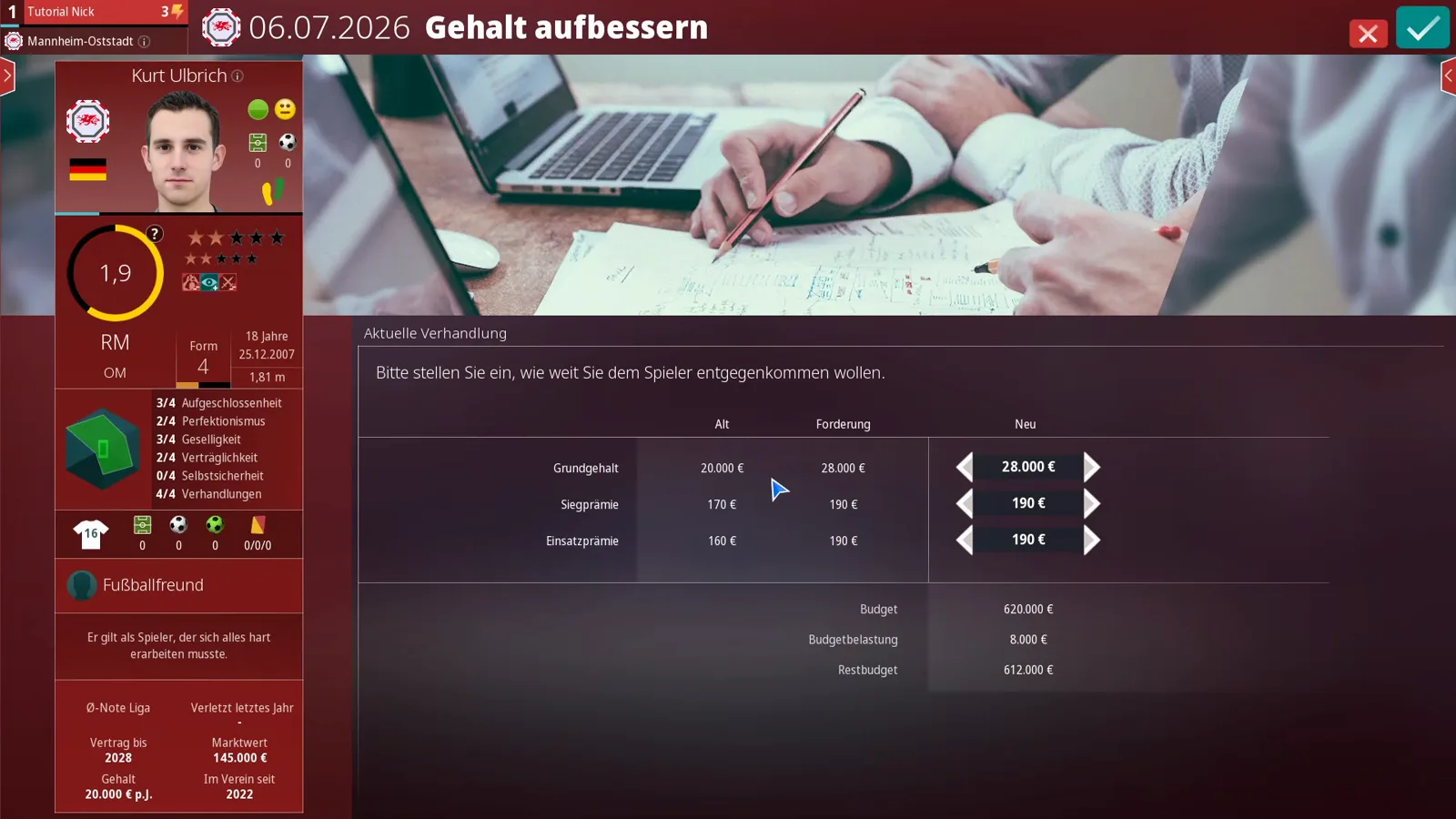
Contract structure and bonus tiers are covered in the contract negotiations guide, and missing loyalty pay is one of the usual reasons a bar turns yellow mid-season.
Too much competition. The 32-year-old defender below reads Der Spieler strebt nicht aktiv nach einem Wechsel (he is not actively pushing for a transfer) with the bite label Muss motiviert werden (needs to be motivated), and the largest red row in his satisfaction list is Hat zu viel Konkurrenz at -2. The presenter’s advice is arithmetic rather than psychological: if four of your six centre-backs carry the same complaint, sell one and the rest clear up.
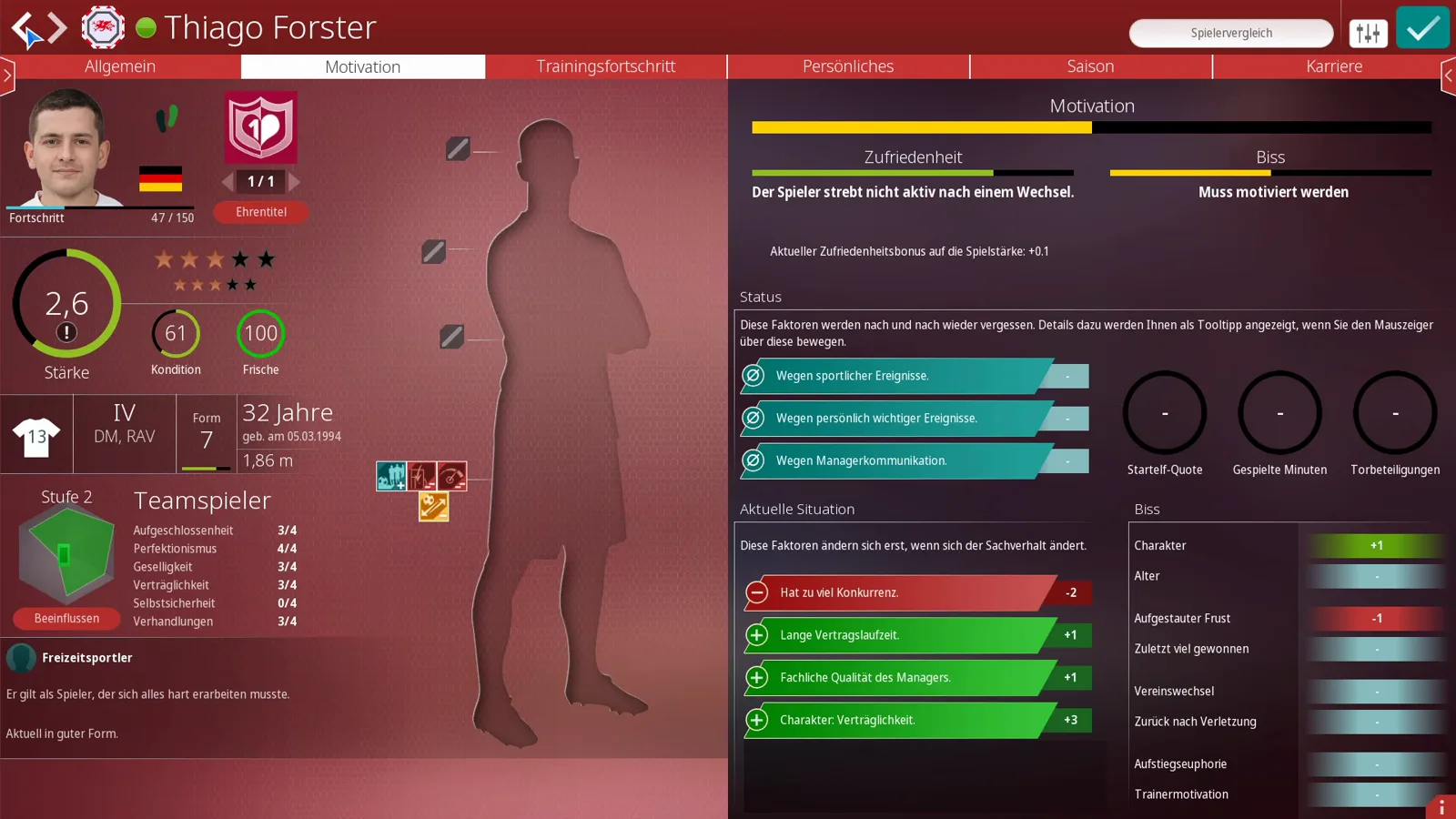
Pent-up frustration. Some players cannot motivate themselves. A conversation releases the frustration — Aufgestauter Frust is its own row in the bite block — and the bite comes back; if it never does, the character itself is the problem.
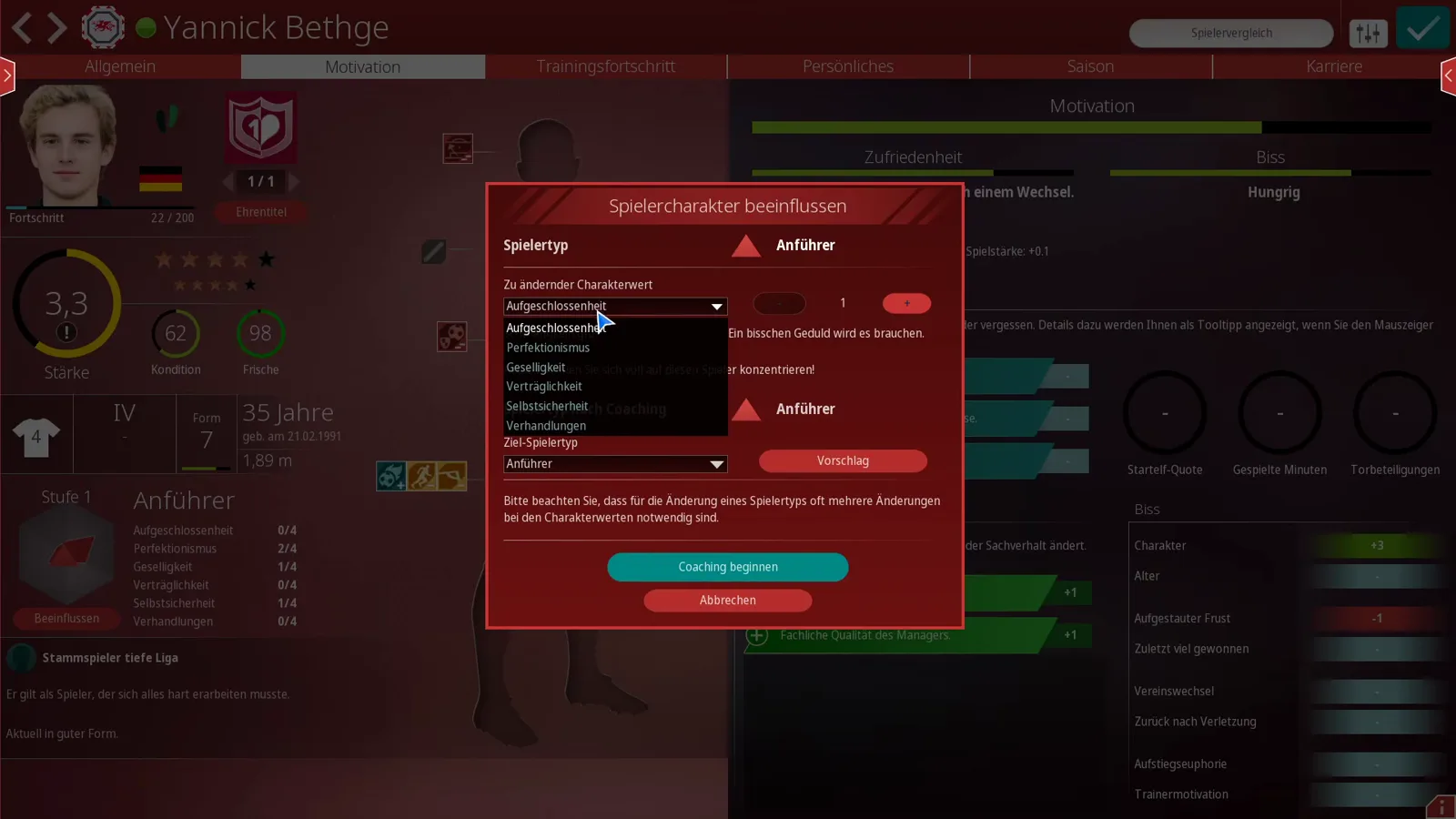
That last case has a deeper tool, and it is in the player file rather than the staff menu: the Beeinflussen button under the ability hexagon opens Spielercharakter beeinflussen, where you pick one character value — Verträglichkeit (agreeableness) among them — and nudge it a single step at a time. The dialog is honest about the cost: “Ein bisschen Geduld wird es brauchen”, and changing a Spielertyp usually needs several values moved. It is slow, but the satisfaction list itself pays for the idea — Charakter: Verträglichkeit shows up as a scored row there, so the point you coach in is the point that was missing. See the staff and HR guide for the staff who speed this process up.
Where Morale Ends Up
Dissatisfaction is priced in strength, and the dossier prints the price directly under the bars: Aktueller Zufriedenheitsbonus auf die Spielstärke (satisfaction bonus to playing strength) reads +0.1 on the content defender, while Aktueller Unzufriedenheitsabzug von der Spielstärke reads -1 on the unhappy youngster. The presenter puts the far end of the scale at -2. That is why an unhappy starter is worse than a spare, and why he recommends scanning every file weekly rather than reacting after a losing run.
One more header figure belongs here, from the training-progress tutorial: the fitness figure in the dossier is not one stat but two separate gauges, Kondition (stamina) and Frische (freshness). A red fitness reading can therefore mean a player who is fit but tired, which is a rotation problem, or one whose substance is missing, which is a training problem.
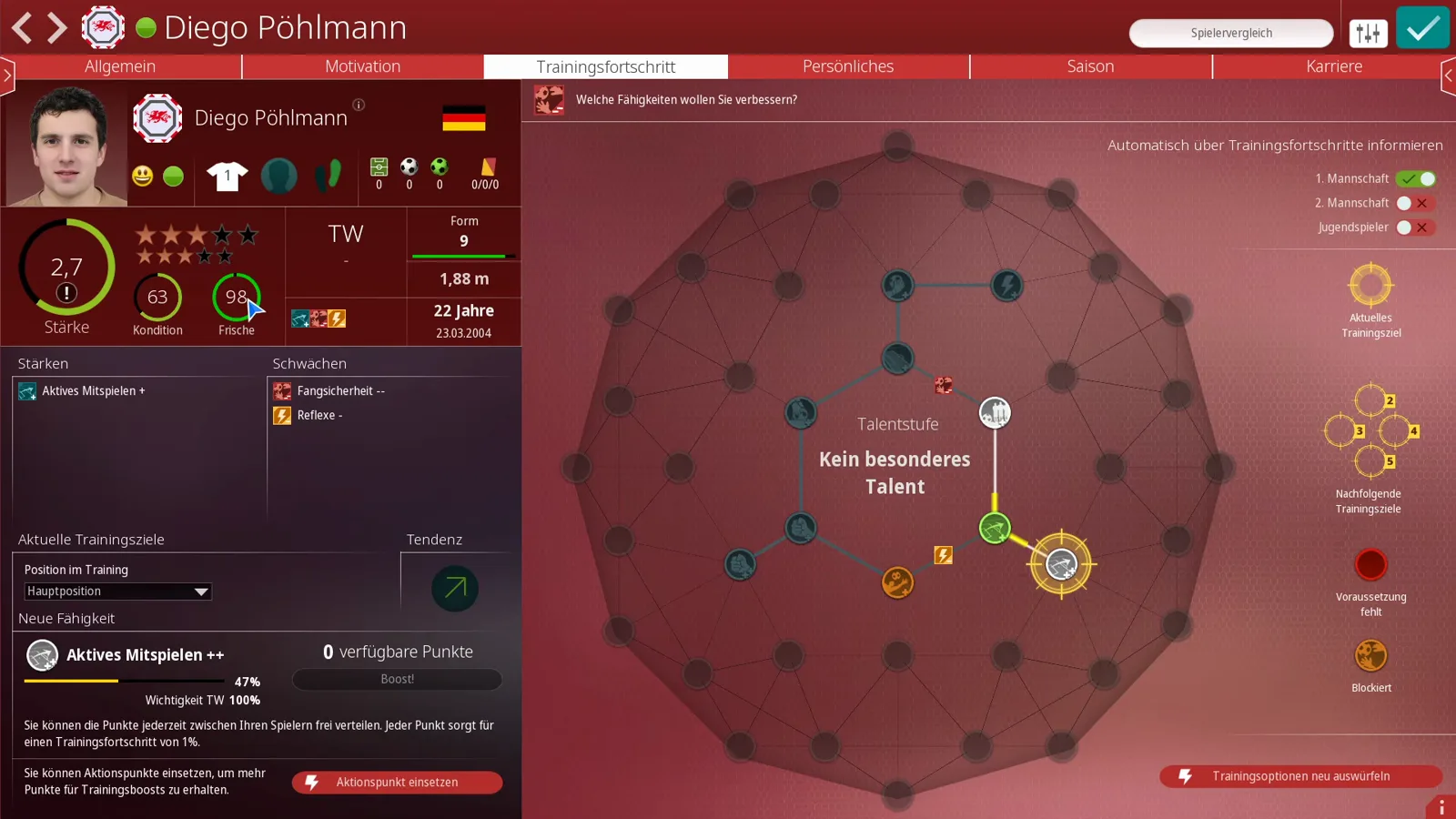
Sort the fitness side with the rotation rules in the medical and injuries guide, and keep the mood of the whole club — including the board — in view with the board expectations guide.
Related Guides
guides
WE ARE FOOTBALL 2027: Board Expectations, Popularity & Season Goals
Board expectations in WE ARE FOOTBALL 2027 explained: the Präsidium screen, season goals, popularity, budget requests, member approval and fan work.
guides
WE ARE FOOTBALL 2027: Staff, HR Department & Employee Effects
What every employee does in WE ARE FOOTBALL 2027: department heads, diligence, training budget tiers, staff workload, seasonal bonuses and the cost-cut switches.
guides
WE ARE FOOTBALL 2027: System Requirements & Compatibility
WE ARE FOOTBALL 2027 system requirements: 64-bit Windows 10, 8 GB RAM, 4 GB VRAM, Shader Model 6.0. Plus Mac, laptop, ultrawide, controller and offline answers.
Was this helpful?
Thanks for the feedback!