WE ARE FOOTBALL 2027 Sponsors Guide: Contracts, Boards and TV Money
Sponsors in WE ARE FOOTBALL 2027: the four big contracts, stand sponsorship, advertising boards, TV money and a full board-deal negotiation, screen by screen.
Frequently Asked Questions
How do sponsors work in WE ARE FOOTBALL 2027?
What do the sponsor risk types in WE ARE FOOTBALL 2027 mean?
How does TV money work in WE ARE FOOTBALL 2027?
How do you win a sponsor negotiation in WE ARE FOOTBALL 2027?
Matchday tickets keep the accounts breathing, but sponsorship is what makes a WE ARE FOOTBALL 2027 club wealthy: four big partner contracts, the naming rights on your stands, a market of advertising boards and the television money your league pays. All of it lives behind one menu — Sponsoren — split into four tabs: Verträge, Tribünen, Banden und Fernsehgelder and the Sponsorenpyramide. The full money machine around it — budgets, wages, taxes, reserves — is mapped in our finances and wage budget guide; this page stays inside the sponsor screens and follows the tutorial through the whole lifecycle, from reading a contract card to signing a better board deal yourself.
Verträge: the four big contracts
The first tab is where the money sits. The official manual puts it plainly: under Sponsoren “you can sign contracts with a total of four major sponsors. These are the main sponsor, the kit supplier, the sleeve sponsor and the stadium sponsor” (EN p. 152 / DE S. 163) — Hauptsponsor, Ausrüster, Armelsponsor and Stadionssponsor on the German screen.
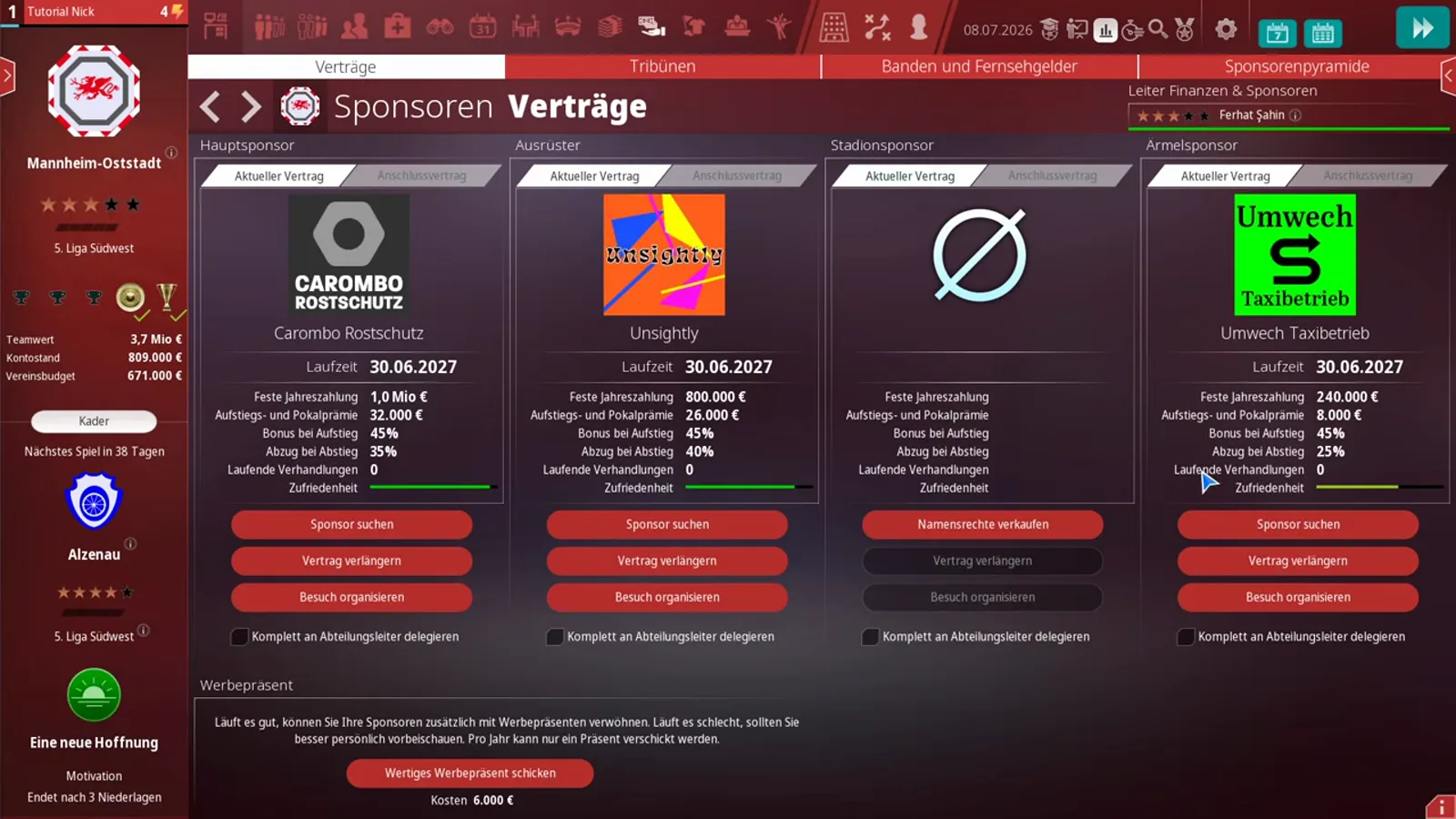
Every slot holds one card with the same anatomy, so reading a contract takes seconds:
- Aktueller Vertrag / Anschlussvertrag — today’s deal on the left tab, the pre-arranged follow-up on the right.
- Laufzeit — the term. All four deals in the shot run to 30.06.2027.
- Feste Jahreszahlung — the guaranteed money: €1.0 million for main sponsor Carombo Rostschutz, €800,000 for kit supplier Unsightly, €240,000 for sleeve sponsor Umwech Taxibetrieb.
- Aufstiegs- und Pokalprämie — a flat bonus for promotions and cup runs (€32,000, €26,000 and €8,000).
- Bonus bei Aufstieg / Abzug bei Abstieg — the percentage your payment climbs on promotion (45%, 45%, 45%) or shrinks on relegation (35%, 40%, 25%).
- Laufende Verhandlungen and the Zufriedenheit bar — ongoing talks and the sponsor’s mood.
Under each card sit three buttons — Sponsor suchen, Vertrag verlängern, Besuch organisieren — and a checkbox that hands the whole lot to your department heads. The presenter declines to delegate: “I do it all myself. It’s much more fun.” The empty stadium slot shows what an unsold slot looks like: instead of buttons, it offers Namensrechte verkaufen — and it costs you every week it stays empty. The manual agrees: “If a sponsorship slot is vacant, you should start looking for a sponsor straight away, as you’ll be losing money” (EN p. 152 / DE S. 163).
Fixed pay or bonuses? The three sponsor types
Sponsors are not interchangeable. The tutorial’s rule of thumb: a green sponsor prefers to pay a solid fixed amount, a red one pays mostly bonuses, and an orange one splits the difference — medium fixed, medium bonus. If you need cash you can plan around, hunt for the green kind: “you’re guaranteed to get the cash every month”. The official manual describes the same split as risk categories with icons on every offer (EN p. 153 / DE S. 164): “Low risk means high fixed amounts and small bonuses. With high-risk contracts, it’s exactly the opposite, though these are usually slightly better remunerated.” The colour types themselves are the creator’s verbal explanation — the screens shown do not label them.
The bonus-heavy deals hide the game’s best compound machine. The presenter tells of a third-division main sponsor whose contract escalated the payment by 90% with every promotion — promoted every season, he ended up with a lower-league deal paying more than a first-division club’s, “because it was always doubled with each promotion”. His practical takeaway cuts the other way too: don’t drop a decent contract just because you expect to renegotiate after promotion — the follow-up offer can look smaller in fixed pay yet still lose to the old deal once bonuses in the higher league kick in.
Zufriedenheit: visits and gifts
The satisfaction bar under each contract is a maintenance meter. Sponsors invite you now and then — accept, because always refusing lets the bar sink until they grow reluctant to renew. When it has already slipped, Besuch organisieren sends you round in person. When things go well, flip it around: the Werbepräsent strip at the bottom of the screen sells promotional gifts for €6,000 — and the small print on the screen sets the rhythm: one gift per year. The presenter sends his around Christmas and reports thank-you emails in return. When satisfaction is falling, gifts are wasted — that is visit territory.
Tribünen: stand sponsorship
The second tab sells your stadium, stand by stand.
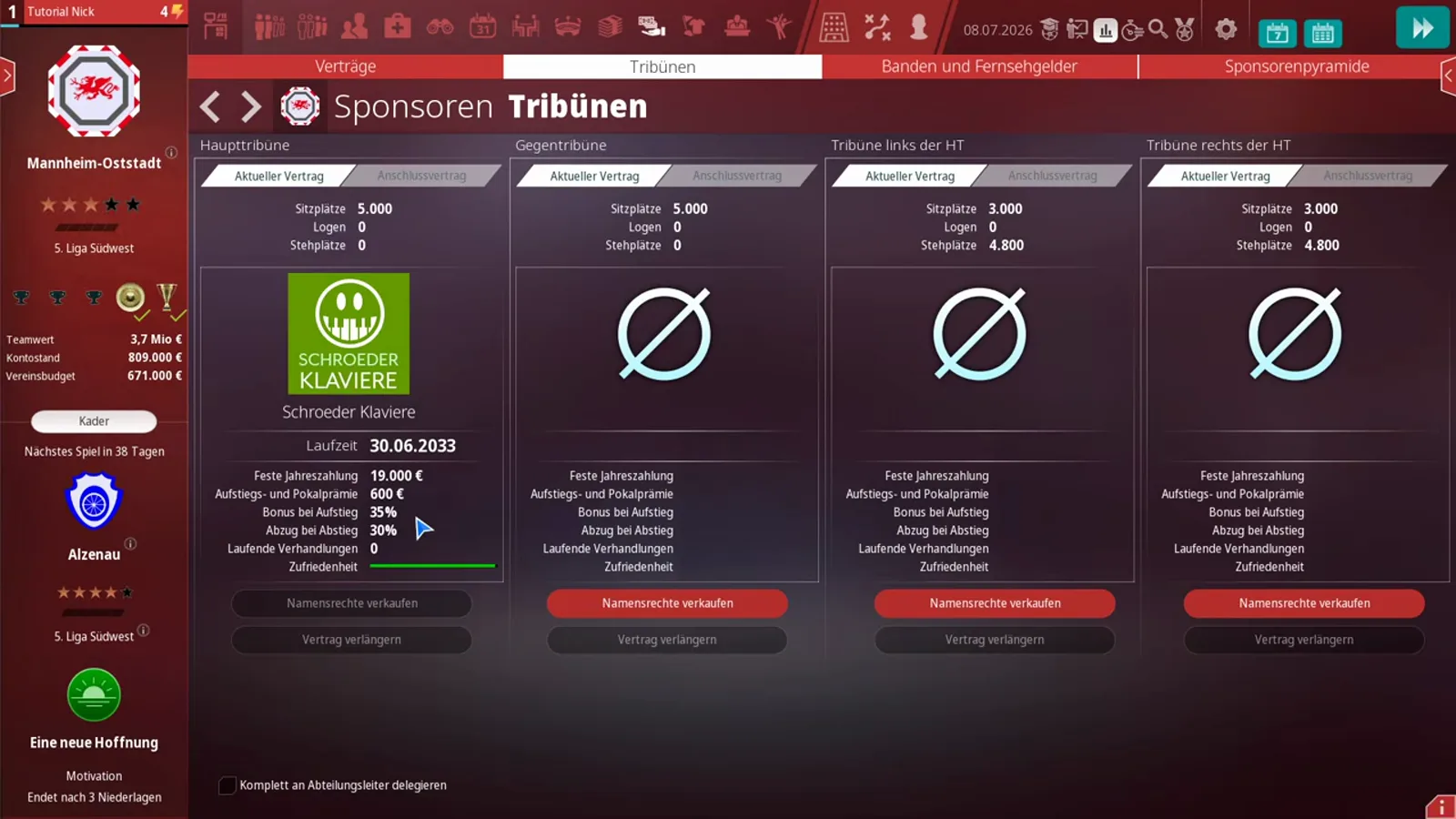
Four slots mirror the contract screen — Haupttribüne, Gegentribüne, Tribüne links der HT, Tribüne rechts der HT — each headed by its capacity (5,000 seats on the two main stands, 3,000 seats plus 4,800 standing places on the sides). The video’s club has sold one naming right: Schroeder Klaviere on the main stand, locked in until 30.06.2033 for a modest €19,000 a year, a €600 promotion-and-cup premium and a balanced 35% / 30% promotion-relegation split. That is the stand market in one card: long terms, small money, small premiums — the creator calls the terms “rather long” and the premiums modest compared with the big contracts. Every unsold stand offers Namensrechte verkaufen, and per the tab logic those revenues flow into the same budgets. How the stands themselves get built and expanded is the stadium expansion guide’s territory.
Banden und Fernsehgelder: boards and television money
The third tab is two markets and a payout table in one screen.
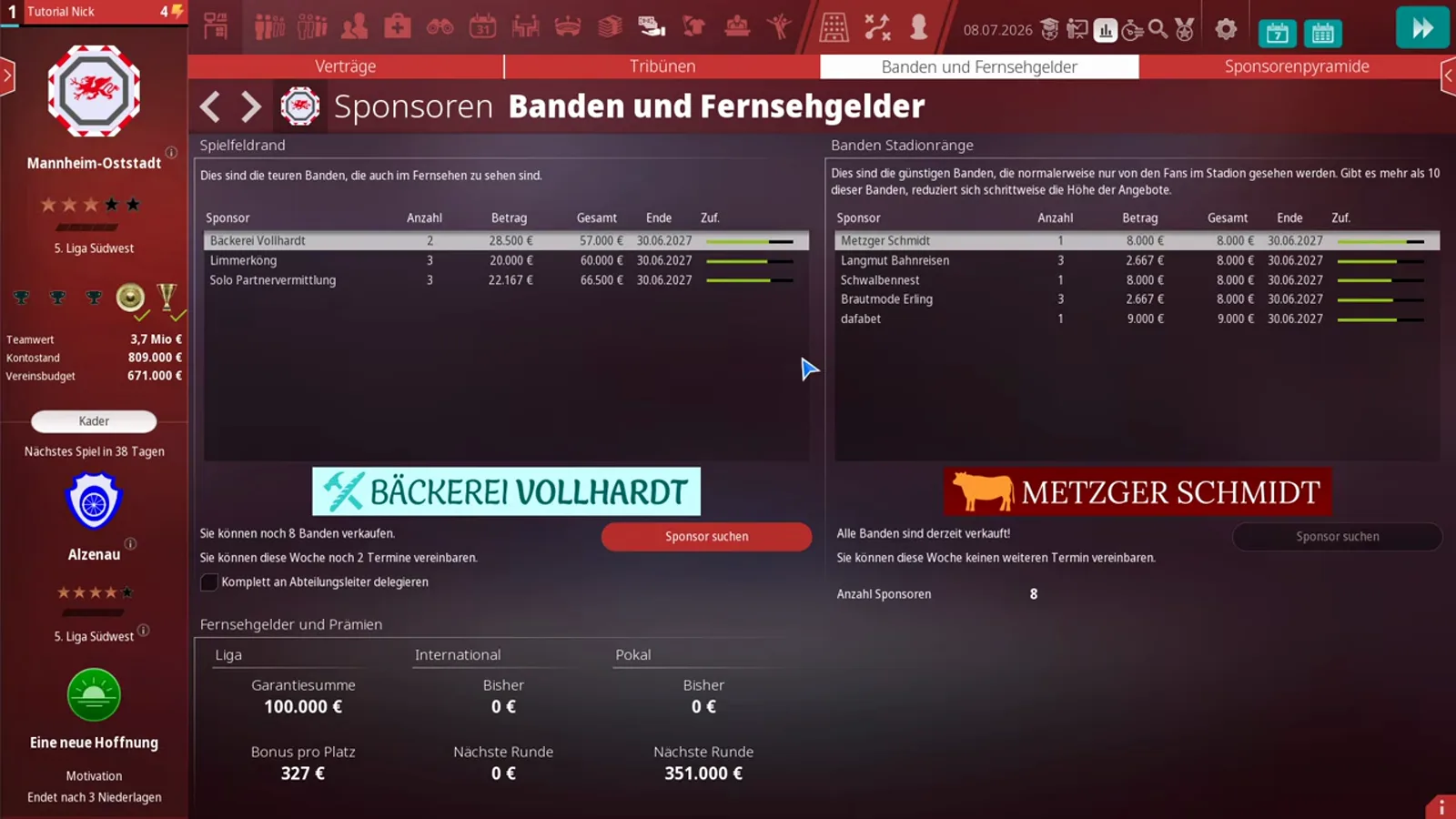
The left column, Spielfeldrand, is the premium market: “Dies sind die teuren Banden, die auch im Fernsehen zu sehen sind” — the expensive boards that TV cameras pick up. Baeckerei Vollhardt pays €28,500 per board (2 boards, €57,000), Limmerkong €20,000 (3 boards) and Solo Partnervermittlung €22,167 (3 boards), all running to 30.06.2027. The right column, Banden Stadionrang, is the budget market — “the cheap boards, normally only seen by the fans in the stadium” — where Metzger Schmidt, Langmut Bahnreisen, Schwalbennest, Brautmode Erling and dafabet run one-to-three-board deals worth €8,000–9,000. The screen prints its own warning on the right: once you host more than ten of these stadium boards, the offers shrink step by step. Why do boards pay so little compared with the main sponsor? The creator’s explanation: if board deals paid well, you could fill the entire stadium with advertising and print billions — they are designed as additional income.
Boards are sold through appointments. Every sale needs one, the counter under each market tracks how many boards you can still sell (8 in the shot) and the week limits your bookings: two appointments at the start of the season, one afterwards — and once a market is sold out, no further appointment at all. One investment improves the whole market before you negotiate: rotating boards. The manual is emphatic about the order — “Always buy the rotating boards first, then only sign any missing perimeter advertising contracts” (EN p. 131 / DE S. 87) — because “The rotating boards will give you 5% more revenue from this source” (EN p. 143 / DE S. 96). The tutorial quotes the same 5% bonus; the purchase itself happens outside this screen and is not shown in the video.
Fernsehgelder: the payout table
The bottom block, Fernsehgelder und Prämien, splits television revenue into three columns — Liga, International, Pokal. The league column shows a Garantiesumme of €100,000 and a Bonus pro Platz of €327. The presenter reads it as two payouts: the guaranteed sum arrives stretched across the year — “practically €8,000 every month”, twelve instalments for playing in the league at all — while the per-place bonus is a single cash payment at the start of next season for last season’s finish: last place earns €327, second-to-last €654, and every place above adds another €327.
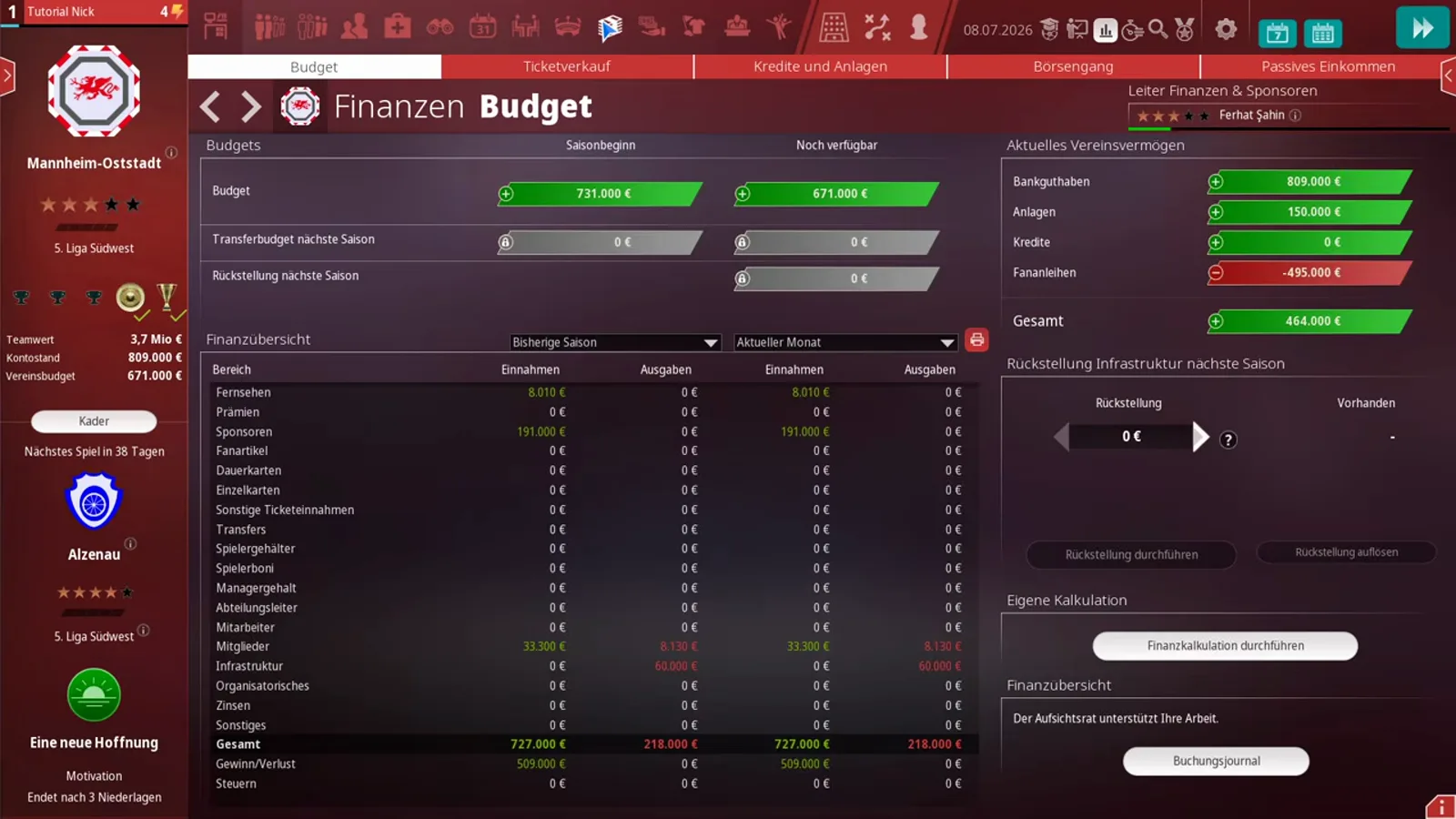
Where does it land? In the Finanzen Budget screen — the video cuts there mid-explanation — the Finanzübersicht books €8,010 under Fernsehen and €191,000 under Sponsoren for the current month, right next to ticketing and membership income. How those instalments meet budgets, reserves and taxes is the bookkeeping the finances and wage budget guide works through in full. The international and cup columns work differently: they show what you have earned so far (Bisher) and what the next round would pay (Nächste Runde — €351,000 for the cup in this save). The creator is openly sceptical here: those figures only become real when you actually qualify, reach and play the rounds — until then he calls the displayed cup money “a bit of a fib”. The manual adds that under Pokal only the regular cup competition is shown and the rest of the detail lives in the accounting journal (EN p. 153 / DE S. 164).
Sponsorenpyramide: the showcase
The last tab is pure overview.
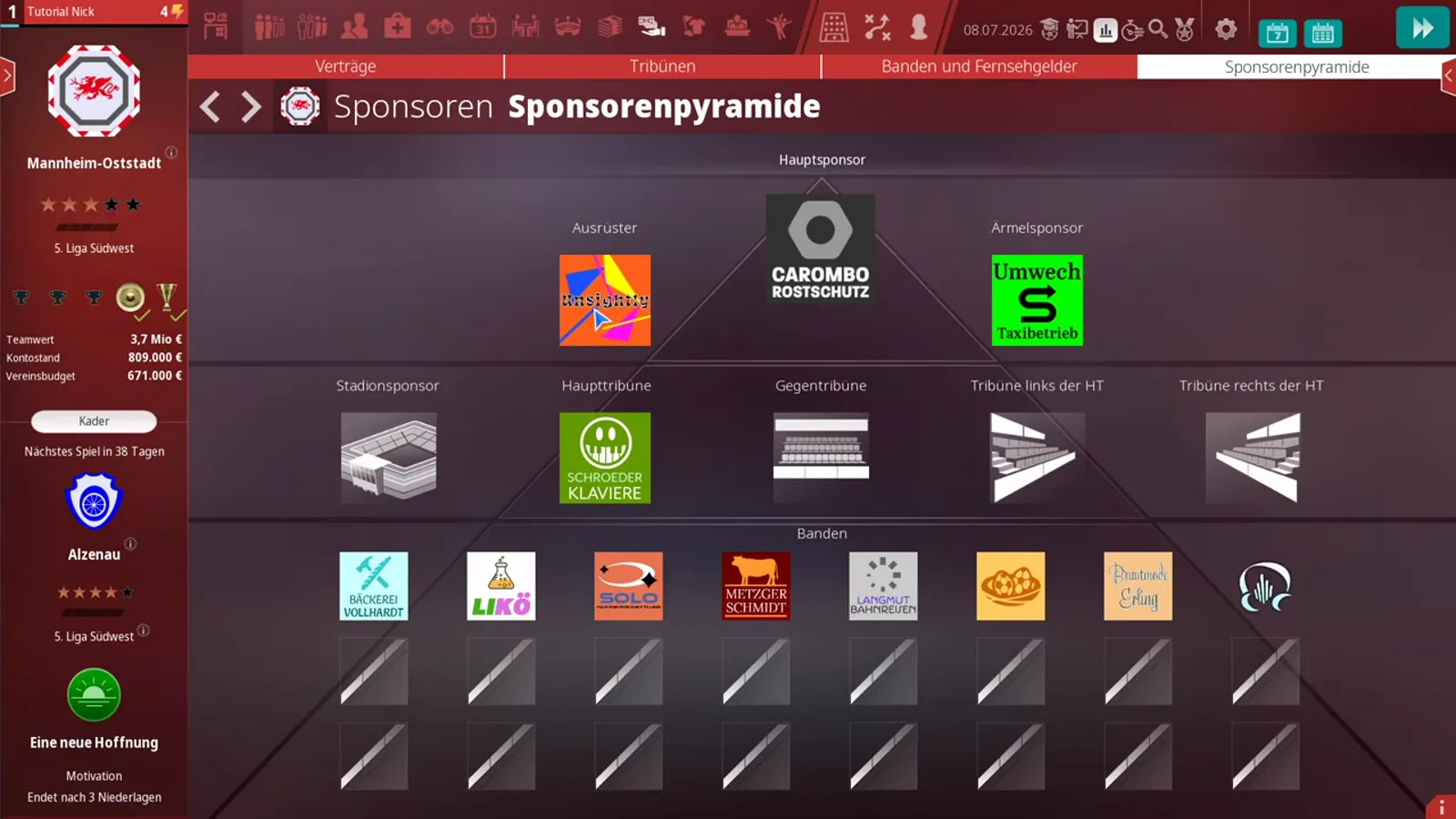
The pyramid stacks every sponsor logo by importance — Carombo Rostschutz alone at the top as Hauptsponsor, kit and sleeve sponsors on the second tier, then the stadium and stand slots, and the eight board sponsors along the base. Nothing here is clickable, and the creator says so twice: it is a representation, nothing more. Its value is the ten-second health check — empty boxes are gaps you are being paid nothing for.
Verhandlung: negotiating a board deal step by step
Everything above is reading. The last third of the tutorial plays an actual negotiation — the part the creator saved his own chapter for.
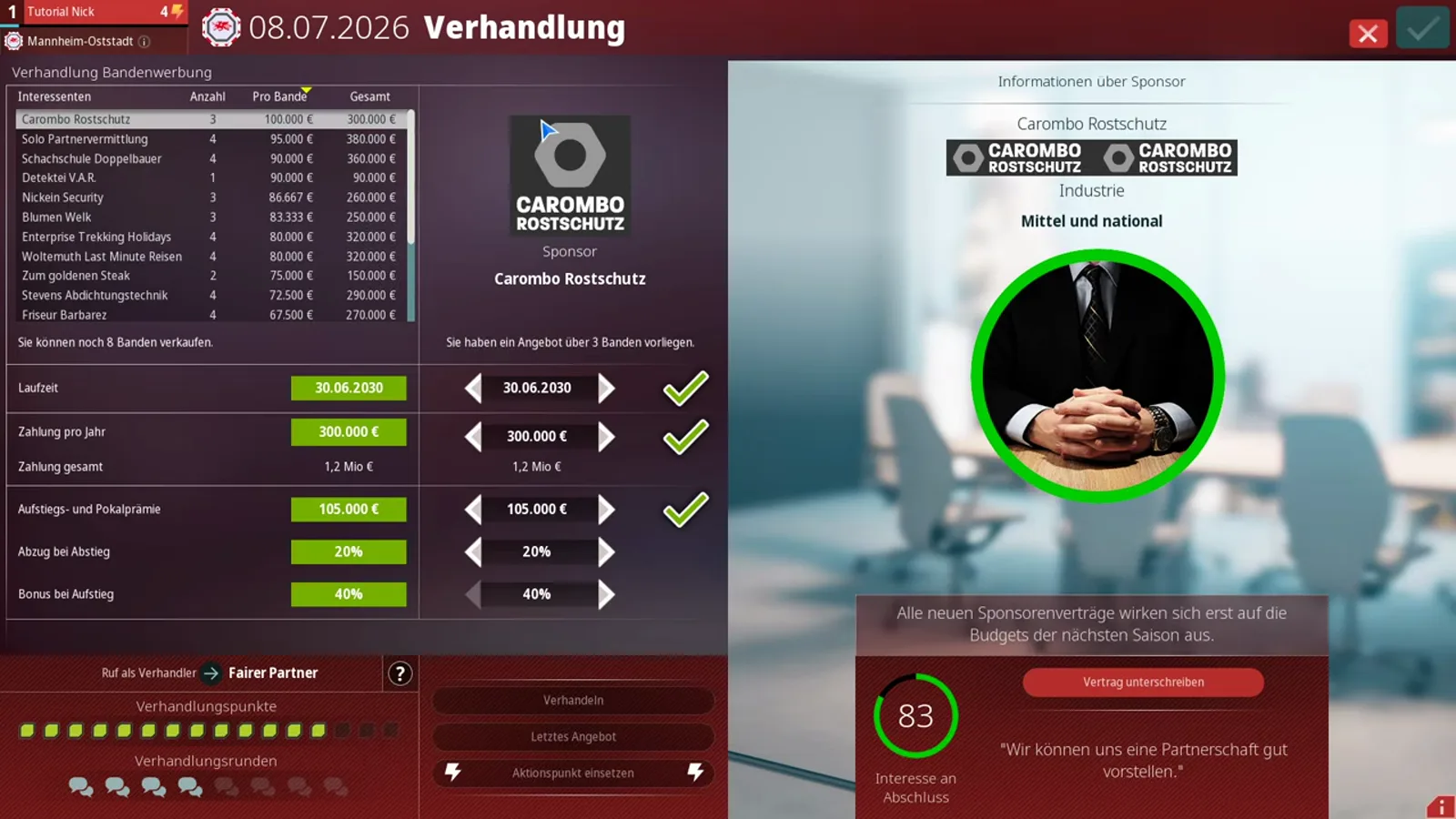
Book an appointment, and the Verhandlung window opens with three panels. Left, the Interessenten list — every interested sponsor with board count, offer per board and total, sortable by either (the presenter always sorts by per-board pay, “Pro Bande”). Carombo Rostschutz tops the list at three boards × €100,000 = €300,000 a year; Solo Partnervermittlung counters with four boards at €95,000. Centre, the offer itself: Laufzeit 30.06.2030, Zahlung pro Jahr €300,000, Zahlung gesamt €1.2 million, plus Aufstiegs- und Pokalprämie €105,000, Abzug bei Abstieg 20% and Bonus bei Aufstieg 40%. Right, the dossier: Carombo Rostschutz, industry, “Mittel und national”, an interest gauge at 83, and the quote of the day — “Wir können uns eine Partnerschaft gut vorstellen.” At the bottom sit your resources: Verhandlungspunkte, Verhandlungsrunden — three of them here — and the buttons Verhandeln, Letztes Angebot and Aktionspunkt einsetzen.
Each term has arrows. Move one and your demand lands next to the sponsor’s value; the pair is colour-coded from then on. The presenter’s loop: make a change, meet them halfway, hit Verhandeln, read the reaction, repeat — and sign when the important rows stay green.
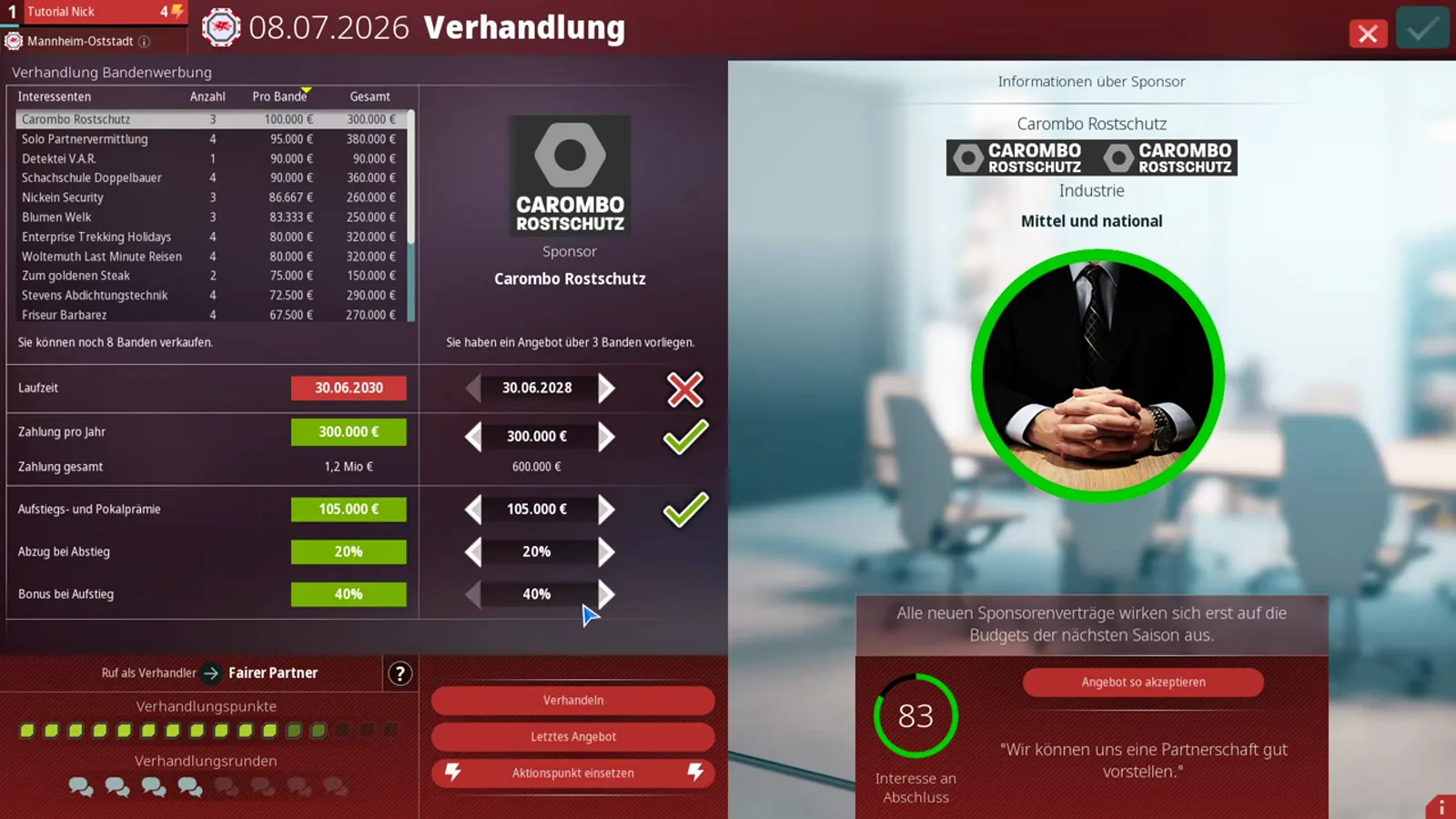
First lever: the term. He trims 2030 down to 30.06.2028 — the sponsor’s original stays red with a cross, and Zahlung gesamt drops from €1.2 million to €600,000 because the contract now covers two years instead of four. A shorter deal is not free; it is a trade.
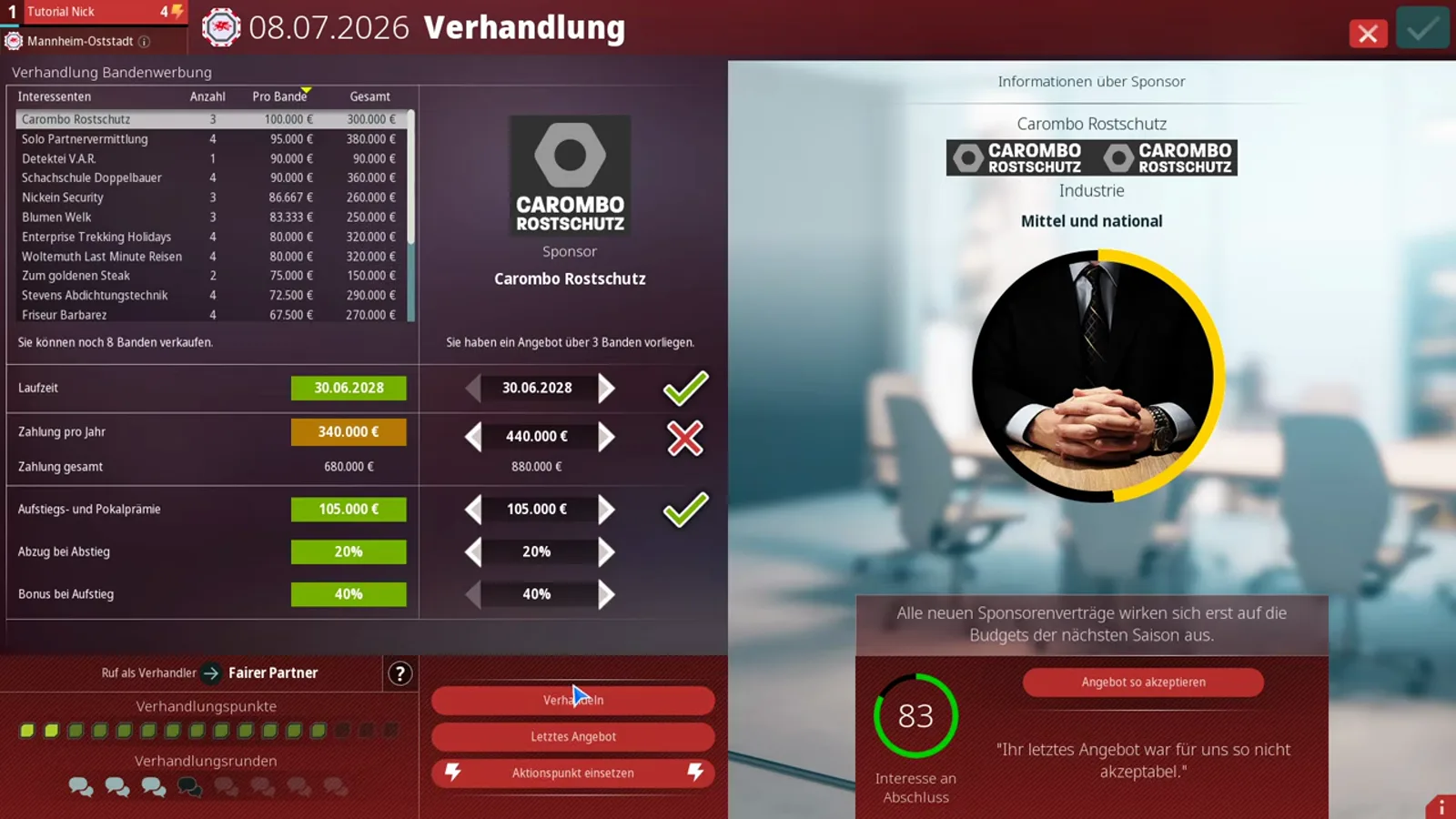
Second lever: the money. He pushes Zahlung pro Jahr up to €440,000 — too far. The sponsor’s counter sits at €340,000, the demand gets its red cross, and the portrait ring flips from green to yellow: “Ihr letztes Angebot war für uns so nicht akzeptabel.” The gauge of goodwill is literally the frame around the sponsor’s portrait. The manual’s advice runs in the same direction: the wider the gap between demand and offer, the faster patience drains, and raising a demand after conceding it goes down particularly badly (EN p. 153 / DE S. 164).
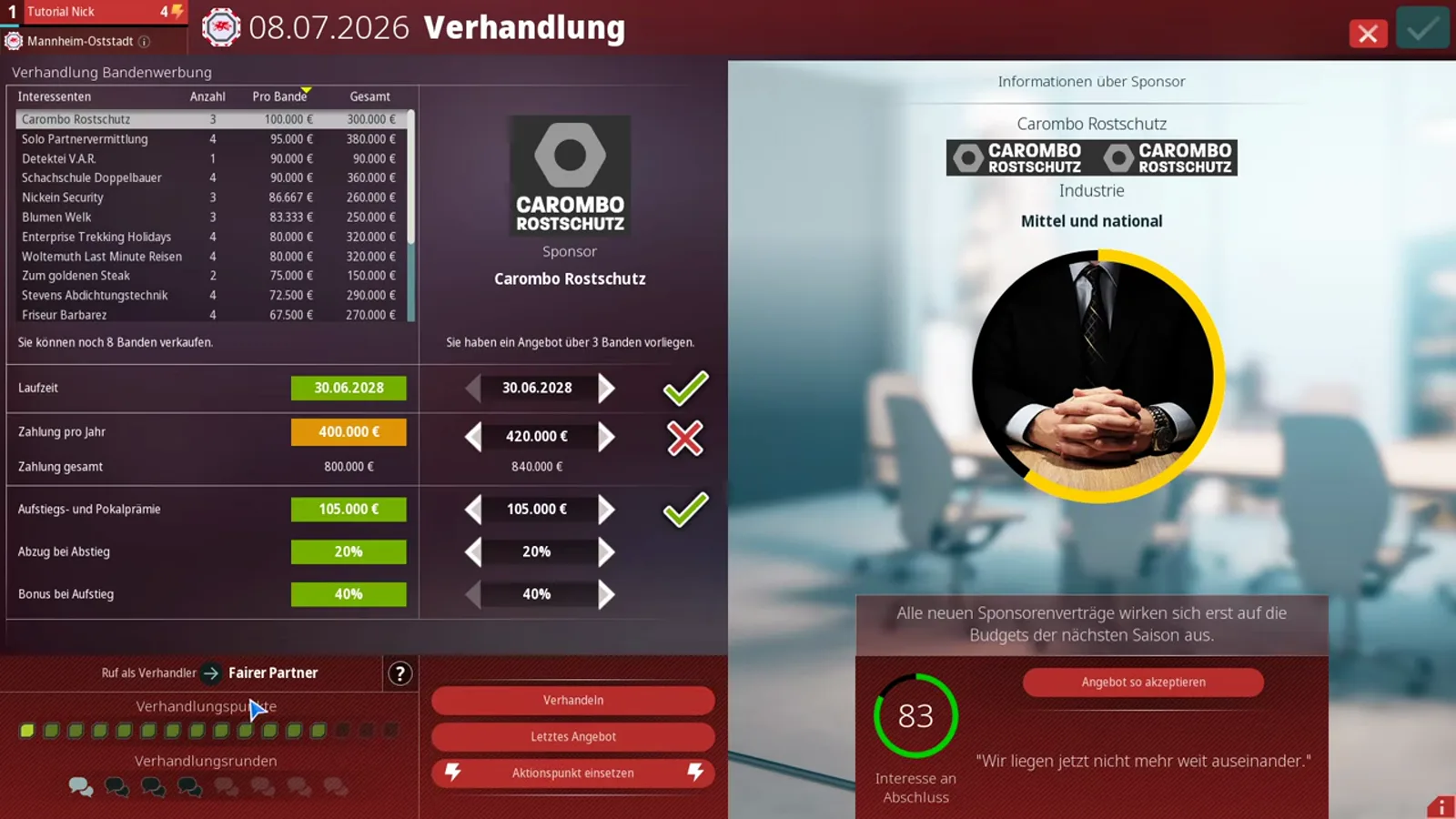
Third round: meet in the middle. The sponsor climbs to €400,000, he holds at €420,000, and the window concedes: “Wir liegen jetzt nicht mehr weit auseinander.” A final step later both sides agree on €420,000 a year — “and then I say sign the contract.”
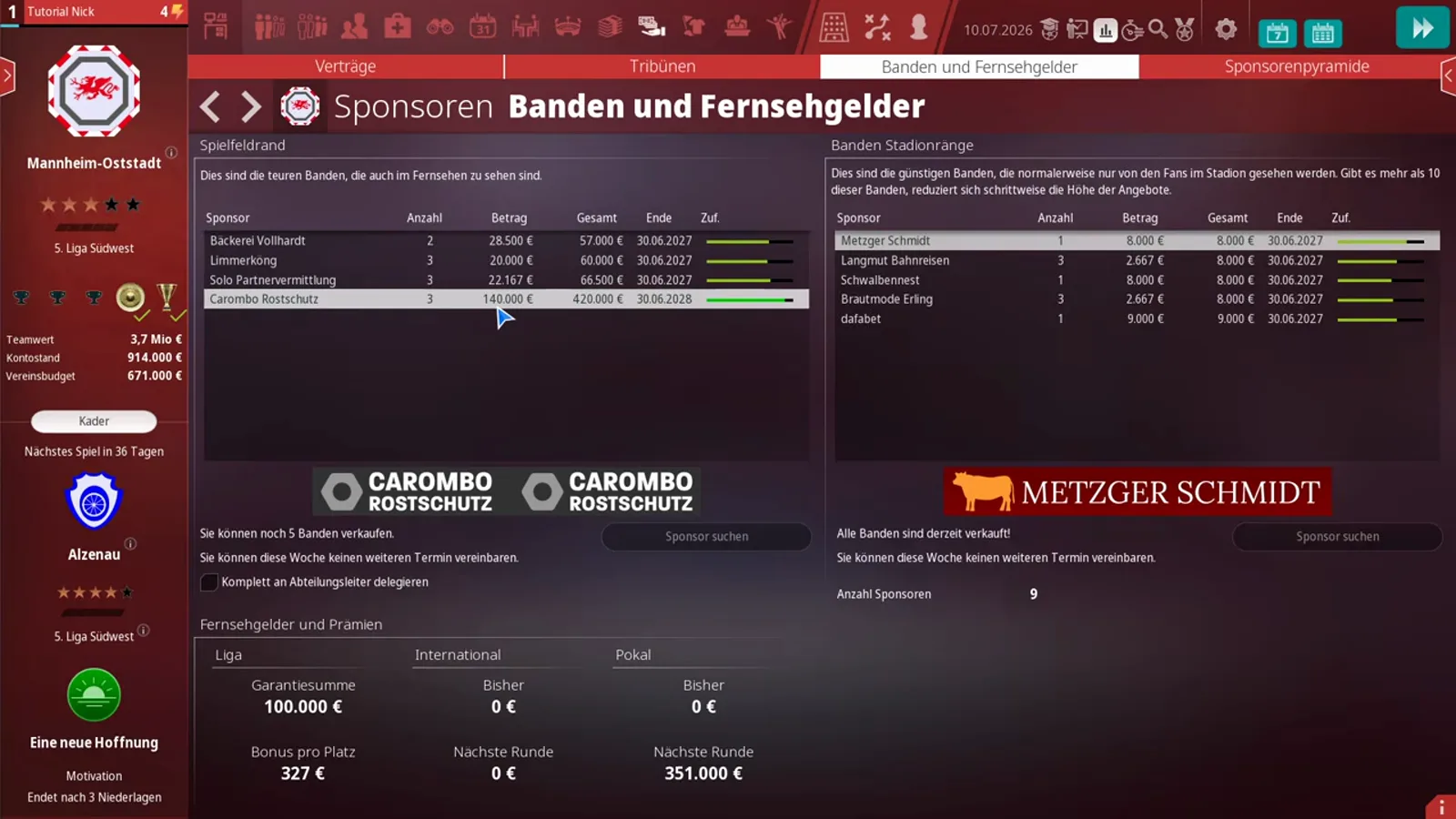
The result shows up back on the Banden screen: a new Carombo Rostschutz row in the Spielfeldrand table — 3 boards × €140,000 = €420,000 a year until 30.06.2028 — a second Carombo board logo next to the first, five board slots still to sell, and a deal that “brings us a good amount of money”, visibly above every other row. Two footnotes matter. The window itself warns: Alle neuen Sponsorenverträge wirken sich erst auf die Budgets der nächsten Saison aus — new sponsor money reaches the budgets next season, not this one. And the appointment system has a cost: after the deal, this week’s booking slot is spent. The manual rounds out the mechanics: arranging a meeting in the Terminplaner and stretching its duration buys extra negotiation rounds (EN p. 153 / DE S. 164).
Your first sponsor season, in order
The tutorial’s flow compresses into a checklist. Fill every empty slot — the manual’s “you’ll be losing money” is not decorative (EN p. 152 / DE S. 163). Book your board appointments in the first weeks while two are still allowed, and buy the rotating boards before that first appointment. Keep satisfaction bars full with accepted invitations, a visit when things slip and one well-timed gift. Sort negotiations by per-board pay, trade term against payment, and stop pushing when the ring turns yellow. Then let the money work: what the new deals unlock in transfer talks is the transfer market guide’s business, the board only grows your budgets when the targets in the board expectations guide are met — and the full accounting of where every euro lands stays in the finances and wage budget guide.
Related Guides
guides
WE ARE FOOTBALL 2027 Multiplayer: Hotseat for Four Players and Remote Play
WE ARE FOOTBALL 2027 has no online multiplayer servers: up to four managers share hotseat mode on one PC, and Steam Remote Play is the way to play online.
guides
WE ARE FOOTBALL 2027 Team Talks and Heatmaps: Match Day Control Explained
Team talks and heatmaps in WE ARE FOOTBALL 2027: the Halbzeitansprache dialog at halftime, one-on-one Spielergespräche, Extra-Motivation! and the heatmap tabs.
guides
WE ARE FOOTBALL 2027 Troubleshooting: Crashes, Editor Fixes and the Update Log
Crashes and editor problems in WE ARE FOOTBALL 2027, and what Update 1 fixed: the official fix list from 24 September, what is still open, and where to check next.
Was this helpful?
Thanks for the feedback!