WE ARE FOOTBALL 2027: Player Types & Roles Explained
Player types in WE ARE FOOTBALL 2027 explained: Ehrentitel hero powers, leader vs. team-player colours, development potential, and reshaping types with coaching.
Frequently Asked Questions
What do the Bollwerk and Joker hero powers do in WE ARE FOOTBALL 2027?
Can a player lose an honorary title again?
Why does a new 29-year-old signing already decline?
Can I change a player's character type in WE ARE FOOTBALL 2027?
What does the Entwicklungspotenzial bar guarantee?
What do Wollen and Können in the Flexibilität block mean?
What is the Swag-Faktor in the player file?
Every Answer Lives in the Player File
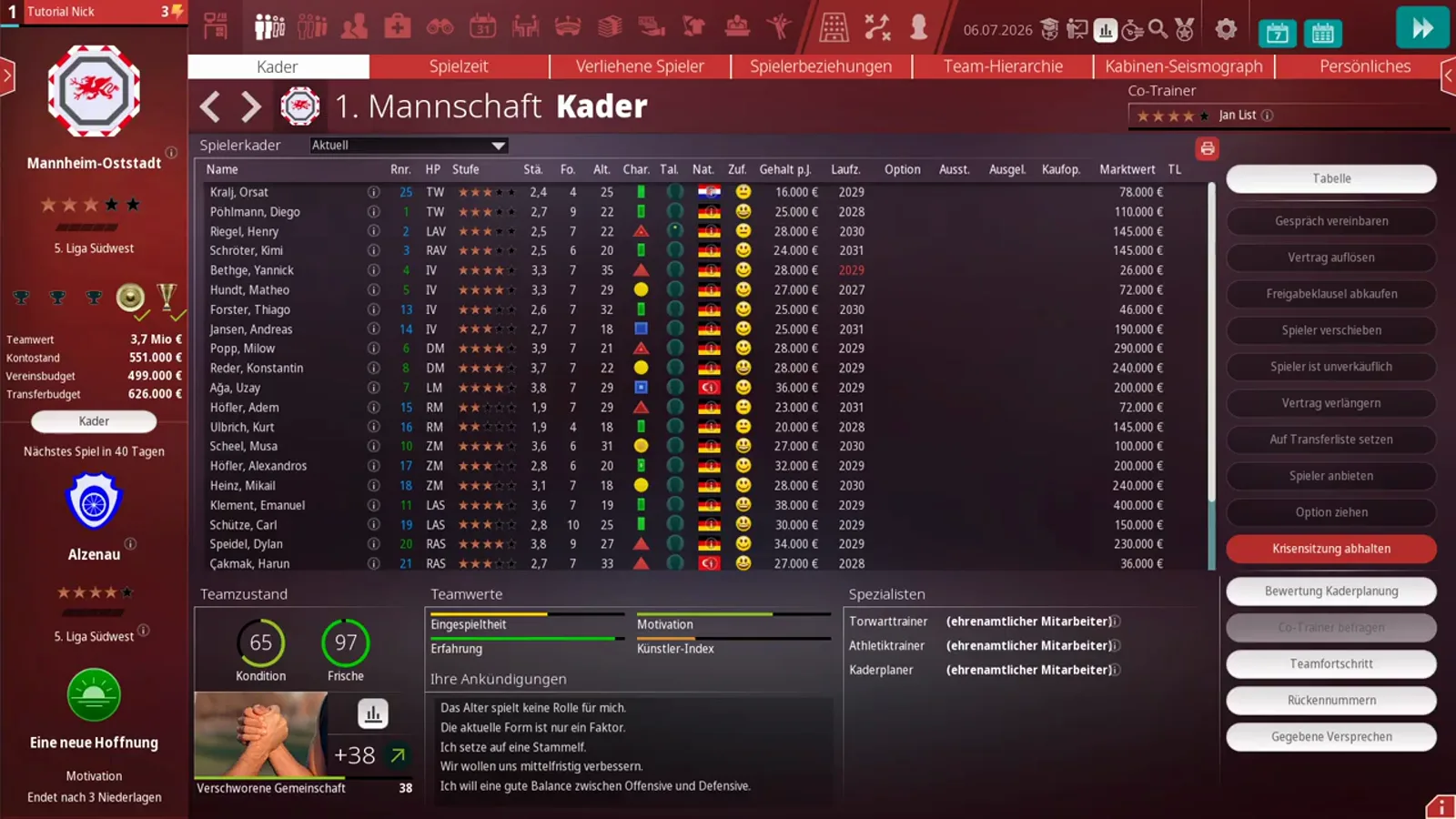
Player types are read from the player file, which opens with a single click on any row of the squad list (1. Mannschaft → Kader). Six tabs split the information — Allgemein, Motivation, Trainingsfortschritt, Persönliches, Saison and Karriere — and everything about types and roles sits on the first one.
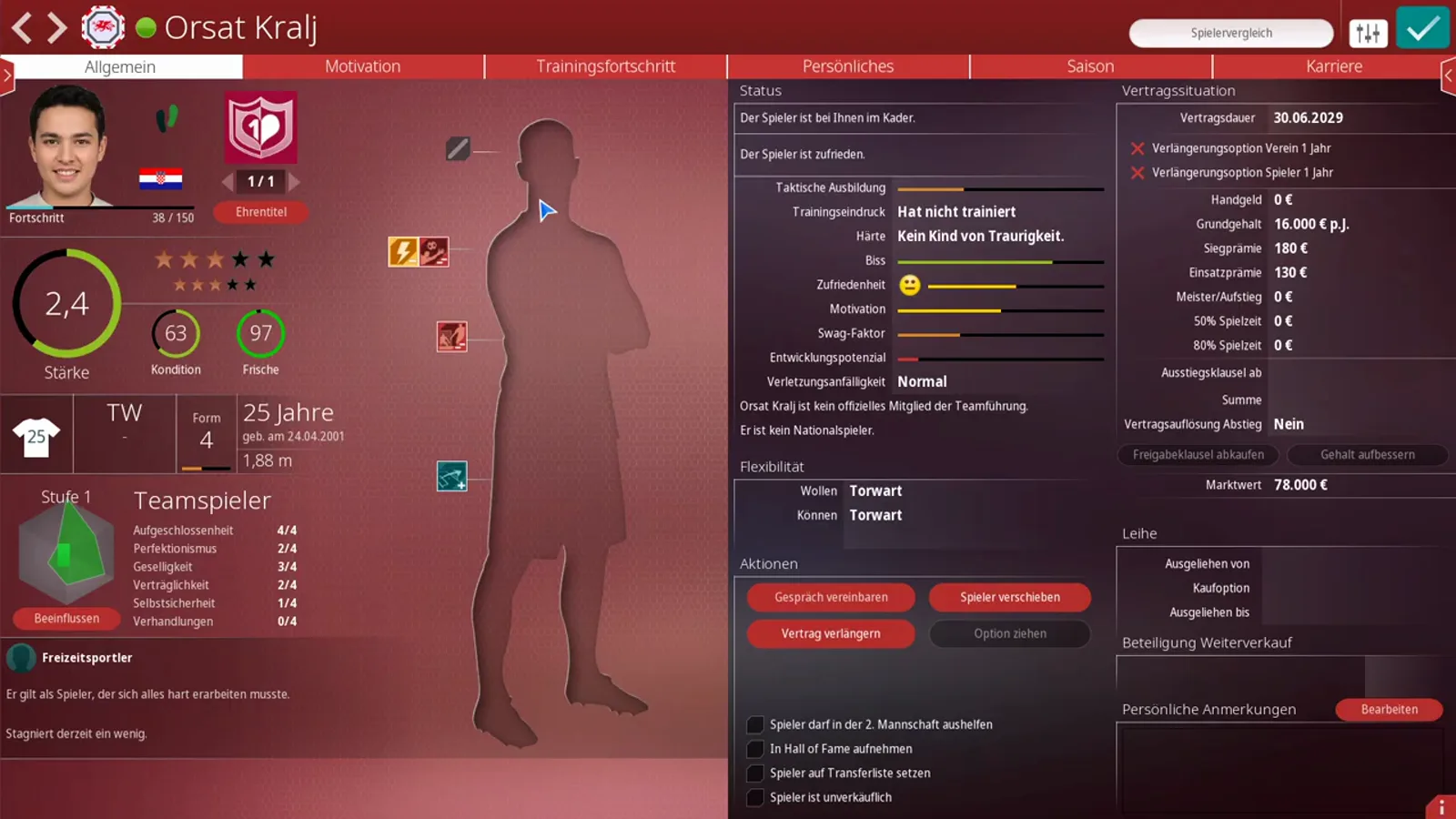
The left column of the file is your sixty-second read: the Stärke ring with the star row, Kondition and Frische, jersey number, main and secondary position, Form (10 is the best score), age with the exact birthday, and height.
The Strength Recalculation Behind the Stars
Under the portrait, the progress bar tracks level experience — the tutorial’s example sits at 38 of 150 points and gains roughly +2 points per competitive match, up to +5 depending on the league. When the bar fills, the player gains a level, shown as another strength star.
The ring number itself is then recalculated from the level plus the ability mix. The tutorial’s keeper is a three-star-level player who shows only 2.4, because two heavily negative and one plain negative ability drag the value down while a single positive ability lifts it. The practical takeaway: training away negatives is often cheaper than buying new strengths, and /guides/training-plan-guide/ shows how to structure those blocks.
Ehrentitel: Honorary Titles and Hero Powers
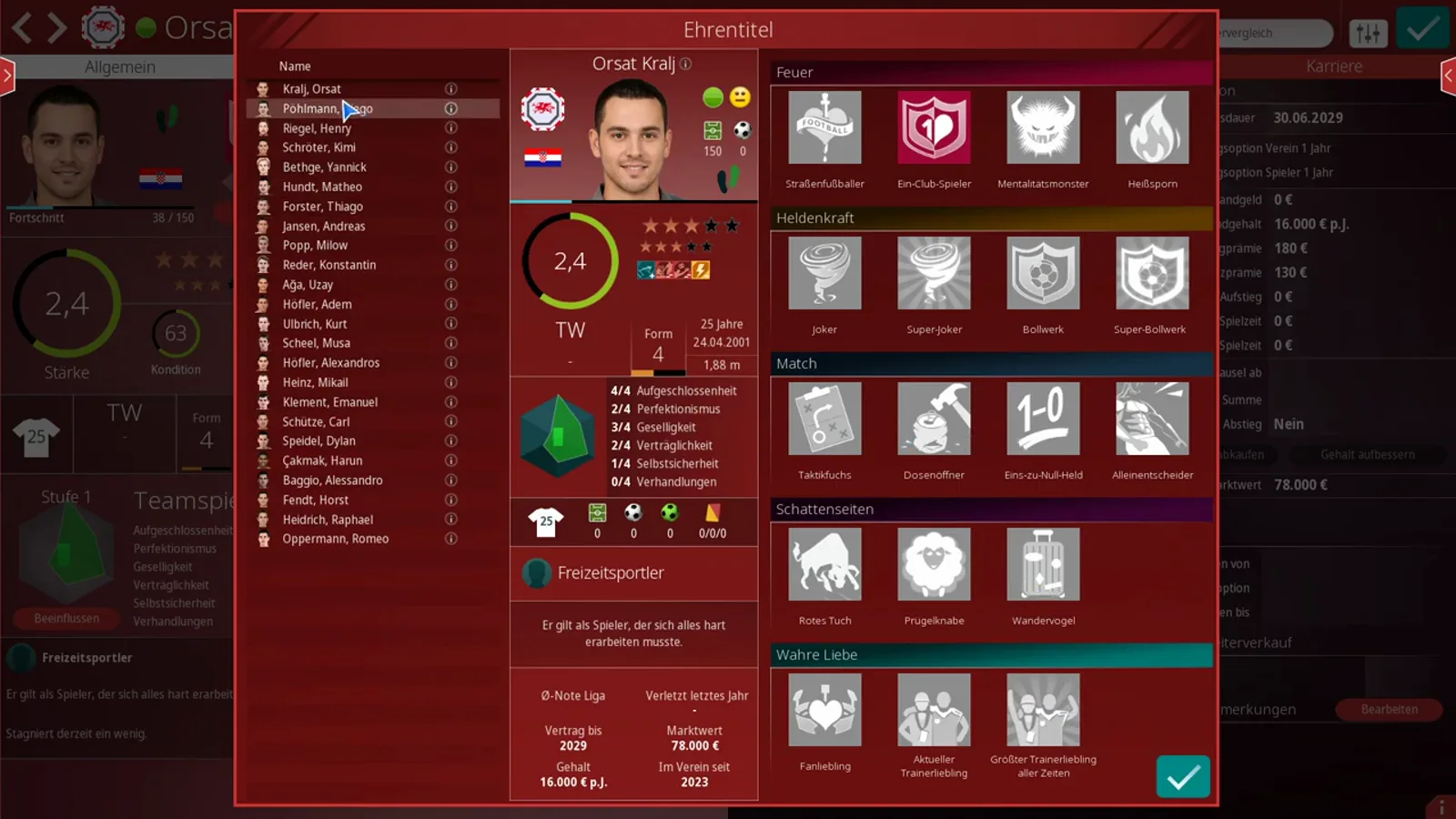
The Ehrentitel! badge next to the club crest pages through the titles a player already owns. The full overview behind it lists every title in the game across five categories: Feuer (Straßenfußballer, Ein-Klub-Spieler, Mentalitätsmonster, Heißsporn), Heldenkraft (Joker, Super-Joker, Bollwerk, Super-Bollwerk), Match (Taktikfuchs, Dosenöffner, Eins-zu-Null-Held, Allementscheider), Schattenseiten (Rotes Tuch, Prügelknabe, Wandervogel) and Wahre Liebe (Fanliebling plus the two Trainerliebling variants). Icons light up for titles the player holds; grey ones are still open.
Heldenkraft: the substitution hero powers
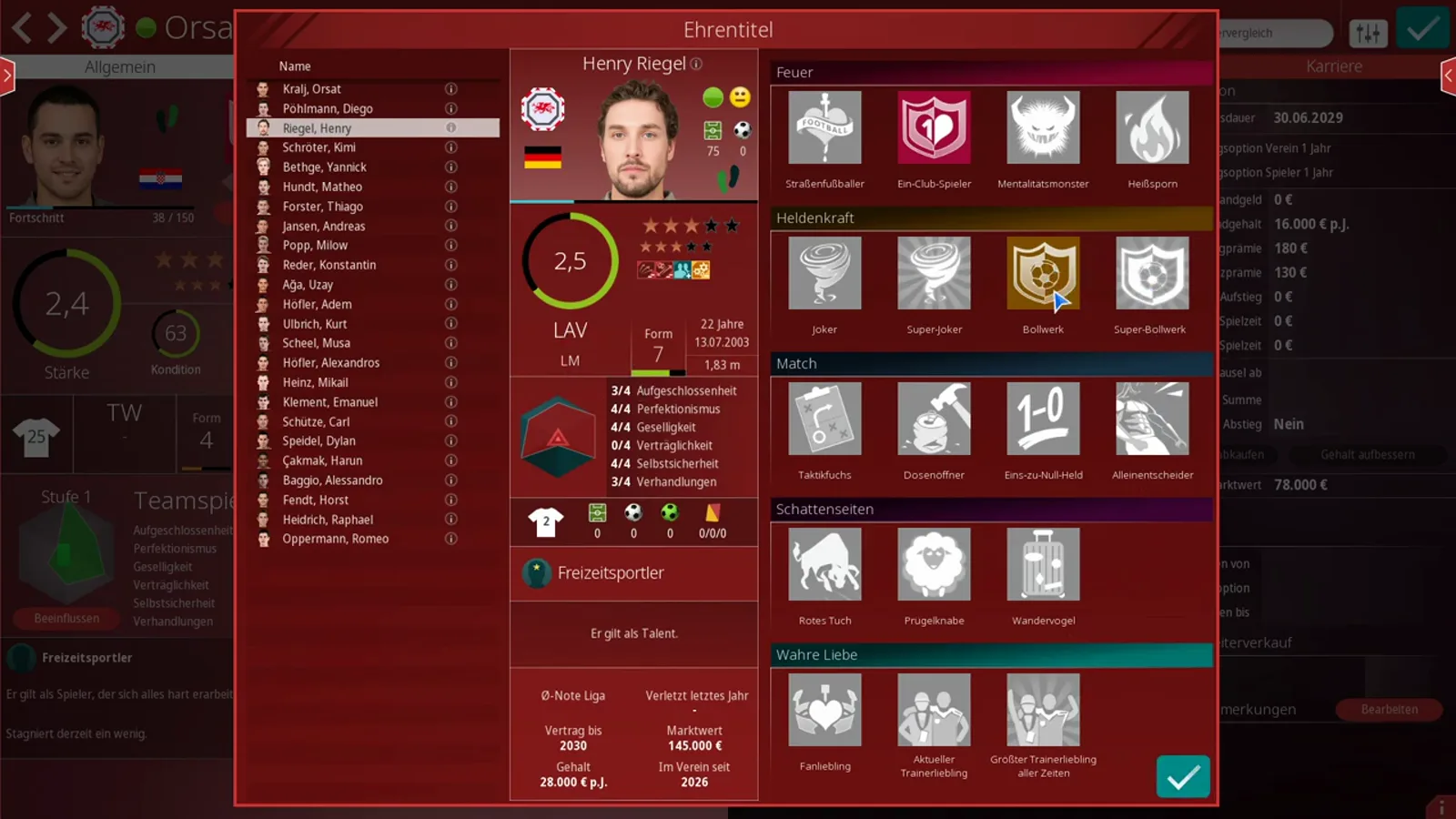
The Heldenkraft row holds what the tutorial calls the hero powers. Joker and Super-Joker players are described as particularly dangerous right after being substituted on — the type who occasionally scores the goal you needed from the bench. Bollwerk and Super-Bollwerk do the opposite job: when the result is narrow late on, they help hold it. The video’s verdict: most defenders — centre-backs and full-backs — should carry a Bollwerk variant.
Titles are earned — and lost — dynamically
Titles gate on measurable thresholds. The tutorial’s example: a positive ability in man-marking at level 3 was enough for Bollwerk at the player’s current strength. If the player grows stronger and the ability no longer meets the bar, the title disappears again. So re-check the badge after every development leap instead of assuming titles are permanent.
Age, July Birthdays and Decline
The season starts in July, and birthdays land there — the tutorial’s example player turns 30 on July 13. That timing creates the contract trap: sign a “29-year-old” born on July 13 to a three-year deal because he covers you “from 29 to 32”, and he actually plays the whole first season at 30. You paid three years for a decline phase.
From 30, the slide begins: level progress comes slower, abilities and levels erode, and training yields less. The tutorial’s rule of thumb: outfield players past 31 become a problem, goalkeepers past 35. Nobody says you must discard them — a 35-year-old can still do a job — but not at the strength he had at 30.
The ring itself signals the slide: the tutorial notes it turns red once overall level progress decreases, and his 35-year-old example already carries the warning state — an exclamation mark at the ring, four earned stars, a strength of 3.3, and only 22 of 200 progress points left on a deal that runs to 2029.
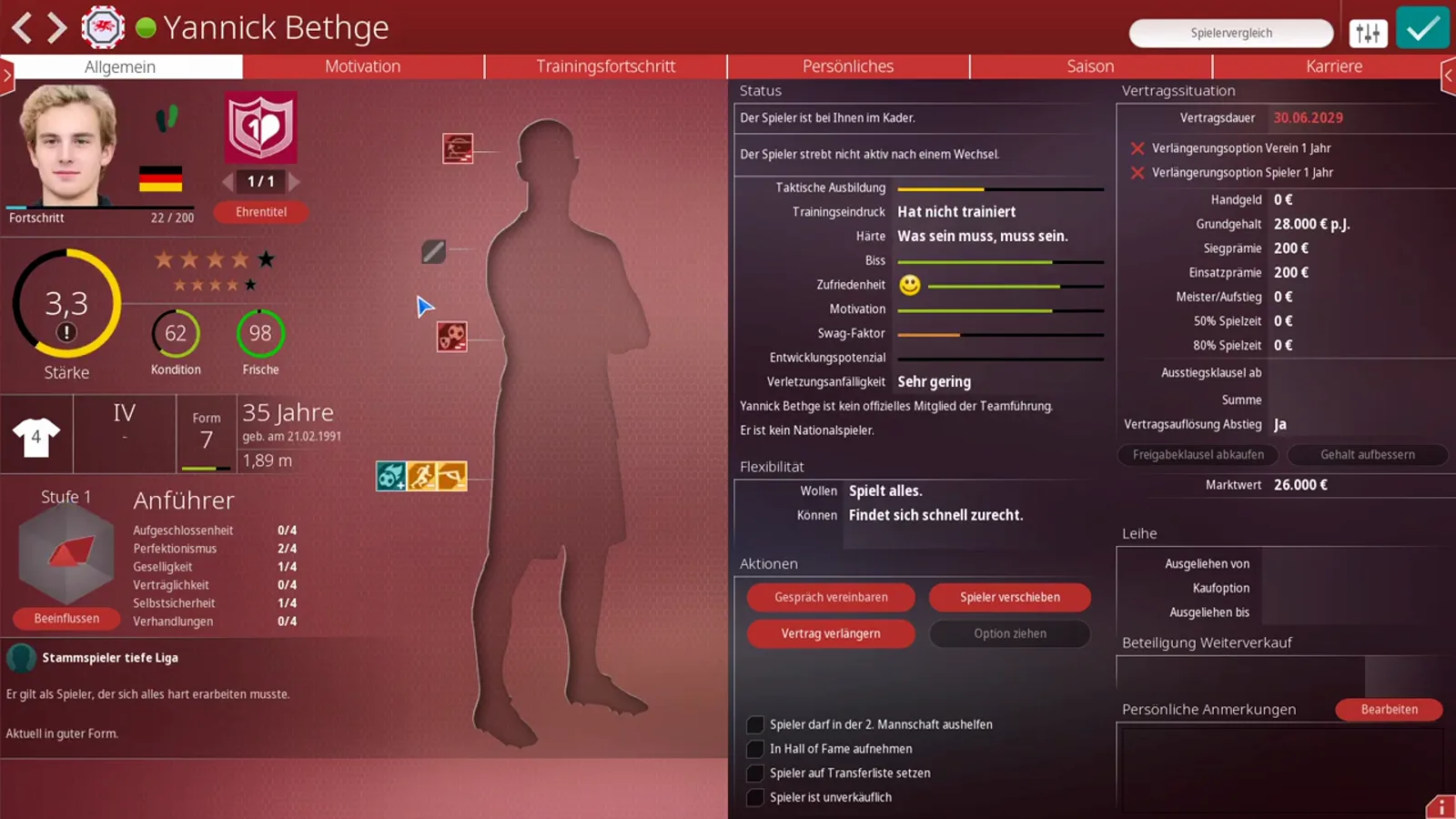
Age curves and contract length interact directly, so the clause and loyalty options in /guides/contract-negotiations/ decide how expensive a declining profile gets.
Character Types: Leader, Team Player — and the Analyst Detour
Below the position box sits the character panel: a coloured hexagon with a Stufe rating and six character values scored 0 to 4 — Aufgeschlossenheit (open-mindedness), Perfektionismus (perfectionism), Geselligkeit (sociability), Verträglichkeit (considerateness), Selbstsicherheit (self-confidence) and Verhandlungen (negotiations).
The colour coding is explicit: red marks the Anführer (leader), green the Teamspieler (team player). The tutorial’s level-3 leader combines 4/4 self-confidence with 3/4 negotiations — exactly the profile that drags a dressing room forward. High Geselligkeit pushes a player towards the leader or team-player side; that is the value to watch. And the road out of leadership is teachable too: lower sociability, feed Perfektionismus instead, and the player drifts towards the Analyst type.
Beneath the panel, an archetype line adds context — the demo players read Freizeitsportler (recreational athlete) or Stammspieler tiefe Liga (regular in a lower league) with a one-line description such as “Gilt als Talent” (considered a talent).
Shaping Types with Coaching — New in 2027
The headline change in WE ARE FOOTBALL 2027: the type is no longer fixed. Press the Beeinflussen button under the character panel and the Spielercharakter beeinflussen dialog opens. It shows the current Spielertyp, lets you pick a Ziel-Spielertyp — the demo aims for Künstler (artist) — and the Vorschlag button tells you which value to raise: in the demo, Aufgeschlossenheit +4. Confirm with Coaching beginnen and the player starts drifting towards the new type.
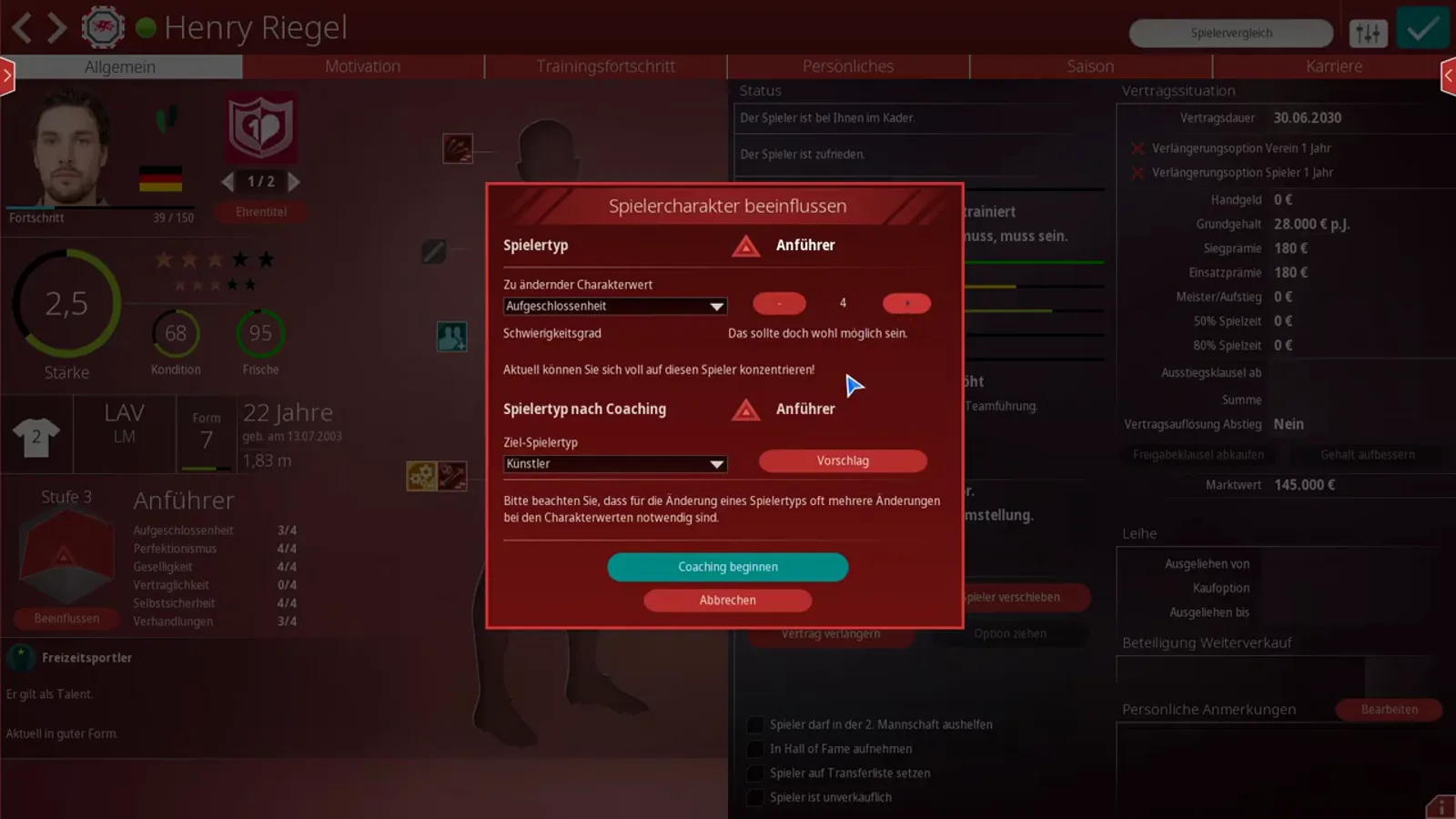
Two honest footnotes from the dialog itself: changing a type usually takes several character-value changes, not one, and the difficulty line (“Das sollte doch wohl möglich sein”) suggests feasibility differs from player to player. Because leadership traits overlap with the mood system, pair this with /guides/morale-and-satisfaction-guide/ before you start reprogramming a dressing-room pillar.
Status and Development: What the Bars Promise
The Status column stacks the live meters, and each has a distinct job:
- Biss — the fighting-spirit share of the motivation bar; the tutorial’s example player runs it full and green.
- Zufriedenheit — satisfaction. A yellow bar means something is wrong, even if the player has not formalised a request yet.
- Motivation — the short-term drive the tutorial reads alongside satisfaction.
- Swag-Faktor — how well this player’s fan merchandise sells. Full green bars are the shirt bestsellers; a stubby bar signals little marketing value.
- Entwicklungspotenzial — development potential, and the one that needs a warning.
Development potential is computed from talent, age and level: young plus talented plus low level equals a long bar. It shows where a player can get to, never where he will get to. Leave a century talent unused, train the wrong things, and he flops completely — while the bar quietly shrinks with every birthday because less time remains to convert talent into strength.
Two closing lines matter for squad planning: Verletzungsanfälligkeit (injury susceptibility — “Leicht erhöht” means he picks up injuries more easily and sits out more often) and the pair of status notes — whether he belongs to the Teamführung leadership group, and whether he is a Nationalspieler. A non-international never leaves for a call-up, which the tutorial flags as a quiet scheduling advantage.
Young, high-ceiling profiles are exactly what /talents/best-wonderkids-guide/ hunts for, /talents/youth-camps-guide/ grows your own, and which prospects at other clubs are worth digging out is the job of the /talents/scouting-youth-guide/.
Position Flexibility: Wollen and Können
The Flexibilität block answers two different questions: Wollen — will he accept the position? — and Können — how fast will he learn it? The video walks through three honest combinations:
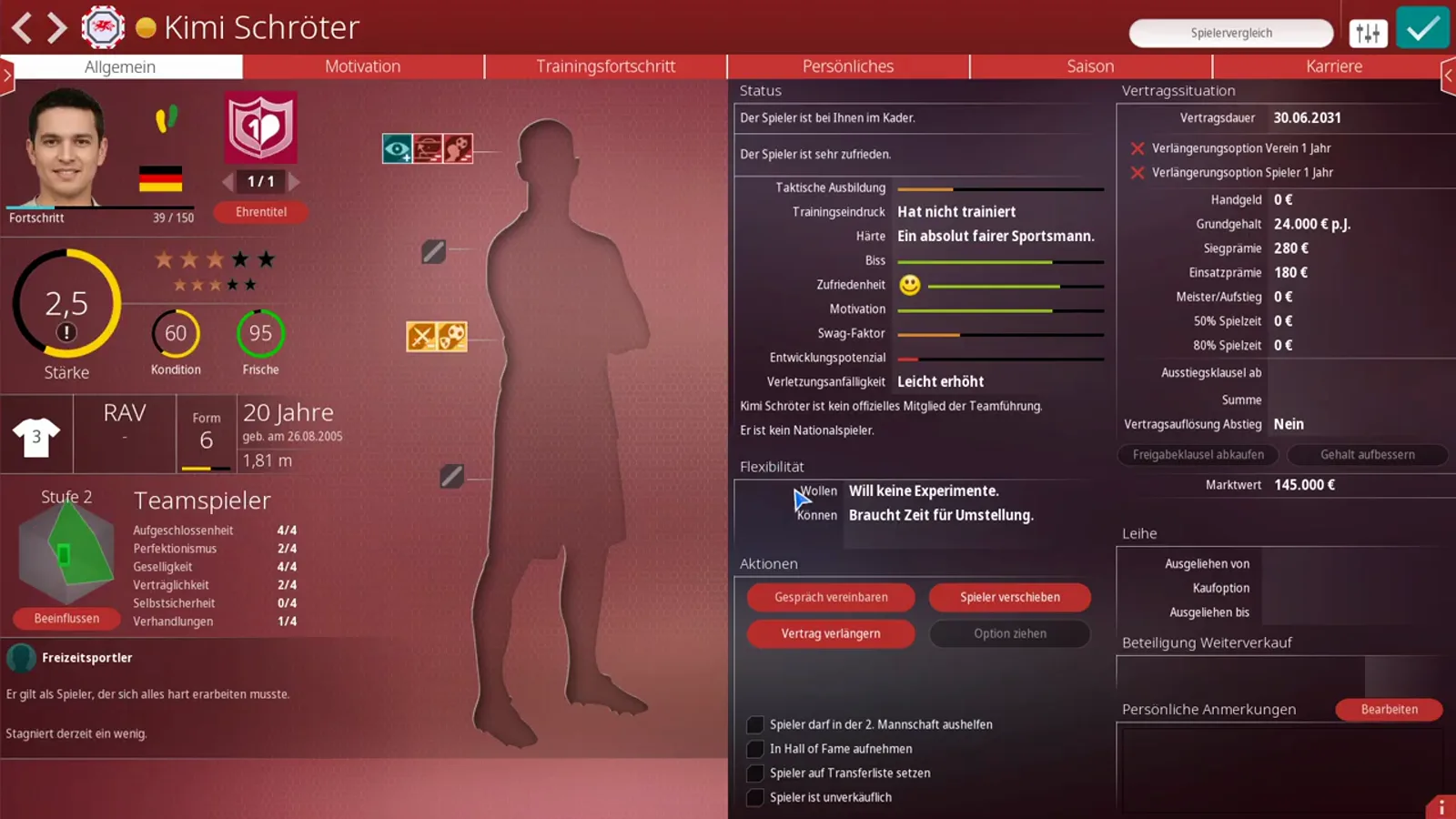
| Wollen | Können | What it means on the pitch |
|---|---|---|
| Das Team geht vor. | Braucht Zeit für Umstellung. | Never complains out of position, but learns it slowly. |
| Will keine Experimente. | Braucht Zeit für Umstellung. | Grumbles in an unfamiliar role and still needs time — the hardest pairing. |
| Spielt alles. | Findet sich schnell zurecht. | No complaints, and the learning bar fills fast. |
The tutorial also describes the fourth combination — a player who refuses experiments yet learns quickly. That one it calls a bet: he may complain after three games out of position, but if you leave him in place the learning bar fills and the grumbling fades. Whether to push through the moody weeks is your call as manager.
The retraining arbitrage
Flexibility unlocks a market trick the video demonstrates: a player whose skills fit attacking midfield but who is rated — and priced — as a centre-back is cheap to buy. Retrain him into his natural fit and his level, and therefore his market value, gets re-rated upwards. You buy where the rating is wrong and benefit where the role is right; /guides/transfer-market-guide/ covers the selling side afterwards. Just make sure the role you retrain him into actually exists in your shape — /tactics/best-tactics-formations/ keeps the system honest.
Related Guides
guides
WE ARE FOOTBALL 2027: The Official Manual and Where to Get It
Where to find the official WE ARE FOOTBALL 2027 manual, what its 281 (EN) and 321 (DE) pages cover, and which of our guides pairs with each section.
guides
WE ARE FOOTBALL 2027 Personal Life Guide: Popularity, Shares, Villa, Family
The personal life system in WE ARE FOOTBALL 2027: popularity, action points, club shares, coach skills, villa, health, languages, family — and switching it off.
talents
WE ARE FOOTBALL 2027 Youth Scouting Guide: Talents, Poaching, Fees
Youth scouting in WE ARE FOOTBALL 2027: scouting days, the training-observation bonus, outliers in the statistics centre, poaching fees and a suspected contract bug.
Was this helpful?
Thanks for the feedback!