WE ARE FOOTBALL 2027 Training Guide: Plans, Drills and Training Scope
How WE ARE FOOTBALL 2027 training works: amateur, semi-pro and pro training scope, every drill, intensity, training groups and saving weekly plans.
Frequently Asked Questions
How do I get the professional training plan in WE ARE FOOTBALL 2027?
Why is my team losing fitness despite fitness training?
Which training drill improves counter-attacking?
What are training groups for?
Training in WE ARE FOOTBALL 2027 is not a list you set once — it is a budget your wage bill quietly decides. A club with three drills a week can be fit or it can be tactically sharp, but it cannot be both. This page takes the Trainingsplanung screen apart: what the three scopes Amateur, Halbprofi and Profi really change, which drills exist, what a drill card tells you when you hover it, how weekly plans are saved and named, and what training groups are for. Freshness, rotation and injuries are handled in the medical and injuries guide, bite and satisfaction in the morale and satisfaction guide — this page is about the plan itself.
Your training scope is decided in the squad list, not in a menu
The tutorial’s author needed a long time to pin this down, because the rule was not in the manual when he started: he assumed the constantly shifting plan was a bug, wrote to developer Gerald Köhler, and the answer turned out to be a salary formula. So open the squad, sort by Gehalt p.J. (annual salary) and count.
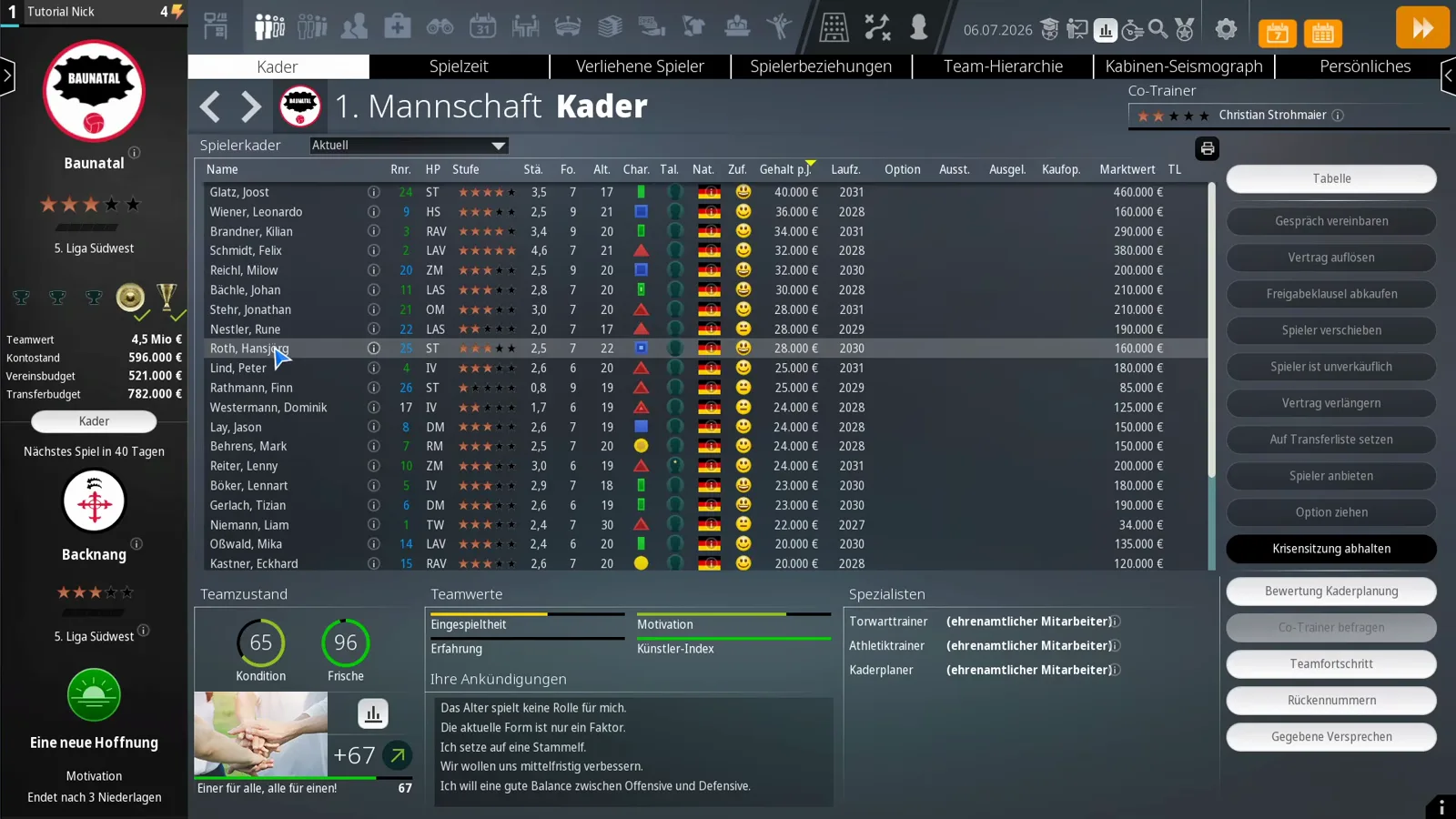
The screenshot lists eleven players at 25,000 € or above (40,000, 36,000, 34,000, then 32,000 twice, 30,000, 28,000 three times, 25,000 twice) — and that is exactly why this club is still on the amateur plan. The thresholds, as played out and counted on camera:
| Training scope | Required in the squad | Drills per week in the plans shown |
|---|---|---|
| Amateur | fewer than 15 contracts above 25,000 € | 3 |
| Halbprofi (semi-pro) | 15 players above 25,000 € | 7 |
| Profi (pro) | 15 players above 60,000 € | 14 |
A professional counts as two semi-professionals. The workaround is the real training tactic: to climb the table in the fifth division you have to raise salaries — the tutorial extends contracts and bumps pay purely to move from three drills a week to seven. Why the table ends the season with the semi- and full-professional clubs on top explains itself from that table.
The training screen: two tabs, fourteen slots
Along the top sit the tabs Trainingswoche (week plan) and Trainingsgruppen (training groups); below them, seven days in two rows. Every card has the same anatomy: a Belastung (workload) header, the drill name, the two or three things it trains, a group-size icon, a five-dot row, a player-selection dropdown (here Alle, everyone) and, underneath, the intensity you step up and down with the two arrows.
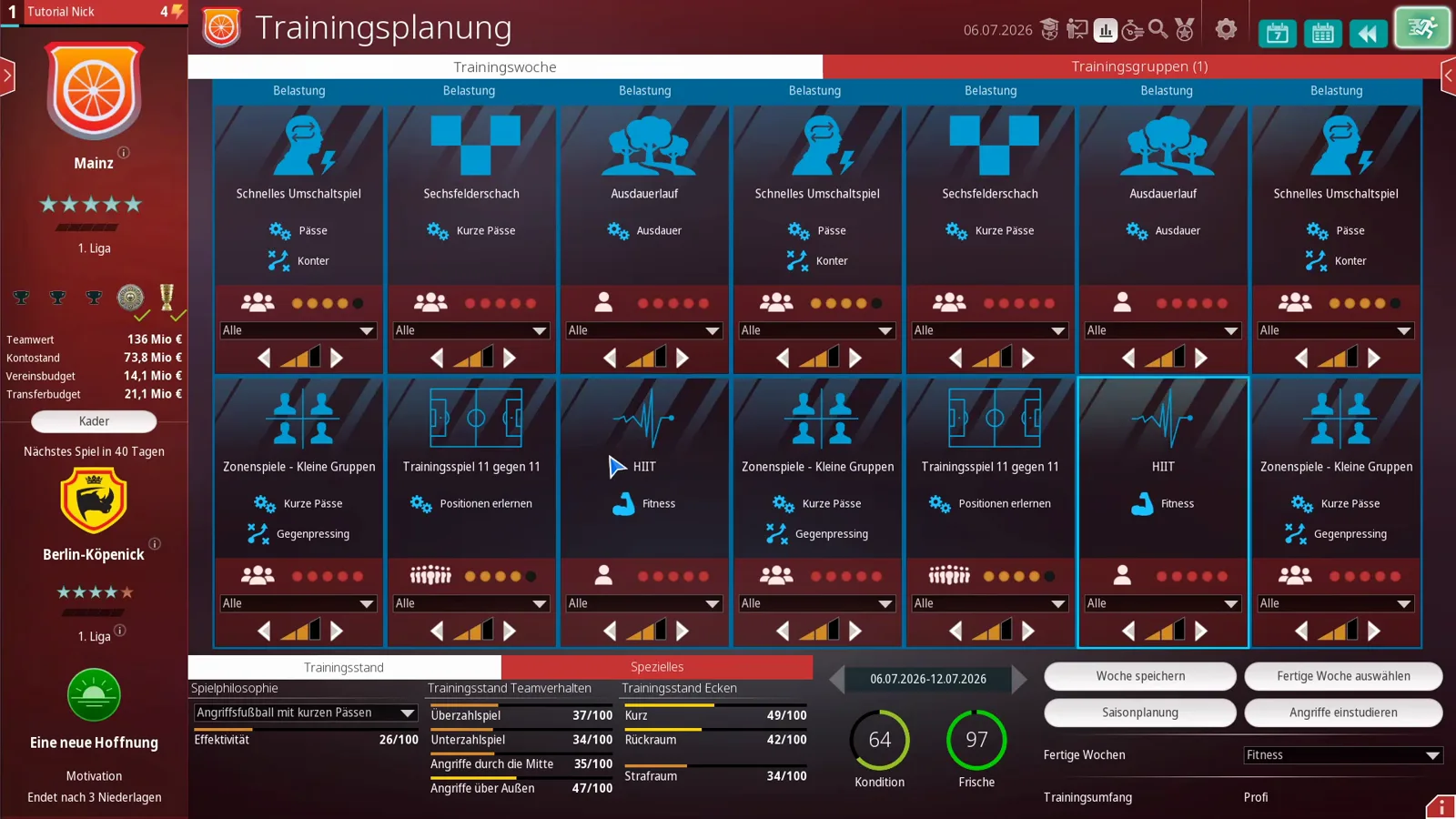
The professional week in the shot is a ready-made fitness plan pulled from the Fertige Wochen dropdown (visible bottom right), not something he built: Schnelles Umschaltspiel three times with the entries Pässe and Konter, Sechsfelderschach twice with short passes, Ausdauerlauf twice, Zonenspiele - Kleine Gruppen three times with short passes and Gegenpressing, Trainingsspiel 11 gegen 11 twice with position training, and HIIT twice with fitness. Bottom right reads Trainingsumfang: Profi, next to the rings Kondition 64 and Frische 97 — high fitness and high freshness two weeks into the season.
The same screen one tier down, built out as a semi-pro:
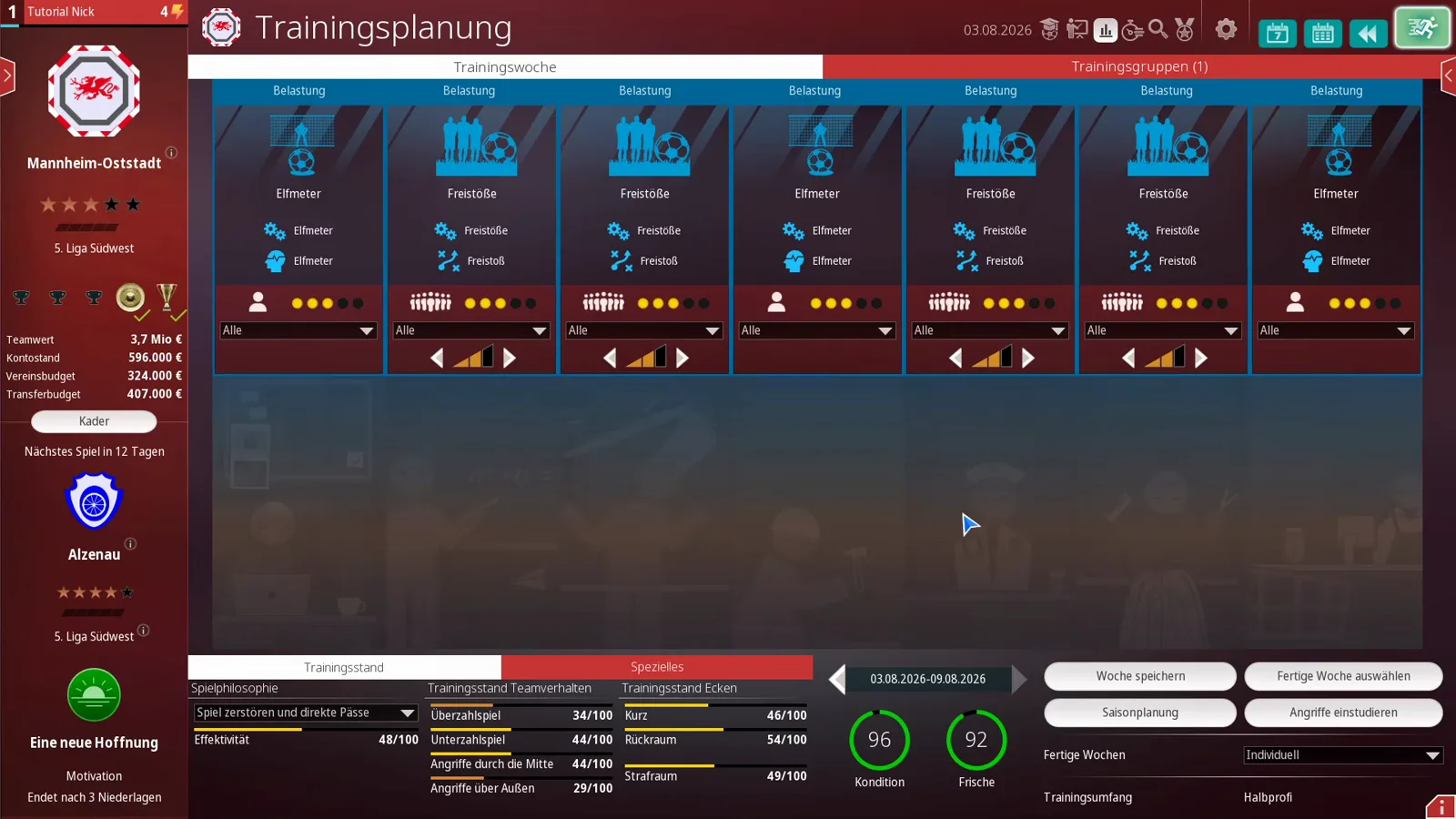
Seven drills, all spent on set pieces — Freistöße three times, Elfmeter four times — with tactic progress at 48/100 underneath. And at the bottom, the amateur week from the same author:
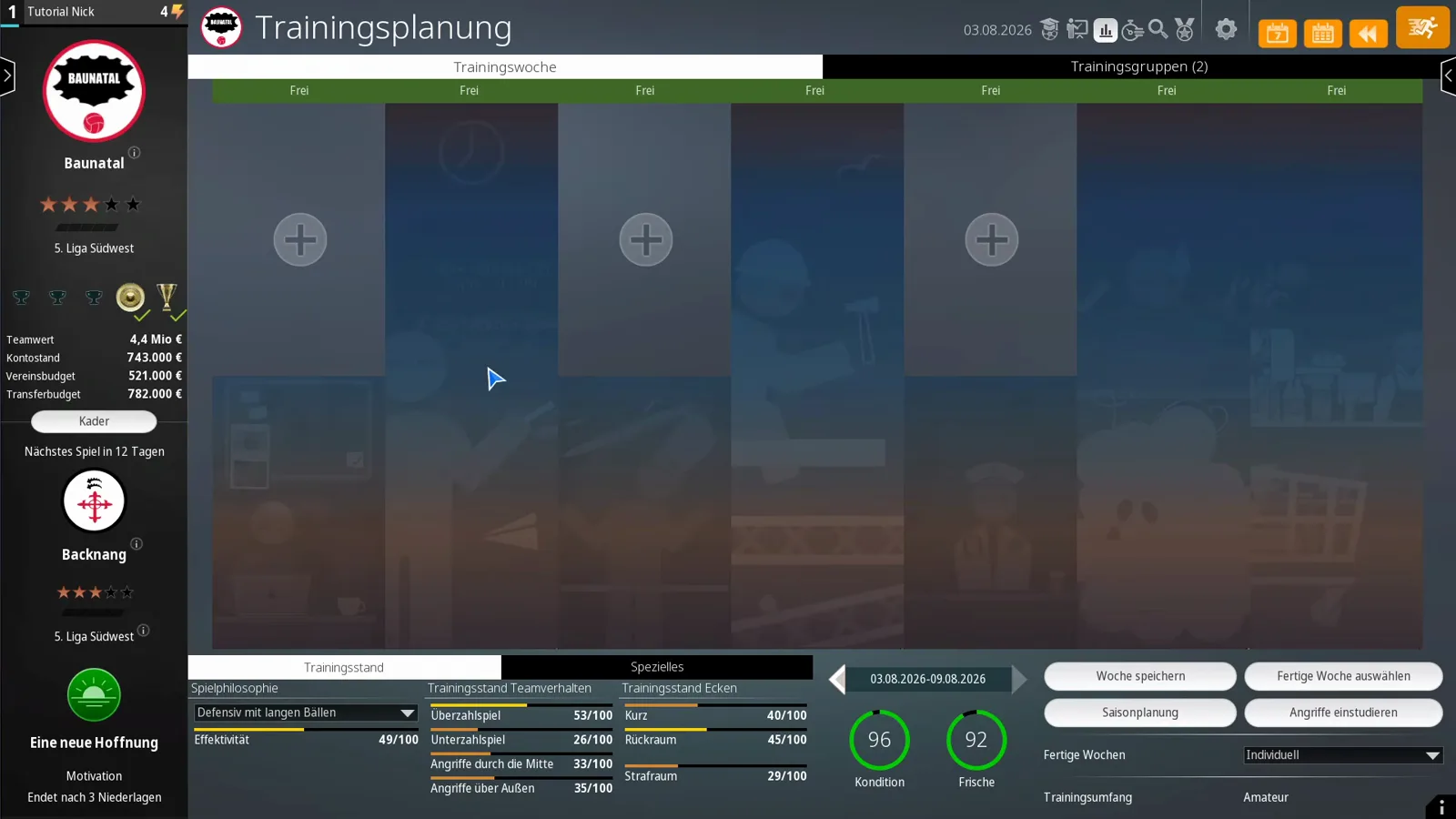
An amateur squad gets three slots in the entire week, and every day is headed Frei until you fill them — the greyed-out hours are the ones the players spend at work, and the author counts the pattern out: part-time, full-time, part-time, full-time. His prescription for that budget is blunt: fitness first and as hard as it goes. Do not pick Aktive Erholung, take the most strenuous conditioning unit available, and leave tactics and playing philosophy for later — his own summary is fitness, fitness and even more fitness. The reason is not ideology: he reports a side whose fitness ran down to roughly half during the season because the training budget went elsewhere, and in this league an unfit team loses the second half of every match.
What a drill trains: the card on hover
This is the information that costs the most time to find, because it is not printed next to the drill. Hover a card and a panel opens with six lines — in the shot for Angriff über die Mitte:
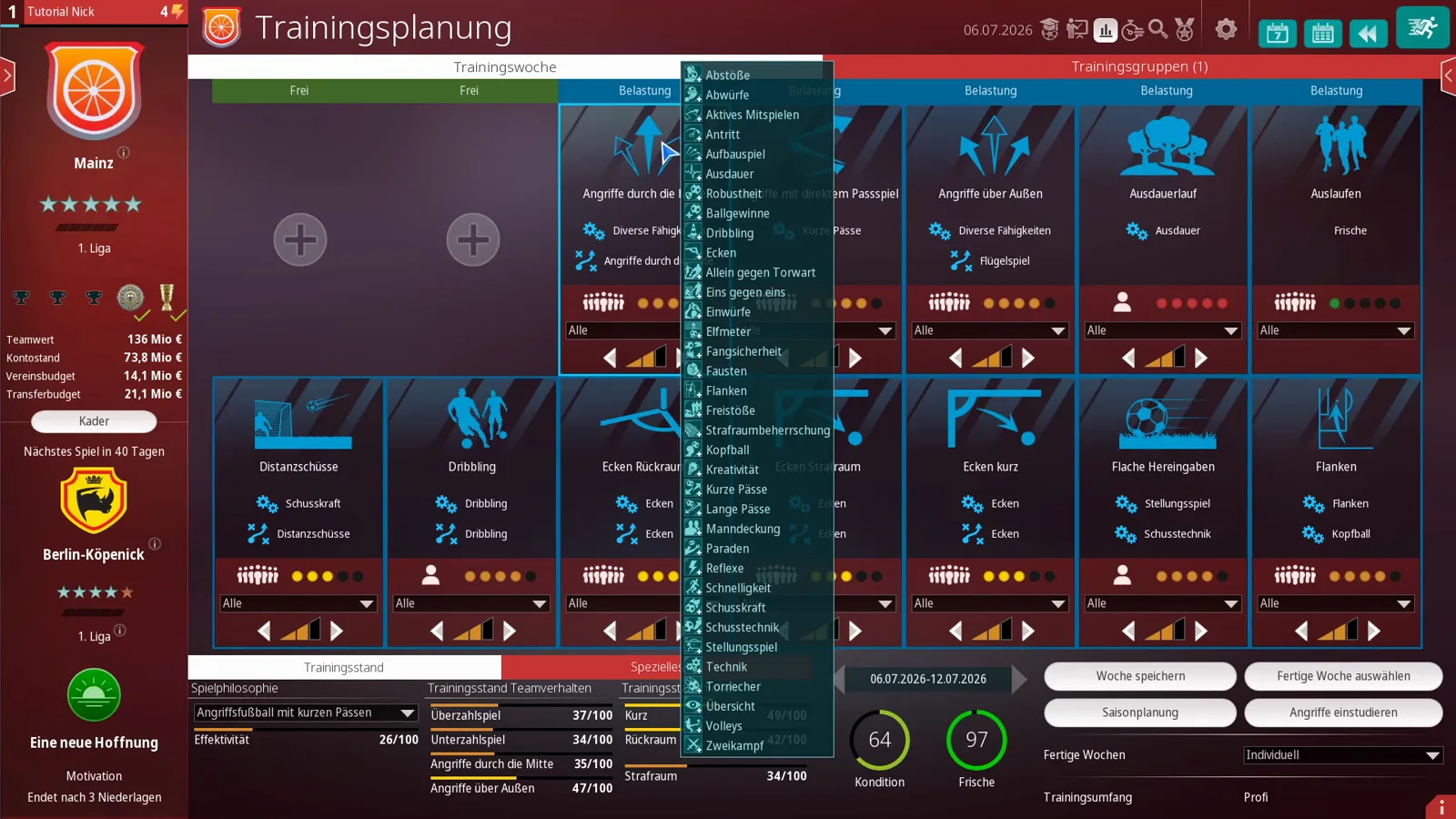
Verschiedene Fähigkeiten (various abilities) — a long strip running from Abschlag, Anbieten, Auffassen, Aufbauspiel, Ausdauer, Ballhalten, Ballsicherheit, Biss, Dribbling, Erobern, Fangsicherheit, Flanken, Freistöße, Kopfball, Kreativität, Kurzpass, Langpass, Manndeckung, Paraden, Reflexe, Robustheit, Schnelligkeit, Schusskraft, Schusstechnik, Stellungsspiel, Technik, Torgefährlichkeit, Übersicht and Volley through to Zweikampf — then Taktik (here Angriff über die Mitte), Spieler 30/30, Intensität 100 %, Frische -1, Verletzung 0 % and Spaß +0. Those last three lines are why the plan is a trade-off: every drill costs a little freshness, may carry injury risk, and lands on the mood meter.
And here is the trap the author warns about twice, in two different episodes: only Schnelles Umschaltspiel improves counter-attacking. The cards with “counter” in the name — Konter mit Passspiel, Konter mit weiten Bällen — train passing, speed and ball winning, not the tactic. If you want a counter-attacking team, you schedule the quick transition game, however misleading that feels.
The complete drill list
Select a drill in a week and the Löschen (remove) dialog opens — and the same dialog lists the entire catalogue, alphabetically in two columns, each row with its group size, the values it trains and a five-dot row:
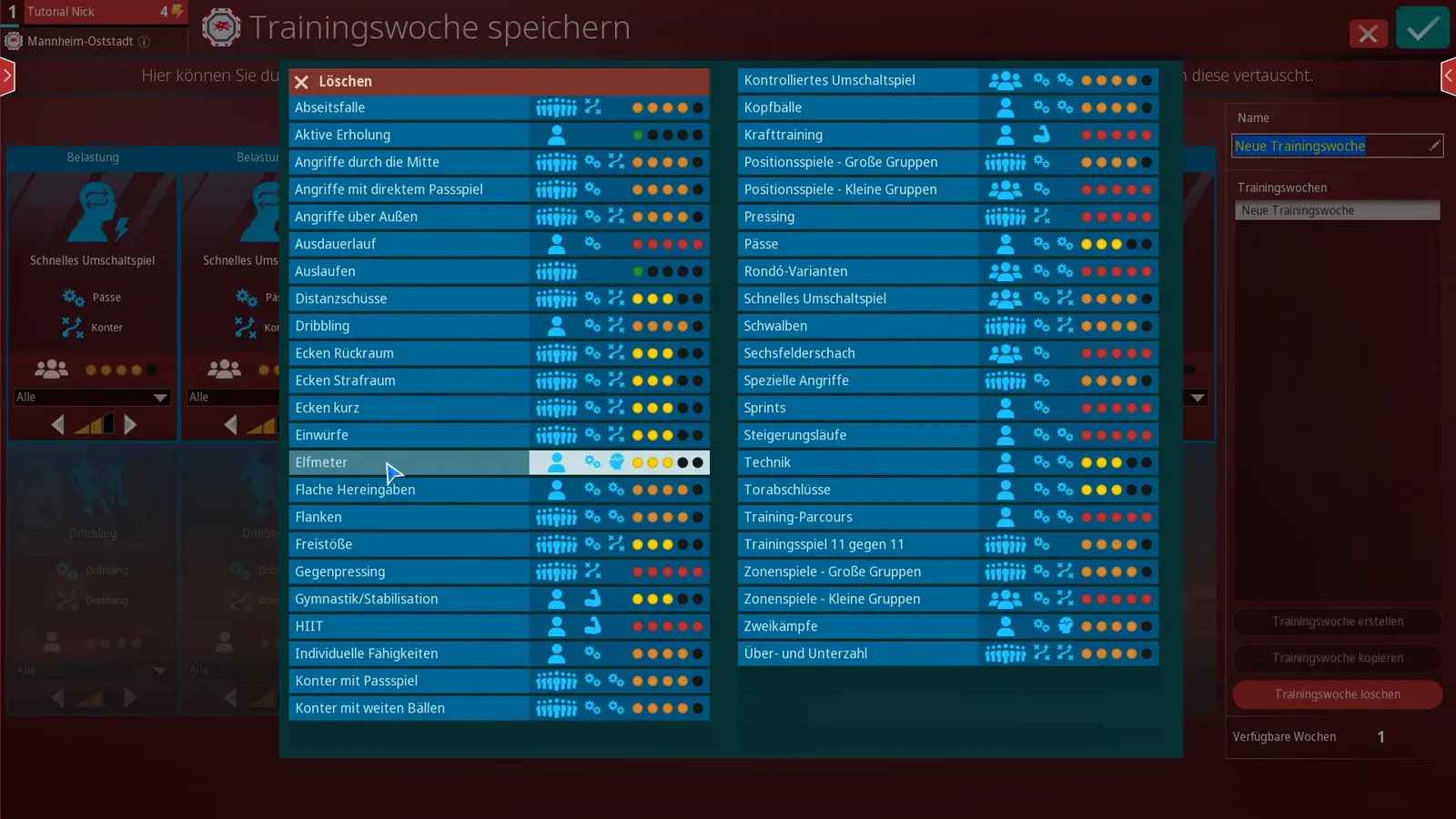
From the screenshot, 45 drills in two alphabetical columns. Column one: Abseitsfalle, Aktive Erholung, Angriffe durch die Mitte, Angriffe mit direktem Passspiel, Angriffe über Außen, Ausdauerlauf, Auslaufen, Distanzschüsse, Dribbling, Ecken Rückraum, Ecken Strafraum, Ecken kurz, Einwürfe, Elfmeter, Flache Hereingaben, Flanken, Freistöße, Gegenpressing, Gymnastik/Stabilisation, HIIT, Individuelle Fähigkeiten, Konter mit Passspiel, Konter mit weiten Bällen. Column two: Kontrolliertes Umschaltspiel, Kopfbälle, Krafttraining, Positionsspiele Große Gruppen, Positionsspiele Kleine Gruppen, Pressing, Pässe, Rondó-Varianten, Schnelles Umschaltspiel, Schwalben, Sechsfelderschach, Spezielle Angriffe, Sprints, Steigerungsläufe, Technik, Torabschlüsse, Training-Parcours, Trainingsspiel 11 gegen 11, Zonenspiele Große Gruppen, Zonenspiele Kleine Gruppen, Zweikämpfe, Über- und Unterzahl.
Which of those you need is decided by your tactics, not by the calendar. The reading from episode #038, mapped drill by drill onto the playing philosophies:
| Playing philosophy | Drills that support it |
|---|---|
| Defensiv mit langen Bällen | Schnelles Umschaltspiel |
| Park the bus | Konter mit weiten Bällen |
| Sicherer Spielaufbau | Angriffe durch die Mitte, Angriffe über Außen, Kontrolliertes Umschaltspiel |
| Ballbesitzfußball (possession) | Kontrolliertes Umschaltspiel, Rondó-Varianten |
| Attacks with short passes | Angriffe mit direktem Passspiel, Schnelles Umschaltspiel |
| Direkter Offensivfußball | Angriffe durch die Mitte, Angriffe über Außen, Schnelles Umschaltspiel |
Two more rules of thumb follow directly from the Spezielles tab at the bottom of the training screen. First: anything there with no slider is used automatically and therefore has to be trained — free kicks and the Ecken Strafraum corner routine are always taken, so they belong in the plan. Anything that does have a slider (Abseitsfalle, Dribbling, Schwalben, Pressing, Gegenpressing, crossing height) you can set to zero and then skip in training; the short and back-post corner variants run at 20 % at most anyway. Second: Über- und Unterzahl plus Angriffe durch die Mitte and Angriffe über Außen belong in every plan, because every attacking situation is one of them. The Trainingsstand panel prints these as x/100 values — in the professional shot Überzahlspiel 37/100, Unterzahlspiel 34/100, Angriffe durch die Mitte 35/100, Angriffe über Außen 47/100, plus Kurz 49/100, Rückraum 42/100, Strafraum 34/100. How those numbers behave once the whistle blows is worked out in the match engine tactics guide.
Intensity, repetition and the two constants
Intensity lives on the card itself, not in the drill menu: a triangle with two arrows that sets the workload as a percentage.
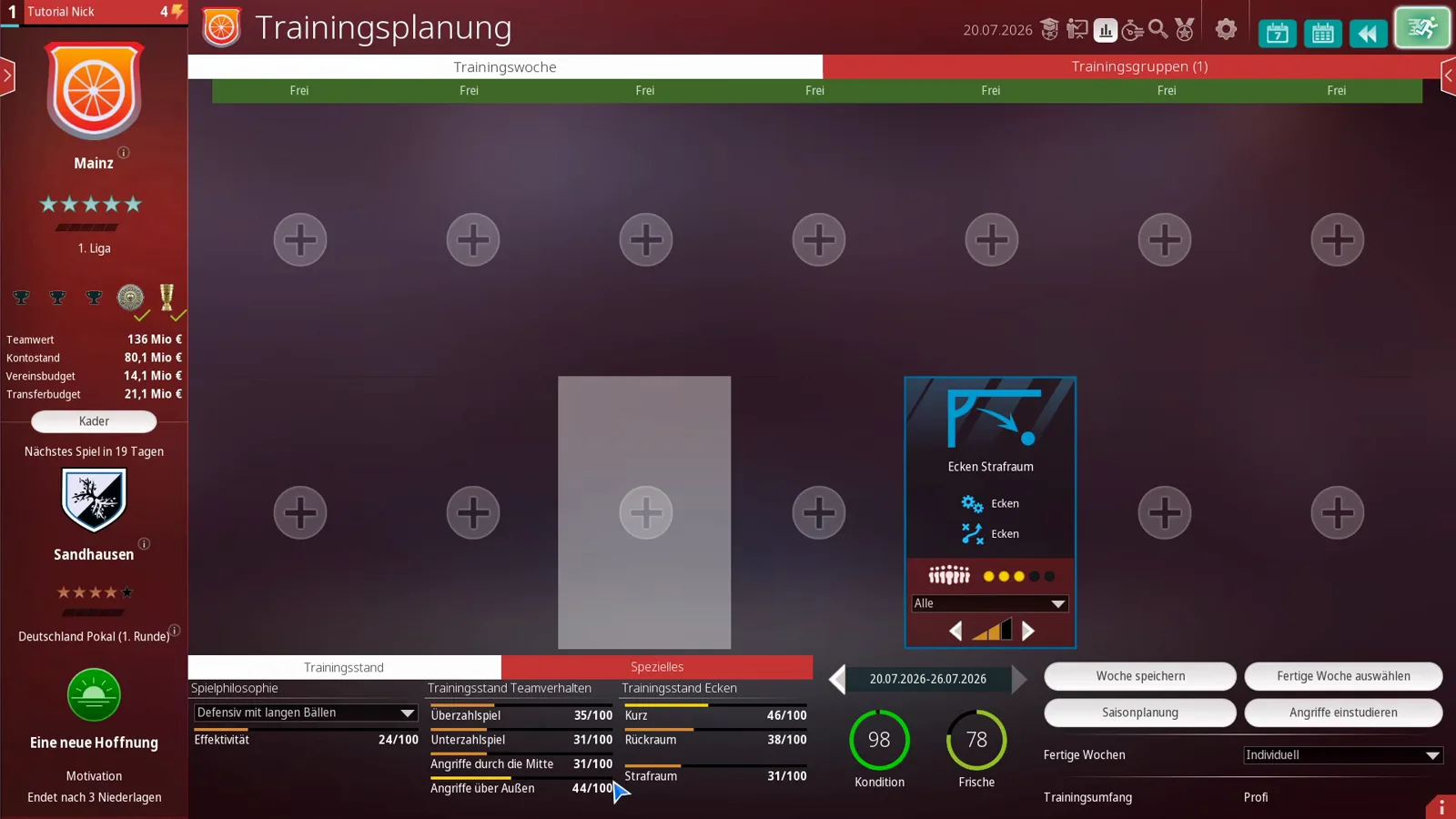
In the shot the Ecken Strafraum card carries two “Ecken” entries above a triangle sitting at the middle step; in other weeks from the same author, cards at 100 % and 150 % sit side by side. His rule of thumb: the middle ground is roughly 120–180 % effort. Conditioning lacking, dial up; squad tired, dial down. And because the drill Aktive Erholung does the opposite — it buys freshness instead of fitness — it is the wrong pick in a build-up week unless recovery is genuinely the goal. How fast players improve at all is decided by a line on the difficulty screen, Erfolgreiches Training, covered in our difficulty settings guide.
On repetition, the rule is what separates progress from a mutinous dressing room: never the same drill more than three times a week, and if you do use three, do not repeat it the following week — twice is the safe ceiling. The reason is printed on the card: too much of the same annoys the players, and annoyed players train worse. His two constants, which stay in every week, are Ausdauerlauf for the reserves and Auslaufen for everyone — so the players who did not feature carry the same load as the eleven who did and fitness does not leak away through the bench. In a professional week that leaves six slots for tactics.
Saving and naming weekly plans
The Woche speichern button at the top right opens the Trainingswoche speichern screen, with a name field on the right, a list of saved weeks and the actions Trainingswoche erstellen, Trainingswoche kopieren and Trainingswoche löschen; below them Verfügbare Wochen counts what you have.
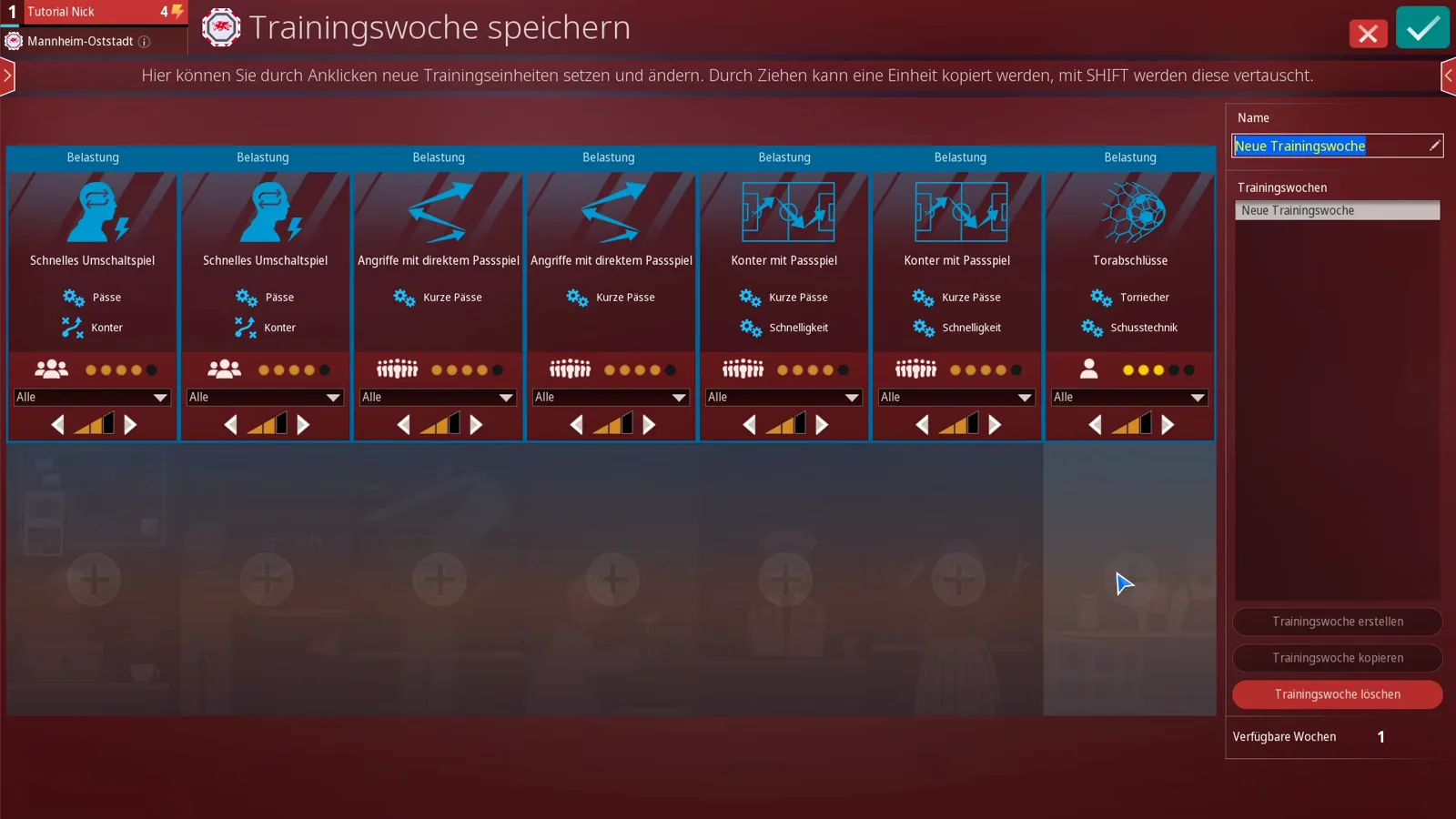
Why naming is worth the typing: saved weeks belong to the manager, not to the save, so a fourteen-slot professional plan simply does not fit an amateur week with three. The author therefore prefixes each name with who built it and for which save, then the purpose and the tier, and finishes with a variant letter — week 1 semi-pro A, then week 2a and 2b in rotation. The letter is not decoration: if he promises the team a day off before a match, or a fixture lands in the middle of the plan, he needs the alternate version loaded. You pull a saved week back in through Fertige Wochen, and the Fertige Woche auswählen button shows what the game ships as templates — the fitness week in the professional screenshot above came from exactly there.
Training groups: three different weeks inside one plan
The second tab of the training screen splits the load by group instead of by day. On the left sits Reguläres Training under the line “Diese Spieler trainieren die im Trainingsplan gesetzten Einheiten”, with a player table (HP, NPs, Name, Stä., Fo., Fähigkeiten, Alter, Char., Kon., Fri., Tal.); on the right, the groups, each running its own week type.
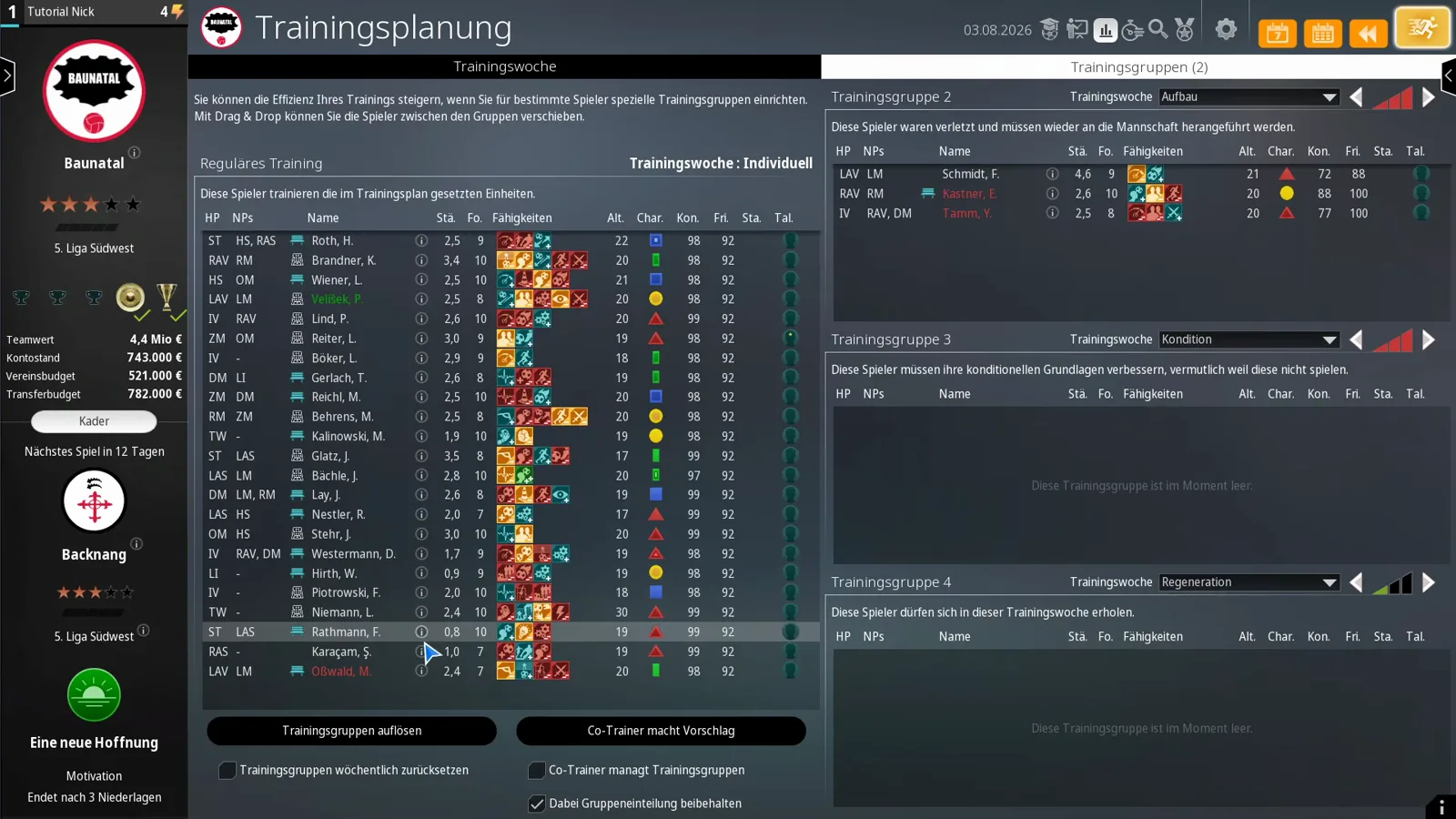
The groups in the shot: Trainingsgruppe 2 set to Aufbau with the note “Diese Spieler waren verletzt und müssen wieder an die Mannschaft herangeführt werden” (they were injured and have to be worked back into the squad), Trainingsgruppe 3 set to Kondition for players whose base is not there yet, and Trainingsgruppe 4 set to Regeneration, “Diese Spieler dürfen sich in dieser Trainingswoche erholen”. Below them: Trainingsgruppen auflösen, Co-Trainer macht Vorschlag and three checkboxes — Trainingsgruppen wöchentlich zurücksetzen, Co-Trainer managt Trainingsgruppen and Dabei Gruppeneinteilung beibehalten. Groups are filled by dragging players across, and the headcount sits in the NPs column.
That is also where the hub warning Keine Trainingsgruppen points, when the club hub reads “Sie nutzen die Möglichkeit nicht, durch die Aufteilung auf Trainingsgruppen die Ergebnisse des Trainings zu optimieren” — the route to that panel is in the controls and menus guide. Handing the whole split to the co-trainer means relying on his competence stars, diligence and department workload, which the staff and HR guide explains. And the four buttons at the bottom right are what tie the plan back to matches: Woche speichern, Fertige Woche auswählen, Saisonplanung and Angriffe einstudieren. If the bars still refuse to move, the cause is usually freshness in the wrong week — the rotation logic in the medical and injuries guide — or an intensity spiral the beginner guide places into the pre-season calendar.
Related Guides
guides
WE ARE FOOTBALL 2027: Career Mode & Game Modes Explained
Realistischer Modus vs Kreativmodus, the six career starting points, and what a week, a transfer window and a season in a real save look like.
guides
WE ARE FOOTBALL 2027: Difficulty Settings and Career Start Options
All ten WE ARE FOOTBALL 2027 difficulty lines explained: presets, budgets, transfer market, scouting, job security, injuries, fines, start country and contract.
guides
WE ARE FOOTBALL 2027: Install, First Launch & New-Game Setup Guide
How to install WE ARE FOOTBALL 2027 on Steam and start your first save: language choice, database scope, manager creation, difficulty and club selection.
Was this helpful?
Thanks for the feedback!