WE ARE FOOTBALL 2027 Winter Break Guide: Friendlies & Fitness
The winter break in WE ARE FOOTBALL 2027: the season-end budget forecast, friendlies with appearance fees, fitness plans, scouting and the youth Sichtungstag.
Foire aux questions (FAQ)
When is the winter break in WE ARE FOOTBALL 2027?
Do friendlies cost money in WE ARE FOOTBALL 2027?
How do you build fitness and freshness during the break?
What is the Sichtungstag in WE ARE FOOTBALL 2027?
Can players get injured in winter friendlies?

Bringt uns die Transferphase die nötigen Impulse? | We are Football 2027 (12) — Täglich Angespielt
The pre-season guide covers the weeks before a campaign, the weekly schedule guide covers a normal in-season week, and the season transition guide covers the ceremony at the end. That leaves the stretch in between that no matchday interrupts: the winter break. In the video’s 5. Liga West save it spans the turn of the year — a January of free weeks where the club plays friendlies, pushes fitness, scouts, runs its youth sighting day and quietly does the club business the matchday calendar normally crowds out. This page walks that half-season screen by screen, in the order the source video plays it.
What does the break mean for the club’s budget?
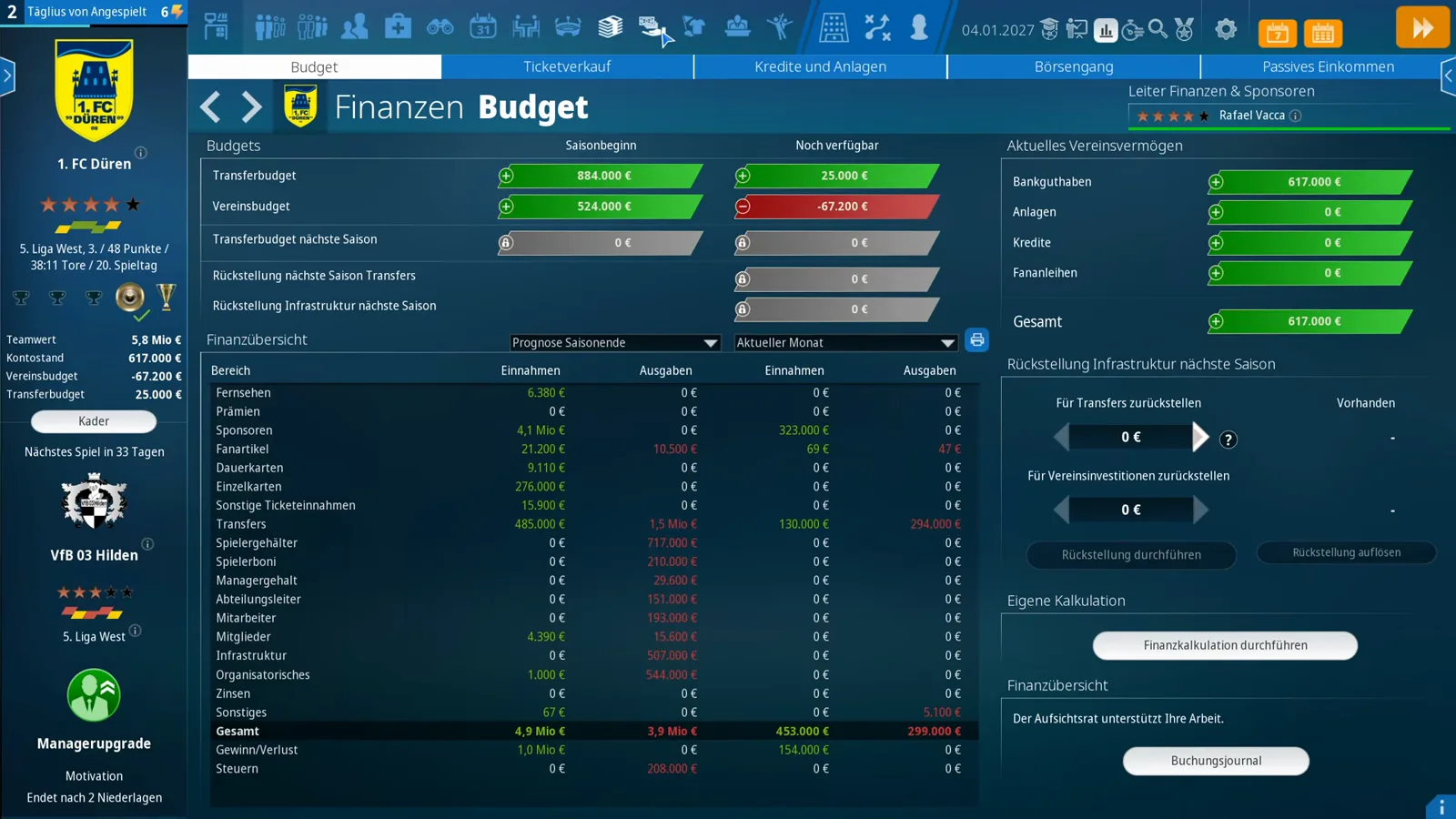
The video opens the break at the Finanzen Budget screen, and the screen to read is the forecast: the budget planning block shows the transfer budget with its post-signings adjustment — 25.000 € still available — and the club budget beside it, deep in the red at -67.200 €. The Finanzplanung table switches to Prognose Saisonende — where the season’s money lands if nothing changes: the Gesamt line projects 4.9 Mio € earned against 3.9 Mio € spent, and the club’s current wealth reads 617.000 € in green — the cushion the second half of the season gets to spend.
How do you arrange friendlies during the break?
Through the Freundschaftsspiel vereinbaren screen, dated 4 January in the save. It lists candidate opponents with dates — Energie Cottbus, KSV Hessen Kassel, FC Rot-Weiß Erfurt and further down the pyramid — and clicking one opens its club card: Energie Cottbus appears as a 2. Liga (Profi) side with a squad value of 17.2 million euros and, decisive for this save, an Antrittsgeld of 12.000 € attached to facing them.
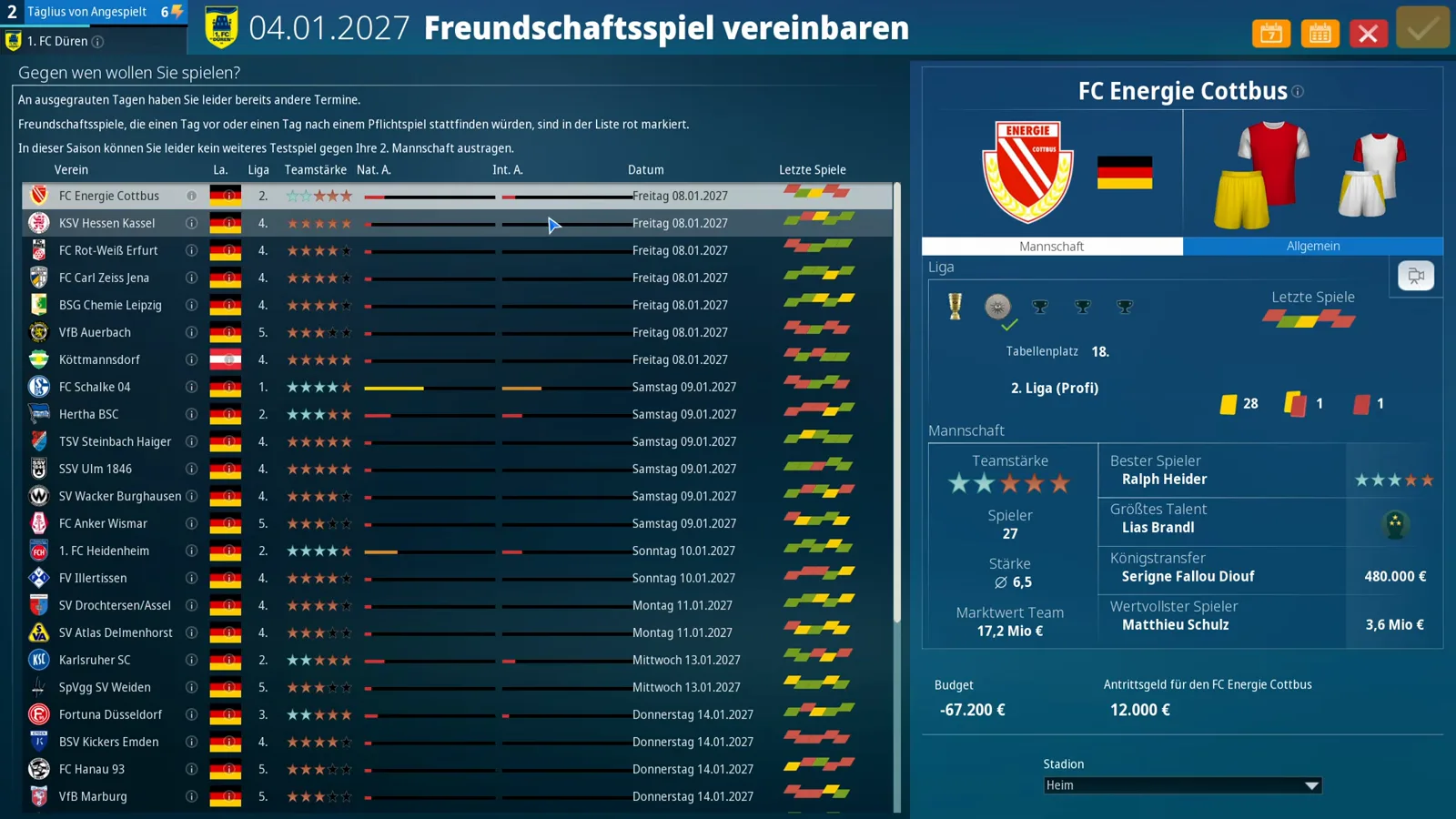
That entry fee is why the save declines to host: the manager’s stated reason for playing the friendly away is that the club cannot afford it. The friendly actually booked is against VfB Marburg — away, the last name on the same list — and it doubles as the fitness test the training plan wanted first.
How do you build fitness and freshness in the free weeks?
The Trainingsplanung is where the break earns its keep. In the save’s first full break week the friendly card sits midweek with a Tapering unit ahead of it, the two training groups are set to Pressing and Gegenpressing, and the team dials read Kondition 92 / Frische 92. The spoken plan around the grid is pure break logic — friendlies first, «then into conditioning, then into freshness», because freshness costs money and the break is exactly the time to push it. Set-piece units (corners, free kicks) and individual skill work fill the gaps between the fitness blocks.
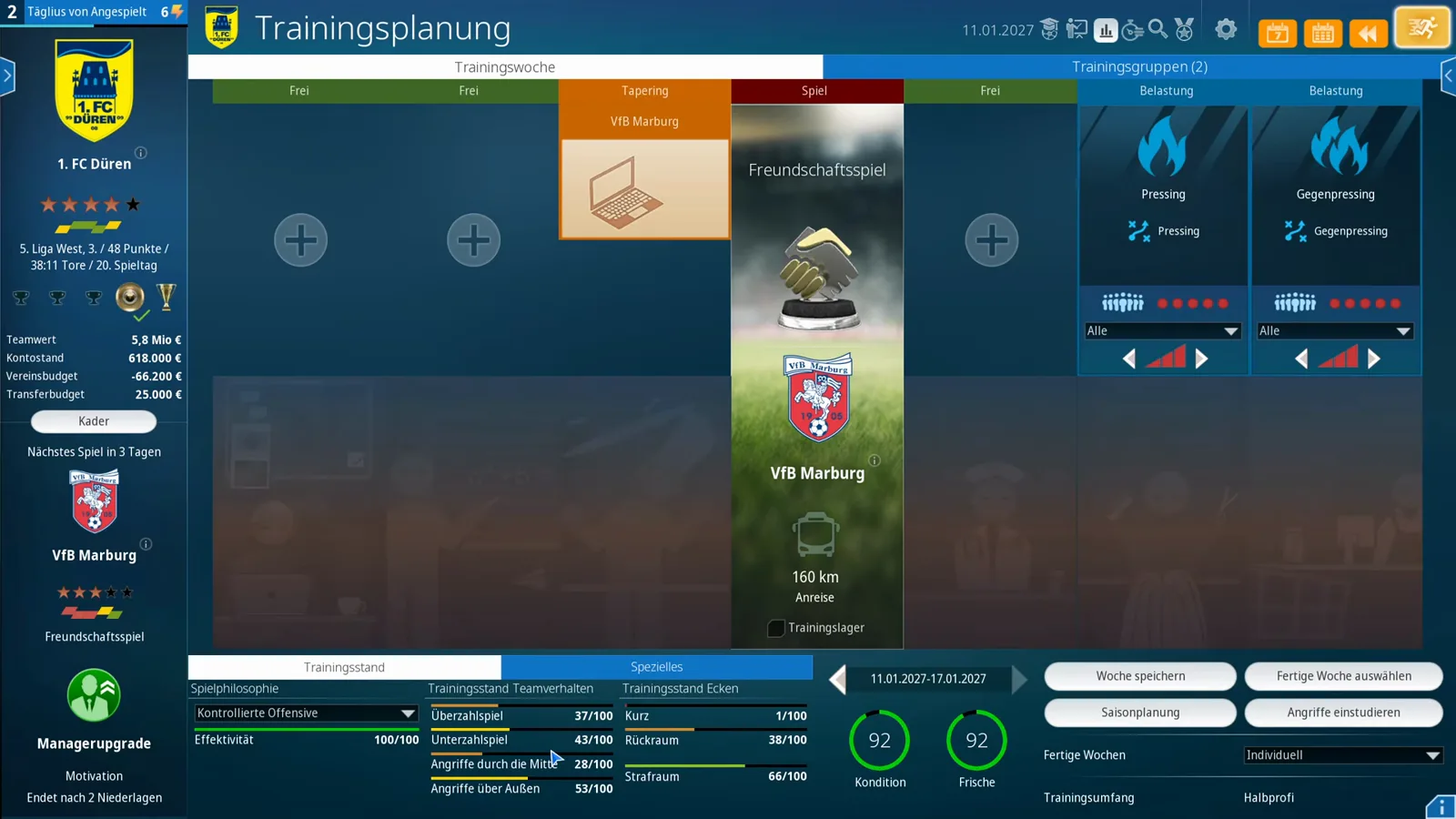
The training mechanics behind the units are the training plan guide’s territory; the break matters because it is the only stretch where weeks of pure physical work fit without a matchday stealing the freshness they build.
Can you scout during the winter break?
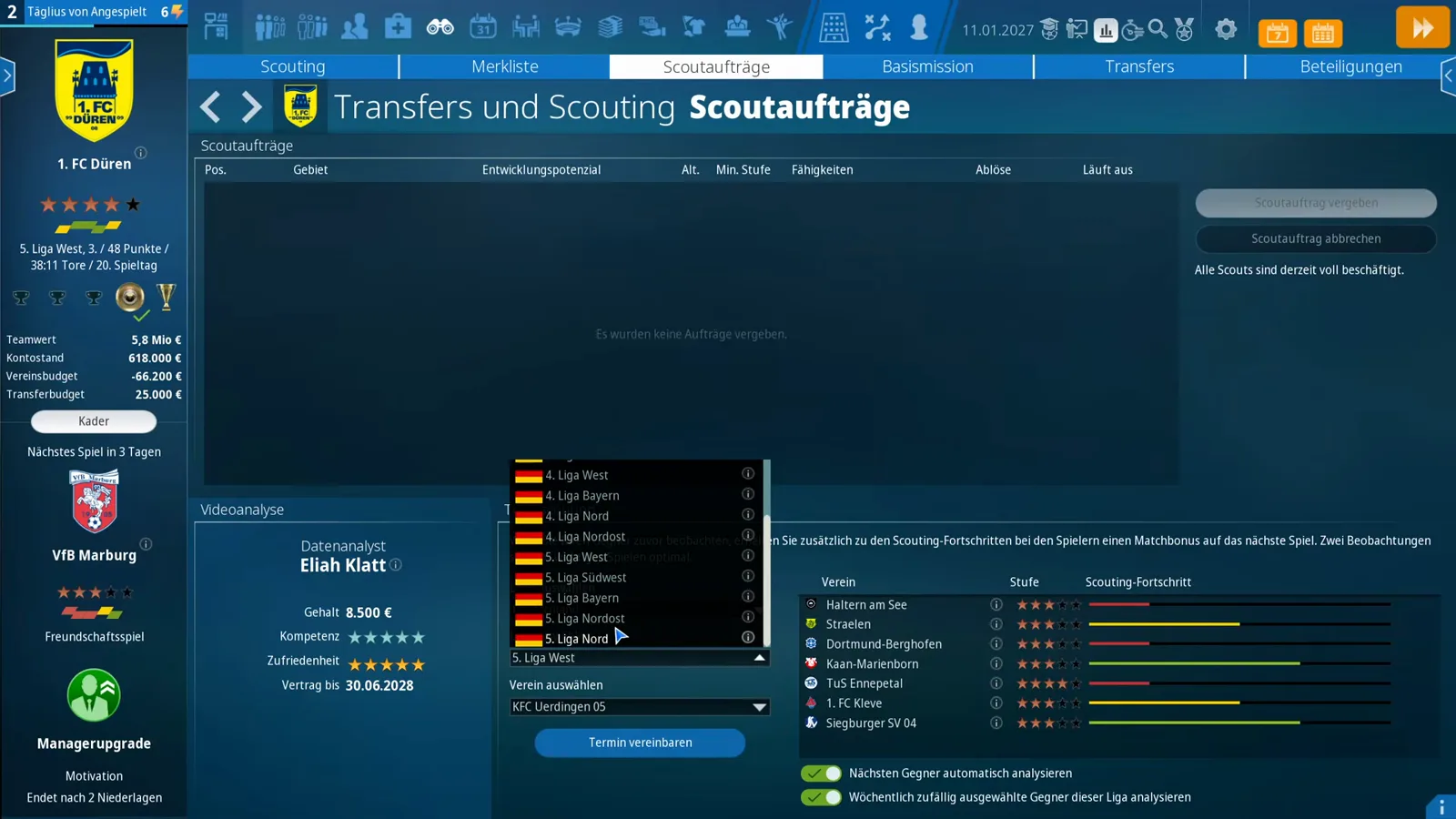
Yes, and the video does it with a purpose: scouting the friendly opponent «so that we can play there under virtually normal conditions» — the game’s video analysis turns an unknown away trip into a prepared one. The Transfers und Scouting area holds both halves of that. The Scoutaufträge tab is where assignments would live — the save’s own list reads «Es wurden keine Aufträge vergeben», with every scout fully booked — while the assignment panel opens the league dropdown — 4. Liga West, 4. Liga Bayern, 5. Liga West and so on — to aim a scout at a division, with the per-club Scouting-Fortschritt bars tracked beside it.
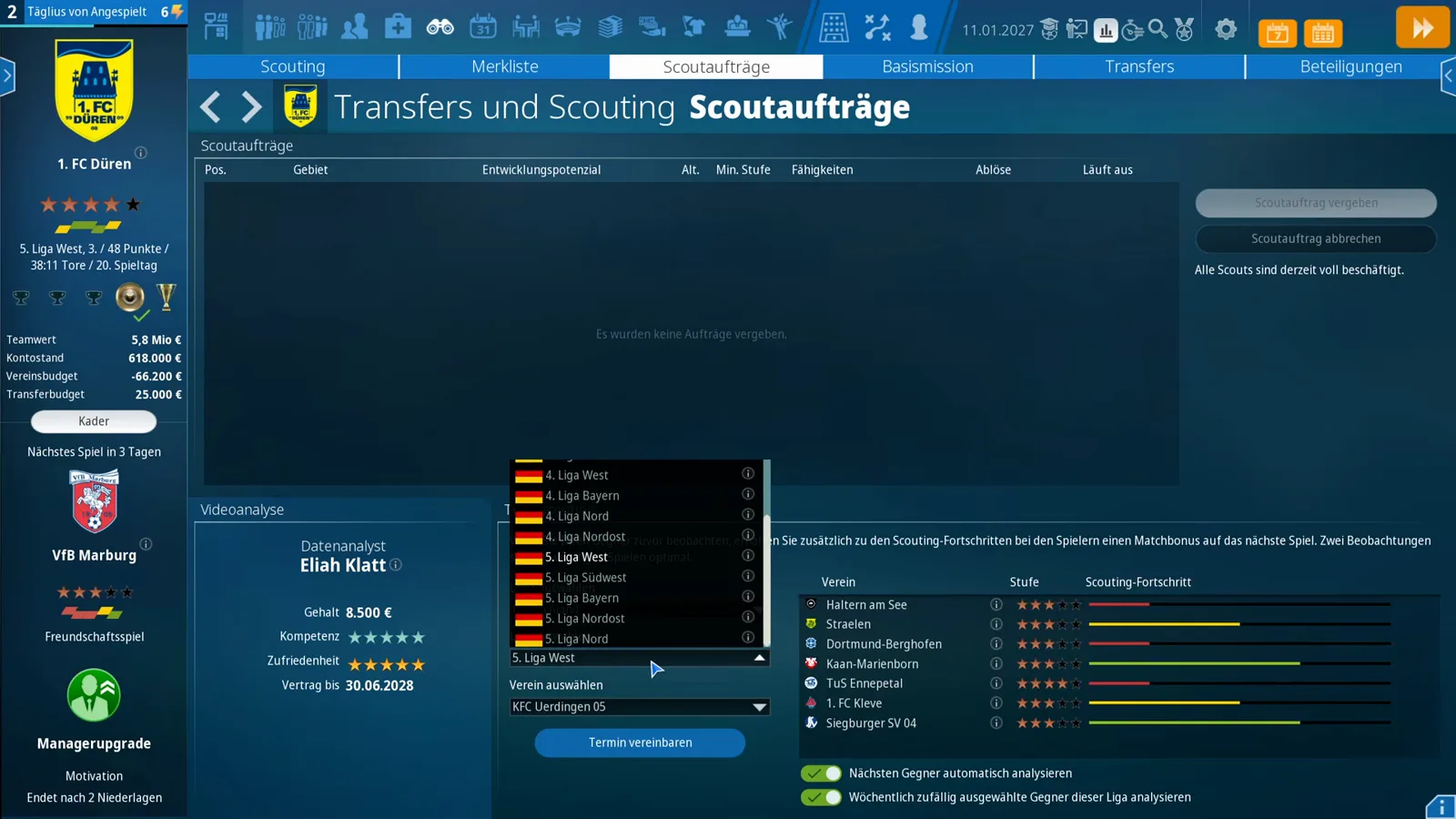
Below it sits the Videoanalyse block with its Datenanalyst — Eliah Klatt in the save, 8.500 € a year — and two automation toggles: «Nächsten Gegner automatisch analysieren» and a weekly random analysis of the division’s clubs, which together keep the scouting progress table moving without weekly clicks.
Does the youth work continue during the break?
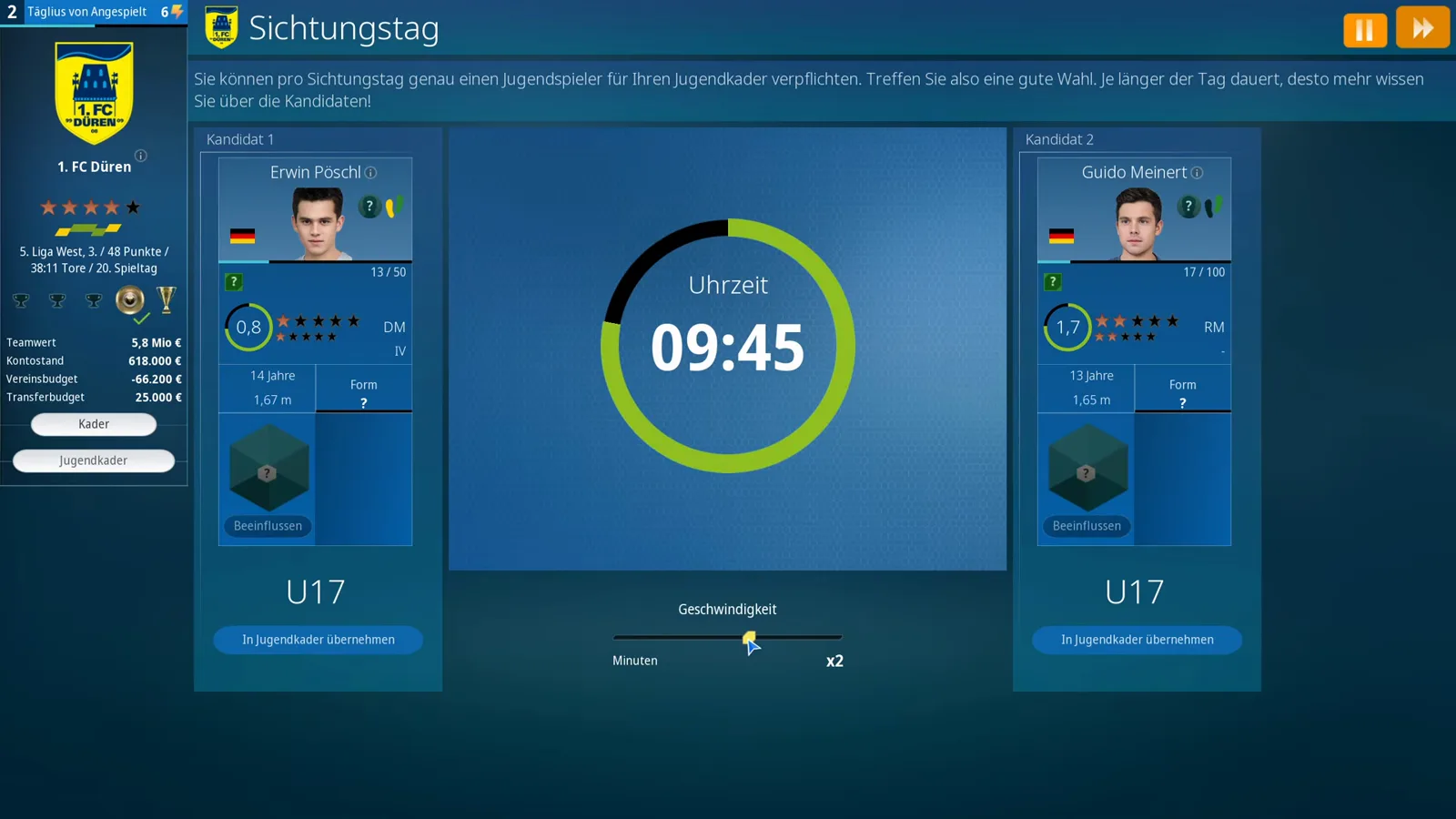
It does — the Sichtungstag keeps running through the pause, and the video walks into one mid-break. Candidates arrive as a pair of U17 cards flanking a Uhrzeit clock that burns through the day — the save’s capture reads 09:45 — and each card fills in as the hours pass: Erwin Pöschl scouted to 13/50, Guido Meinert to 17/100, both with talent stars and a spot in the youth academy waiting («In Jugendkader übernehmen»). The header’s rule: one signing per Sichtungstag, and the longer you let the day run, the more you learn about the candidates.
What a sighting day feeds into — the academy, the poaching routes, the youth contracts — is the youth scouting guide’s territory. The break is simply the only phase where the academy’s rhythm is not competing with matchdays.
What can go wrong in a January friendly?
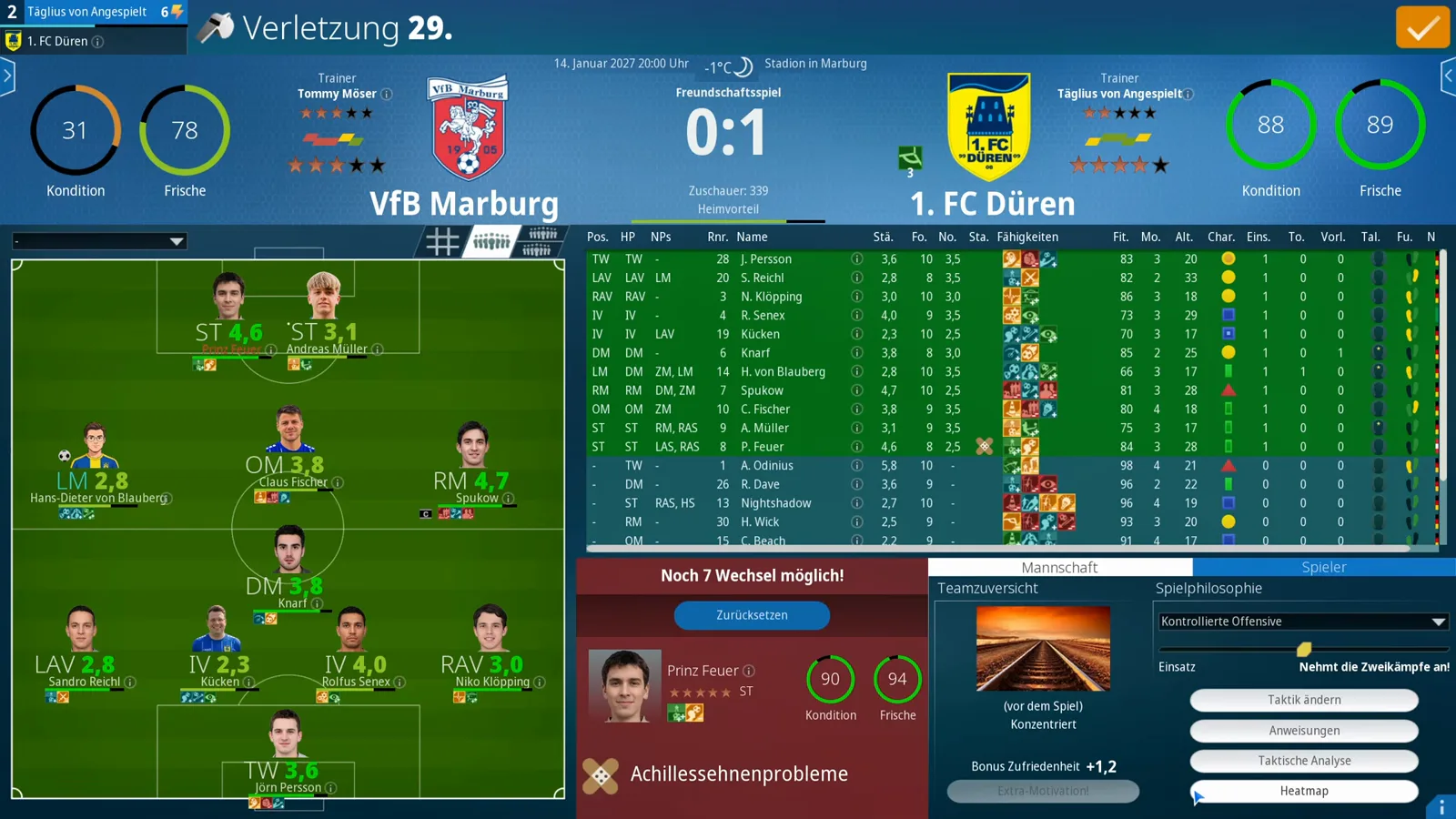
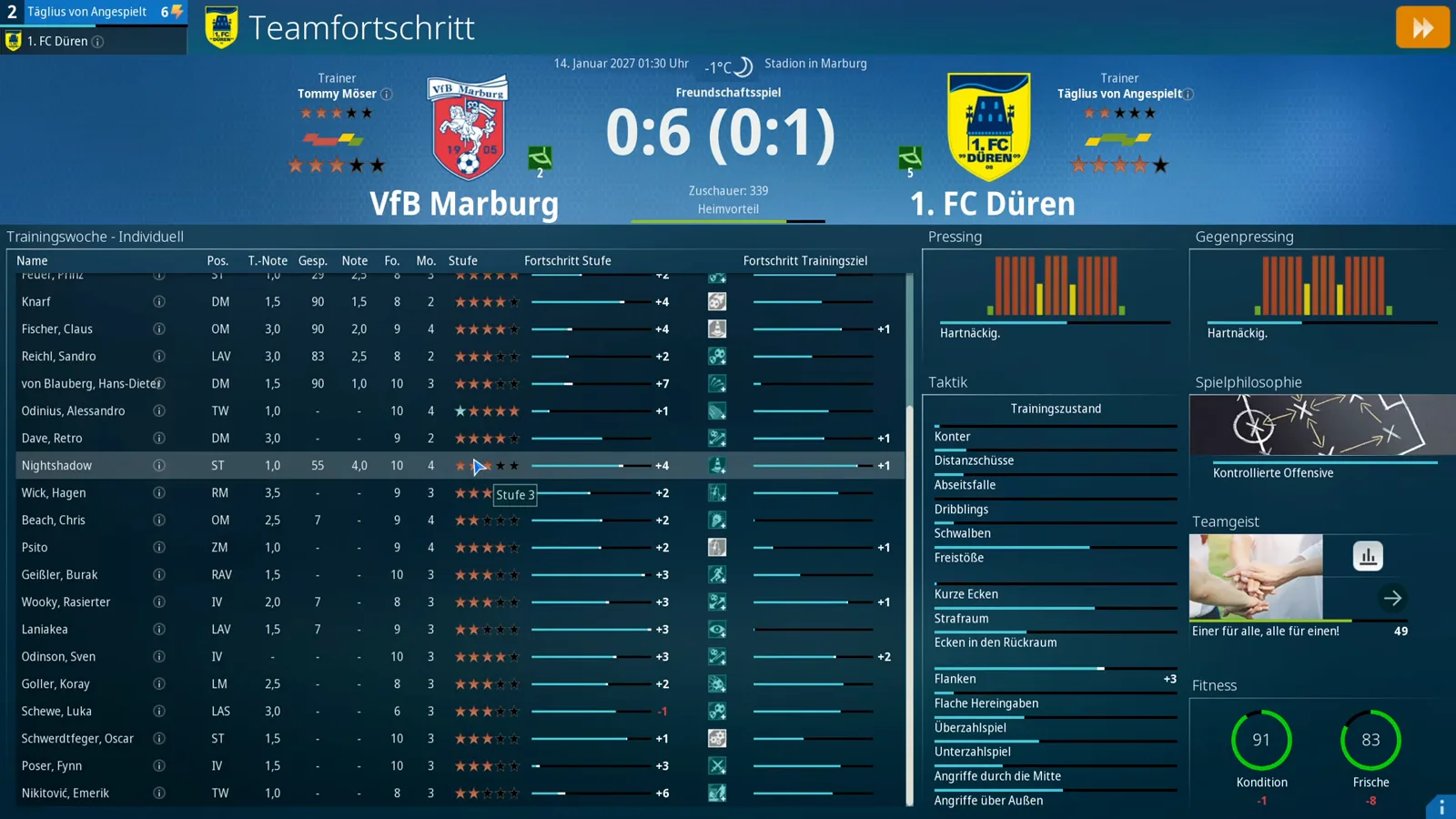
Plenty. The friendly itself plays out like any match — the save’s trip to Marburg ends 0:6 — but the moment that matters arrives as a Verletzung 29. banner: a red panel putting striker Prinz Feuer’s card next to the diagnosis Achillessehnenprobleme, with Düren leading 0:1 at the time. A low-stakes friendly can still take a squad member out for weeks — the transcript’s verdict on the same popup: it ruins «all the preparation» for the player.
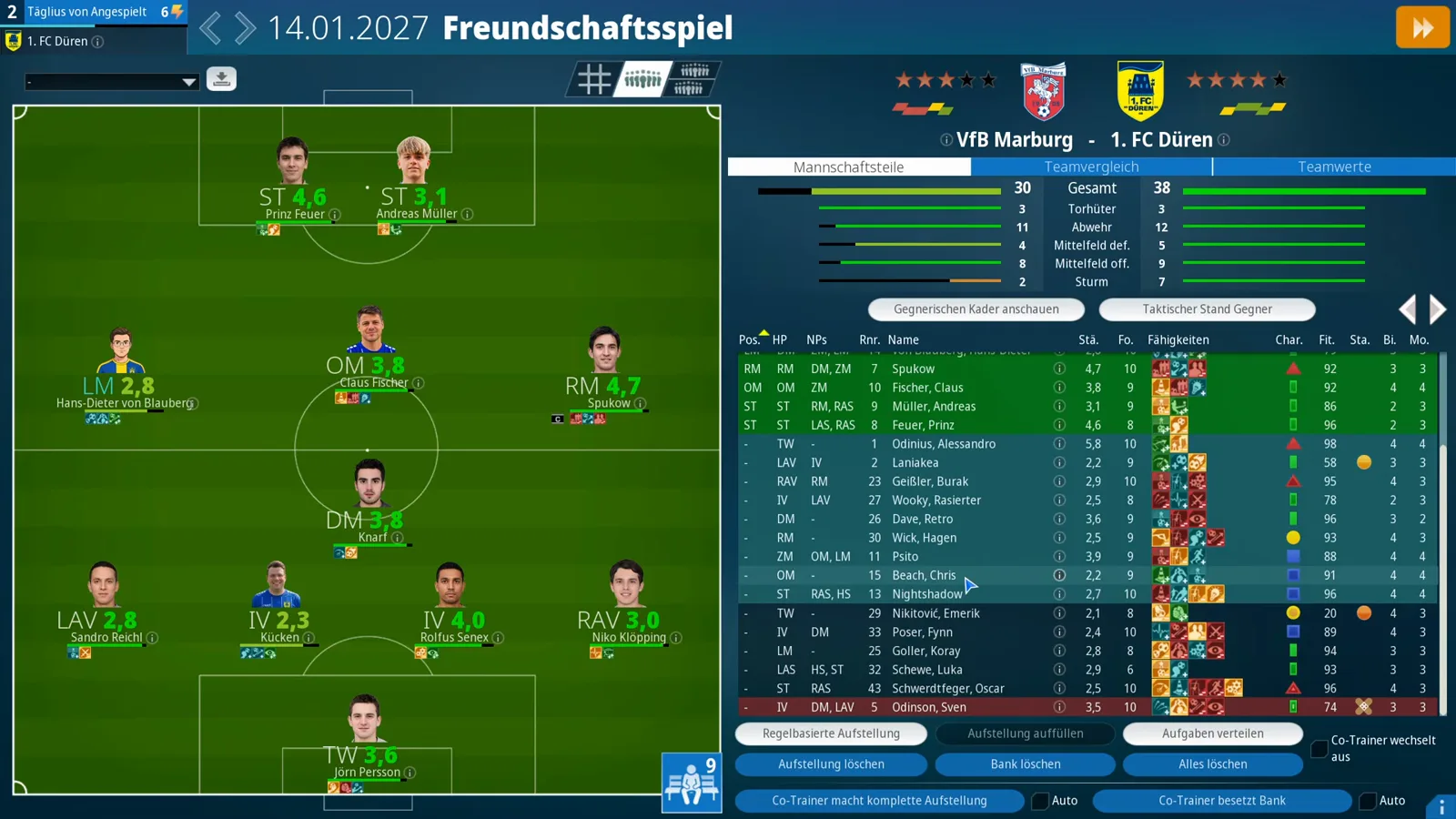
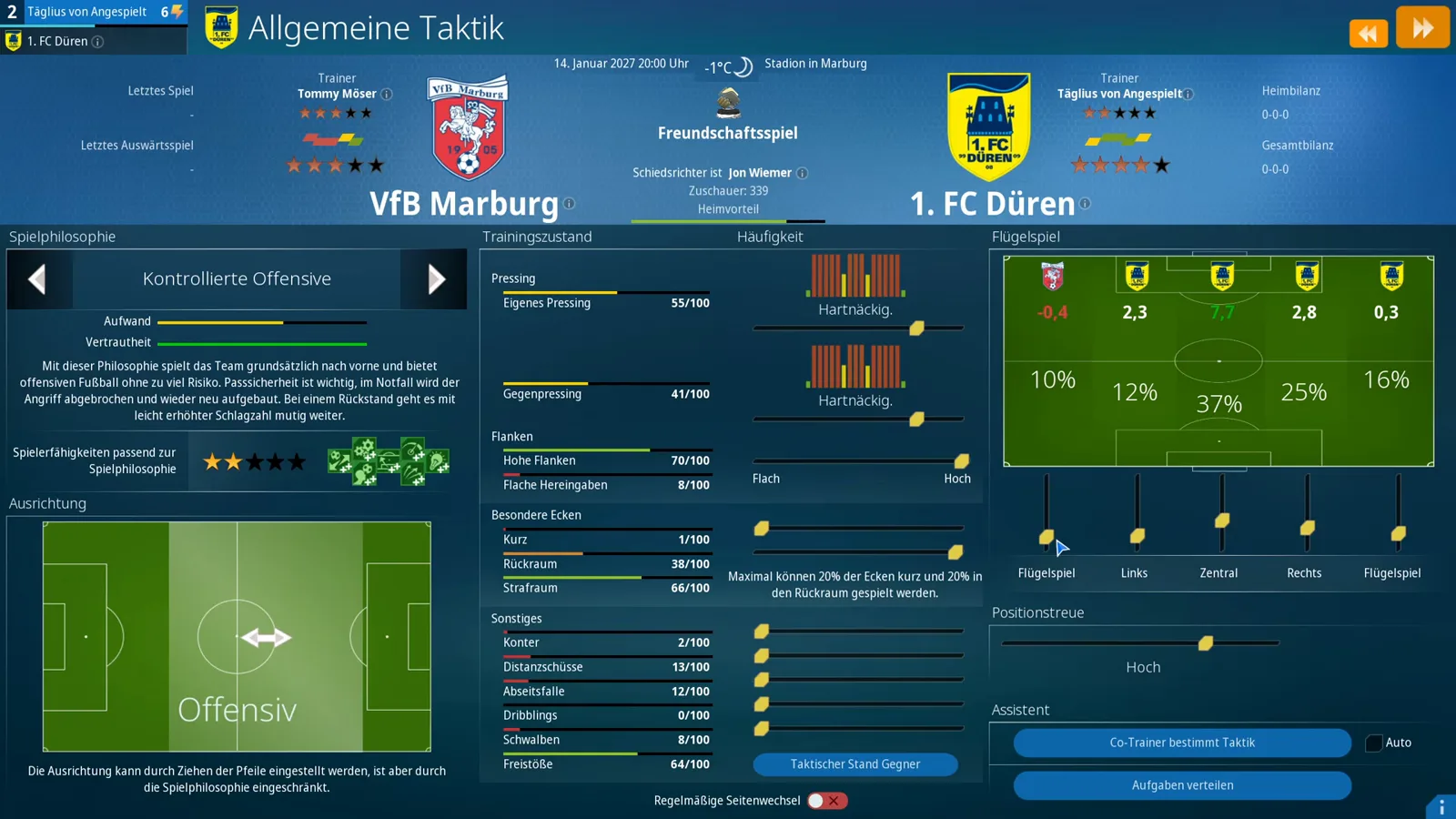
The match itself still uses the full toolbox — the video adjusts via the Allgemeine Taktik screen mid-friendly, the same sliders the match engine tactics guide documents — and afterwards the Teamfortschritt screen tallies what the 0:6 did to the squad’s development bars.
What club business fits into the break weeks?
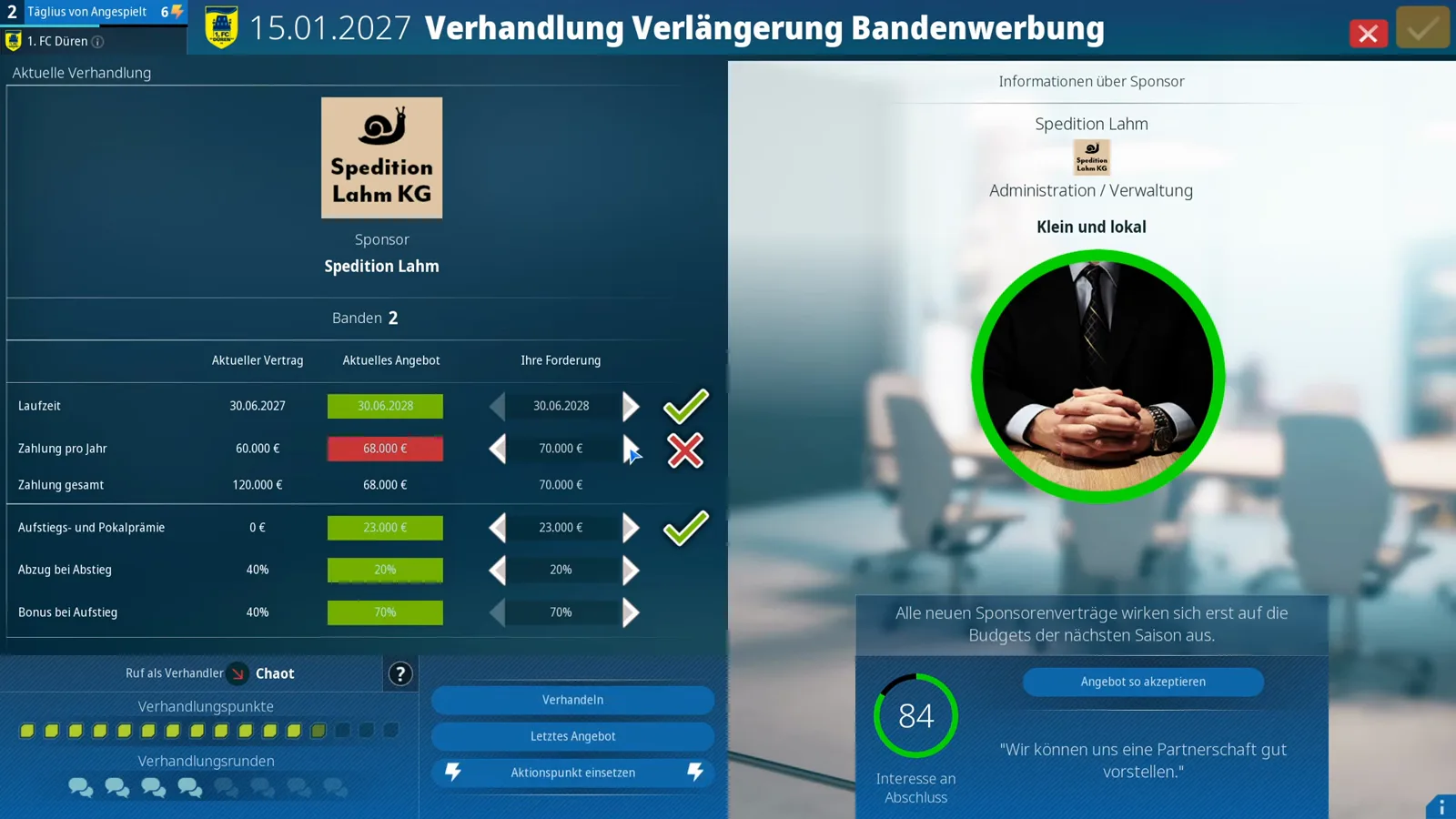
The quieter screens. The Bandenwerbung renewal — the perimeter advertising deal with Spedition Lahm KG in the save — runs as a full negotiation over runtime, yearly payment, promotion bonuses and a relegation discount, with an 84 percent handshake meter and the sponsor’s quote «Wir können uns eine Partnerschaft gut vorstellen.» The frame’s footnote is worth reading before signing: all new sponsor deals only feed the next season’s budgets.
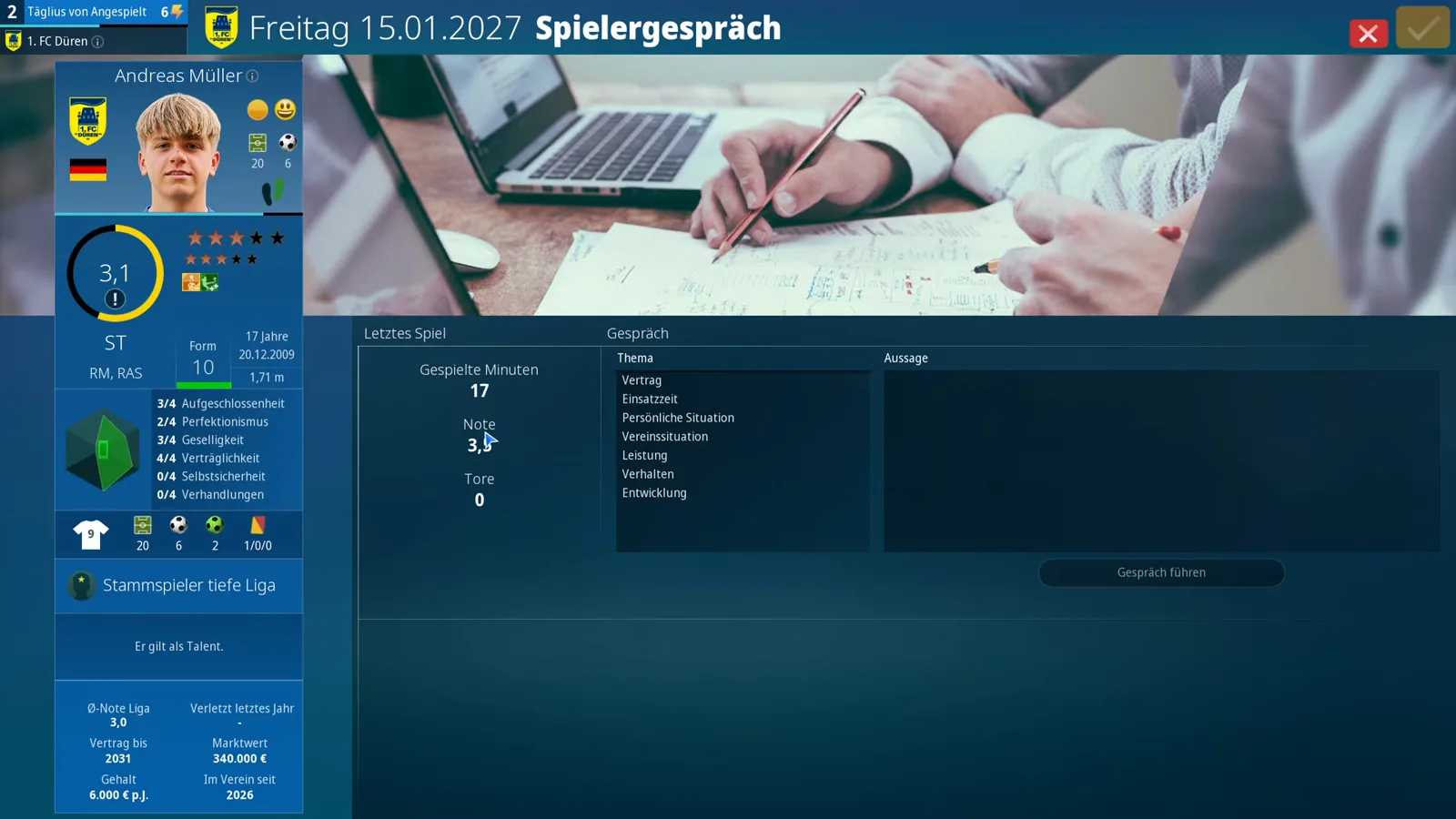
Player business moves too: a Spielergespräch dated Friday, 15 January sits the manager across from Andreas Müller with the full talk-option list, the kind of one-on-one that costs no matchday and pays in morale.
That is the break: a budget forecast to read, friendlies with appearance fees to weigh, fitness and freshness to bank, scouting that keeps running, a youth sighting day that never pauses — and then the transfer window opens, which is the transfer window guide’s half of the same episode. When the second half of the season finally kicks off, the weekly schedule guide takes over again — and if those weeks tighten into a battle for the top of the table, the promotion race guide follows the run-in from there.
Guides recommandés
guides
WE ARE FOOTBALL 2027 Team Strength Comparison: Stars, Gauges, Scouting Lists
How to read team strength in WE ARE FOOTBALL 2027: Kader stars, the profile gauge, the pre-match Mannschaftsteile bars and the scouting list for the next fixture.
guides
WE ARE FOOTBALL 2027 Season Planning Guide: Budget Split, Kits and Squad Numbers
The Saisonplanung stretch in WE ARE FOOTBALL 2027 screen by screen: promotion payout, league target, budget split, new kits, club rules and squad numbers.
guides
WE ARE FOOTBALL 2027 Relegation Battle Guide: Escaping the Red Rows
A relegation battle in WE ARE FOOTBALL 2027 screen by screen: the red Verbandsliga table rows, a 0:1 away steal, a 1:4 home defeat and the January deals in between.
Ce guide vous a-t-il été utile ?
Merci pour votre retour !