WE ARE FOOTBALL 2027 Transfer Window Guide: Selling, Signing and Deadline Day
The transfer window in WE ARE FOOTBALL 2027 step by step: fee negotiations, contract rows, the Deadline Day clock and deals that collapse at the line.
Foire aux questions (FAQ)
When does the transfer window open and close in WE ARE FOOTBALL 2027?
What is Deadline Day in WE ARE FOOTBALL 2027?
Are the transfer fee and the player contract negotiated separately?
What is the Beteiligung am Weiterverkauf in WE ARE FOOTBALL 2027?
Who leads a contract negotiation in WE ARE FOOTBALL 2027?

Bringt uns die Transferphase die nötigen Impulse? | We are Football 2027 (12) — Täglich Angespielt
Most transfer advice for WE ARE FOOTBALL 2027 is about scouting and deciding who you want. The transfer window is the part where it becomes contractual: a window with its own calendar, a negotiation screen for the fee, a second one for the player’s package, and a Deadline Day that runs on a clock. This page follows one complete January window in a 5. Liga West save — selling a winger, signing a replacement, living through Deadline Day, and losing a deal at the finish line — screen by screen, in the order the source video plays it. The season transition guide covers what happens when the season itself flips; this is what happens in between.
When does the transfer window open in WE ARE FOOTBALL 2027?
The save’s window runs through January, and the game makes sure you cannot miss its end: the top bar carries a permanent countdown — «5 Tage bis zum Deadline Day» in the save’s last full January week — sitting above every screen you work through.
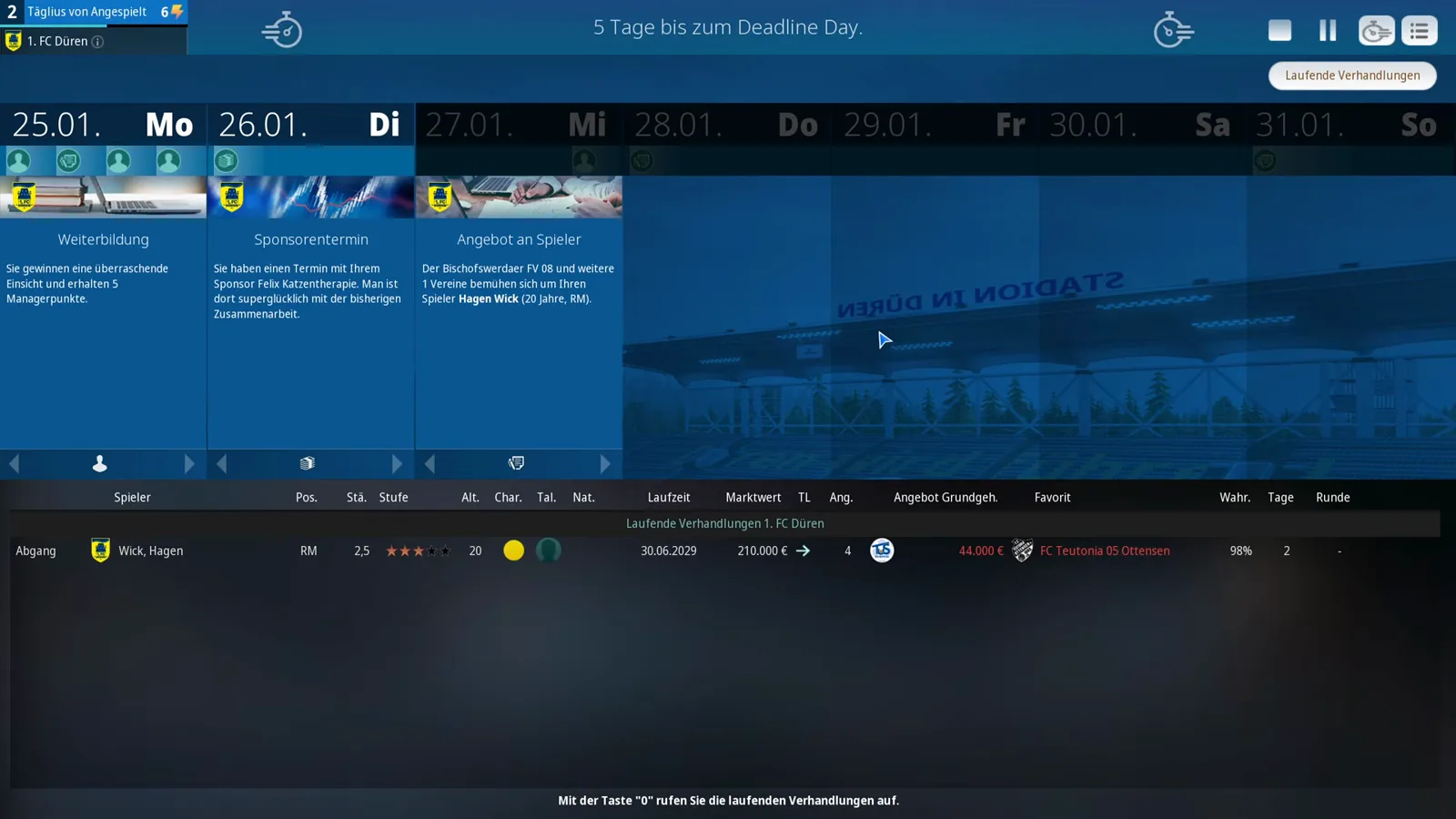
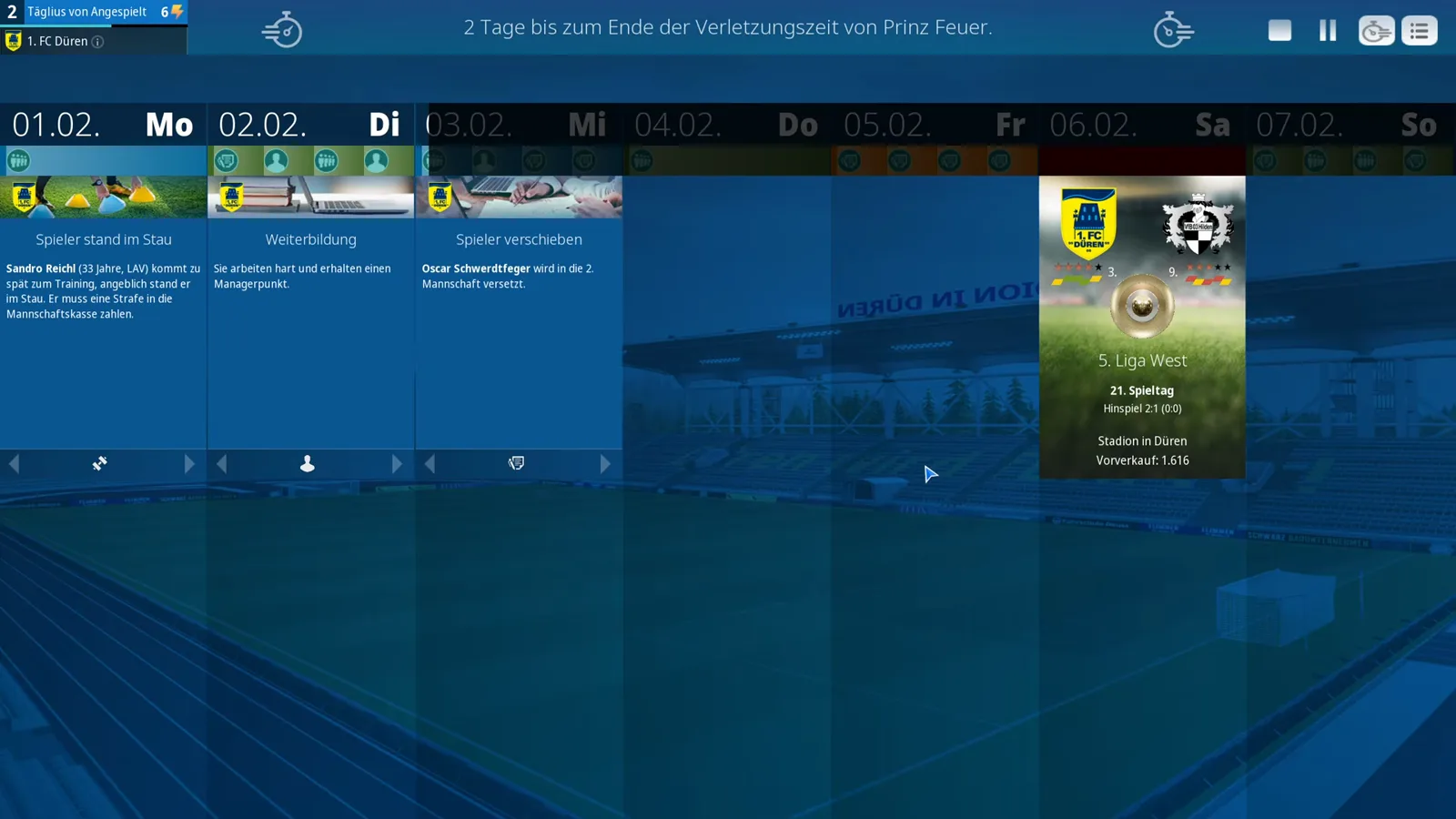
The window itself needs no menu hunt: offers arrive, targets appear on the market, and the week after the deadline the planner simply shows league business again — the save’s first post-window week ends with a 21. Spieltag home match against VfB 03 Hilden, a rematch the save notes won 2:1 in the first half of the season.
How do you sell a player in WE ARE FOOTBALL 2027?
Selling happens in the Vereinsverhandlung — club-to-club talks, marked Verkauf when you are the seller. The video sells the 20-year-old winger Hagen Wick to FC Teutonia 05 Ottensen. The dialog puts two money columns side by side: the buyer’s Angebot and your Ihre Forderung, each with a slider — here both sit at 135.000 €, which is why the row carries the green checkmark — plus the Beteiligung am Weiterverkauf, the sell-on percentage, at 0 percent on both sides in this example.
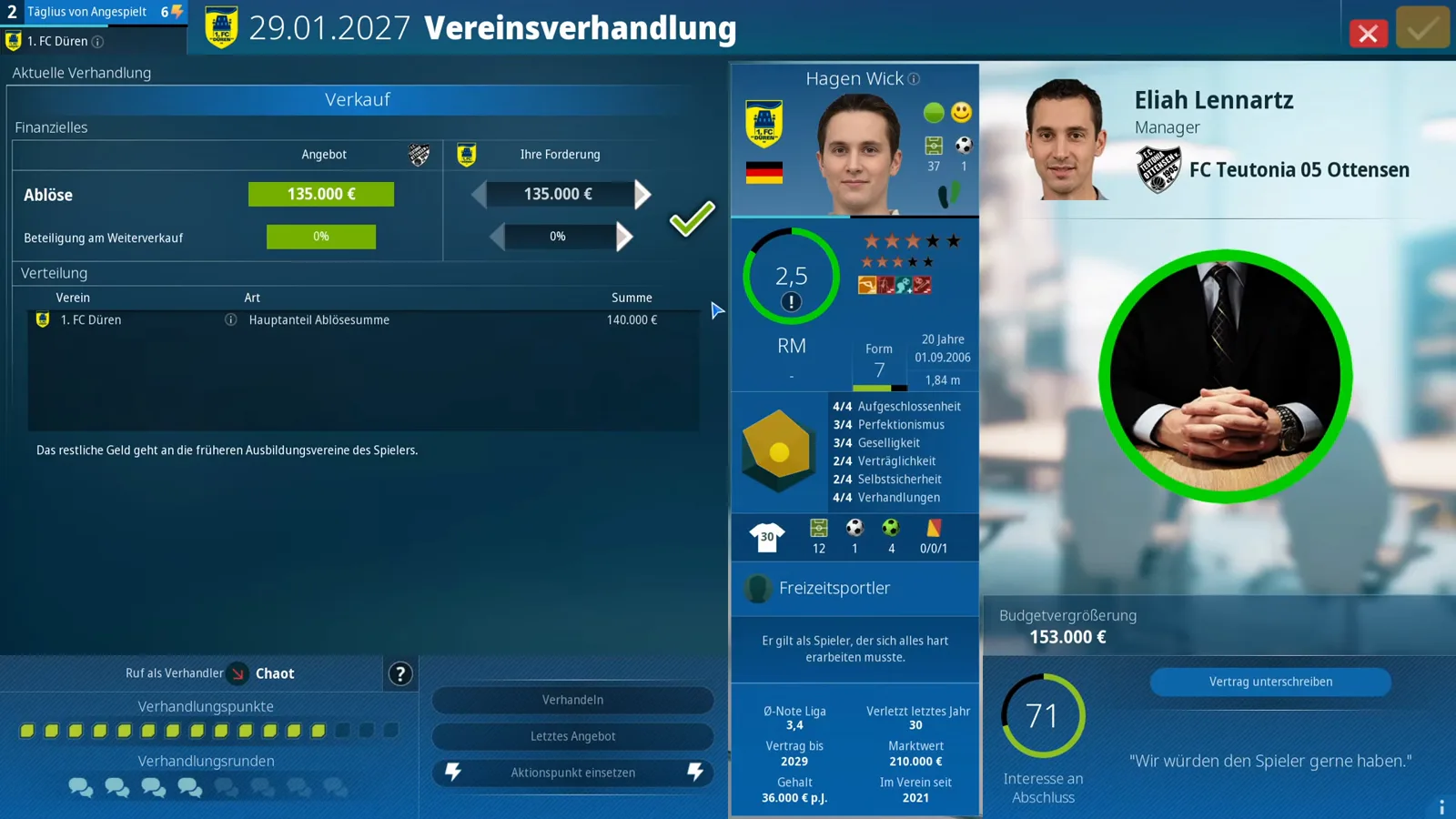
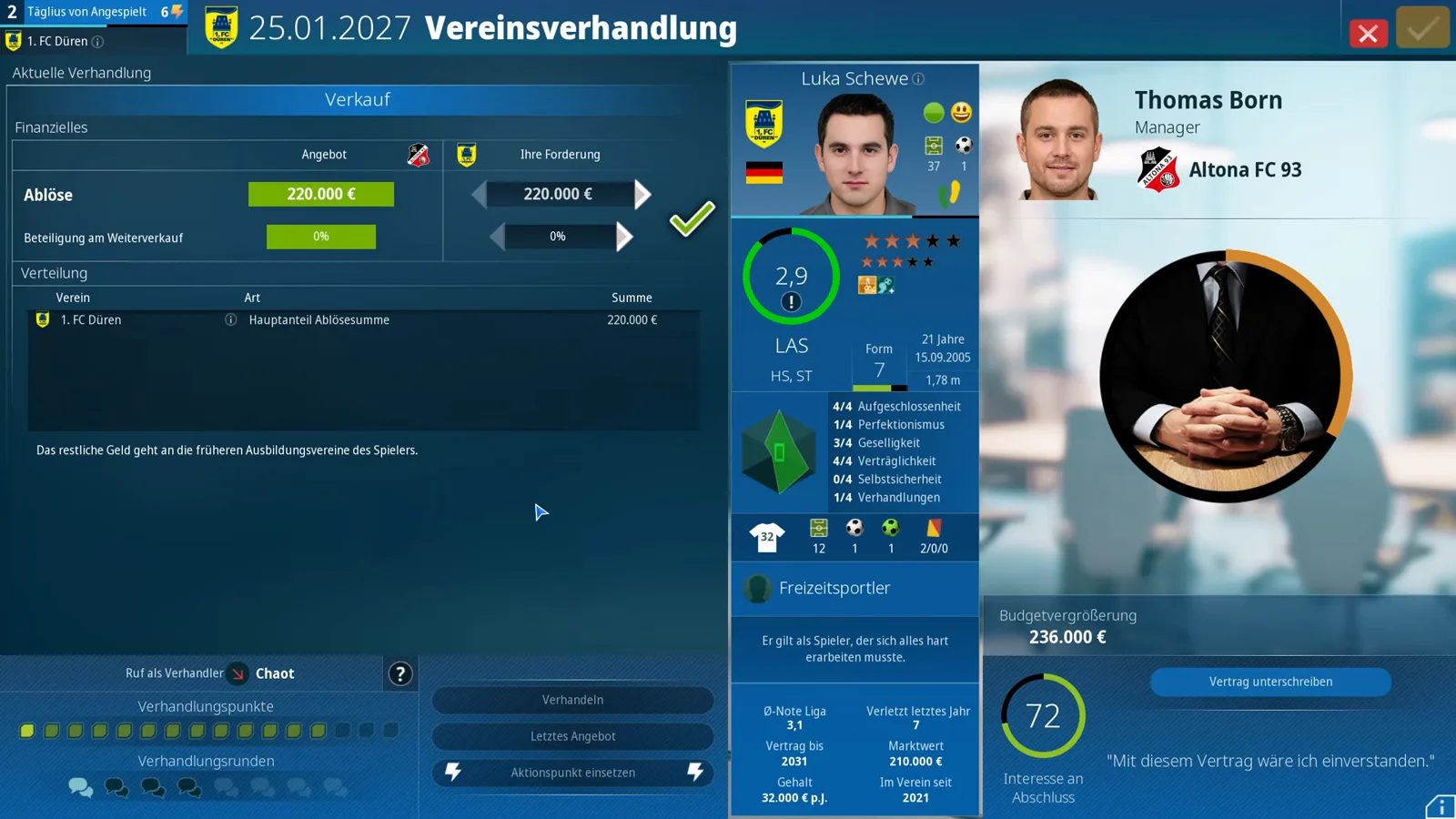
Below the fee, the Verteilung table shows where the money actually goes: 1. FC Düren collect the Hauptanteil Ablösesumme of 140.000 €, and the note underneath states — verbatim — «Das restliche Geld geht an die früheren Ausbildungsvereine des Spielers», so training clubs of the player’s past get their cut automatically. The buyer’s side confirms the deal from their perspective: Budgetvergrößerung 153.000 € for them, a handshake meter at 71 percent, and the quote «Wir würden den Spieler gerne haben.» The negotiation panel tracks your reputation as a negotiator — the save’s reads «Chaot» — along with remaining negotiation rounds and the option to spend an Aktionspunkt on the talks. Several negotiations can run in parallel, too: the video cuts from the Wick sale to a second Vereinsverhandlung that moves Luka Schewe to Altona FC 93 — matching 220.000 € fee columns, a handshake meter at 72 and the same «Chaot» negotiator panel.
Whether the fee itself arrives on time, though, is a question the community has just started asking. A Steam thread from 4 October 2026 (four replies) reports the sequence at a season’s end: offers trickle in for players you are done planning with anyway, the sale completes — «Der Verkauf kommt zustande, aber Geld gibt’s keins, weil wohl der Spieler erst zur neuen Saison wechselt», the sale goes through but no money appears, apparently because the player only moves at the new season — and on the new season’s first day the player is gone from the squad while «Geld gab’s irgendwie nicht», the money somehow never showed. Nothing in the thread confirms when the fee is supposed to land: the replies guess at the next season’s budget, report the money being partially credited to the new campaign’s transfer pot, or simply call the arrangement opaque. Treat it as a player report with a question mark attached — but if you sell in a season’s final days, it is worth checking the first budget screens of the new season before spending a fee that has not visibly arrived.
The fee levels themselves, not just their timing, got their own thread a few days later. In «Ablösesummen» (Riftdancer, 8 October 2026, one reply at the time of writing), the opener’s own players can reportedly leave for «maximal 50% des Marktwerts», at most 50 percent of market value, while for signings «beginnen die Verhandlungen meist erst ab 300% des Marktwerts» — talks usually start at 300 percent of market value. An asymmetry he refuses to believe is intended: «Das kann so doch nicht geplant sein, oder?» — that can’t be intended, can it? He also misses the predecessor’s negotiation currency, «in den Verhandlungen auch keine Aktionspunkte einsetzen, wie es im Vorgänger üblich war» — no action points to spend in negotiations, as was usual in the predecessor — curious next to the Aktionspunkt option the Wick dialog above shows, though an empty action-point pool would explain that just as well as a missing feature. Brixen’s reply adds the community’s practical read: players placed on the Transferliste (TL) can hardly ever be sold at their market value, while bids for players outside the list tend to run above it.
Three replies stood in the thread by 11 October 2026, and the opener’s own follow-up doubles down on the selling side: offers for his own players arrive «extrem selten bis gar nicht» (extremely rarely, if at all), market value should at least be within reach «bei gerade jungen Spielern auf der TL oder bei aktiven Anbieten» (for young listed players or active offers) — and his bottom line: «Derzeit habe ich das Gefühl, dass ich Spieler quasi verschenken muss, um Geld zu genieren» — right now he feels he has to give players away almost for free to generate any money. The sell-on clauses Brixen recommends have not rescued his balance sheet either: «habe da aber bisher (bin in Saison 6) nicht wirklich was zurückbekommen» — six seasons in, his sell-on percentages have so far returned nothing worth the name. A third voice extends the complaint to free agents: «Selbst Spieler “ohne Vertrag” mitten in der saison kosten ein vermögen an Handgeld und Lohn, obwohl sie gerade NICHTS bekommen» (sic) — even contract-less players mid-season cost a fortune in signing fee and wages although they are currently getting nothing — which damoclessk calls «völlig unlogig» against the real-world transfer market: «Für sowas gibts Trainingslager über die Fussballergewerkschaft… Die sind froh wenn die irgendwo unterkommen» — for that, real football has union-run training camps, and the players are simply glad to land anywhere at all. Still player reports, all of it, not documented mechanics — but the shape matches this page’s own Deadline Day screen, where Eastleigh’s 170.000 € bid lands far beneath the 290.000 € the game itself values Psito at.
How do you sign players during the window?
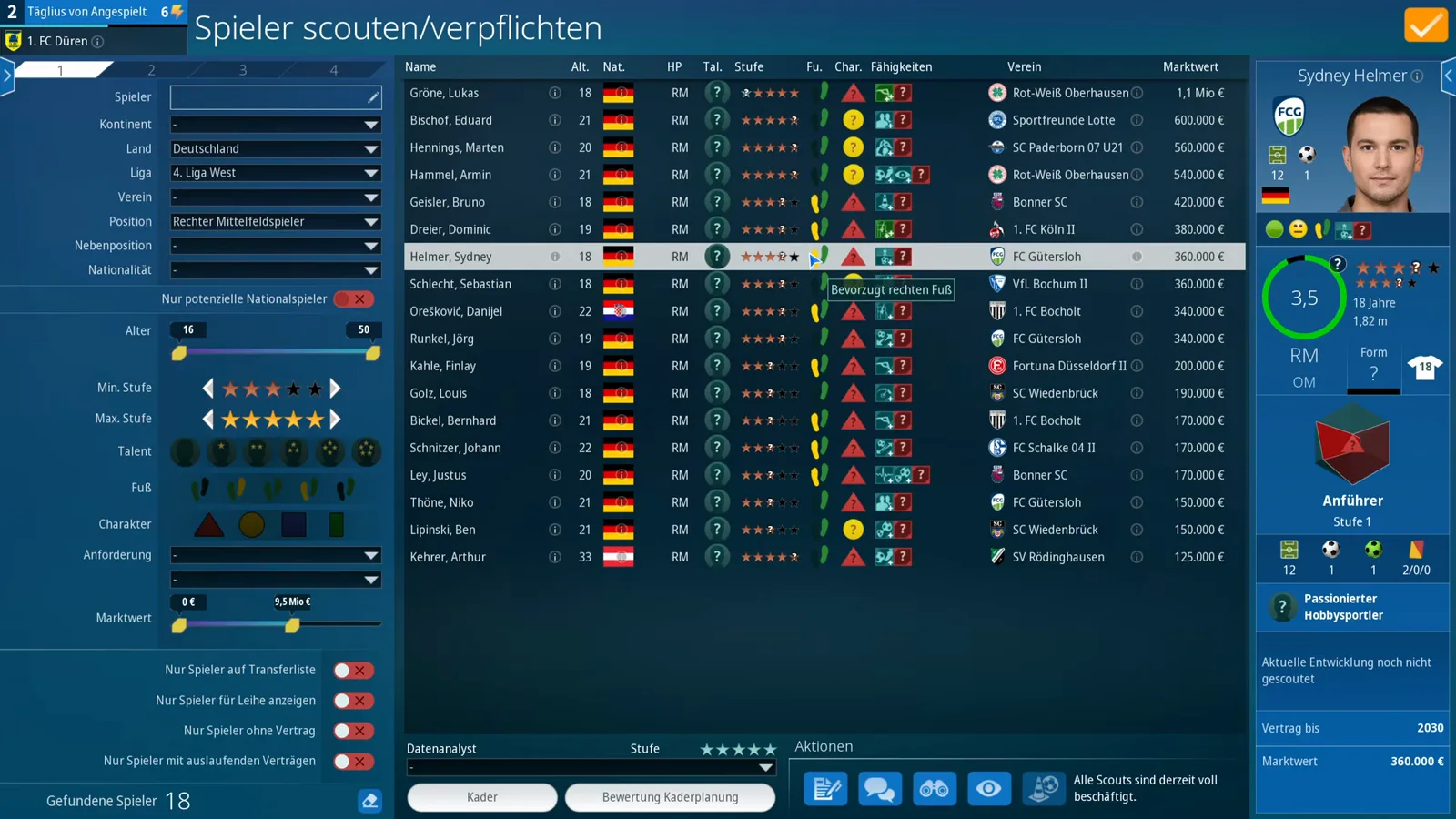
The buying side starts in Spieler scouten/verpflichten, the market list behind the Transfers tab: filterable rows of available professionals with ratings and contract data, and a filter rail on the left.
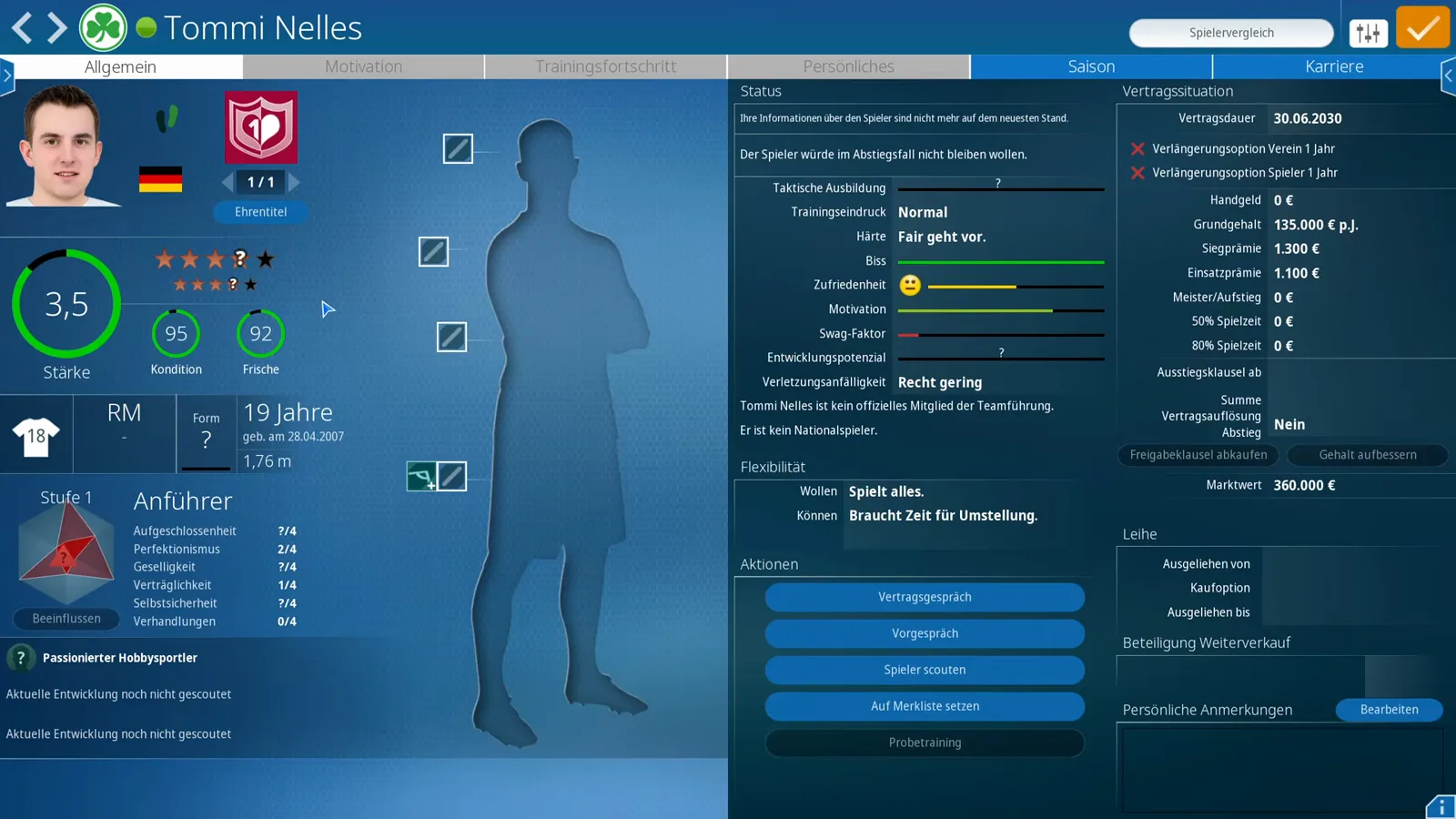
The save’s target is Tommi Nelles, a 19-year-old right midfielder at 3.5 stars, whose profile carries his contract status, personality polygon and the «Vertragsgespräch» action rail.
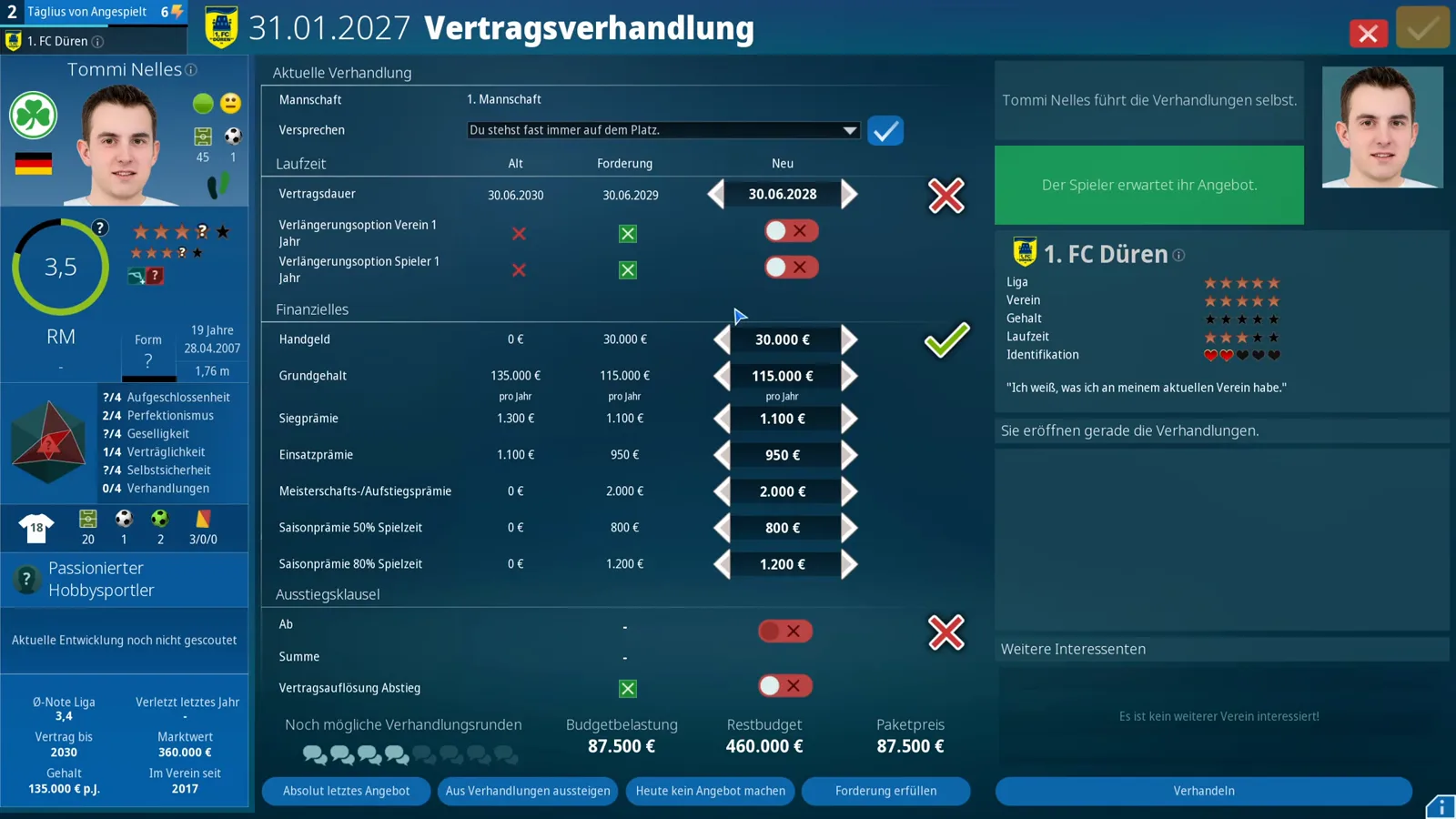
Then comes the second negotiation layer: the Vertragsverhandlung with the player. Its rows are the full salary structure — Handgeld (signing bonus), Grundgehalt per year, Siegprämie, Einsatzprämie, Meisterschafts-/Aufstiegsprämie and two Saisonprämie tiers for 50 and 80 percent playing time — each with the old value, the player’s demand and your offer. Below sit the runtime totals: Budgetbelastung (what the deal costs the budget now), Restbudget and Paketpreis. The save’s bottom line at this point: 87.500 € cost against a 460.000 € remaining budget.
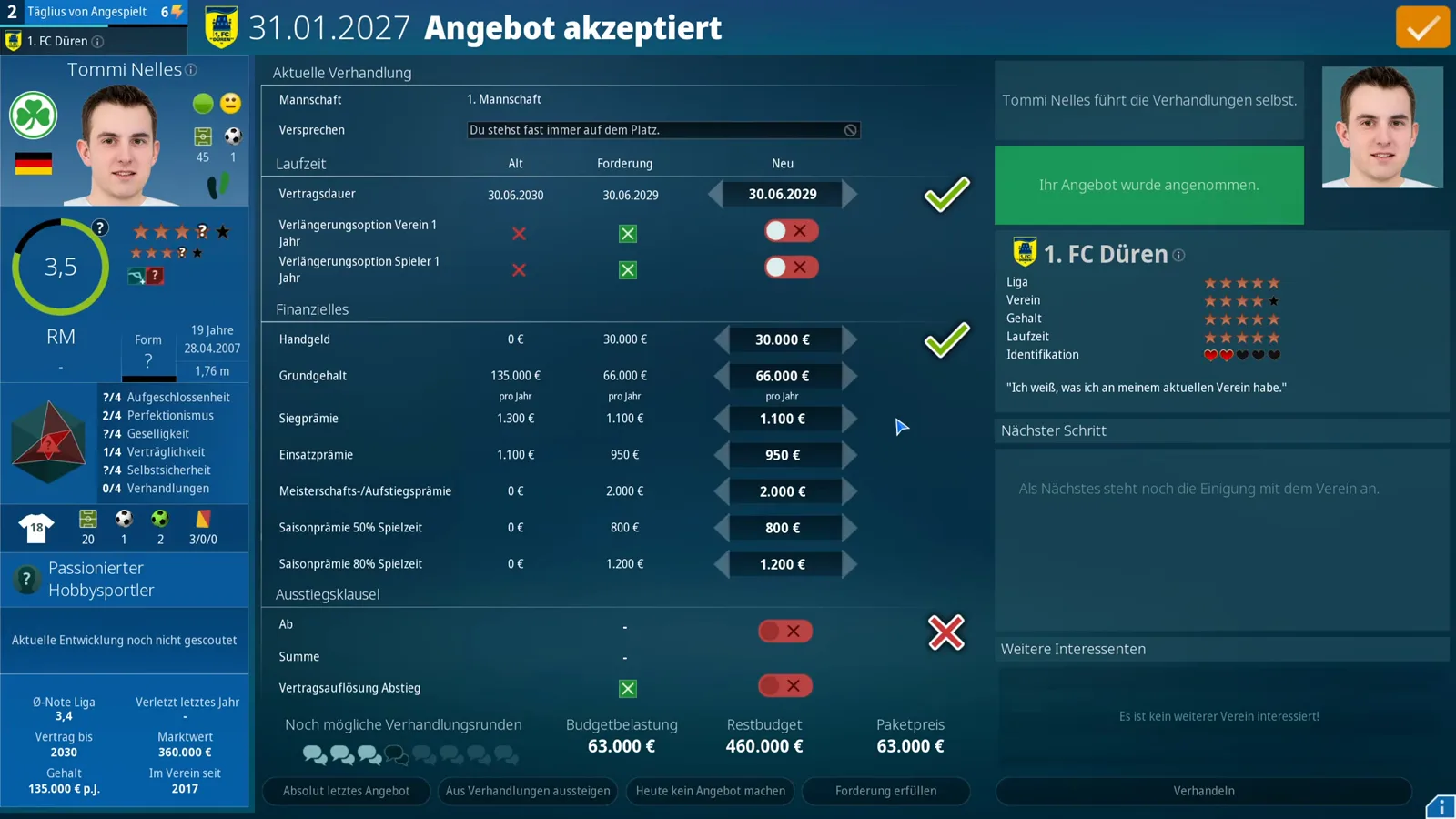
When both sides give the green light, the Angebot akzeptiert screen confirms the package line by line — «Ihr Angebot wurde angenommen.» — with the club-to-club Einigung the only step still queued.
What is Deadline Day in WE ARE FOOTBALL 2027?
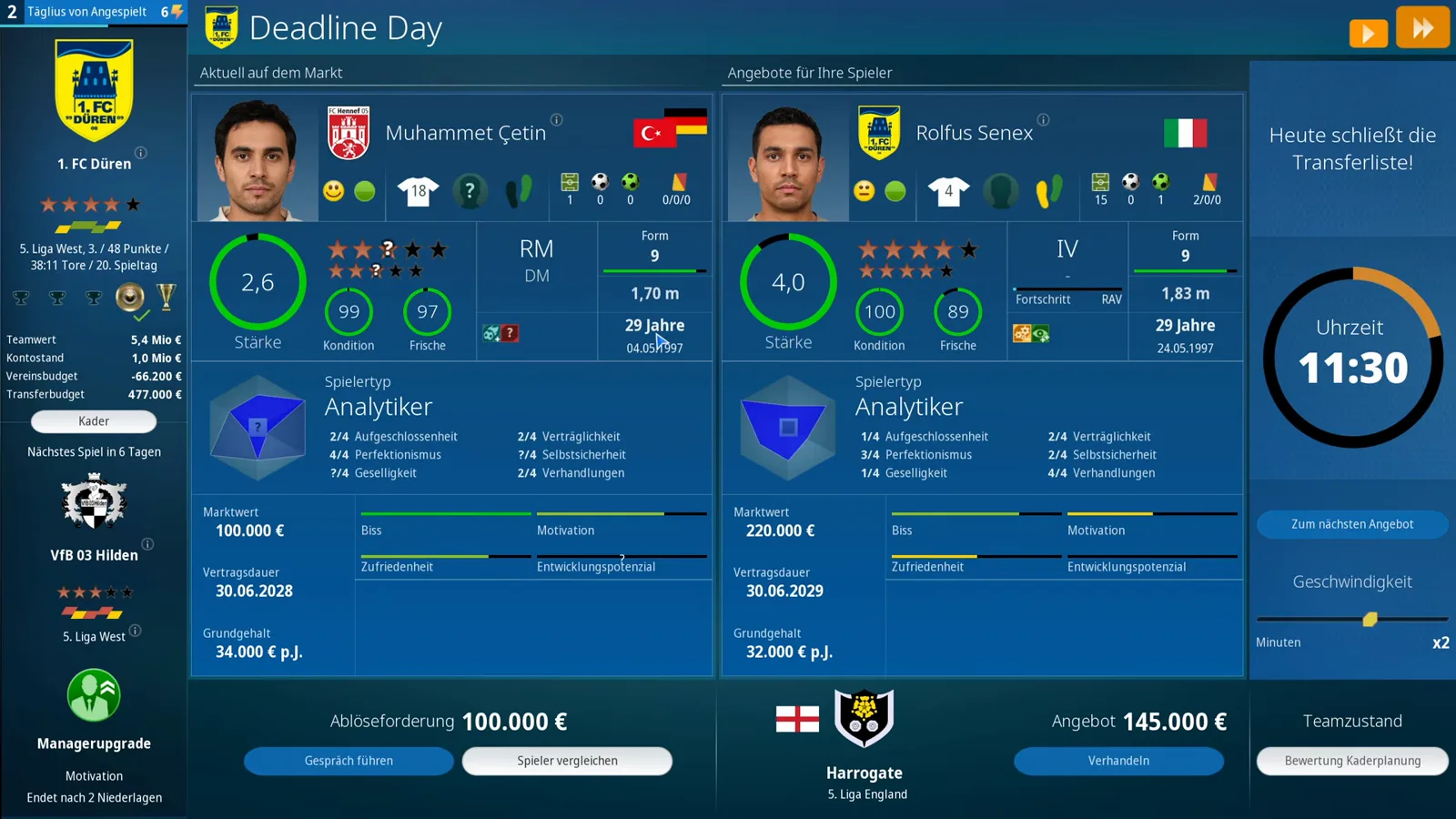
Deadline Day gets its own screen, and it is the best-structured screen in the window. It opens on the line «Heute schließt die Transferliste!» with a Uhrzeit clock that runs all day — the save’s late-morning pass reads 11:30 — and splits the market in two columns. «Aktuell auf dem Markt» lists targets: at 11:30 it holds Muhammet Çetin of FC Hennef 05, a 29-year-old right midfielder at 2,6 stars, market value 100.000 €, contract until 30.06.2028, with an Ablöseforderung of 100.000 € and buttons for «Gespräch führen» and «Spieler vergleichen». «Angebote für Ihre Spieler» shows who is bidding for your men: centre-back Rolfus Senex — 4,0 stars, contract until 30.06.2029 — has an Angebot of 145.000 € on the table from Harrogate of the English 5. Liga, with a «Verhandeln» button.
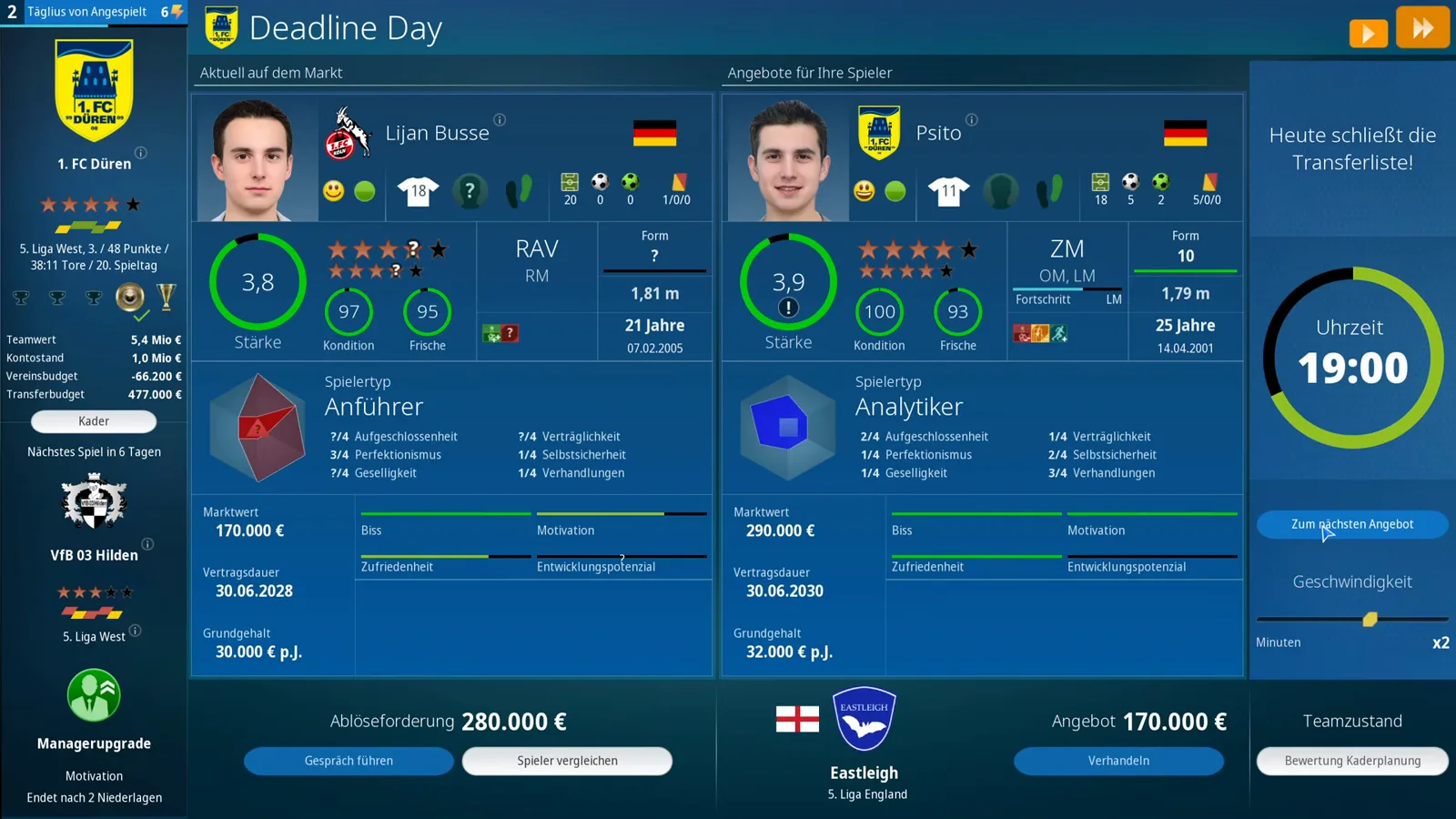
By evening the clock reads 19:00 and both columns have moved on: the target card now shows Lijan Busse, a 21-year-old right-back from 1. FC Köln who also covers right midfield, Anführer type, market value 170.000 €, contract until 30.06.2028, with an Ablöseforderung of 280.000 €, while the midfielder Psito — market value 290.000 €, contract until 30.06.2030 — still carries an Angebot of 170.000 € from Eastleigh of the English 5. Liga. The right rail adds the pace controls: «Zum nächsten Angebot» to cycle through bids and a Geschwindigkeit slider marked «Minuten x2» for speeding up the day. The save passes on the Psito bid — squad planning says the midfielder stays — and keeps working the market list instead.
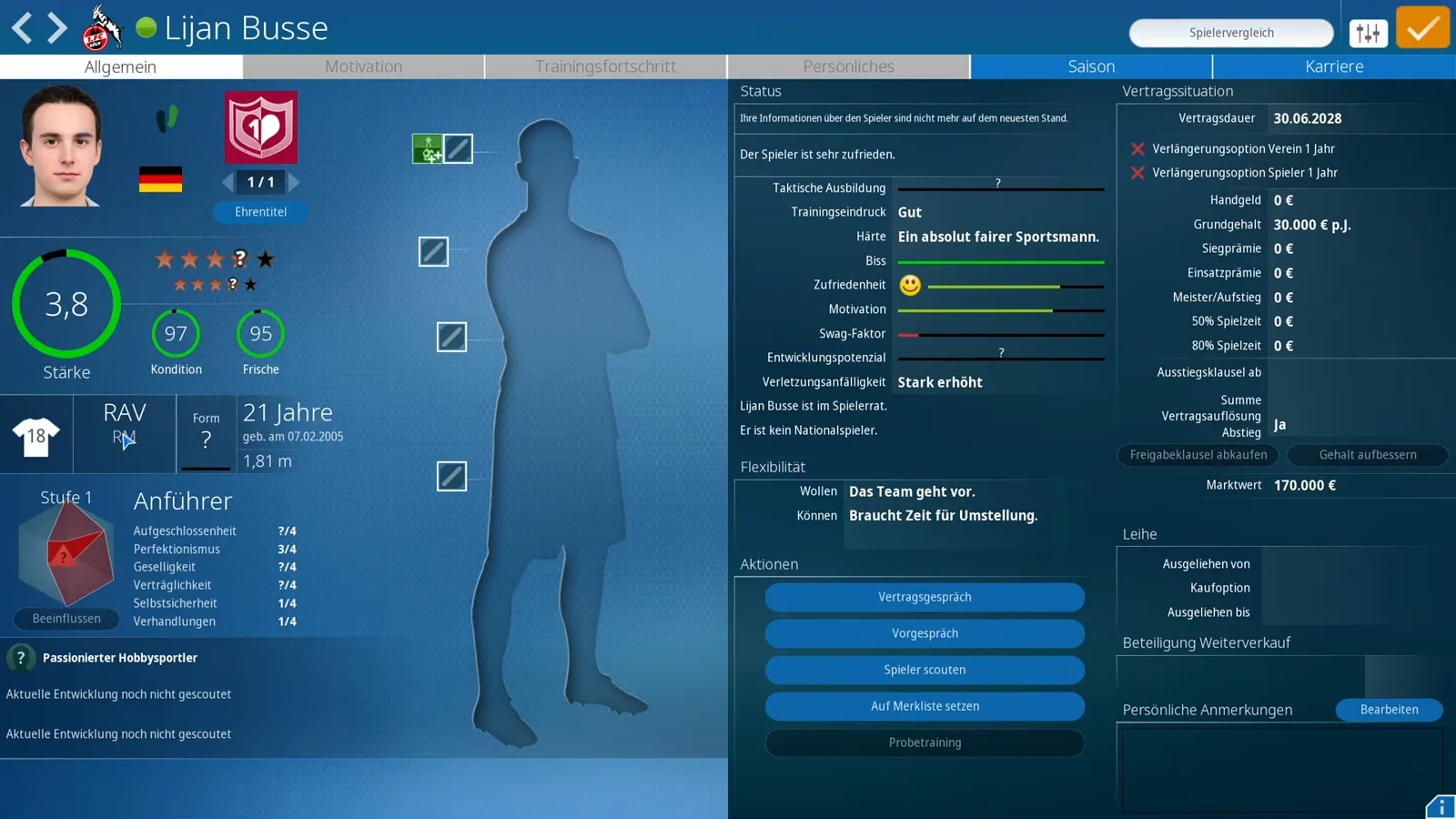
Individual targets open as full profiles straight from the deadline screen, with condition, freshness, personality type and contract data — the video’s profile is Lijan Busse, the 3.8-star Anführer.
Can a deadline-day deal collapse after the contract is agreed?
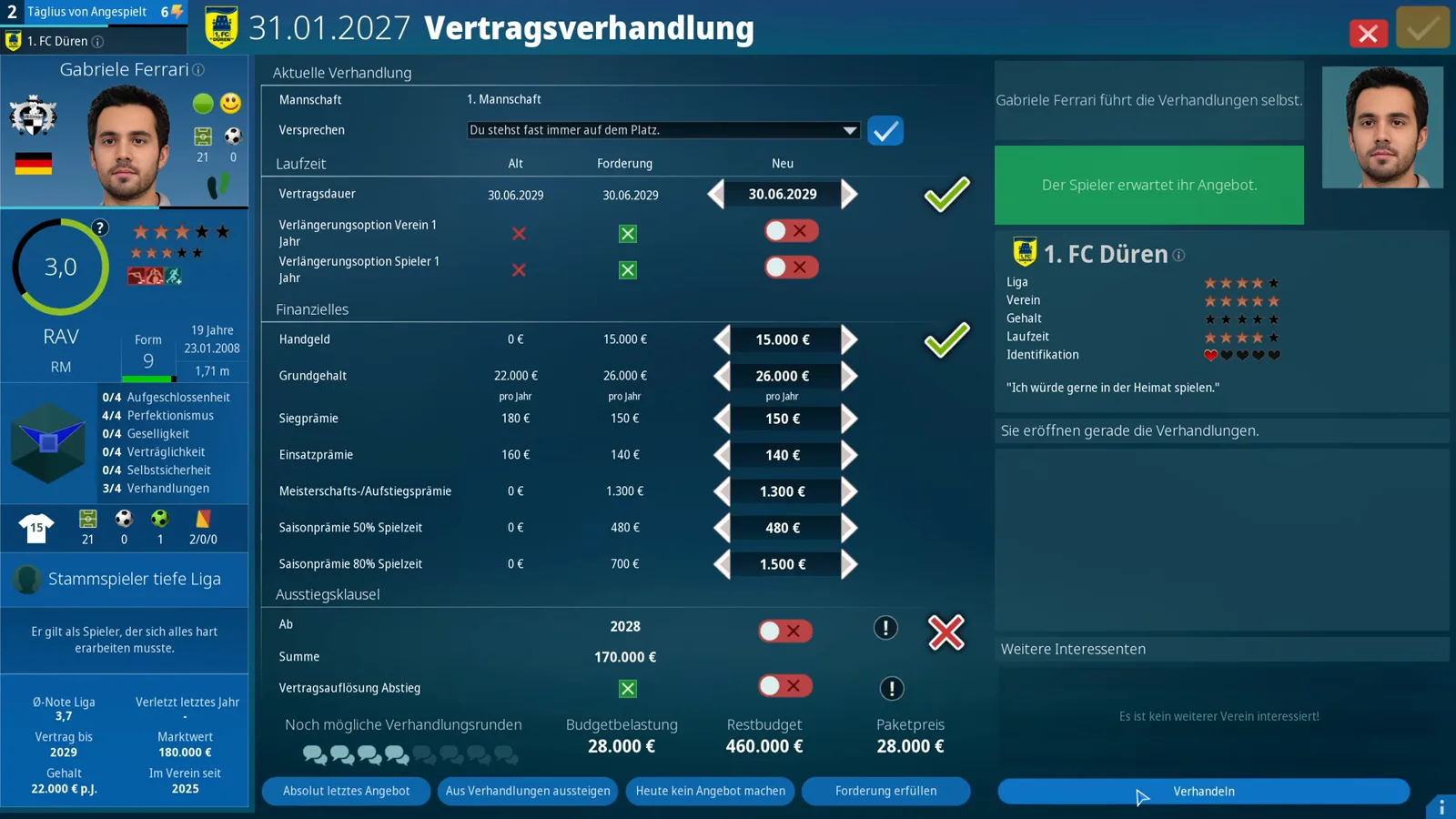
Yes — and the video’s failed signing is the best lesson in the whole window. The save chases Gabriele Ferrari, a 19-year-old right-back from VfB 03 Hilden who can play right midfield, and gets his contract fully lined up on deadline day: contract until 30.06.2029, Handgeld 15.000 €, Grundgehalt 26.000 € (up from his current 22.000 €), win and appearance bonuses, a 1.300 € title bonus, season bonuses — the key rows ticked green, Budgetbelastung 28.000 € against a Restbudget of 460.000 €. His exit-clause rows are refused and marked red. The panel notes «Gabriele Ferrari führt die Verhandlungen selbst.» and quotes his stance: «Ich würde gerne in der Heimat spielen.»
The contract was never the problem. The game’s own kicker newspaper reports the verdict on a news card: «Ablöseverhandlungen um Gabriele Ferrari scheitern — Spieler bleibt bei VfB 03 Hilden» — the club-to-club fee talks broke down, the player stays, and the window closes on a fully agreed contract worth nothing.
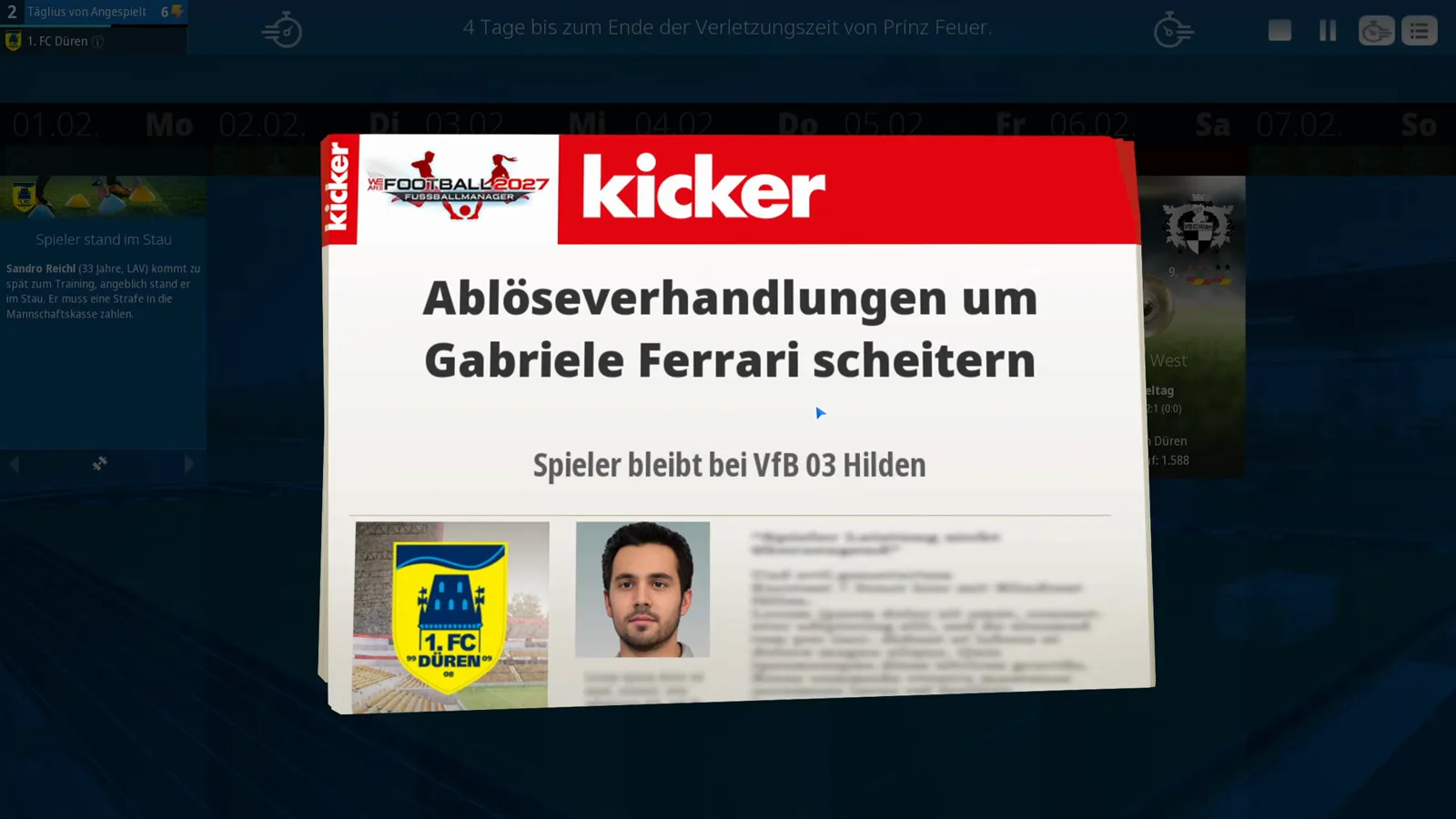
The manager’s own summary, dropped during the next match against Hilden itself: «We almost signed Gabriele Ferrari.»
Do contract extensions use the same negotiation screen?
They do — Vertragsverlängerung mirrors the signing dialog row for row, and it is where exit clauses get rebuilt. The save extends 17-year-old Laniakea, whose existing contract carries an Ausstiegsklausel from 2026 at 140.000 € — a buyout any club can trigger. The demand columns ask to move the clause to 2031 at 300.000 € and to pay a Handgeld of 20.000 € on a wage rising from 3.400 € to a demanded 28.000 € per year; the save counters low and keeps the clause discussion open. The panel header is its own mechanic: «Laniakea führt die Verhandlungen selbst.» — the teenager negotiates for himself. Runtime totals show Restbudget 260.000 €, and «Weitere Interessenten» reports no other club is interested.
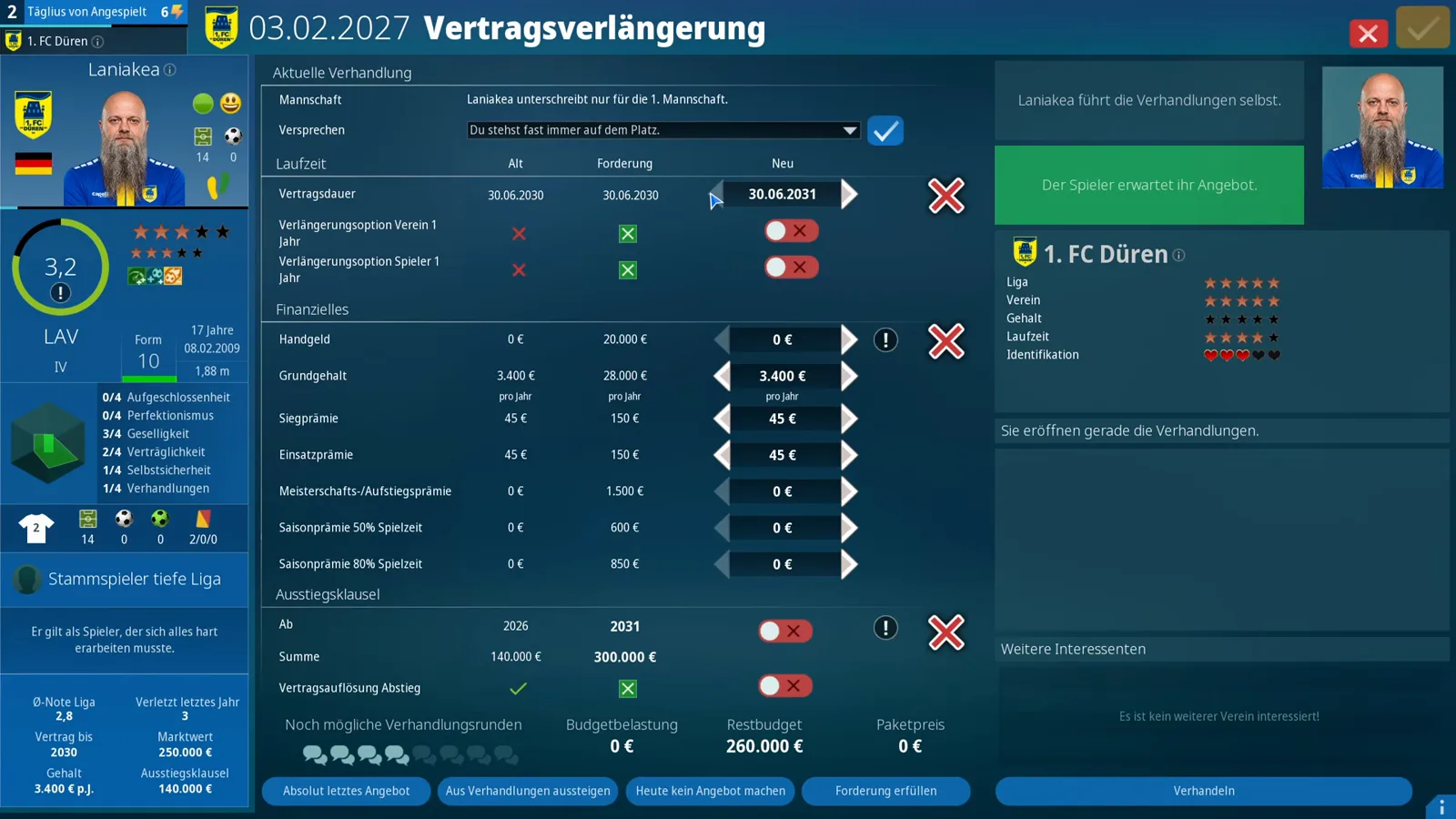
That is the anatomy of a window: a countdown that ends on one long day, a fee dialog with the clubs, a contract dialog with the player — and no guarantee the two ever meet. Where the signed players come from is the scouting network guide’s territory, the wage rows plug into the contract negotiations guide, and the weeks before the window belong to the winter break guide.
Guides recommandés
guides
WE ARE FOOTBALL 2027 Team Strength Comparison: Stars, Gauges, Scouting Lists
How to read team strength in WE ARE FOOTBALL 2027: Kader stars, the profile gauge, the pre-match Mannschaftsteile bars and the scouting list for the next fixture.
guides
WE ARE FOOTBALL 2027 Season Planning Guide: Budget Split, Kits and Squad Numbers
The Saisonplanung stretch in WE ARE FOOTBALL 2027 screen by screen: promotion payout, league target, budget split, new kits, club rules and squad numbers.
guides
WE ARE FOOTBALL 2027 Relegation Battle Guide: Escaping the Red Rows
A relegation battle in WE ARE FOOTBALL 2027 screen by screen: the red Verbandsliga table rows, a 0:1 away steal, a 1:4 home defeat and the January deals in between.
Ce guide vous a-t-il été utile ?
Merci pour votre retour !