WE ARE FOOTBALL 2027 Club Facilities Guide: Every Clubgelände Building
Every WE ARE FOOTBALL 2027 club facility: training pitch injury maths, the changing-room and toilet rule, fan shop floors, the museum formula and build costs.
Foire aux questions (FAQ)
Do you need one changing room per training pitch in the WE ARE FOOTBALL 2027 club facilities?
How many training pitches should you build in WE ARE FOOTBALL 2027?
Is the club museum worth building in WE ARE FOOTBALL 2027?
Are multiple fan shops worth it on the WE ARE FOOTBALL 2027 club grounds?
What happens to training in winter without a training hall?
The stadium gets the glory, but the Clubgelände — the club grounds — is where WE ARE FOOTBALL 2027 quietly decides how many players break, how fast your staff fills every desk and whether the tactics you picked survive the winter. The NickFrei zockt tutorial series devotes its longest episode to this single screen, and after walking it end to end it is easy to see why: half the buildings look like decoration and secretly run your injury list, your office capacity and your youth boarding places.
This guide follows the video’s route: the screen itself, every facility and what it does, the level and cost numbers, the changing-room rule players keep arguing about, and an upgrade order the maths supports. The stadium next door is its own construction site with its own logic — that one is covered in our stadium expansion guide.
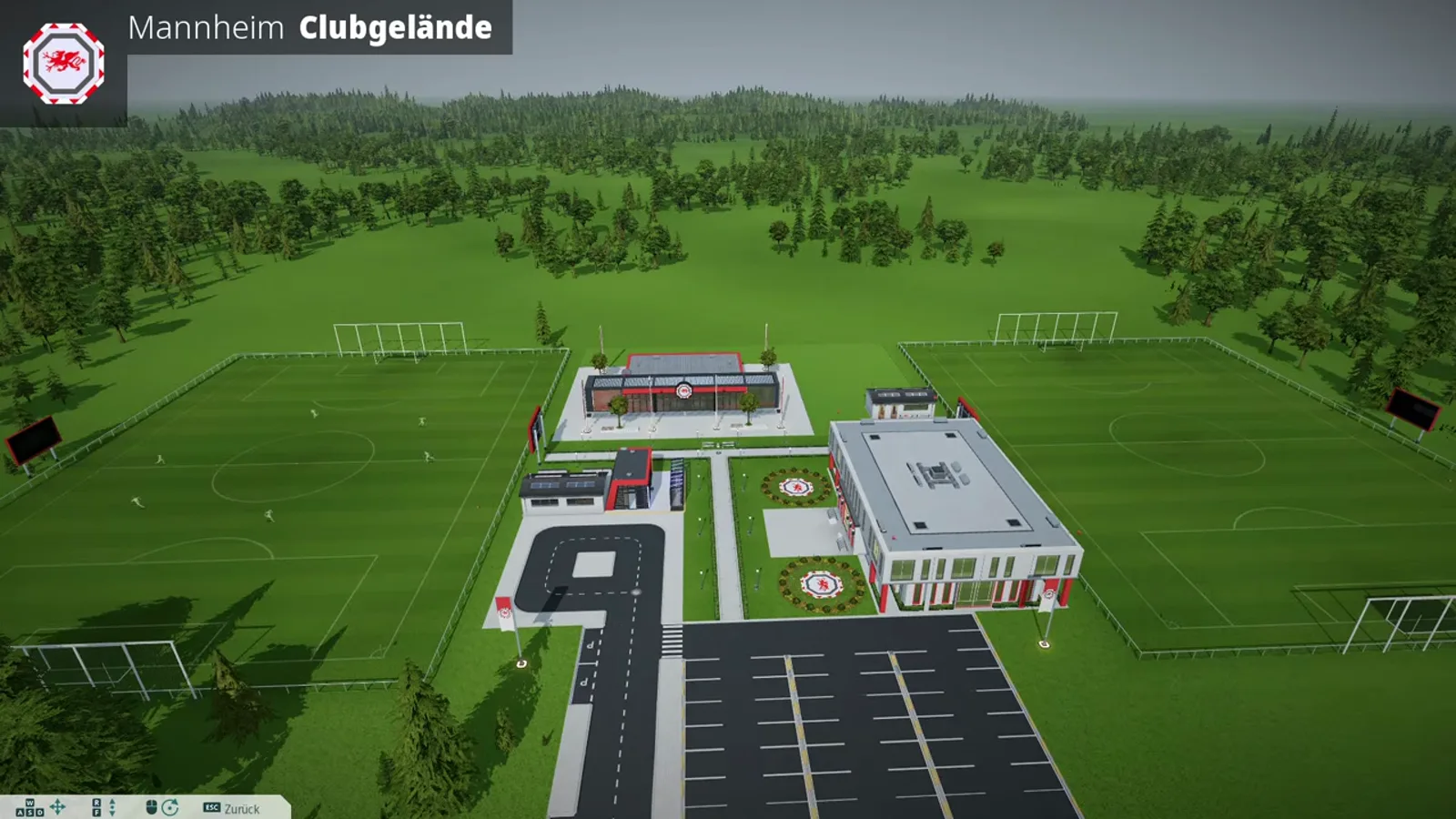
What is the Clubgelände screen in WE ARE FOOTBALL 2027?
The Clubgelände is your training and working campus, reached through Infrastructure → Clubgelände. The screen lists every building you own with its count and value, and the single button Gelände ausbauen opens the build mode where the video spends its 45 minutes: a top-down editor with a catalogue of everything from training pitches to the presidential villa. Around it sits a 3D view with the stadium’s camera controls, weather and day-night toggles.
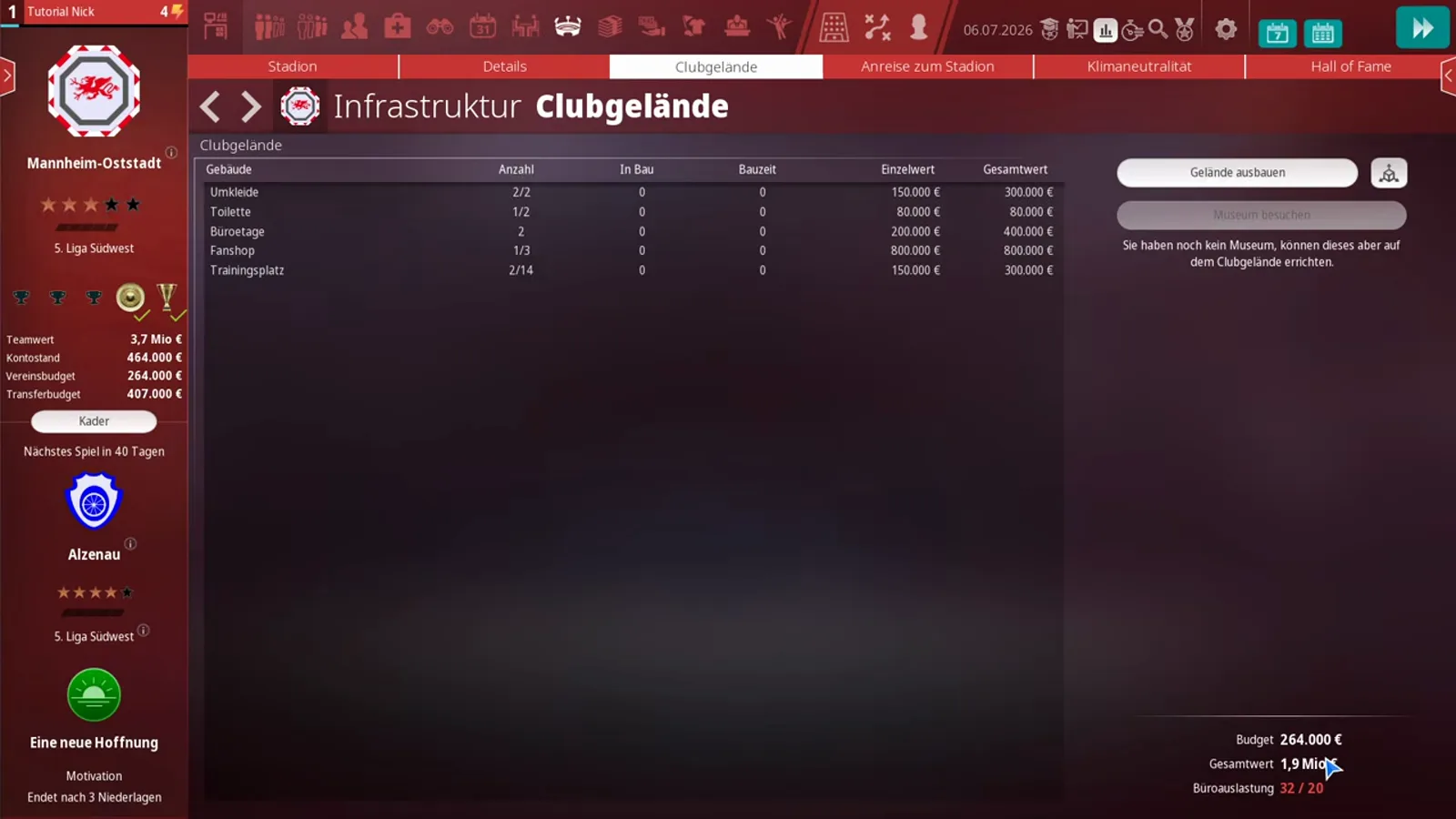
The summary table is worth a pause, because it doubles as your audit report. The author’s Mannheim-Oststadt save shows Umkleide 2/2, Toilette 1/2, Büroetage 2, Fanshop 1/3 and Trainingsplatz 2/14, a total grounds value of 1.9 million — and, in red, Büroauslastung 32 / 20: his staff need 32 office places, his two office floors provide 20. Two rules the manual adds for free: the position of buildings has no gameplay effect, and neither does the beauty of your landscaping (DE p. 92 / EN p. 88). Build the pretty campus for yourself. Its other warning is funnier: do not linger in the 3D grounds, or your players will tire from all that walking — „That will then be your fault.”
Which training facilities exist and what do they do?
The normal Trainingsplatz is the backbone of the grounds: training requires it, it costs 150.000 € and 53 days per pitch, and up to 14 fit on a campus. Three pitches form the injury baseline — below three, each missing pitch adds +20% to injuries; above three, each extra pitch removes 2%, up to −20%. Thirteen pitches therefore reach the cap, and the 14th is pure showing off.
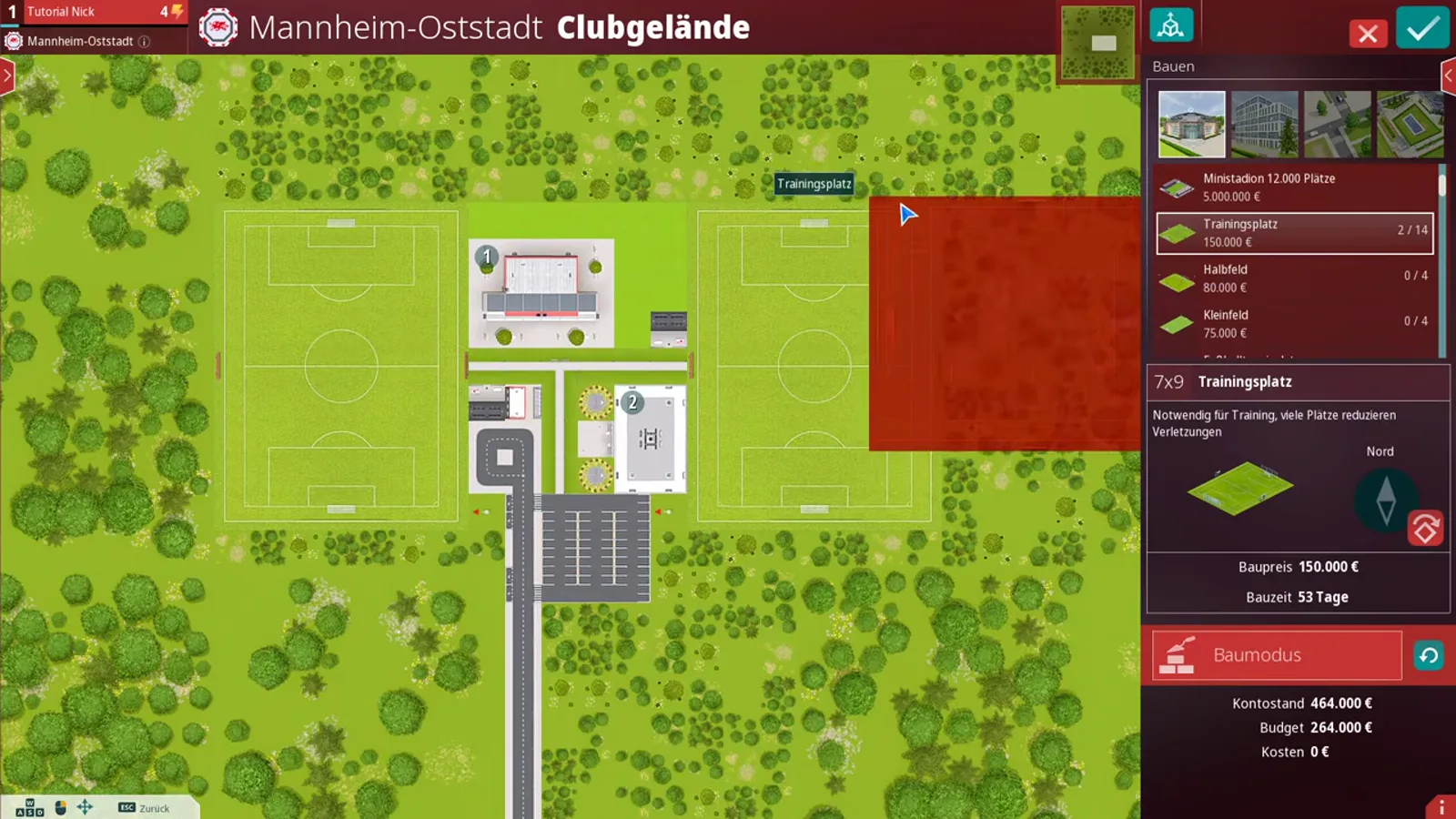
Those numbers come straight from the manual’s club-grounds table (DE p. 93 / EN p. 89) and its tips chapter (DE p. 180 / EN p. 166) — the build-menu tooltip only says „Notwendig für Training, viele Plätze reduzieren Verletzungen”, which undersells the mechanic badly. The author’s arithmetic holds up: 3 + 10 × 2 = 20, so pitch 13 hits the −20% floor and pitch 14 does nothing. He then spends a minute on realism — Bundesliga clubs run three to six professional pitches, Liverpool’s training ground does not have thirteen — and concludes that 13 is fantasy, but cheap fantasy, and that lower-league saves lose most players to exactly this missing baseline.
The same table hides two more pitch effects. The first four pitches above three each slow the forgetting of tactics by +10%, +5%, +3% and +2% — meaningful because team tactics decay weekly (DE p. 128 / EN p. 165). And every pitch carries a 2% chance of an extra point during technique training. What you then do on those pitches is a different screen entirely: our training plan guide assembles the weekly units.
What do small pitches, football tennis and sports parks add?
Three cheap add-ons refine the pitch block. Kleinfeld and Halbfeld are small-format pitches for tactical work and special game forms, football tennis courts feed the technique bonus, and the sports park is a build-once fitness machine. None of them need a changing room, and none stack forever: every one of them caps at four or a single build.
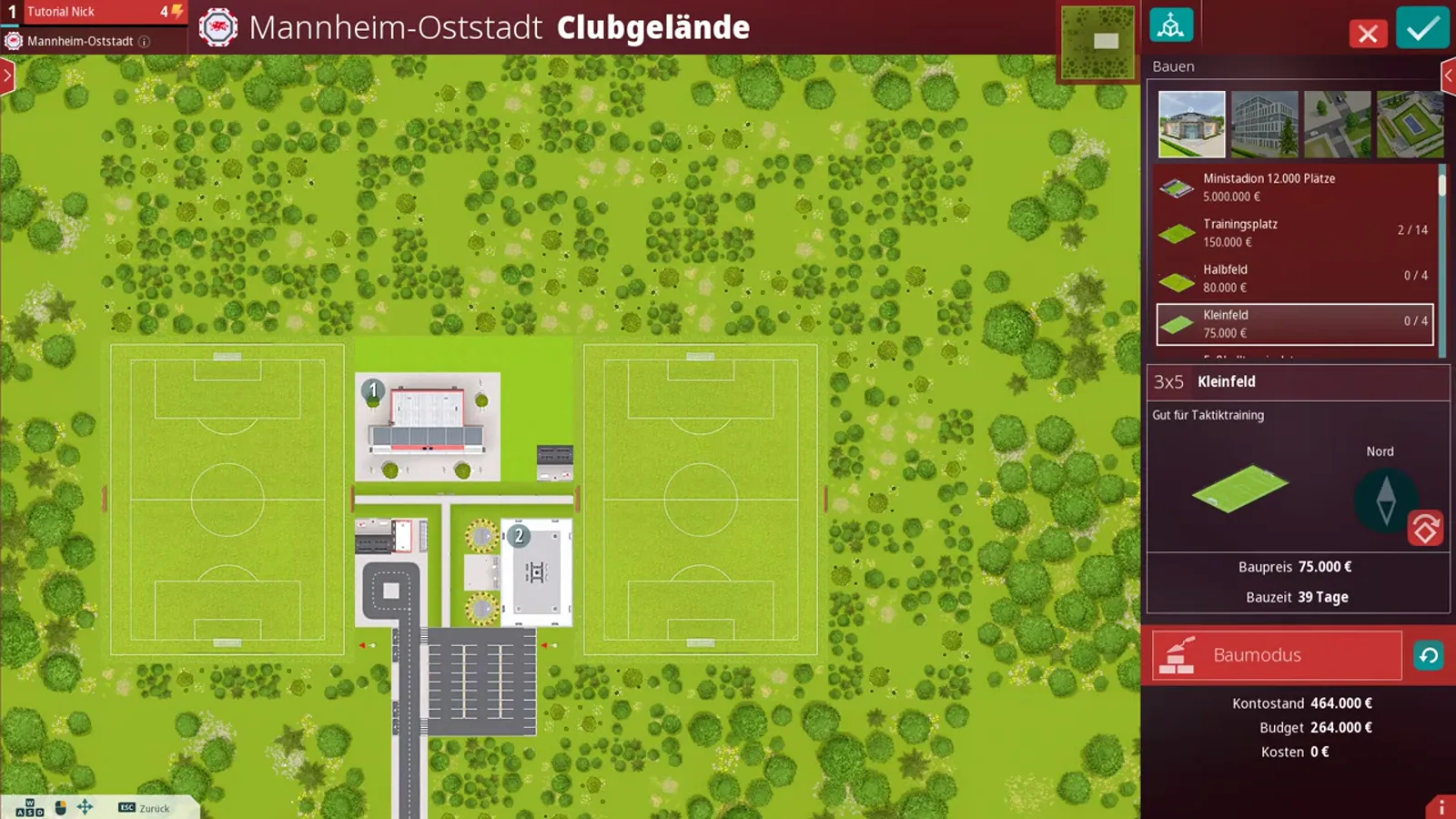
The Kleinfeld (75.000 €, 39 days, „Gut für Taktiktraining”) repeats the tactical bonus of the big pitches — the first four reduce tactics forgetting by 10/5/3/2% (DE p. 93 / EN p. 89). The Halbfeld (80.000 €, up to four) counts as a substitute for a full pitch provided you own at least three times as many full pitches — twelve full pitches plus four half pitches play like thirteen, which makes it more of a design toy than a bonus machine, as the author concludes.
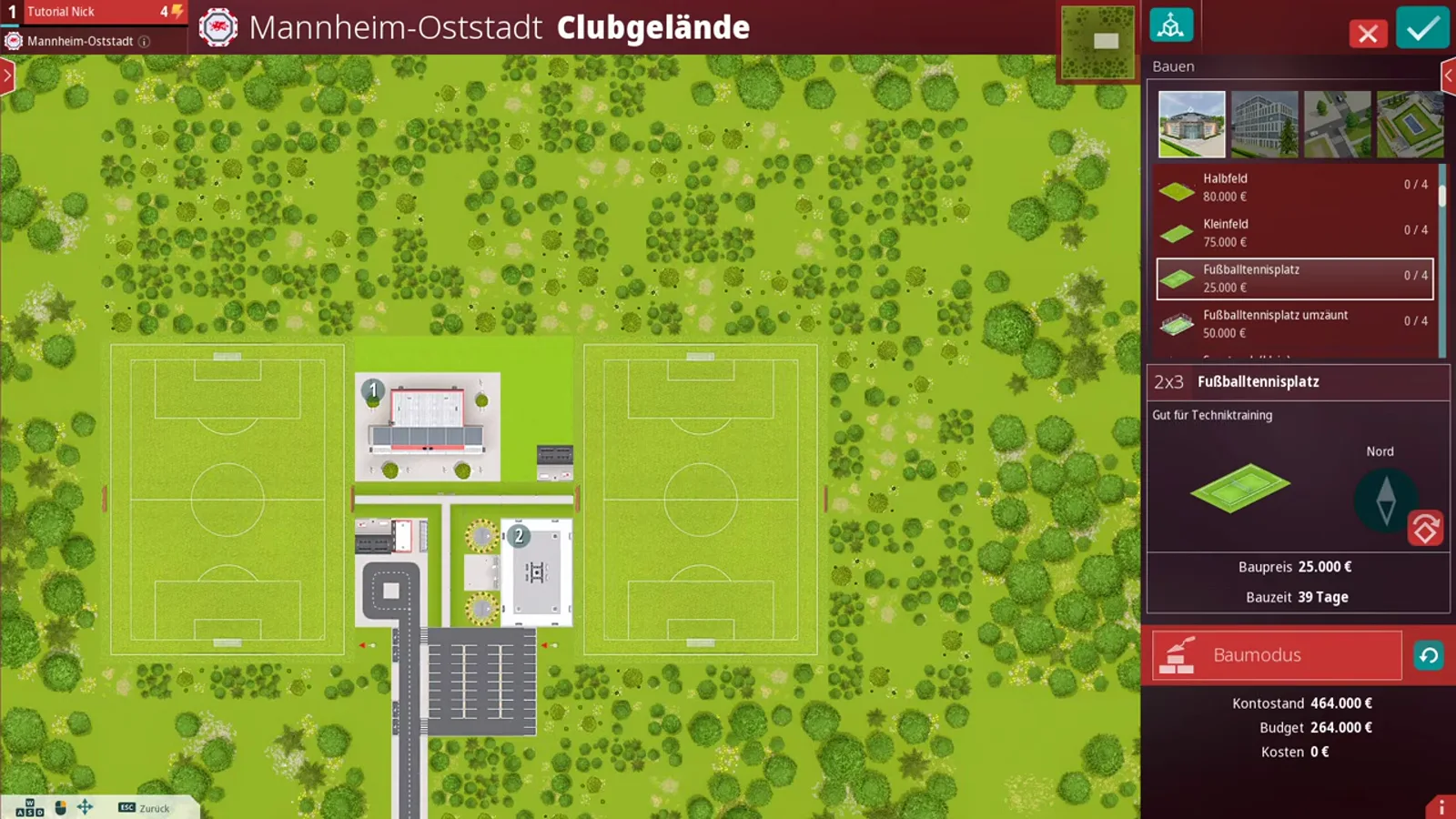
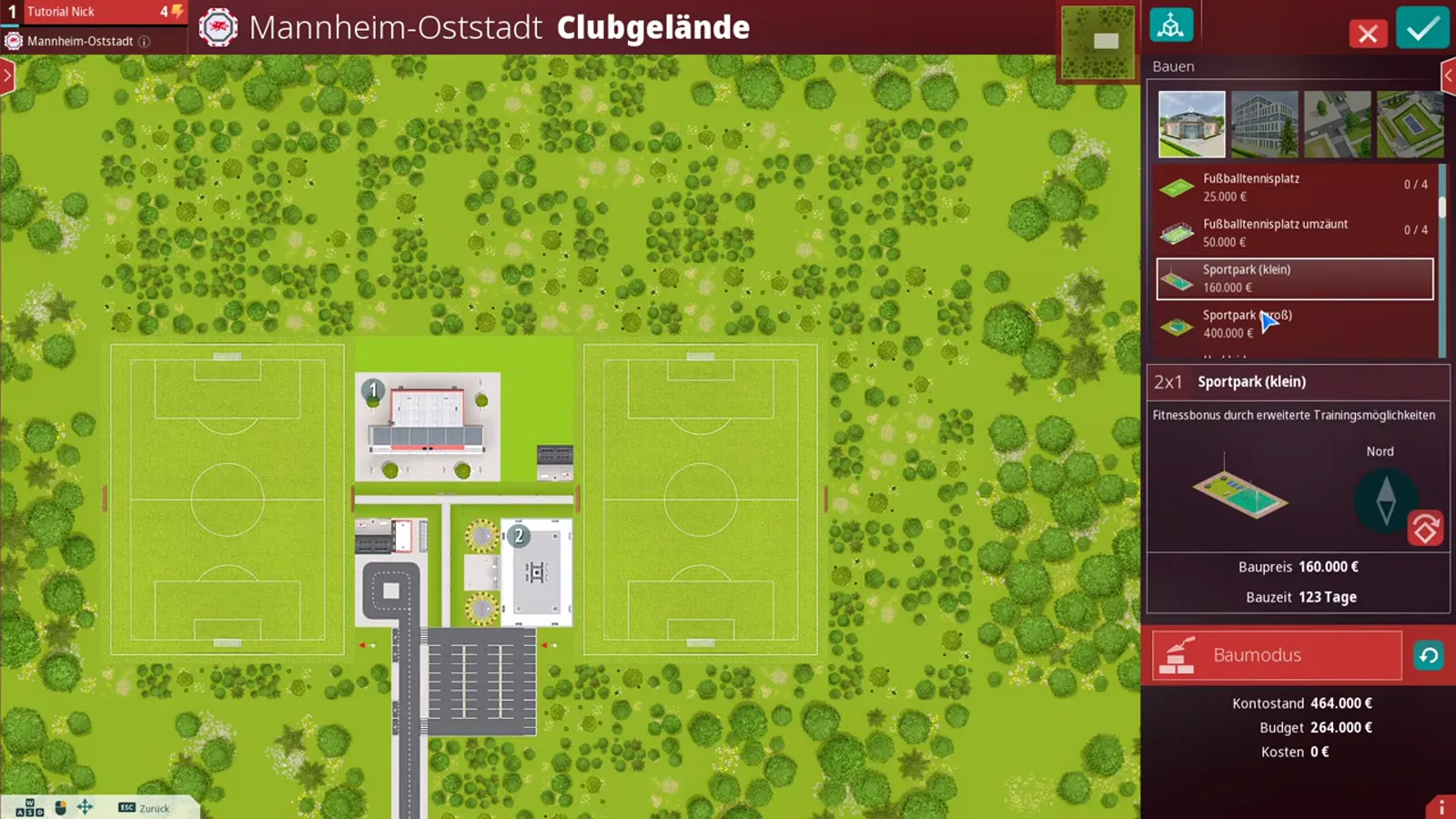
The Fußballtennisplatz (25.000 €) sharpens technique training — the manual lists a 2, 3 and 4% chance of an extra point across courts, and the fenced variant adds +0.5% per court on top, at exactly twice the price (50.000 €), a trade-off the author points out with a laugh. The Sportpark closes the block: the small one (160.000 €) grants a daily 1-in-200 chance of a fitness point, the large one (400.000 €) a 1-in-100 — and one park of either type is enough, a second does nothing (DE p. 94 / EN p. 90).
How do you keep players fit: pools, halls and clinics?
The recovery block trades money for availability. A swimming pool speeds up active recovery and rehabilitation, training halls rescue winter training when temperatures drop below zero, the vacuum hall and the gym add daily fitness chances, and the rehab clinic with the surgical centre shorten whatever injuries slip through anyway.
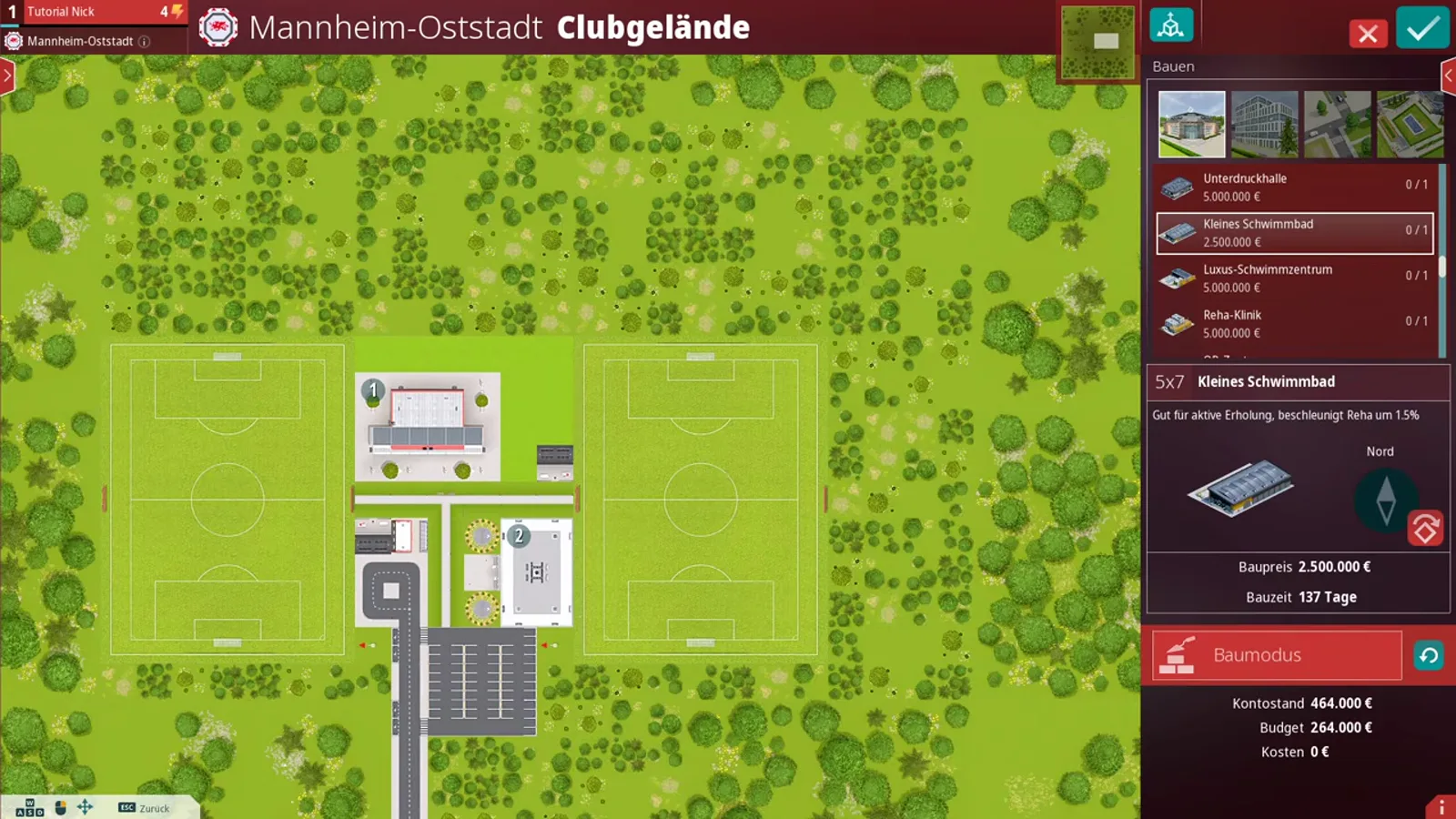
The Kleines Schwimmbad (2.500.000 €) raises active recovery by 25% and speeds rehab by 1.5%; the Luxus-Schwimmzentrum (5.000.000 €) raises both to 50% and 3% (DE p. 93 / EN p. 89). One honesty note: on the video the author reads „2% more effect” for the luxury pool — the manual’s table says 50%, and that is the figure we print. The Unterdruckhalle (5.000.000 € in his build menu) adds a 1-in-100 daily fitness point, the same as a gym — real Bundesliga micro-optimisation, in the author’s words, where they work on players down to the millimetre.
The Trainingshalle matters only where winters freeze: below 0 °C a level 1 hall preserves 75% of the tactics and skills training effect, level 2 preserves 100%, and without any hall you drop to 50% (DE p. 93 / EN p. 89). In Saudi Arabia, the author’s example, skip it. The Reha-Klinik (5.000.000 €) cuts injury durations by 5% and bends the dice — positive injury events count double, negative ones half, so a collision becomes a bruise instead of a concussion. The OP-Zentrum (4.000.000 €) shortens injuries beyond 90 days by a further 10% (prices visible in the video’s build menu).
What do canteen, restaurant and popularity buildings do?
This block feeds moods rather than muscles. The canteen makes players happier and drips team spirit, the restaurant is a fan-facing business that also unlocks the chef, the information centre and media centre push popularity counters, and the presidential villa buys a one-off block of board sympathy. None of it touches training directly.
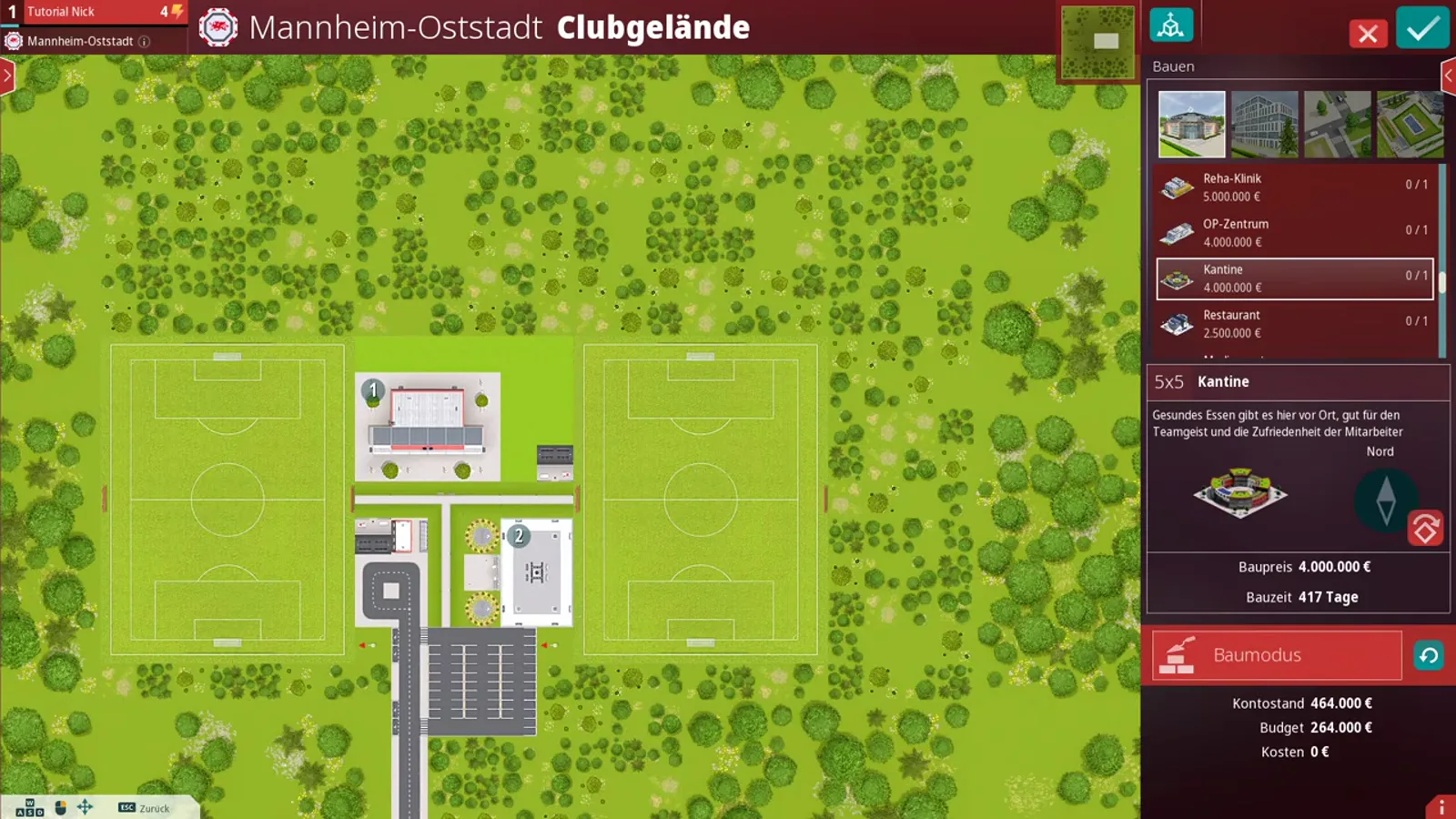
The Kantine (4.000.000 €, 417 days) gives the team a daily 1-in-60 chance of a team-spirit point and a 3% bonus to department heads’ satisfaction (DE p. 94 / EN p. 90). „The canteen is not the restaurant,” the author insists — the Restaurant (2.500.000 € in his menu) addresses the fans with a fixed +1 bonus and allows hiring a chef with all the associated perks. The Informationszentrum grants a permanent +1 (level 1) or +2 (level 2) to fan popularity — the author’s emergency exit if a board ultimatum needs 40 popularity and you sit at 39.
The Medienzentrum pushes fan popularity by +1 at a rate of 1-in-75 per day and public popularity by +1 at 1-in-150 (DE p. 94 / EN p. 90) — numbers the author garbles live and then surrenders on, which is why we quote the manual. The Präsidentenvilla completes the mood block with one-off +10 (level 1) or +20 (level 2) popularity with the board.
Which buildings earn money: museum, fan shop and rentals?
Three and a half money-makers live on the grounds. Rentals and catering pay reliably, the sausage stand collects from visitors, the fan shop multiplies merchandise turnover by floors — and the club museum is the gamble: a trophy-driven formula that can just as easily run at a loss every single month.
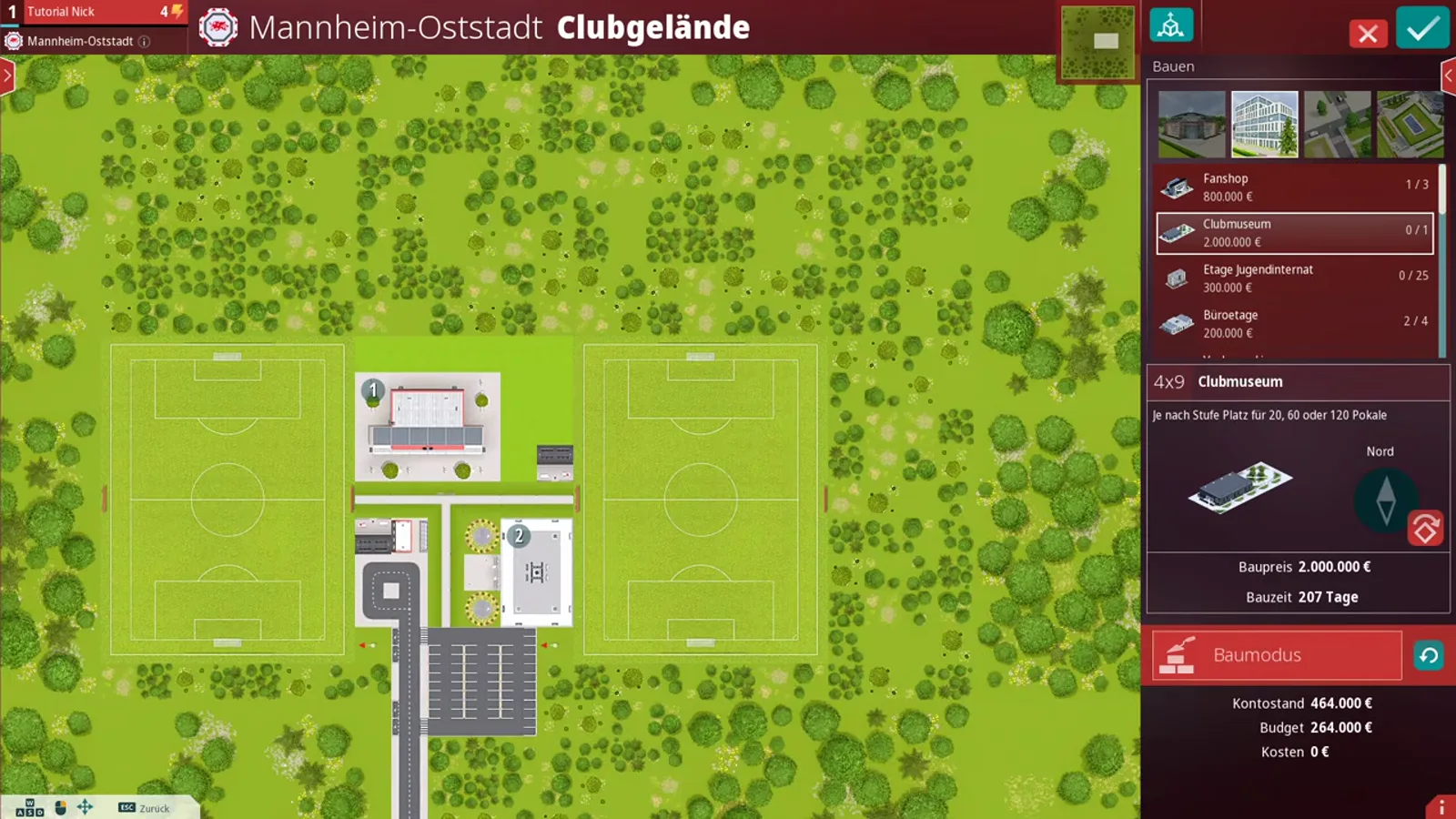
The Clubmuseum (2.000.000 €, 207 days) earns trophies × 500 − level × 4.000 per month, with a ±20% swing per level above or below the season target (DE p. 93 / EN p. 89); the build screen adds that a museum holds 20, 60 or 120 trophies depending on level. The author wrestles with the formula on camera, cannot pin down what „level” refers to, then discovers museums themselves have levels — and lands on ten trophies at level 1 as his break-even point. That last number is his arithmetic, not the manual’s. His verdict after four confusing minutes: sometimes you just have to build it and see.
The Fanshop is the opposite: precise, and quietly punishing. Floors pay +5%, +9% and +12% merchandise turnover, but a second building contributes only 20% of a shop’s effect (4%, then 0.8%), the fourth none at all, and the largest fan shop is evaluated first (DE p. 93 / EN p. 89). The author fights this syntax for a good four minutes of video before settling on the practical reading — one shop, three floors, done. His save agrees: Fanshop 1/3.
The safe money is boring: Mietshäuser (250.000 € and up, visible in his menu) and catering are the guaranteed income the manual names outright, the author quotes 500 and 1.000 € per floor per month for the two rental types [his figures], and the Imbissstand earns passive income from visitors while delighting staff — he keeps the exact bonus to himself. Where all this money comes from and where it belongs is the territory of our wage and budget guide.
How do youth boarding school, offices and containers work?
Two building groups keep the club’s organism running. Every Jugendinternat floor adds two boarding places for youth players — 25 floors and 50 places maximum — while office floors and their container cousins house staff, without whose desks departments start causing problems. Both caps are hard numbers, not guidelines.
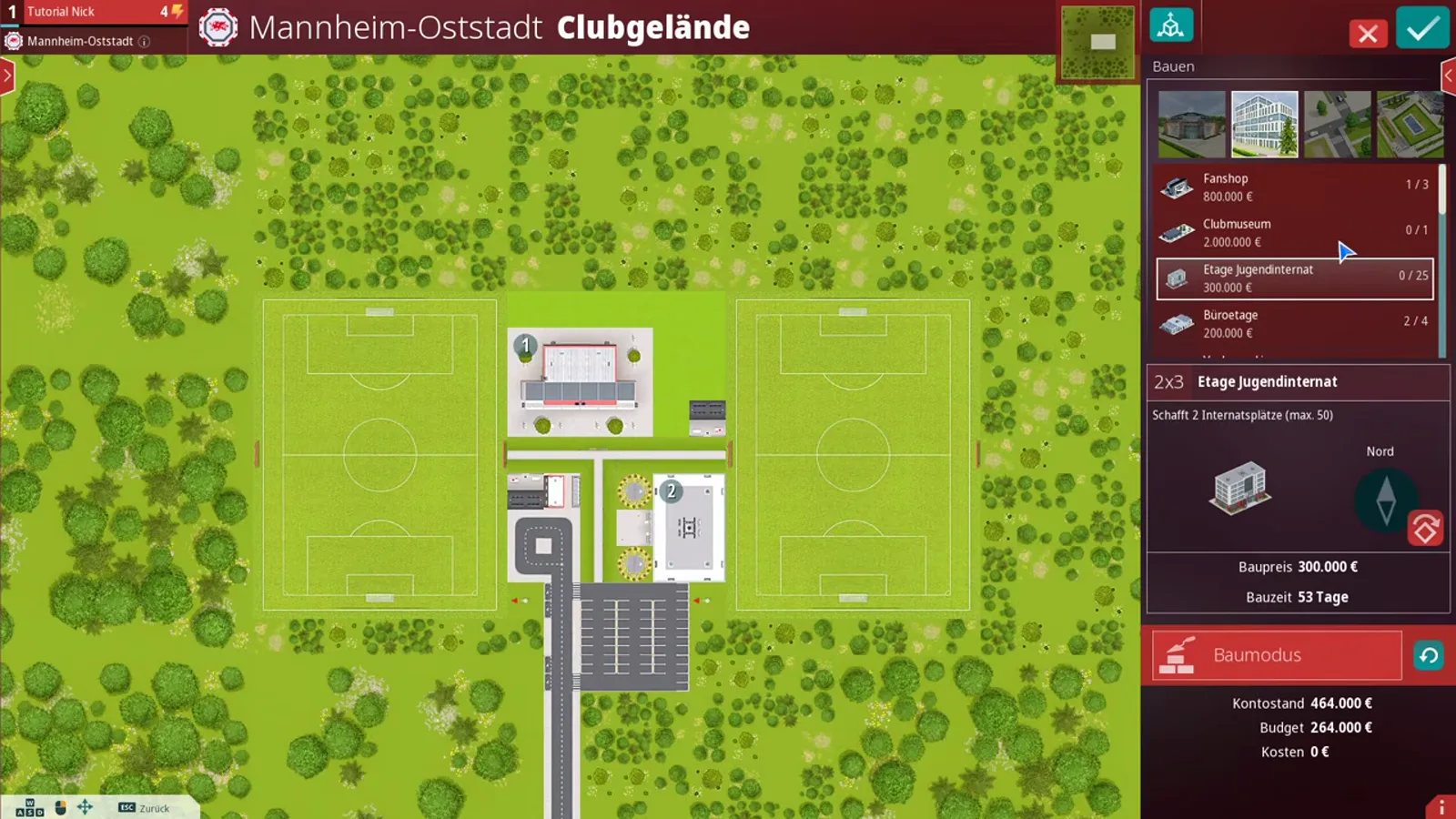
An Etage Jugendinternat costs 300.000 € and, as the tooltip says, „Schafft 2 Internatsplätze (max. 50)”. The places then need equipping on the youth screen, and more boarding places help young players progress faster — the author’s summary. The rest of youth development happens away from this screen; our youth camps guide covers that side.
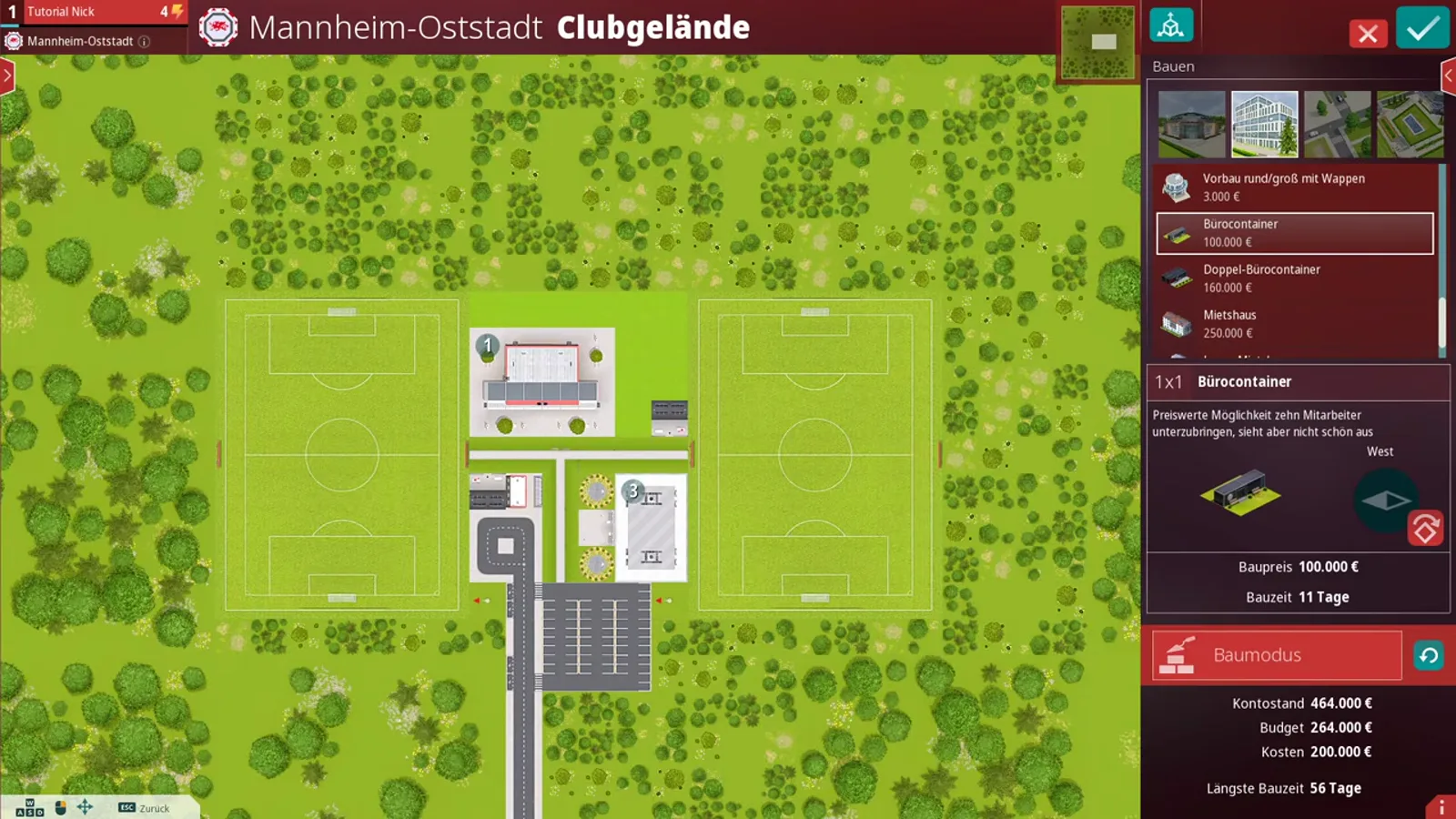
Offices are the quieter emergency. A Büroetage costs 200.000 € and houses ten employees, with a maximum of four floors — the author’s save sits at 2/4 while his Büroauslastung runs red at 32/20, which is precisely what an undersized office block looks like. The Bürocontainer (100.000 €, ten places) and Doppel-Bürocontainer (160.000 €, twenty places) are the quick fix: per place roughly half the price of an office floor, built in days instead of months, with a morale penalty for the staff sitting in them (DE p. 94 / EN p. 90). The author’s take: staff a little demoralised beats staff standing in the rain.
Changing rooms and toilets: what does the game actually require?
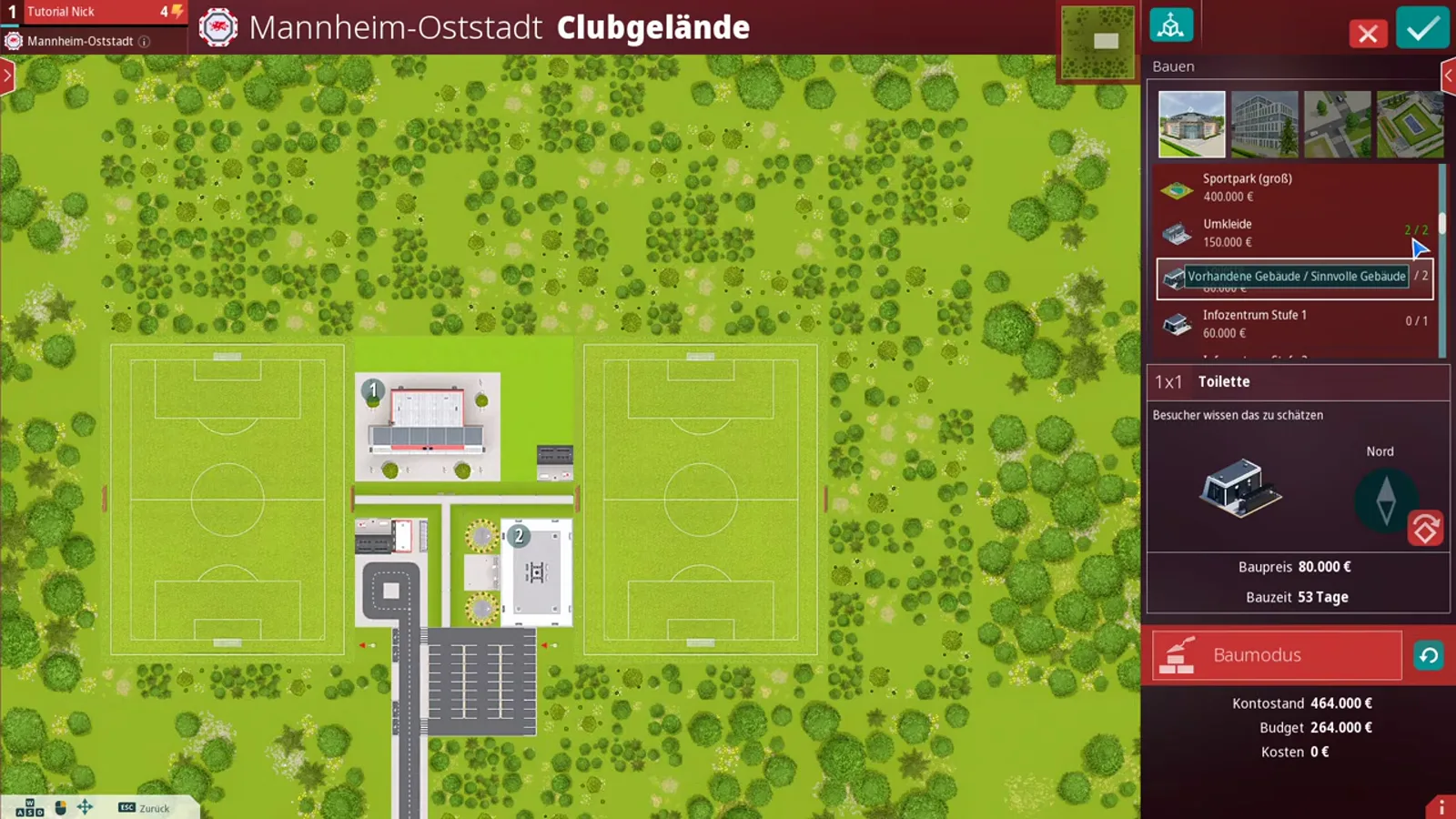
This is the most-argued rule on the whole screen, and the manual settles it: every normal training pitch needs exactly one changing room and one toilet, or all positive pitch effects are cut in half. Small pitches are exempt. The build-menu tooltip never mentions any of this — it lets you find out by halves.
The argument is real. In a German „Training und Praxis Guide” thread from late September 2026, players ask exactly this — „Aber ist beim Clubgelände nicht eine Umkleidekabine pro Trainingsplatz Pflicht, um den kompletten Bonus auf Verletzungsrisikoreduzierung zu bekommen?” — and the follow-up „Toilette auch? Dachte nur die Umkleiden sind wichtig für den Bonus?” is where most saves go wrong. The manual’s answers, quoted: „Alle positiven Auswirkungen werden halbiert, wenn keine Umkleide oder keine Toilette für den Platz vorhanden ist” (DE p. 93 / EN p. 89) and „Für jeden normalen Trainingsplatz (nicht für die kleinen Varianten) ist exakt eine Umkleide und eine Toilette nötig” (DE p. 94 / EN p. 90). So yes — toilets count too, one per pitch.
The video agrees from the practitioner’s side. The author admits he „underestimated it in the past” and only recently re-learned the rule; his own infrastructure table shows Umkleide 2/2 next to Toilette 1/2 — two training pitches, one toilet, half a bonus — and he notes mid-video that a second toilet is exactly what his grounds are missing. At 150.000 € per changing room and 80.000 € per toilet, budget them together with the pitches, not after the first injury wave.
Since this guide was written, the developers have quietly settled part of the argument at the source: Update 2 (28 September 2026) includes „Help texts added for scouts (costs) and buildings (meaning of the two figures)” — the two figures every building shows are now explained in the game’s own help texts, which is precisely the mystery the forum threads and this screen keep fielding. If a building number puzzles you after the patch, the game itself is now the first place to look; the troubleshooting and update log quotes the fix list in full.
Climate neutrality, cosmetics and the fusion reactor
The grounds also carry your climate balance. Solar systems add +2% each — up to twenty of them — and electric charging stations +1% for up to ten, wind turbines push it further, and the 50-million-€ Fusionsreaktor tops it off; those per-building figures are the author’s spoken numbers [not screen-verified]. The manual, meanwhile, confirms the reactor is „nicht ganz ernst gemeint” — an effect far too small for its price — and recommends climate certificates as the cheap alternative (DE p. 121 / EN p. 85).
Everything else in the catalogue — roundabouts, pedestrian bridges at 100.000 €, ground patterns, flags with your crest, flower beds, water basins, the mini-golf course for distracting your squad — is decoration with no gameplay effect, which the manual states plainly, right next to the note that building positions do not matter either. Design the campus you want to look at; just do not stay in the 3D view too long, or the players get their miles in without you.
What does the Klimaneutralität screen actually measure?
All of that solar arithmetic has a home screen of its own: Infrastruktur → Klimaneutralität, the tab between Anreise zum Stadion and the Hall of Fame. The screenshots for this section come from Gadarol Deluxe’s episode above — his FC Memmingen save (4. Liga Bayern, 15 March 2027) — so the numbers on them belong to that club, not to the Mannheim save or to a standard career. The meter at the top is the club’s climate balance, and it opens humbly: Aktuell 6%, with the breakdown on the right naming what feeds it — Gebäude 0%, Stadion 0%, Klima-Zertifikate 0%, Reisen und Sportliches 6%, ÖPNV 0%. The screen’s own intro line lists the levers: measures in the areas Anreise (Auswärtsspiele, Trainingslager, Stadion) under the Klimaschutz heading, ÖPNV, and Clubgelände investments all improve the balance, and the Klima-Zertifikate can push it „auch über 100% Reduktion hinaus“ — beyond full reduction.
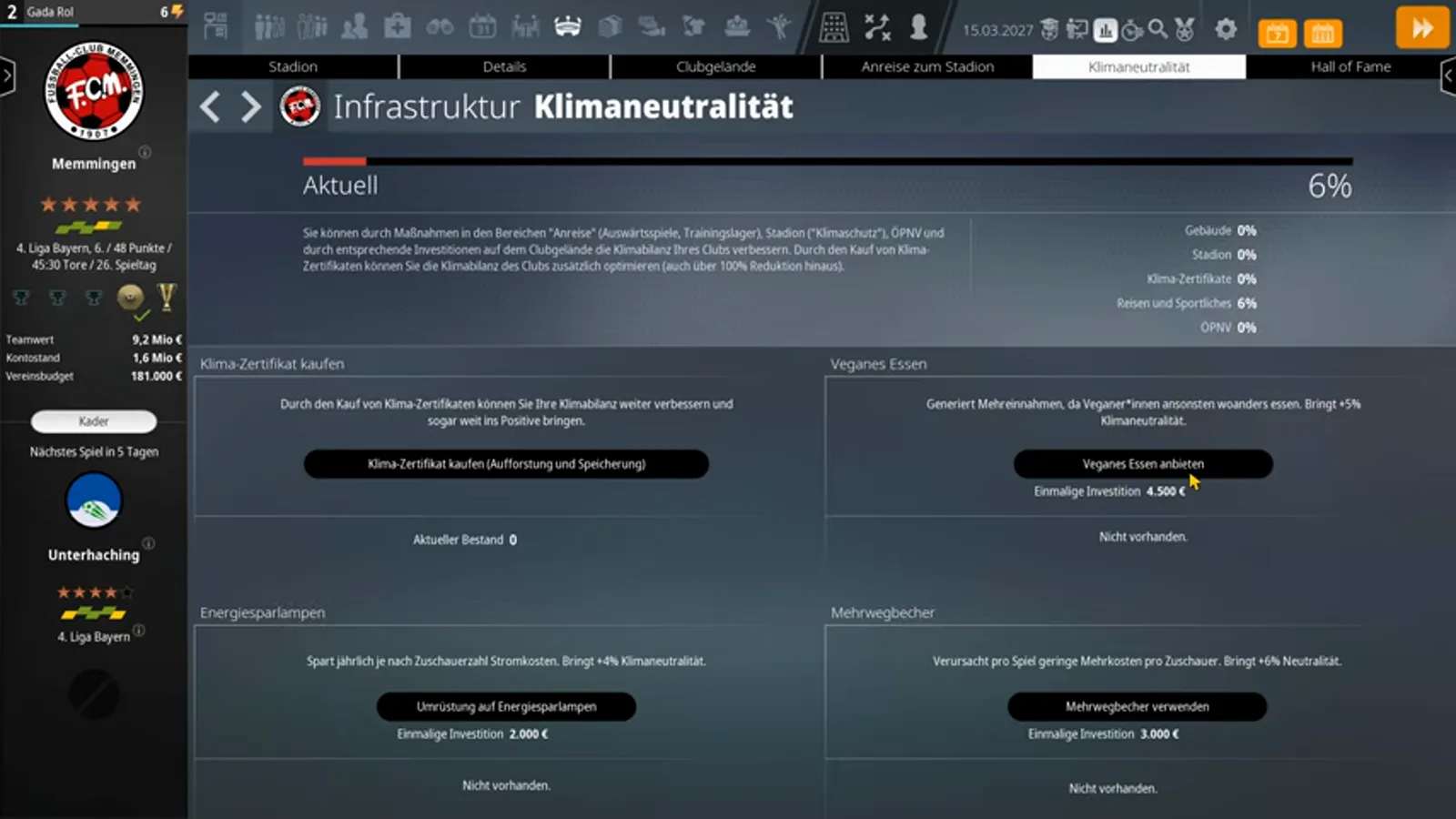
35:12 in the source video: the balance before any purchase.
Four purchase panels sit under the meter, each price tag welded to its percentage: Veganes Essen at a one-off 4.500 € bringing +5% Klimaneutralität, Energiesparlampen at 2.000 € bringing +4% („Spart jährlich je nach Zuschauerzahl Stromkosten“), Mehrwegbecher at 3.000 € bringing +6% with small per-spectator costs per match, and the Klima-Zertifikat kaufen (Aufforstung und Speicherung) button with a stock counter — Aktueller Bestand 0 in the frame. The episode buys the vegan option on camera, and the meter answers within seconds: Aktuell climbs from 6 to 11%, and the breakdown’s Stadion line moves from 0 to 5 — the promised five points, booked under the stadium’s balance. The purchased panel then keeps a small ledger of its own: Preiszuschlag veganes Essen 10%, Mehreinnahmen veganes Essen 11%, Mehreinnahmen bisher diese Saison 0 €.
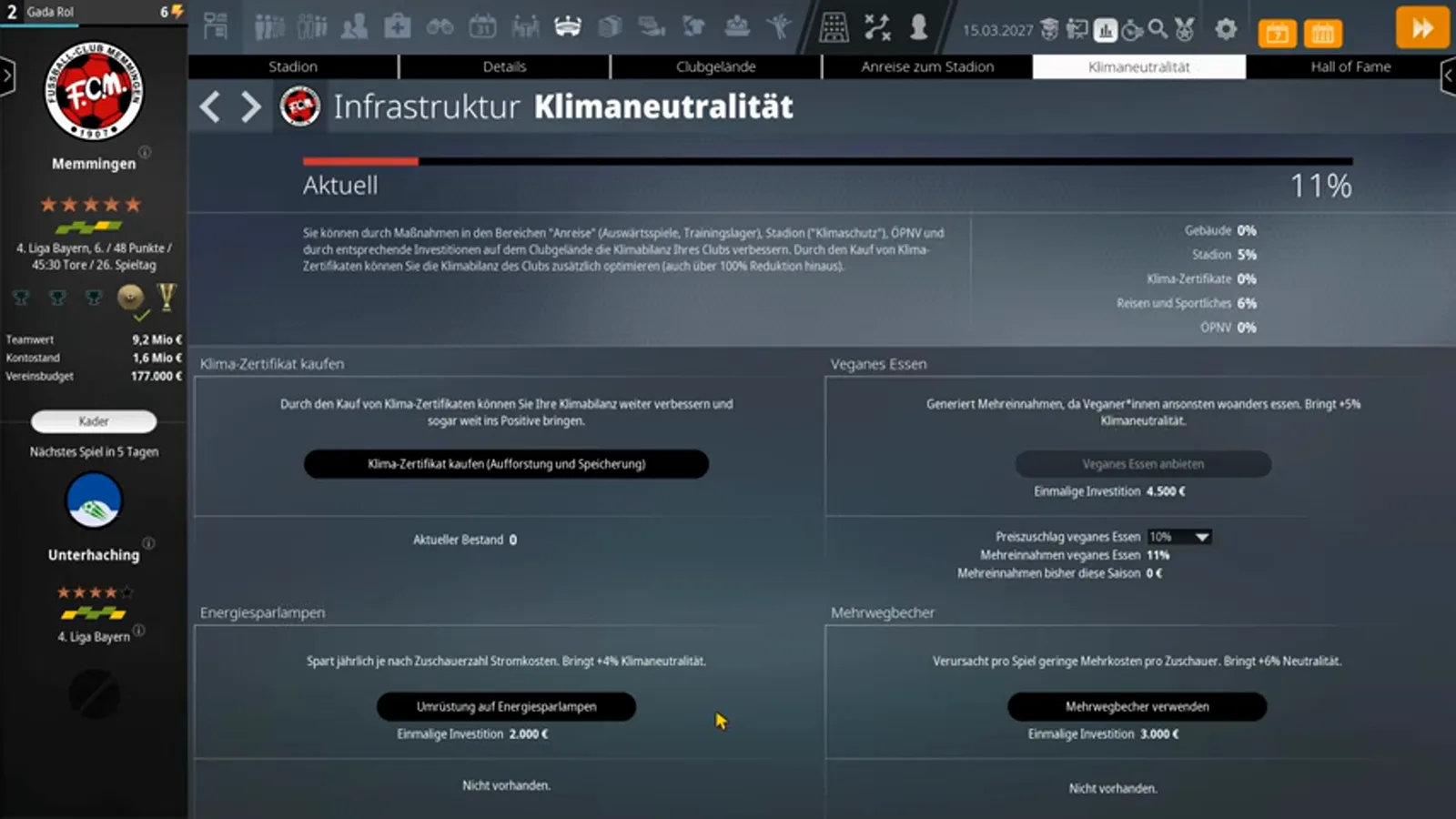
35:25: the +5% on the meter, seconds after the click.
The Anreise zum Stadion tab next door feeds the same balance from the fan side. Three dials measure how the spectators travel — ÖPNV 40%, Auto 40%, Flugzeug 0% in this save — each with a Verbessern! button priced at 40.000 €, 100.000 € and 160.000 €, and underneath sits the Klimaschutzbonus ÖPNV at 0% with its rule printed out: „Ab 50% erhalten Sie für jeweils 2% einen Bonus von 1% bei der Klimaneutralität.“ — from a 50 percent public-transport share upward, every 2 points pay 1 point of climate balance. The tab’s own note ties the block back to business: improvements „können sich positiv auf das Vereinsimage und auf die Sponsoren auswirken“ and bring „ein besseres Stadionerlebnis und mehr Zuschauer“ — which is where the climate ledger meets money again, and the sponsor deals guide and the fans and marketing guide take over from there.
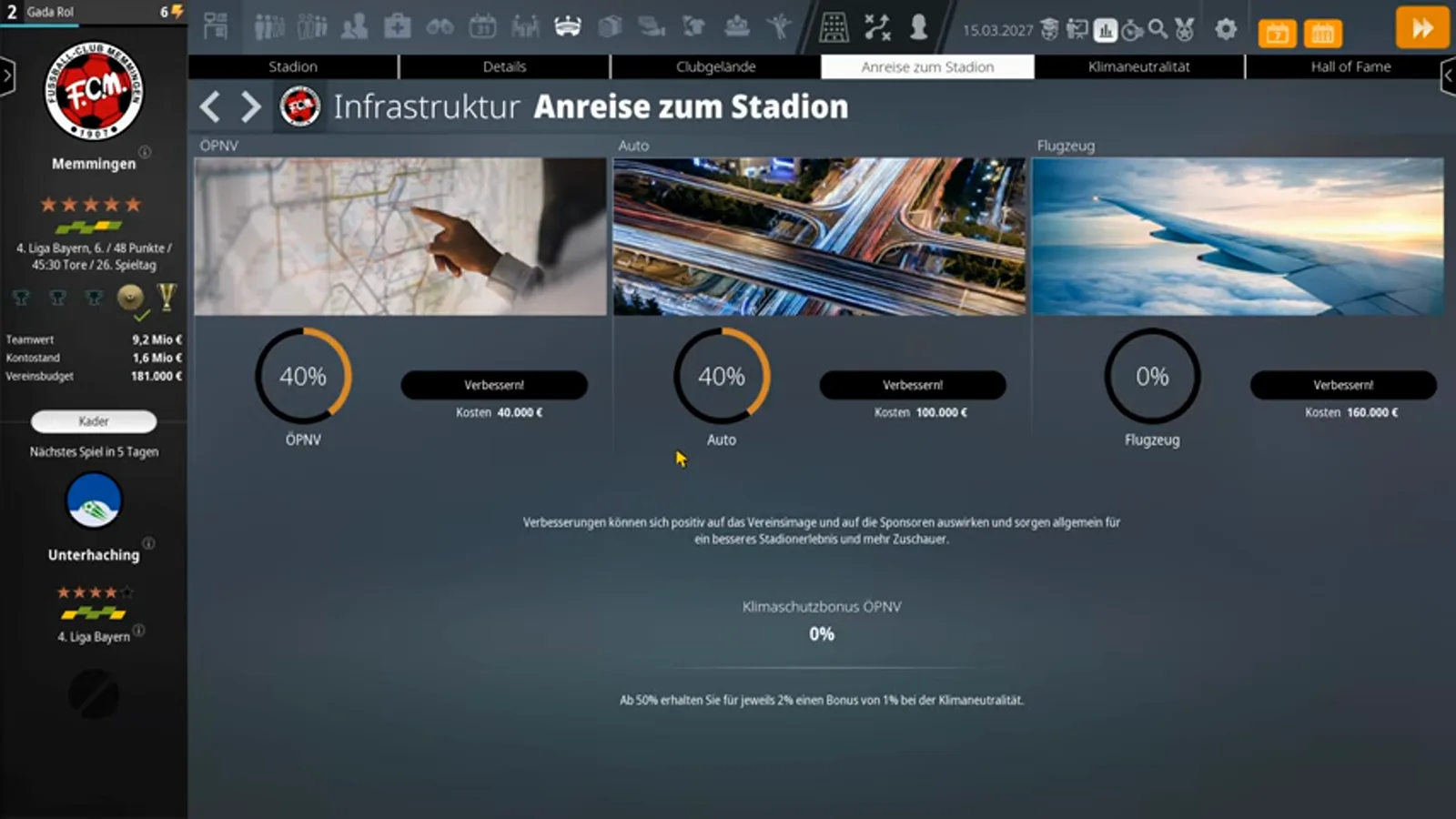
35:00: the travel dials that feed the ÖPNV line.
In which order should you upgrade the club grounds?
The numbers suggest a fixed order: three training pitches first, because nothing else touches the injury baseline; changing rooms and toilets immediately with them, or the pitches run at half value; office space before your staff count outgrows it; then fitness, recovery and the money-makers — with the museum last, once trophies actually exist. Treat this as the author’s priorities backed by the manual’s table, not as scripture.
He is disarmingly honest about the aesthetic half of the job: prefabricated predecessor campuses annoy him, tearing everything down is expensive, so his compromise is to declare the inherited core untouchable — „That’s the old core. From now on, I’m building” — and make everything new both pretty and correct. Starting from scratch changes the maths again; our club creation guide shows which facilities a founded club should place first. And once the big ticket items pass two and five million, the funding question decides itself in the budgets — our wage and budget guide keeps that side sorted.
That is the full circuit of the grounds: pitches and their halving rule at the core, moods and money around them, cosmetics wherever your heart desires. Build the injury baseline first, and every other building gets to be fun.
Guides recommandés
guides
WE ARE FOOTBALL 2027 Team Strength Comparison: Stars, Gauges, Scouting Lists
How to read team strength in WE ARE FOOTBALL 2027: Kader stars, the profile gauge, the pre-match Mannschaftsteile bars and the scouting list for the next fixture.
guides
WE ARE FOOTBALL 2027 Season Planning Guide: Budget Split, Kits and Squad Numbers
The Saisonplanung stretch in WE ARE FOOTBALL 2027 screen by screen: promotion payout, league target, budget split, new kits, club rules and squad numbers.
guides
WE ARE FOOTBALL 2027 Relegation Battle Guide: Escaping the Red Rows
A relegation battle in WE ARE FOOTBALL 2027 screen by screen: the red Verbandsliga table rows, a 0:1 away steal, a 1:4 home defeat and the January deals in between.
Ce guide vous a-t-il été utile ?
Merci pour votre retour !