WE ARE FOOTBALL 2027: Transfer Market & Scouting Guide
Master the WE ARE FOOTBALL 2027 transfer market: scouting network levels, player search filters, loan list rules, scouting assignments, and solidarity payments.
Foire aux questions (FAQ)
How many scouts should I assign to one player in WE ARE FOOTBALL 2027?
Can I ask a club to loan me a player in WE ARE FOOTBALL 2027?
What does the scouting network level do?
Can I recall a loaned player early in WE ARE FOOTBALL 2027?
When does a sold player's fee actually arrive in WE ARE FOOTBALL 2027?
Inside the Transfers und Scouting Hub
Every WE ARE FOOTBALL 2027 transfer starts in one place: the Transfers und Scouting hub. Six tabs split the work — Scouting, Marktliste (market list), Scoutingaufträge (scouting assignments), Basismission (basic assignment), Transfers, and Beteiligungen (participation payments). The Scouting tab doubles as your shortlist, holding up to six scouted players; from there you open a Vertragsgespräch (contract talk), a Vorgespräch (preliminary talk), or register interest via Interesse hinterlegen.
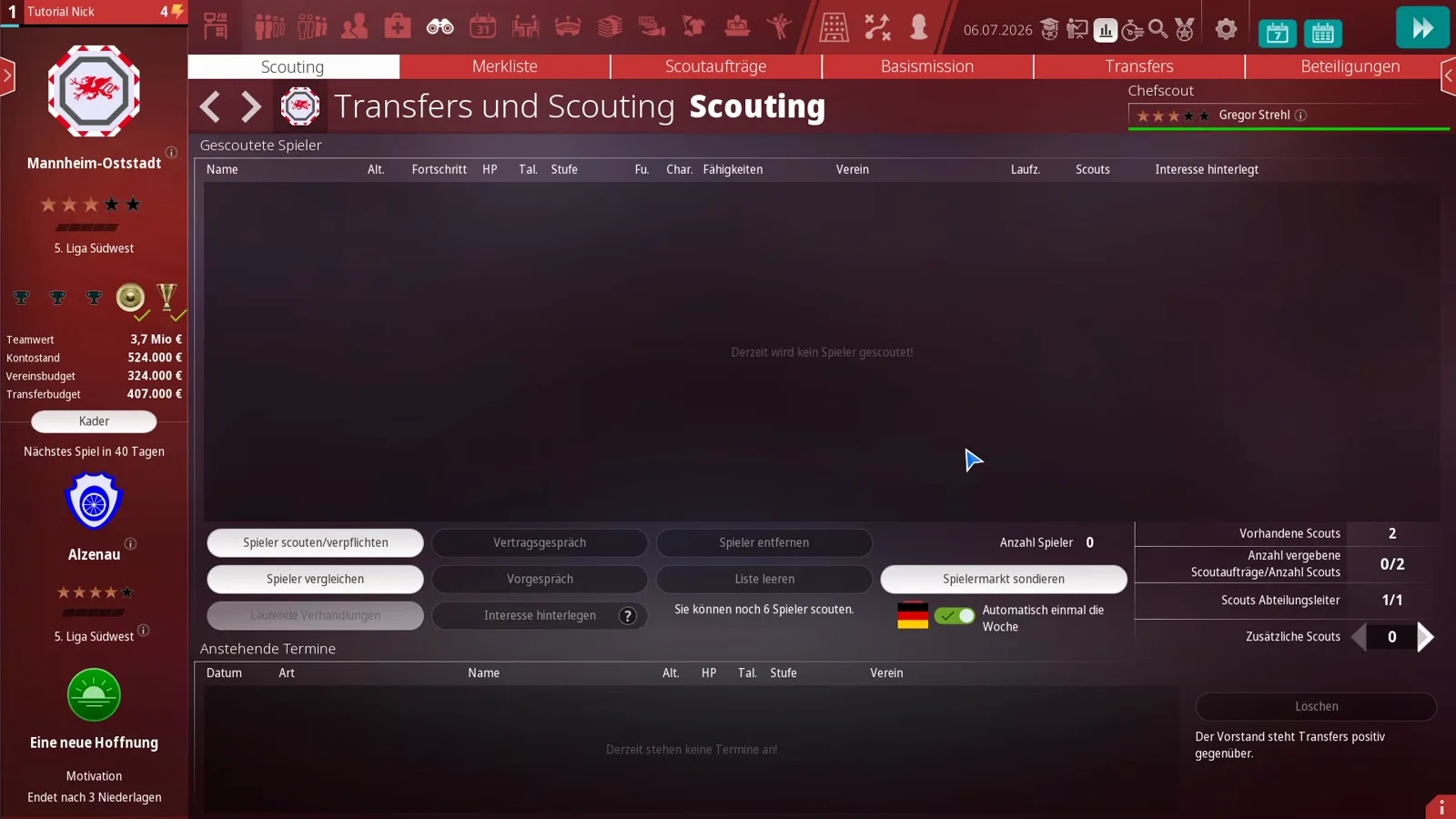
The right column tracks available scouts, assignments per scout, and the Chefscout, whose rating and staff drive scouting speed. You can employ up to 20 scouts, but each needs an office — grow the department alongside your infrastructure. The bottom line matters: “Der Vorstand steht Transfers positiv gegenüber” means the board backs deals, so scouted players move into appointments without resistance. Pair this screen with the first-week routine in our beginner guide.
Scouting Network Levels Decide What You See
Open Ihr Netzwerk and you get a map of your international contacts. Every country carries a network level from 1 to 5, and the on-screen rule is simple: the larger a country’s flag, the faster you scout players there. A career in Germany hands you level 3 for free — push it to 5 as soon as the budget allows.
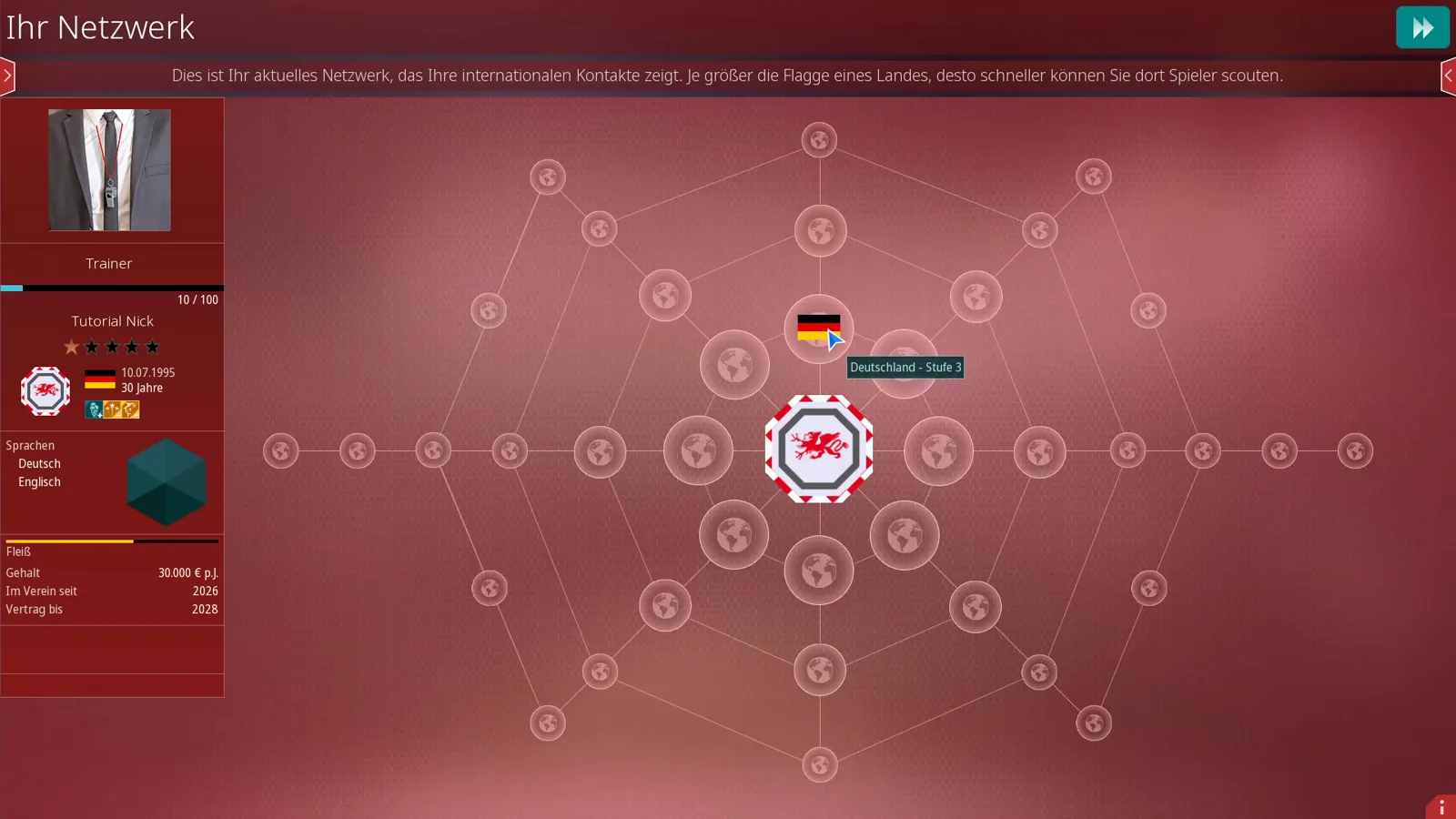
The network also decides what the player search shows you. Filter the market for a level-5 striker with the Torjäger (goal-scoring) trait and only German forwards appear — Spanish or Italian players stay invisible until your network covers their countries. A strong network also saves scout hours, because players enter your list at a higher knowledge level.
Filter the Player Search Like a Professional Scout
The Spieler scouten/verpflichten screen is the transfer market’s engine room. Four numbered tabs at the top store four separate filter sets — striker, backup keeper, and wonderkid searches can stay live side by side. Name fragments work too: type “Allen” and every matching player appears.
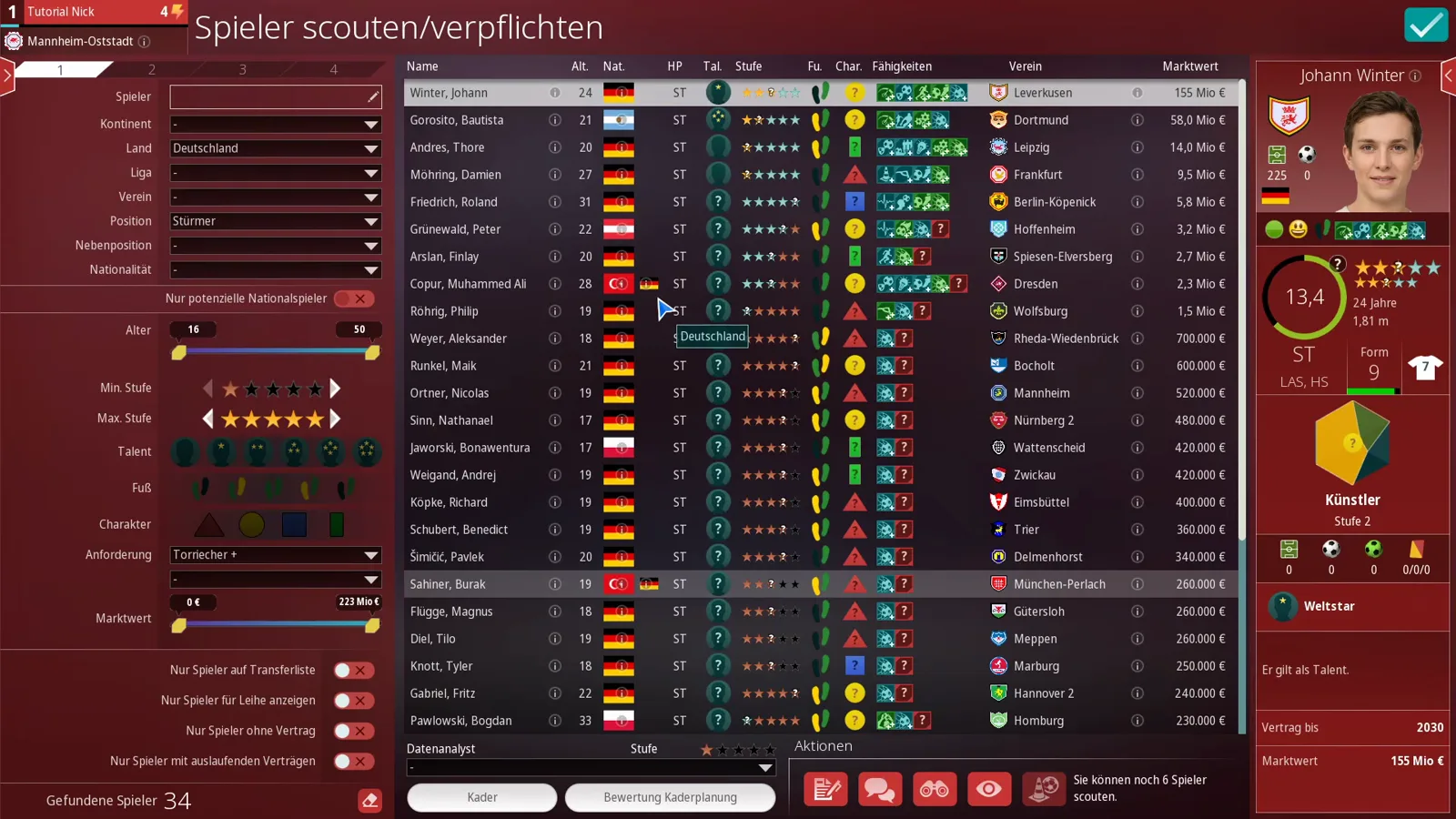
The filter column covers continent, country, league, club, position and Nebenposition (secondary position — an attacking midfielder who also plays right wing covers two roles in one signing), nationality, age, minimum and maximum level, weaker-foot strength, character type, and up to two ability traits. The market value slider protects small clubs: cap it at 300,000 € and the unaffordable Bundesliga-talent noise disappears. Colored stars mark levels 15 to 20, searchable for the first time in 2027. Your Datenanalytiker (data analyst) unlocks further squad-planning filters with level; from level 7 you can isolate dissatisfied players and players with a release clause — the cheapest signings on the market. Pair it with our best wonderkids guide for wonderkid hunts.
Loan List, Free Agents and Expiring Contracts
Four toggles at the bottom of the filter column reshape the market: transfer-listed players, loan-available players, free agents, and expiring contracts.
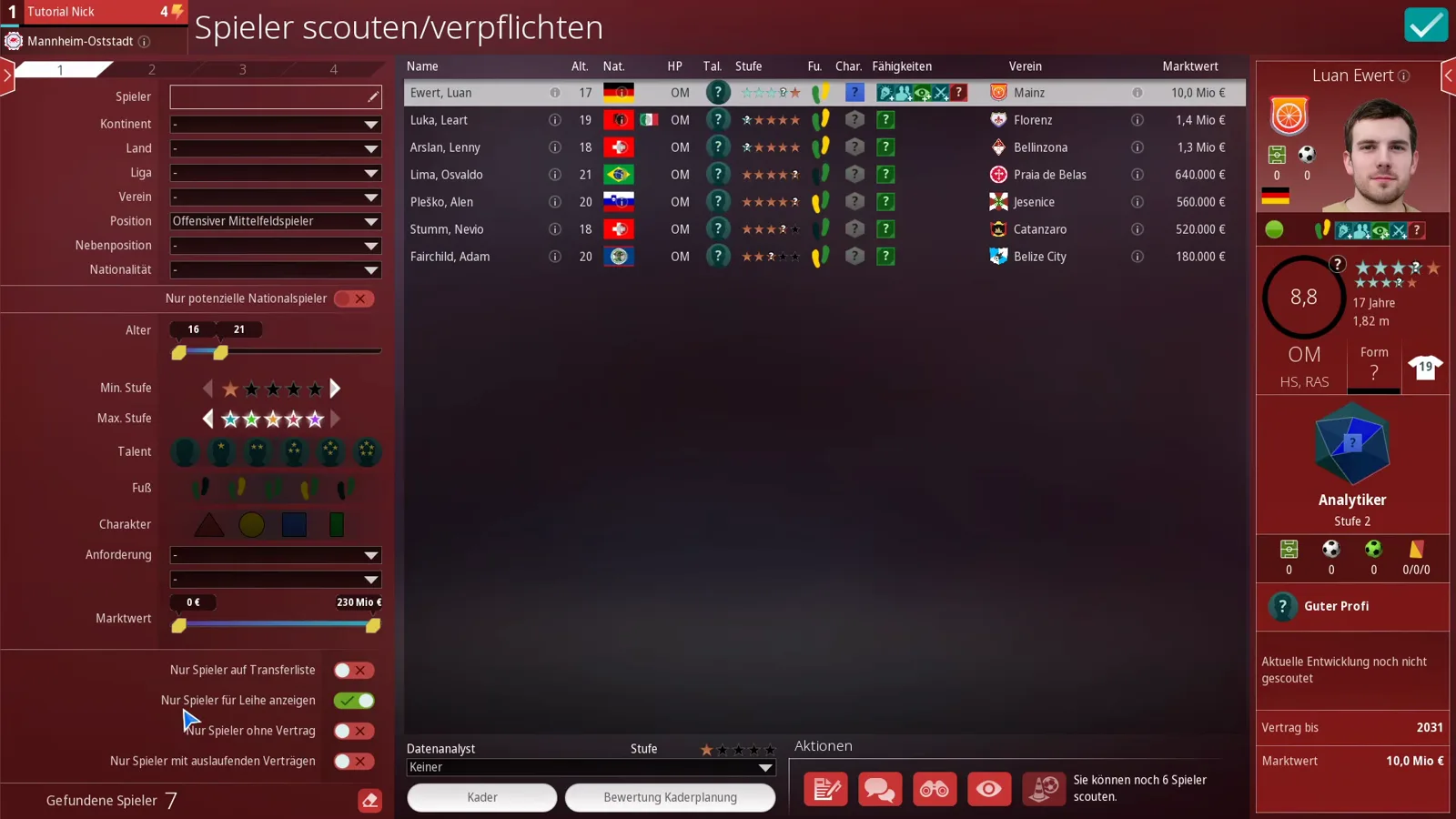
The loan toggle matters most: WE ARE FOOTBALL 2027 has no direct loan request — you cannot ask a club to borrow its winger. Instead, enable Nur Spieler für Leihe anzeigen, work through the shortlist — seven names in the tutorial save — and arrange an appointment with a player who fits. Unemployed players sign anytime without a fee; expiring contracts are the bargain window — in the second half of the season you negotiate without a transfer fee, in the first half at a significantly reduced one.
Loan Deals: How the Mechanics Actually Work
The filter above finds loan targets; what happens next is its own topic. Loans sit outside the 2027 negotiation revamp: the manual’s entry on ongoing negotiations states that the new multi-day player negotiations “relate only to transfers. Loans will continue to be arranged directly” (EN p. 123 / DE S. 124). On the money side, a loan fee hits the same transfer budget as a permanent fee — alongside the wages for the current season, as our finances and wage budget guide details — and the manual’s “package price”, its term for the all-in cost of a signing, bundles “the transfer fee or loan fee” with the player’s total salary payments (EN p. 126 / DE S. 139). How the wage burden is split between the two clubs deal by deal, the manual leaves undocumented; the contract screen shows it per signing, and our contract negotiations guide covers the purchase-option field that turns a loan into a permanent transfer.
Sending players out on loan and taking them back has documented rules too: a loan that began in the summer can be terminated early during the winter break if a player is not being used — the winter window must be open, he must have played two matches at most for the new club, sat out its last match, and his form must be below 6. The recall button lives under 1st Team - Players on Loan (EN p. 139-140 / DE S. 184-185). On the incoming side, the data analyst unlocks an “only loaned players” filter as early as level 1 (EN p. 94 / DE S. 95). The manual documents no dedicated loan-out action beyond the transfer list.
How offers are distributed around these windows is currently dividing the community. In a 30 September 2026 thread (nine replies, in German), the original poster — second season with a self-founded Swiss club — reports that not one of his players received an offer outside deadline day, and that deadline-day offers all came in far below market value, even for developing young regulars: “simply unrealistic”, in his words. The replies paint a split picture: one player sees offers arrive one to two months before the window even opens, some above market value; another, also in season one of a founded club, received offers around market value for two transfer-listed players; the original poster himself has only ever drawn interest for transfer-listed players. These are player reports, not documented rules — the manual only states that deadline day delivers new offers every few hours (EN p. 95 / DE S. 95) and says nothing about offer volume outside it.
Scouting Assignments, Basismission and Opponent Analysis
The Scoutingaufträge tab lets you run up to six paid assignments. The dialog prices duration against manpower: one week with three scouts cost 60,000 € in the tutorial save; spreading the same brief over six weeks is the budget route. Save every brief as a named template — “young players, market value around 300,000 €, level 3+, moderate development potential” — and reload it in one click. That template trawls the professional market; the youth-side version of the same hunt — scouting days, boarding-school places and poaching fees — has its own playbook in the youth scouting guide.
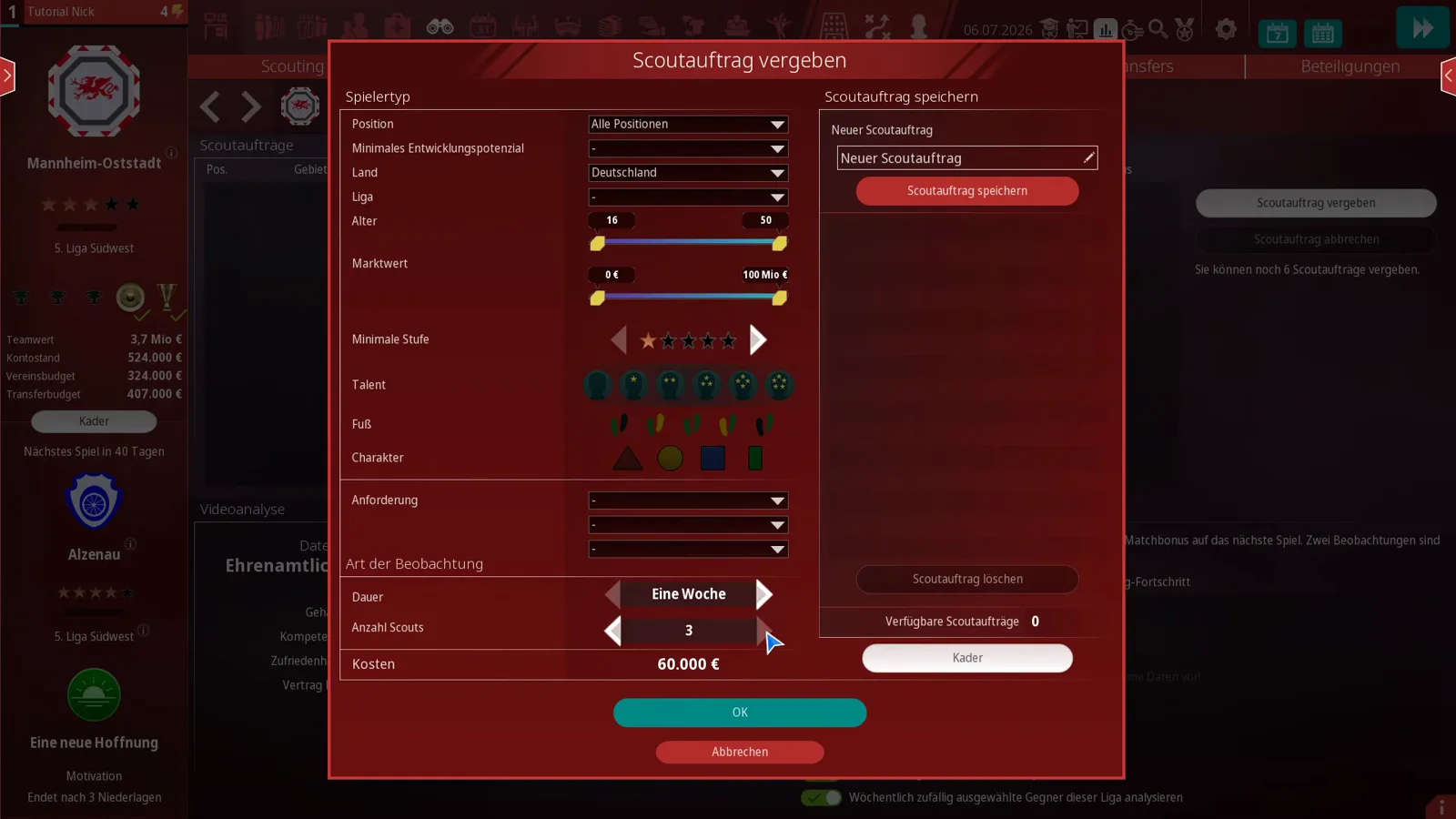
Below the assignments sits the Basismission: two scouts who permanently work your saved pattern whenever nothing else occupies them. It costs nothing extra, and 2027 adds a maximum level slider next to the minimum, so the mission no longer proposes unaffordable talents.
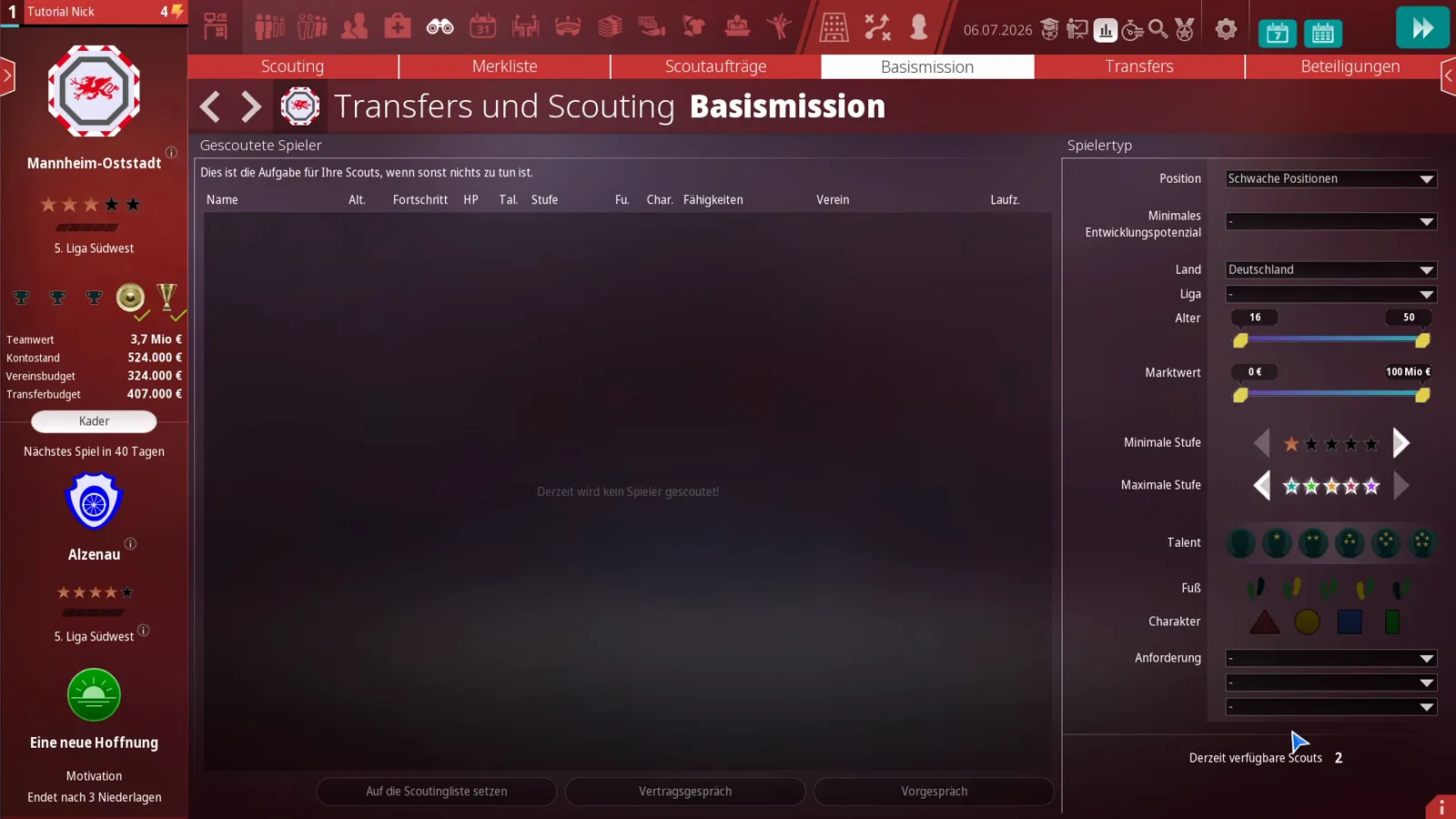
The same tab handles opponent analysis. Set the league you actually play in — not one from a former club — then activate automatic next-opponent analysis, the weekly random opponent, and book observation appointments via Termin vereinbaren. Observing an opponent grants a match bonus for the next game, two observations before a big match are optimal, and your data analyst turns the footage into tactical preparation in training.
Transfer Balance, Sell-On Shares and Solidarity Money
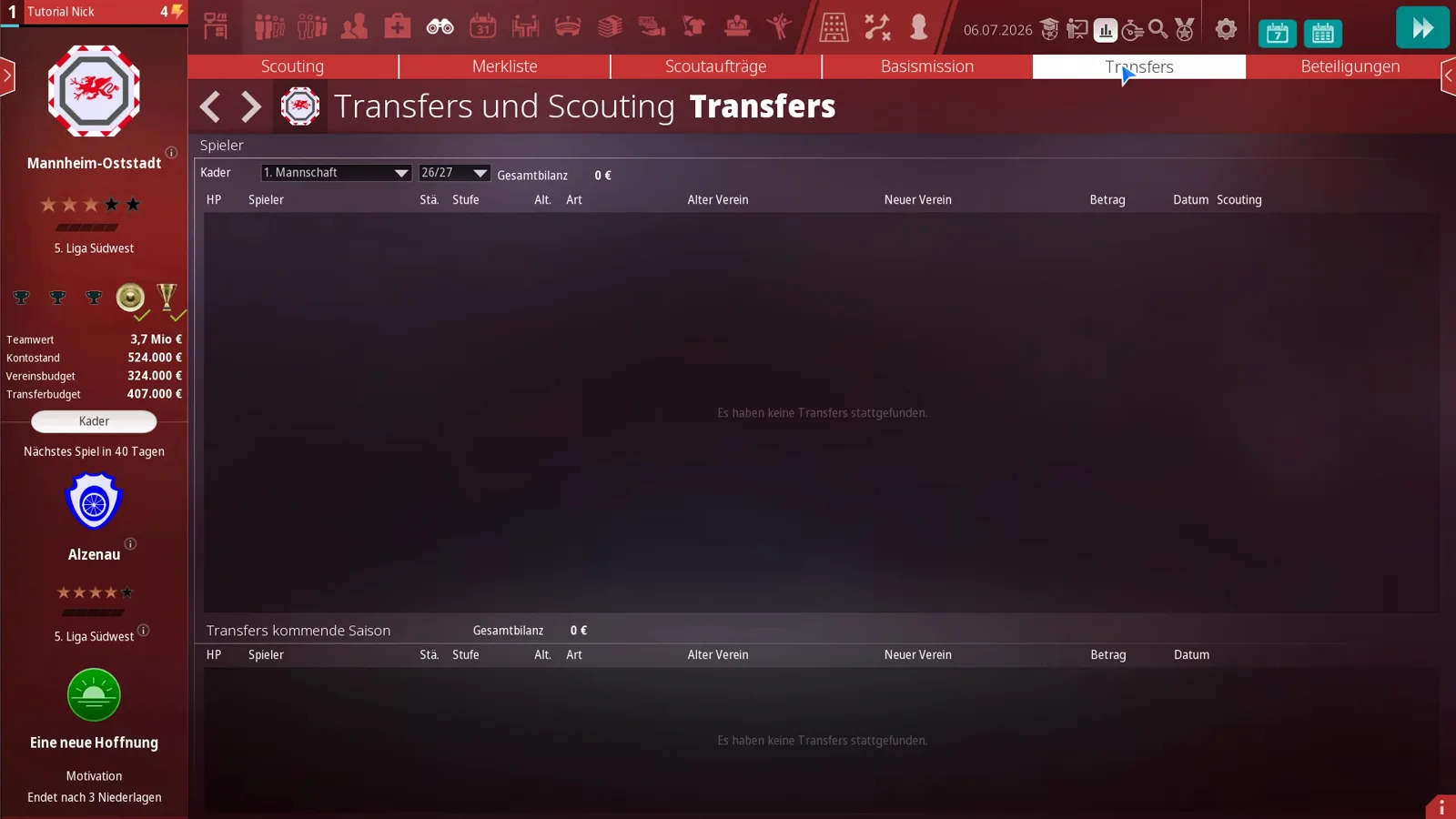
The Transfers tab lists every deal per squad and season, with an overall balance figure and a separate table for next season’s committed fees. Every euro here flows straight through the club account — see our finances and wage budget guide for how budgets, reserves, and taxes absorb it.
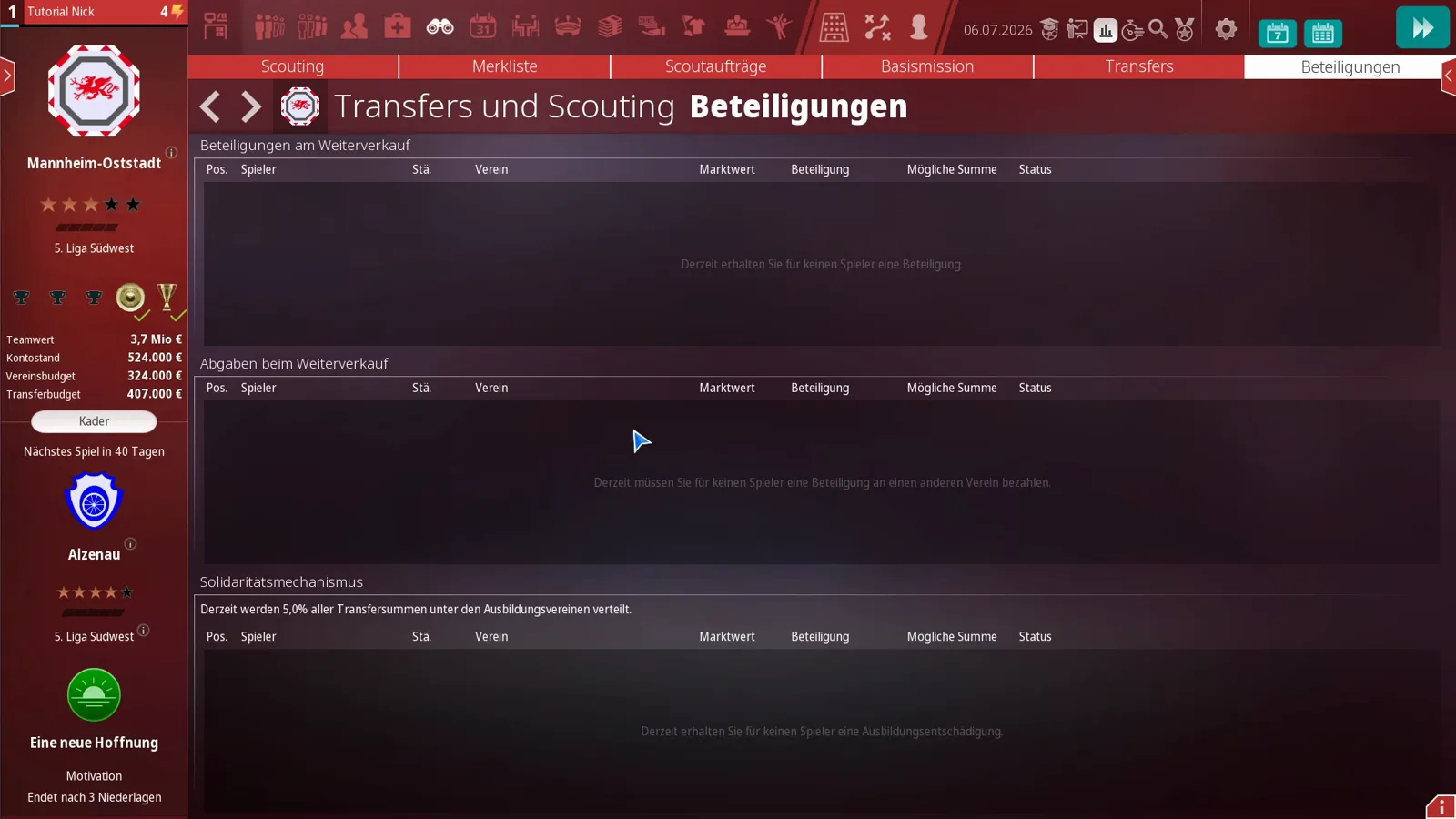
The Beteiligungen tab is where training-linked money lives: sell-on shares you receive, sell-on shares you owe when reselling, and the Solidaritätsmechanismus — 5% of all transfer fees distributed among the clubs that trained a player. Check it before pricing any sale.
From Shortlist to the Negotiation Table
Scouting ends at the Vorgespräch — a preliminary talk that reveals whether the player is even interested before you commit budget. If he bites, open the Vertragsgespräch: the clause-by-clause mechanics live in our contract negotiations guide, the second half of every deal. Whatever positions you scout should also fit the roles in our best tactics and formations guide, so every signing has a job from day one. And when the deal leaves this screen for the calendar, the transfer window guide follows the whole phase — fee talks, Deadline Day and the contracts that decide whether any of it happens.
Guides recommandés
guides
WE ARE FOOTBALL 2027 Team Strength Comparison: Stars, Gauges, Scouting Lists
How to read team strength in WE ARE FOOTBALL 2027: Kader stars, the profile gauge, the pre-match Mannschaftsteile bars and the scouting list for the next fixture.
guides
WE ARE FOOTBALL 2027 Season Planning Guide: Budget Split, Kits and Squad Numbers
The Saisonplanung stretch in WE ARE FOOTBALL 2027 screen by screen: promotion payout, league target, budget split, new kits, club rules and squad numbers.
guides
WE ARE FOOTBALL 2027 Relegation Battle Guide: Escaping the Red Rows
A relegation battle in WE ARE FOOTBALL 2027 screen by screen: the red Verbandsliga table rows, a 0:1 away steal, a 1:4 home defeat and the January deals in between.
Ce guide vous a-t-il été utile ?
Merci pour votre retour !